This is “Young Person,” by Henry Rollins.
Show it to one.
[Thanks to Fark]
 New commenter Christine has a valuable personal experience to relate, as an individual who donated a kidney to a stranger herself. The main thrust of her post covers a topic that I have written on before but did not mention in this case, though I should have. Someone who performs a kind and generous act counting on rewards, copious thanks and gratitude, is doing it for the wrong reasons. The act itself is all that matters. Certainly, gratitude is the right way to respond to generosity, but an act done in anticipation of personal benefits isn’t really altruistic. It is opportunistic. This is a cliché to be sure, but true nonetheless: the generous act must be its own reward.
Here is Christine’s Comment of the Day on the post, Ethics Chess Lesson: The Tale of the Kidney and the Ungrateful Boss.
I want to also commend Christine for following the comment policies, which many of the new visitors here who commented on this post did not do. I prefer full named on posts, but I only require that I am informed of every commenter’s real name and have a valid e-mail address within a reasonable time of their first submitted comment. One way or the other virtually all of the regular commenters here have managed to do this, and it makes a difference, even in my responses. I regard such commenters as collaborators , not just marauders, and most of the time, I treat them accordingly: tgt, Steven, Lianne, Margy, Glenn, Tim, both Michaels, Karl, Neil, Karla, Rick, blameblakeart, Barry, gregory, Eric, Curmudgeon, Eeyore, Julian, King Kool, Joshua, Jay, Tom, Bill, Danielle, Elizabeth, Patrice, Ed, Bob, The Ethics Sage and Jeff…I know there are others. Thanks to all of you for letting me know who you are.
Now, Christine: Continue reading
 There are those who say that human beings are incapable of truly altruistic conduct, and that everything we do, no matter how outwardly generous and selfless, is in fact self-serving. There are others, and I am among them, who believe that human beings have natural ethical instincts that lead them to sacrifice for the benefit of society generally, those in peril, and those who are weaker than themselves, especially children. Those instincts can be nurtured by our culture or extinguished by it, but I believe that they are there in most of us….for a while, at least, sometimes weak or dormant, but there, nonetheless.
They were obviously there in Specialist Dennis P. Weichel Jr. of Providence, Rhode Island, a National Guardsman serving in an Afghan province east of Kabul. On March 22, he left the 16-ton gun truck he was riding in to disperse local children who were wandering in front of his heavily armored convoy, searching for treasure, the brass shell casings that could be melted down for other uses or be sold. Suddenly a small girl saw a casing and ran into the path of one of the huge military vehicles. Weichel, a father of three, dashed to her, grabbed her, and threw her to safety unharmed. The gun truck struck the Guardsman instead, fatally injuring him.
Weichel was engaged to be married. He is the first member of the Rhode Island National Guard to die in Afghanistan.
Nothing can erase the tragedy of the U.S. serviceman who turned mass murderer in Afghanistan a month ago, and Weichel’s heroism is unlikely to change any hearts and minds there. That wasn’t Weichel’s objective anyway. He saw a young life in danger and acted, risking his own. It would be a better United States if all of us were raised to react as he did, and if our culture more unambiguously encouraged our best instincts rather than our worst ones. The cliché mouthed by politicians is that our military combat personnel are fighting for American values. Dennis Weichel demonstrated that they also carry American values with them, and in his case, he displayed the very finest.
Weichel was promoted posthumously from specialist to sergeant and awarded the Bronze Star, which is appropriate, and Rhode Island’s flags are being flown at half-mast. The honor he most deserves, however, is to be remembered and emulated by the rest of us.
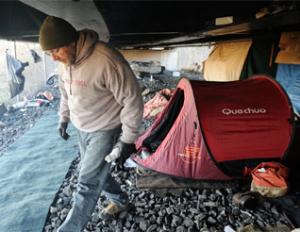
Rev. Keinath on holiday, under the overpass
Thomas Keinath is the pastor at Calvary Temple in Wayne, New Jersey, a so-called mega-church with a 2,000-plus seat sanctuary in an affluent community. It was time for him to take some vacation time, so he did. And what did he do?
Keinath spent his week off living with the homeless in the very un-affluent community of nearby Paterson, New Jersey. During the day, he wandered through the streets along with desperate, sick and destitute. At night, he stayed with them as they built fires to keep warm in freezing cold, and slept with them, under a bridge, surrounded by discarded hypodermic needles. He wrote down the life stories of the people he met, so he could learn from their life stories.
“I needed to understand what they were experiencing, and I needed to feel their pain. How could I bring help or healing to the streets if I did not know what their needs are?” the pastor told reporters. Continue reading
 Here is the final installment of the Ethics Alarms overview of the ethical issues raised in Frank Capra’s classic. Some of the comments on Parts 1 and 2 have suggested that my analysis is unduly critical. Nothing could be further from the truth. I love the movie, and have already said that I find it ethically inspiring. Noting that characters act unethically in a movie about ethics is no more criticism than pointing out that people in horror movies never just leave when things start getting weird (as I would). I know that their actions drive the plot and are necessary. This is, however, how an ethicist watches a movie with as many ethical choices as “It’s A Wonderful Life.” I can’t help it.
Now back to George, Mary, and Bedford Falls:
11. Uncle Billy screws up as we knew he would
11. Christmas Eve arrives in Bedford Falls, and Uncle Billy manages to forget that he left the week’s deposits in the newspaper he gave to Mr. Potter. Thus more than $8,000 is missing on the same day that the bank examiner is in town. Why is Uncle Billy still working for the Savings and Loan? He’s working there because George, like his father, is putting family loyalty over fiduciary responsibility. Potter, of course, is a thief; by keeping the lost money to trap George, he’s committing a felony, and an unnecessary one. As a board member on the Savings and Loan, Billy’s carelessness and George’s negligence in entrusting him with the bank’s funds would support charges of misfeasance. Mr. Potter, had he played fair, might have triumphed over George legitimately, and no Christmas miracle or guardian angel could have saved him. But this is the inherent weakness and fatal flaw of the habitually unethical: since they don’t shrink from using unethical devices, they often ignore ethical ways to achieve the same objectives that would be more effective.
12. George folds under pressure Continue reading
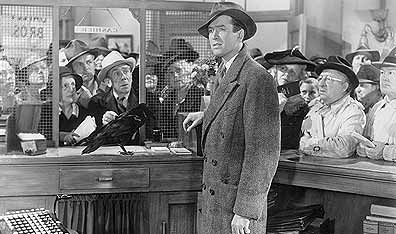 When we last saw George Bailey, he was defending his father’s dubious loan practices. In this, Part 2 of the three installments of “It’s A Wonderful Life” Ethics, we take the saga up the fateful Christmas Eve when George Bailey meets his guardian angel.
6. George’s Fork in the Road
George Bailey’s decision to give up his plans to go to college to save the Savings and Loan is clearly not motivated by his personal dedication to the institution; he doesn’t like the place. He says so over and over again. He admires his father’s motivations for starting it. Had Potter not sparked his resentment with his nasty comments about George’s late father, George would have been out the door. But his passionate speech in rebuttal of Potter’s words put him on the spot: after those sentiments, turning down the Board’s appointment of him to be the new operating manager of the S&L would have made George a hypocrite in his own eyes, and rendered his passion laughable. If George had integrity, then he had to accept the appointment.
It is one of the most interesting ethical moments in the film, because it represents a realistically complex ethical decision. George does what he does for selfish reasons as well as altruistic ones, and irrational reasons as well as considered ones. He wants to respect himself; he fears what might happen to his family and the community if Potter becomes the only financial power in town, and knows he will feel guilty if the consequences are bad. He feels like not staying will be taking Potter’s side over his father’s—completely irrational, since his father had given his blessing to George’s college plans, and wasn’t alive to be harmed by whatever he chose to do anyway. A large proportion of George’s decision seems to be motivated by non-ethical considerations, for he doesn’t like Potter—even hates him, perhaps—and wants to stick it to the old tycoon by foiling his victory. There are few ethical decisions in real life that are made purely on the basis of ethics, and Capra makes George’s decision wonderfully impure. Continue reading
I haven’t posted many Comments of the Day of late, and that is due to my recent schedule and sloth, not the quality of the comments. Michael’s comment below on my recent post about politicians announcing that they have been “called” to the presidency shook me from my torpor, for it usefully details how not all divine callings are equally objectionable. Here is his Comment of the Day:
“I know many people who feel (or say) they have been called by God to do various things. These generally fall into three categories:
“Category 1. A person who feels that God has called them to do something that will benefit many people (other than themselves). The thing they are called to do requires a lot of training, hard work, and results in very little money or praise. They don’t generally tell people they were called to do this except as a response to the question “Why would someone as talented and smart as you be doing something so thankless and impoverishing?”
“Category 2. A person who feels that God has called them to fill a position of power, authority, or extreme skill. Such people pour themselves into preparing to best fill said position. They only admit that they are doing this in close confidence or when asked why they are going to such extreme measures to prepare themselves.
“Category 3. Someone who loudly announces they are called by God to do something. This something is usually something grand, resulting in money, fame, power, or a combination of the three. They generally tell people they were called in response to the question “Why should you be allowed to do this when you don’t appear to have the qualifications, experience, or work ethic required for such a lofty position?”
“People in two of these categories have much more of my admiration than people in the other.”

New research from Harvard University suggests that exemplary ethical conduct may increase an individual’s willpower and physical endurance. Research subjects who performed good deeds or who only imagined helping others excelled over others of similar physical strength in a subsequent task of physical endurance presented by behavioral scientists.
This is good news: the boost in self-esteem, certitude and commitment created by the decision to do something noble and good helps enable us to actually do it, if it is physically challenging. The bad news seems to be that the same holds for people who have made up their minds to do something particularly dastardly, according to the same data. Continue reading
 Ethics Alarms