The ABA Is Defending Its Racially Discriminatory Scholarships…Of Course It Is.

Res ipsa loquitur, no?

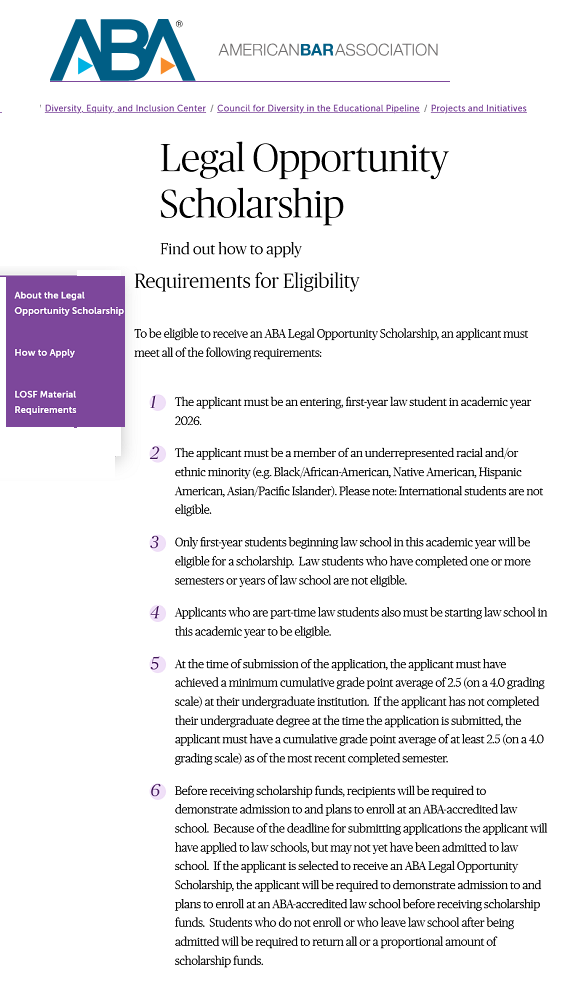
In April, the American Alliance for Equal Rights led by Edward Blum, the scourge of affirmative action and “good discrimination” policies, filed a complaint in an Illinois federal court alleging that the American Bar Association’s 25-year-old Legal Opportunity Scholarship discriminates against white applicants. Since their skin color renders them unable to apply, this contention seems beyond debate. The question is whether, as a trade association, the ABA has a right to discriminate.

The Alliance said it is representing an unnamed white male law school applicant who says that he would apply for the $15,000 Legal Opportunity Scholarship were he not prevented from doing so because he is the “wrong” race. The ABA awards between 20 and 25 such scholarships annually to incoming law students, according to its website, which is excerpted above.

I should have covered this in April: sorry. [Believe me, if I could find a way to work on the blog full-time without ending up living on cat food and in a shack by the docks, I would.] Anyway, this kind of thing is why I do not pay dues to the ABA, and why I am suspicious of any lawyer who does. It is an interesting case. I assumed that Blum would lose if the case proceeded, and that his main objective was to shame the ABA into opening up the race-based scholarships to all. But the ABA has no shame. And I knew that.

The American Bar Association responded to Blum’s suit this week, arguing that a scholarship program designed to boost diversity among law students is protected free speech. The 25-year-old Legal Opportunity Scholarship, the largest lawyer association in the nation asserts, is protected under the First Amendment. In its motion to dismiss the ABA also claimed that plaintiff American Alliance for Equal Rights lacks standing to sue.

Continue reading

More DEI Whac-A-Mole: This Time, It’s the ABA Getting Whacked

A sinister feature of the Diversity/Equity/Inclusion “good discrimination” conspiracy is that the participants know that what they are doing is unconstitutional in spirit, illegal in practice, divisive and unfair by traditional American values, and they go forward with it anyway until they are caught. Then they deny that they were doing what they were doing, change their policies, at least ostensibly, and wait for the next opportunity while other organization pursue their DEI schemes.

The idea is to overwhelm the opposition—that is, those who believe all discrimination on the basis of race, gender and ethnicity is unethical and that jobs, promotions, honors, advancements, privileges and admissions should be based on achievement and not subjective attempts at social engineering or compensatory reparations. Eventually, the strategy goes, “everybody does it” will kick in, and fighting the new social norm will be futile.

The latest institution completely corrupted by political bias to be caught playing DEI games is the august American Bar Association. As revealed by Paul Caron’s Tax Prof Blog, a controversial requirement for law school accreditation, Standard 206, which contained flaming DEI mandates like…

Continue reading

Ethics Dunce (But We Knew That): The American Bar Association

The ABA’s House of Delegates this week approved a resolution urging law schools to give either academic credit or monetary compensation to their students who serve as editors of law reviews or other academic journals. This is right in line with the logic that has college football and basketball plantations paying their student athletes, who already are getting scholarships and often diplomas they couldn’t justify based on their academic skills. Paying or otherwise compensating students who serve as law journal editors is just as reasonable, which is to say that it isn’t reasonable at all. In fact, the proposed practice, which some law schools already embrace, is unethical.

Reuters, in its news article about the ABA’s most recent intrusion into matters they ought to steer clear of, inadvertently explains why this concept is wrong-headed. It notes that these positions are “sought-after credentials that can bolster a law student’s job prospects.” Exactly, which means that students would gladly pay the law schools to get them. Being appointed as a law journal editor is its own reward: why should the recipients be paid for it too? Indeed, if the ABA’s reasoning applies, why only the editors? The other members of the law journals staffs are also providing valuable services to the school, its alumni, and the legal profession. They should be paid as well, or, to put it another way, none of the law journal staff should be paid, including the editors, just as student athletes shouldn’t be paid.

Continue reading

Communication Ethics: The American Bar Association’s Impossible Formal Ethics Opinion 500

difficult-client-yelling-at-lawyer

The duty of communication is both a fiduciary duty and, for lawyers, a professional one. American Bar Association Model Rule 1.4, one rule that every jurisdiction has adopted nearly verbatim, holds that

(a) A lawyer shall:

(1) promptly inform the client of any decision or circumstance with respect to which the client’s informed consent, as defined in Rule 1.0(e), is required by these Rules;

(2) reasonably consult with the client about the means by which the client’s objectives are to be accomplished;

(3) keep the client reasonably informed about the status of the matter;

(4) promptly comply with reasonable requests for information; and

(5) consult with the client about any relevant limitation on the lawyer’s conduct when the lawyer knows that the client expects assistance not permitted by the Rules of Professional Conduct or other law.

(b) A lawyer shall explain a matter to the extent reasonably necessary to permit the client to make informed decisions regarding the representation.

The last part is, much of the time, a fictional standard. I have been hammering at this in my recent ethics seminars, much to attendees alarm: clients often, perhaps even most of the time, don’t comprehend what’s going on on many levels.

Continue reading

Mid-Weekend Ethics Warm-Up, 8/22/2021: It’s No Longer Illegal To Come Back Here After You Are Deported, And Other Surprises…

betwixt

[I had to get up extra-early to wrote this, since there’s no point writing a warm-up once the thermometer tops 80.] Amusing historical ethics note: on August 21, 1980, animal rights advocates Ingrid Newkirk and Alex Pacheco launched PETA, People for the Ethical Treatment of Animals. In the intervening 40 years, it has become the preeminent animal rights organization in the world, in part because it will do almost anything for publicity. It is also consistently the most ridiculous animal rights organization in the world, and on Ethics Alarms, in a lively battle with Citizens for Responsibility and Ethics in Washington as the most hypocritical and unethical non-profit with “ethics” in its name. The PETA ethics rap sheet is here. When last discussed on Ethics Alarms, PETA was protesting using animals as metaphorical insults because it perpetuates “speciesism.” Jackasses…

  1. From the suddenly overstuffed “Incompetence” Files…Mike Richards, the executive producer of “Jeopardy!” who made himself one of the show’s new hosts in a breathtaking display of conflict of interest contempt, lasted less than a week in his new job. Controversial comments he made on a podcast from 2013 “resurfaced,” officials at Sony Pictures Television confirmed. That means someone who didn’t want him to have the job did a maniacal search to find something that would force him to resign. This is, essentially, the Hader Gotcha, and a rotten, Golden Rule-breaching thing to do to anyone unless they are running for office and pretending to be someone they are not. At least Richards recognized that his duties as executive producer required that he dump himself once he became an anchor on the show he has a duty to protect.

The allegedly cancel-worthy comments Richards made came when he was trying to imitate Howard Stern—imagine that as a life objective—by hosting a podcast called “The Randumb Show.” Naturally, this involved saying sexist and racially insensitive things like Howard and Don Imus, who not too many years earlier were still considered witty and brave in their political incorrectness. He refered to a woman’s “boobies.” He said that he aspired to be a “white guy host” like Ryan Seacrest. Salon, which is always a barometer of just how nuts the far left has become, pronounced l such sophomoric banter “alarming.” I know I was terrified when I read them.

2. If this doesn’t prove that our news organizations are worthless, nothing will. U.S. District Judge Miranda Du, a federal judge in Nevada, struck down as unconstitutional a longstanding statute that makes it a crime to return to the United States after deportation. Here reasoning is that the law is racist and discriminatory against “Mexican and Latinx individuals.”

“The record before the Court reflects that at no point has Congress confronted the racist, nativist roots of Section 1326,” Du wrote in her ruling.“The amendments to Section 1326 over the past ninety years have not changed its function but have simply made the provision more punitive and broadened its reach,” Du wrote.

Continue reading

The American Bar Association Adopts Yoo’s Rationalization or “It Isn’t What It Is”

aba-default-feature-img

To be fair, “It isn’t what it is” is an argument lawyers are trained to make, but this is especially glaring.

The Florida Supreme Court recently voted to prohibit the approval of continuing legal education credits for any CLE program with diversity “quotas.” This was a broadside at the ABA, which in 2017 approved a Diversity & Inclusion CLE Policy that requires all its sponsored or co-sponsored CLE programs with three or more panelists, including the moderator, to have at least one member of a a “diverse group.” Programs with five to eight panelists must have at least two diverse members and programs with nine or more panelists must have at least three diverse members. This will supposedly help accomplish the ABA’s Goal III , which aims to eliminate bias and enhance diversity in the profession.

There is a disconnect here, since the only purpose of continuing legal education is to do as good a job as possible keeping lawyers abreast of the law and developments in their profession. Does the skin color, gender, ethnicity or other characteristics of the CLE instructors and trainers advance that purpose in any way? I don’t see how, and neither did the court, which wrote in part,

Continue reading

Unethical Quote Of The Month: American Bar Association President Patricia Lee Rufo

Rufo


The American Bar Association is deeply troubled by the recent proliferation of hate speech directed against members of the Jewish faith and at LGBTQ, Asian American and Muslim communities. Such hateful behavior, coming in the wake of attacks on African Americans and other groups, have serious consequences as studies show a correlation between exposure to hate speech and the increase in hate crimes. Hate speech also serves to legitimize intolerance, reinforce stereotypes and further discrimination. We must not let any messages of hatred be normalized if we hope to advance the rule of law to achieve an inclusive society.

Patricia Lee Rufo, the 2021 president of the American Bar Association, in an official statement last week.

This is disgraceful, and in so many ways. Imagine: the head of the largest lawyers’ association in the country authored that collection of vagaries, buzz words and wokisms in a naked virtue-signaling exercise with no substantive value at all, but with significant sinister potential. Worse, nobody at the ABA had the guts or integrity to tell her, “Uh, Patricia, that’s just plain embarrassing. We can’t put our name on that!” Also…

Continue reading

Morning Ethics Warm-Up, 5/21/2021, To A Chorus Of Cicadas

Cicada Ethics: Sweep up all the disgusting things (and their husks) that have accumulated on your front walk at least twice a day so people don’t have to walk on them and their dogs don’t eat them.

1. Charles Grodin (1935-2021): Thanks a lot! Charles Grodin was a talented and versatile actor who was extremely good at playing dislikable characters. We can blame him (not Jon Stewart) for creating the unfortunate cultural phenomenon of the allegedly funny TV talk show host who decides he is qualified to bombard viewers with partisan rants. It’s a self-indulgent abuse of power, position and trust, but it’s also now the norm, with every late night talk show host (and Staurday Night Live) but the generally sweet James Cordon using their show as a platform to bash Republicans and conservatives and extoll progressives no matter how mockworthy they are. Grodin started the bait-and-switch (He’s funny! Wait, why is he so angry and preaching at us?) in the mid-Nineties, and though it eventually killed his show (not soon enough), the template was born.

Grodin made Ethics Alarms in 2014, with his campaign against the felony murder rule.

2. Speaking of staying in one’s lane…Yet another ugly result of social media is the phenomenon of people publishing uninformed opinions that they are unqualified to be so emphatic about. A baseball writer and recovering lawyer, Craig Calcaterra, whom I have referenced here before, has migrated from NBC Sports to substack, and is asking me to subscribe to his newsletter. Craig is funny and smart, and his baseball analysis is superior to most. But he is addicted to making political pronouncements, and while he has a right to his biased and often ignorant opinions on things he’s far from an expert on, I’ll be damned if I’ll pay to read them. For essentially the same reasons I object to watching football players “take a knee” during the National Anthem, I expect sports writers to stick to sports. Here’s a tip to anyone peddling a newsletter to me: I regard referring to the January 6 Capitol riot as a “deadly insurrection” as Democratic Party propagandist and signature significance for a pundit who is not concerned with facts.

Continue reading

The American Bar Association Has Lost Faith In Professionalism, It Seems.

For as long as I can remember, lawyers took pride in that fact that they could pound away at each other in the court room, shout, sneer, mock and beat an adversary into a metaphorical pulp, and put it all aside the second the case was finished. The idea that being friends, even close friends, with an opposing advocate compromised a lawyer’s determination and willingness to fight for his or her client was an anathema to the whole concept of professionalism. During the Civil War, West Point classmates on opposite sides sometimes met before a battle, shared a whisky, old memories and a few tears, and the next day did their best to kill each other. That mindset was analogous to how I was taught lawyers were supposed to behave, and, indeed, did.

Now the American Bar Association has apparently decided that it was all a myth. In  Formal Opinion 494, “Conflicts Arising Out of a Lawyer’s Personal Relationship with Opposing Counsel,” the ABA expresses doubts that many lawyers are up to the task.

“A personal interest conflict may arise out of a lawyer’s relationship with opposing counsel, the ABA now says. “Lawyers must examine the nature of the relationship to determine if it creates a …conflict and, if so, whether the lawyer reasonably believes the lawyer will be able to provide competent and diligent representation to each affected client who must then give informed consent, confirmed in writing.”

The opinion breaks possible personal relationships into three categories:

Continue reading

No Way Out? The Rodney Reed Affair [UPDATED!]

Rodney Reed was convicted by a Texas jury in 1998 and sentenced to die for the rape and murder of 19-year-old Stacey Stites two years earlier. On April 23, 1996, Stites’s body had been found on the side of a country road outside of Bastrop, Texas. Marks on the woman’s  neck led investigators to conclude that she had been strangled, and she had had sexual relations with someone before she was killed.

Police tested the recovered DNA against that of Reed, then 29 years old.  There was no other evidence tying Reed to the murder, other than the fact that he initially lied to police, claiming that he didn’t know the victim. Finally, Reed said that he was having a sexual affair with her, and that the two had sex a couple of days before Stites was found dead. The witnesses Reed’s defense called to confirm the relationship between the two were not convincing, for varying reasons. It didn’t help Reed’s cause that he was regarded as a serial sex offender, with many arrests on his record.

As The Intercept explains in detail, the case against Reed has deteriorated over time, and was never strong to begin with. Many forensic pathologists have concluded that the verdict lacked scientific support. The medical examiner who conducted Stites’s autopsy has recanted his testimony. In 2018, both a state crime lab and a private DNA lab undercut the testimony of their own employees who had testified at Reed’s trial.  Nonethless, Reed is scheduled to be executed in five days, on the 20th of November.

The new evidence indicating that he was wrongly convicted has not been reviewed by a court and apparently will not be because of the judicial principle of finality, the very old concept that hold that legal disputes at some point achieve a resolution that cannot be appealed and must be regarded as final. The principle is deemed necessary because without it, the public could not trust in the meaning of any law, or the result of any legal process. It is a utilitarian principle: individual cases may have unjust results occasionally, but the system as a whole benefits from the certainty of finality.

When the finality principle will result in the execution of a someone who appears to have been wrongly convicted, however, the gap between law, justice and ethics is difficult to accept.  The Supreme Court will consider Reed’s case today. There is also a plea to Abbott and to the Board of Pardons and Paroles to intervene.

The ABA has also made an appeal to the Board, via a letter from American Bar Association President Judy Perry Martinez.  Continue reading