Unethical Headline Of The Month: The Daily Caller

Dewey Truman

You can hardly publish a more inaccurate. misleading and dumb headline than this one, appearing on the right-wing news and opinion site, over a report by Kevin Daily about the American Bar Association passing a new addition to its Rule 8.4, the ethics rule that defines ethical misconduct, as follows:

It is professional misconduct for a lawyer to: . . . (g) knowingly harass or discriminate against persons, on the basis of race, sex, religion, national origin, ethnicity, disability, age, sexual orientation, gender identity, marital status or socioeconomic status, while engaged [in conduct related to] [in] the practice of law.

Now here is the headline:

Lawyer Lobby Will Now Disbar You For Making An Off Color Remark

And here is how unconscionably misleading and absurd it is:

“Lawyer Lobby”: The American Bar Association is a lawyer’s professional association, and sure, it does some lobbying. However, lobbying is a small, small proportion of its activities. [ Full disclosure: I usually do a couple of ethics seminars for the ABA every year.] Calling it  a lobby suggest that the ABA is primarily political, which it is not. The ABA publishes books, holds educational events, provides indispensable legal assistance to all branches of the profession, facilitates networking, issues critical legal ethics opinions, and many other useful and important services for lawyers.  One reason the ABA doesn’t lobby much is because it represents all kinds of lawyers, and being lawyers, they don’t agree on many issues.Prosecutors, judges and criminal defense attorneys have very different perspectives; so do plaintiffs lawyers and corporate attorneys. “Lawyer Lobby” is an inept and misleading description of the ABA.

“Will Now”: No. Not even close. The proper wording would be “NEVER has, can or will.” The ABA isn’t a bar, and can’t disbar anyone. Any lawyer can belong to the ABA, but the ABA doesn’t have any say in who practices law. The Robert DeNiro “Cape Fear” had an embarrassing line where a lawyer played by Gregory Peck, who should have known better, talks about making an ethics complaint to the ABA to get Nick Nolte’s character “disbarred.” Embarrassing. This part of the headline affirmatively makes Daily Caller readers stupid. Continue reading →
Veterans Day Ethics

"So run a red light today! It's on us!"

“So run a red light today! It’s on us!”

Ugh.

Ethical…

From the ABA Journal:

The ABA is encouraging lawyers to honor veterans through pro bono assistance, according to a statement by ABA President James R. Silkenat.“America’s lawyers join the rest of the nation on Veterans Day in honoring those who have served for their crucial contributions to preserving our democratic rule of law,” Silkenat says in the statement on the American Bar Association website. The ABA has several military assistance programs. They include:

• The ABA Military Pro Bono Project, which accepts pro bono case referrals from military lawyers on behalf of junior-enlisted, active-duty military personnel and their families.

• The Veterans’ Claims Assistance Network, which helps wounded and disabled veterans complete claims packages for expedited review by the Veterans Administration.

• ABA Home Front, a source of free publications and information on legal topics encountered by military families.

More information on ABA programs for veterans is available here.

Unethical (and stupid)…

Also from the Journal:

A New Jersey law firm is offering a free defense to military veterans charged with a traffic offense on Veterans Day.

“Whether it’s a serious matter, like a DWI, or a speeding ticket, we will take care of it for free,” attorney Al Mollo of the Mollo Law Firm told the Asbury Park Press.

He said his Red Bank firm started offering the free representation last year and this year is publicizing it. Mollo, who comes from a military family, says he also hopes to encourage other law firms to join in the effort or adopt similar programs.

An offer of free legal services is generous. Specifying a particular offense…

  • trivializes the offense,
  • suggests that veterans deserve some special leniency regarding the offense, and
  • implies that veterans are particularly likely to engage in the offense.

Imagine a similar offer to veterans for spousal abuse charges on Veterans Day, or illegal drug use, or PTSD rage assaults.

Ugh.


The Kinky Law Professor Principle: “It’s No Shame To Be Kinky, But It Still Might Be Newsworthy”

We haven’t had a “Naked Teacher Principle” story to mull over for a while, and this isn’t one. It raises some parallel issues, though.

I saw the story about the Drexel Law professor who who accidentally sent her students a link to a pornographic video about anal beads. I didn’t find it worthy of a post, though I thought it was funny. It is funny. But we had covered a similar issue here, in the ethics quiz about the hapless teaching assistant at the University of Iowa who somehow managed to send her class not merely sexually provocative photos of herself, not merely nude photos of herself, but something much more kinky. Attached to a message that read “Hi Class, I attach the solutions for number 76 and 78 in this email” were a series of images showing the young woman sans clothes and sans inhibitions having a lively cyber-sexting chat with a partner in which the two were pleasuring themselves in front of video equipment while streaming to each other.

That was funnier. She was “reassigned”—a not unreasonable result of presumed reduced respect from the class.  The Naked Teacher Principle doesn’t strictly apply when the students are adults, and Lisa McElroy, the professor at Drexel University’s Thomas R. Kline School of Law who is apparently an anal bead fan–the video she sent by accident was called called “She Loves Her Anal Beads”—wasn’t naked. There is no “Kinky Law Professor Principle.”

However, Prof. McElroy was mightily offended that her cyber-goof was picked up by the professional publications and websites, and that she was embarrassed as a result. She even posted a Streisand Principle-defying op-ed in the Washington Post, blaming everybody—students, bloggers, and Drexel, which briefly suspended the professor pending an investigation on the basis of possible sexual harassment—but herself. She argued that she should not have been publicly shamed, because, she wrote,

“…there was nothing newsworthy about it. What happened was, in the grand scheme, pretty trivial. My students are adults. The link was quickly removed. There was nothing illegal in the video. The post occurred in the same two-month period when the movie “Fifty Shades of Grey” grossed almost $570 million worldwide. Yet, because it was porn and I’m a law professor, news organizations spread the story around the world.”

Yup. Because it was funny. I understand that the Professor doesn’t see the humor of a law professor—especially her—inadvertently sending her private porn film about anal beads, which themselves are kind of amusing, to a staid law school class. It’s still funny. Trivial? Of course. But trivial can still be funny. Would it be kind for all of us to scrupulously refuse to communicate the hilarious tales of when we do dumb things or embarrass ourselves? Yes. But society as a whole benefits from being reminded that we are all equally fallible human beings—especially the elite and privileged. A lot of people think laughing at slapstick is cruel too.

I pity them. Continue reading →

Life Imitates Saul

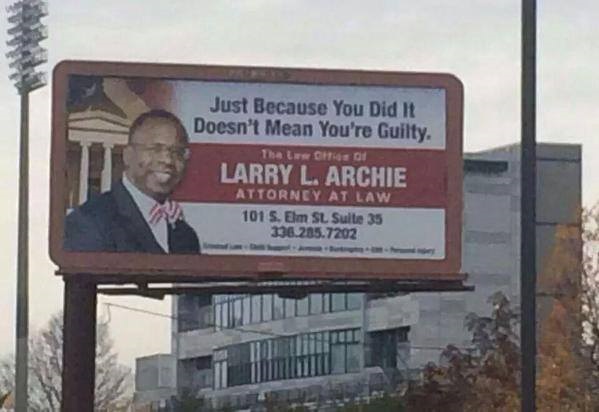
Lawyer Billboard

 The billboard ad of North Carolina lawyer Larry Archie has drawn a lot of attention in the state and on legal ethics forums.

Some observations:

1. I was a little late seeing “Breaking Bad” ( I tend to avoid show with drug dealers as heroes) so I didn’t see the obvious connection between the popular AMC show’s cynical, unethical and effective slime-ball lawyer Saul Goodman, played by Bob Odenkirk, and last year’s jaw-dropping—but funny!—video ad for the services of Pittsburgh criminal lawyer Daniel Muessig.

2. This is why we ignore popular culture at our peril….and I think the legal profession needs to stop laughing and start worrying. People really do think Saul who is a criminal lawyer, is typical, and bar associations are doing very little to dissuade them. This is irresponsible, dangerous, and stupid. The profession has a duty to educate the public about how lawyers are supposed to act and why, and if it whiffs on that obligation (as it has for about the last hundred years) public respect for the justice system will continue to drop. Continue reading →

Banning The “Gay Panic Defense”

Last year, the American Bar Association House of Delegates passed a controversial resolution calling on states to ban the so-called gay panic defense. The defense arises (when it does arise, which is rarely), in cases of a heterosexual accused of an assault on a gay individual when the defense attorney argues that his client was so shocked and terrified by a homosexual advance of a romantic or sexual nature that he was overcome with disgust, anger and fear, and was launched into a psychotic state that compelled violence. Many judges refuse to allow it, because there is no accepted scientific evidence that “gay panic” exists as a legitimate prelude to temporary insanity.

The ABA resolved:

 That the American Bar Association urges federal, tribal, state, local and territorial governments to take legislative action to curtail the availability and effectiveness of the “gay panic” and “trans panic” defenses, which seek to partially or completely excuse crimes such as murder and assault on the grounds that the victim’s sexual orientation or gender identity is to blame for the defendant’s violent reaction.

Such legislative action should include:

(a) Requiring courts in any criminal trial or proceeding, upon the request of a party, to instruct the jury not to let bias, sympathy, prejudice, or public opinion influence its decision about the victims, witnesses, or defendant s based upon sexual orientation or gender identity; and

(b) Specifying that neither a non – violent sexual advance, nor the discovery of a person’s sex or gender identity, constitutes legally adequate provocation to mitigate the crime of murder to manslaughter, o r to mitigate the severity of any non – capital crime.

It should be no surprise that California was the first state to follow this plan, with Gov. Jerry Brown signing an anti-gay panic defense bill into law in September. Now New Jersey has a similar law under consideration. Continue reading →

Are His Accusers’ Lawyers Blackmailing Poor Bill Cosby?

Poor Bill!

Poor Bill!

From ABC, as the Bill Cosby horror continues:

The 77-year-old comedian filed a lawsuit today against Judy Huth, who claims Cosby forced her to perform a sex act in 1974 at the Playboy Mansion, when she was 15.

In documents obtained by ABC News, Cosby alleges that not only is Huth lying but that she filed the lawsuit after failing to extort money from him. Cosby is asking a judge to dismiss the lawsuit and is seeking monetary damages from Huth and her attorney.

In his filing today, Cosby says Huth’s lawyer approached the comedian’s attorney, Marty Singer, last month and made “ominous references” to ‘criminal penalties.'” According to the lawsuit, Huth’s lawyer demanded $100,000 for her silence, and later increased the amount to $250,000 as additional women came forward.

“Through her lawyer, Plaintiff made extortionate claims to Mr. Cosby (through his counsel) about criminal penalties, coupled with ever-increasing demands for a six-figure payday to keep quiet about her long-since-expired claims,” the documents state.

The suit claims that after Cosby’s attorney rejected Huth’s claims and accused her of extortion, her attorney filed a lawsuit two days ago against the comedian.

In relation to this development, my indispensable story scout, Fred, asks:

“The legal profession must have some ancient and passionately held standards for how to offer a confidential settlement without sliding into blackmail, which Cosby’s lawyers accuse the plaintiff of doing. How do those work, and which side’s lawyers (if either) are most likely to be acting ethically?”

The issue is pretty ancient, all right, but it’s also murky, and has become murkier with passing years. Once upon a time, the American Bar Association had an ethics rule that said, “A lawyer shall not present, participate in presenting, or threaten to present criminal charges solely to obtain an advantage in a civil matter.” Later the provision was dropped, on the theory that it was too vague and could constrain legitimate negotiation. Some jurisdictions, like the District of Columbia, New York and Connecticut, retained it, but they also emphasize the word “solely.” That means that a lawyer who says, “Pay my client $25,000 or we’ll get you charged for rape, and that will ruin you!” has probably breached the rule, while one who says, “Look, we want to handle this as quietly as possible, but if you won’t be fair, you’ll leave us no choice but to seek a criminal indictment. Just thought you should know” has tiptoed within the rule’s bounds. What’s the difference? Not much. Continue reading →

In Massachusetts, The Unethical Kind Of Prosecutorial Discretion

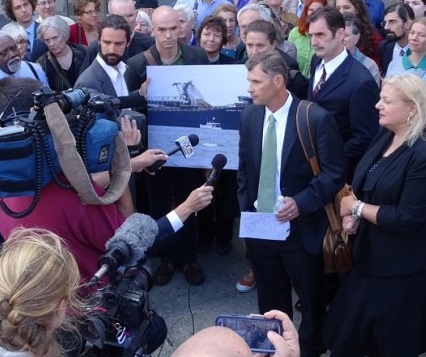
The DA explains why he's glad the law was broken. Wait...WHAT?

The DA explains why he’s glad the law was broken. Wait…WHAT?

Prosecutorial discretion is a critical aspect of the prosecutorial function. There are many good reasons for a prosecutor  to charge an individual with a crime in a particular case, and among the factors a prosecutor may legitimately consider in making this decision are, according to the American Bar Association’s ethical guidelines:

  • whether there is evidence of the existence of criminal conduct;
  • the nature and seriousness of the problem or alleged offense, including the risk or degree of harm from ongoing criminal conduct;
  • a history of prior violations of the same or similar laws and whether those violations have previously been addressed through law enforcement or other means;
  • the motive, interest, bias or other improper factors that may influence those seeking to initiate or cause the initiation of a criminal investigation;
  • the need for, and expected impact of, criminal enforcement to punish blameworthy behavior; provide specific and/or general deterrence;
  • provide protection to the community; reinforce norms embodied in the criminal law; prevent unauthorized private action to enforce the law;
  • preserve the credibility of the criminal justice system; and other legitimate public interests.
  • whether the costs and benefits of the investigation and of particular investigative tools and techniques are justified in consideration of, among other things, the nature of the criminal activity as well as the impact of conducting the investigation on other enforcement priorities and resources
  • the collateral effects of the investigation on witnesses, subjects, targets and non-culpable third parties, including financial damage and harm to reputation
  • the probability of obtaining sufficient evidence for a successful prosecution of the matter in question, including, if there is a trial, the probability of obtaining a conviction and having the conviction upheld upon appellate review; and
  • whether society’s interest in the matter might be better or equally vindicated by available civil, regulatory, administrative, or private remedies.

None of these suggest that the prosecutor’s personal sympathy with the motives of the lawbreaker is a sufficient or ethical reason not to charge when a serious crime has been committed. That, however, appears to be how Bristol County (Massachusetts) District Attorney Sam Sutter sees his role: arbiter and enabler of righteous criminal activity. Continue reading →

First Nomination For “The Donald Sterling Award Award”: The American Bar Association

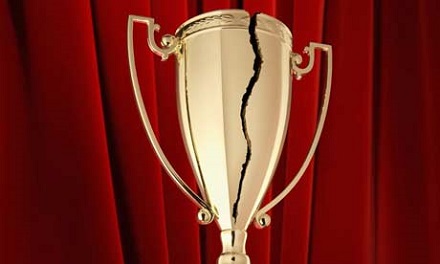
Cracked trophy

It’s time to launch  a new dubious honor here at Ethics Alarms: The Donald Sterling Award Award.

The DSAA gets its name from the embarrassing “Man of the Year” award that the San Diego NAACP was preparing to bestow on Donald Sterling shortly before his racially offensive comments to his mistress were recorded and leaked to the news media. Sterling had already engaged in conduct that seemed to make  NAACP recognition both unlikely and ill-advised, so his award, which the organization retracted, is the perfect model to emulate for future organizations determined to undermine their values and objectives by choosing inappropriate honorees.

And the first nomination for the The Donald Sterling Award Award is The American Bar Association, for its decision to give its 2014 Robert J. Kutak Award to New England Law/ Boston dean John F. O’Brien.  The award is given annually “to an individual who has contributed significantly toward increased cooperation among legal education, the practicing bar, and the judiciary.”

Well, maybe O’Brien technically deserves that award, but then Sterling had given a lot of money to local projects benefiting African-American kids in San Diego, too.  The problem is that O’Brien could serve as the poster boy for the ugly underbelly of legal education and its disconnect to the current economics of the legal profession. In 2013, he gave his school unwanted publicity when it was revealed that he earned a salary of $867,000, among the very highest law dean salaries in the country, while  low-ranked New England Law/ Boston charged $40,904 for yearly tuition. Before considering lowering his own compensation, he started cutting faculty positions, until he finally relented and took a pay cut to a paltry $650,000 a year. I know, it’s less than three Hillary Clinton speeches. But the going rate for deans at the top law schools has been estimated to be “only” $450,000, and O’Brien runs a school that is the opposite of “top.” Continue reading →

Passenger List On The Deadly General Motors Ethics Train Wreck

"Oops! There goes G.M again!"

“Oops! There goes G.M again!”

That great, big, all-American motor car company that the Obama Administration took bows for saving five years ago has been revealed as a thoroughly corrupt, incompetent and deadly enterprise. As the full extent of the General Motors safety scandal unfolds—and it could get worse—this is a good time to take stock of the ethics lessons and miscreants involved, on the off chance that we are interested in learning something.

Did that sound bitter? It is. There is little in this terrible story of corporate ineptitude and corruption that wasn’t known and understood decades ago. Yet here we are again.

The manifest:

  • G.M. management. It pursued the policy of paying large settlements with confidentiality agreements to those injured by ignition switch defects in their cars, never fixing the defect itself. This is the old Pinto calculation, reasoning that if it is cheaper to pay for the deaths and injuries from a design defect than to fix the defect itself, then it makes good business sense to keep doing that, indefinitely. There are three problems with this logic, of course. First, it kills people. Second, it is stupid: eventually the facts will get out, and the whole company will be endangered. Third, it is wrong.
  • The plaintiffs’ attorneys. The trial lawyers association, way back when I worked for it two decades ago, adopted the unofficial position that the practice of accepting settlements from large corporations in product liability cases that included agreements not to reveal the damages and the defects involved to regulators, the news media, and endangered consumers was unethical. Members were urged to make a rejection of such terms a condition of agreeing to represent injured parties. Speeches were given, pledges were made. All agreed that the practice undermined the mission of the plaintiffs’ bar to make America safer through the civil justice system. What happened? Greed, that’s what. Just as every plaintiff has a price, so do many trial attorneys, who received up to 40% of those secret settlements. Every single one of the lawyers who guided their clients to accepting hush money in exchange for letting unsuspecting owners of G.M. cars risk their lives and those of their families were members of the American Association for Justice, which changed its name from the Association of Trial Lawyers of America because a survey showed the term “trial lawyers” was too negative. This is why the term is negative.

Continue reading →

Ethics Dunce: Republican Governors Association…And An Integrity Test For Chris Christie

This ugly beast keeps raising its head out of the muck, and it is the duty of every citizen, Republican or Democrat, who believes in justice and due process under law to beat it back with heavy clubs.

The Republican Governors Association is defending one of its own, South Carolina Gov. Nikki Haley, with a series of ads attacking state Sen. Vincent Sheheen, an attorney who is her Democratic opposition in the gubernatorial race. The message of the ad, as summarized by  a voice-over, is that “Sheheen defended violent criminals who abused women and went to work setting them free.”

False. Continue reading →