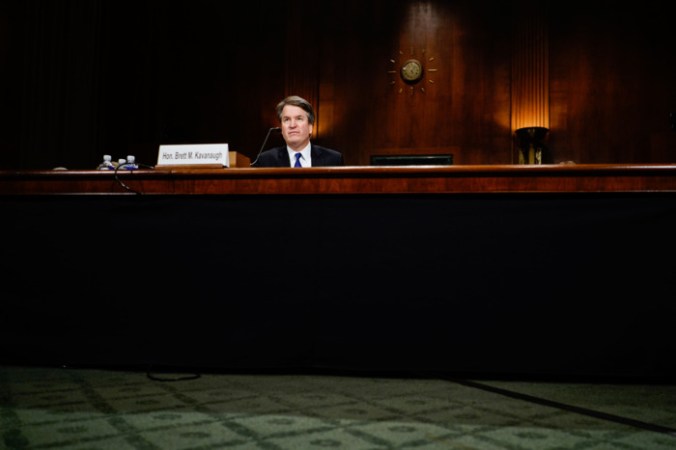
Which brings me to Kavanaugh’s testimony, which was spellbinding in a different way. He behaved, it seemed to me, exactly as an innocent man would behave if accused of a crime in his teenage years — especially a crime that was unveiled by his political opponents at the very last moment. It was one that he could not possibly refute (no one can prove a negative) and it catalyzed a media frenzy — multiple gang rapes! — that continues to get more extreme every day. There’s a reason we have statutes of limitation. When alleged crimes happened decades ago, proof is very hard, and allegations much easier. And when the alleged perpetrator was also a minor, we’re in a very weird and difficult place….
Of course he was angry. Wouldn’t you be if you were innocent or had no idea where this allegation suddenly came from? He wasn’t being accused of sexual harassment, or sexual abuse as an adult in a way he could have refuted or challenged. His long-lost teenage years as a hard-drinking jock were now under the microscope. Even his yearbook was being dissected. Stupid cruelties and brags from teenage boys were now being used to define his character, dismiss his record as a judge, his sterling references, his respected scholarship, his devoted family, his relationship with women in every capacity. He had to fend off new accusations, ever more grave and ever more vague.
…To the extent that the hearing went beyond the specifics of Ford’s allegations and sought to humiliate and discredit Kavanaugh for who he was as a teenager nearly four decades ago (a dynamic that was quite pronounced in some Democratic questioning of the nominee), it was deeply concerning. When public life means the ransacking of people’s private lives even when they were in high school, we are circling a deeply illiberal drain. A civilized society observes a distinction between public and private, and this distinction is integral to individual freedom. Such a distinction was anathema in old-school monarchies when the king could arbitrarily arrest, jail, or execute you at will, for private behavior or thoughts. These lines are also blurred in authoritarian regimes, where the power of the government knows few limits in monitoring a person’s home or private affairs or correspondence or tax returns or texts. These boundaries definitionally can’t exist in theocracies, where the state is interested as much in punishing and exposing sin, as in preventing crime. The Iranian and Saudi governments — like the early modern monarchies — seek not only to control your body, but also to look into your soul. They know that everyone has a dark side, and this dark side can be exposed in order to destroy people. All you need is an accusation.
—Andrew Sullivan in his essay today, essentially stating the same points we have discussed at Ethics Alarms, but in his own inimitable, erudite style.
He’s 100% right, of course. Andrew is also a gay, Trump-hating liberal, so this is a good essay to send to your friends who are teetering on the brink of madness. They won’t listen to me; maybe he can break through.





 Ethics Alarms