Morning Ethics Warm-Up: 8/23/17

Good Morning!

(BOY, there are a lot of especially stupid ethics stories today…)

1. This:
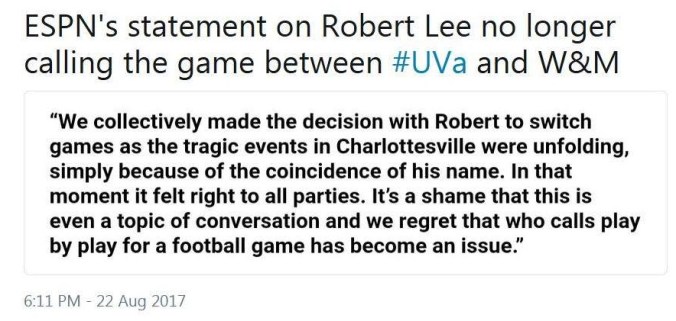
That’s right: an Asian-American broadcaster who never fought for the South during the Civil War has been robbed of a job assignment because his virtue-signaling, grandstanding mega-corporation wants to side with the statute-toppling Left. ESPN regrets that the NAME of one of its broadcasters has become an issue? Who made it an issue? ESPN, that’s who.

Nah, there’s no slippery slope! Nah, this is just about Civil War generals! Nah, the people behind the historical purge or reasonable…they won’t just keep looking for more ways to claim they are being offended!

Can you tell I am losing patience with the defenders, enablers and rationalizes of this toxic nonsense?

2. Or is this dumber? From issue scout Neil, who writes, “Watch the video. [Trump] gestures for the crowd to look up at the sky, then makes a show of looking himself (though CLEARLY not actually trying to see the eclipse). I must have seen at least a dozen other  people yesterday scan the sky in a similar fashion before accidentally getting blinded by an eye-full of rays. The man is inept beyond belief, but he’s not wearing a bib. God this  irritates me.”

These are the ways that that the newsmedia signals to anyone with an open mind and not drooling, gnashing and recoiling at the sight of water from end-stages Anti-Trump Brain-Eating Virus infection that it cannot be trusted, and has traded of its integrity, honesty, fairness and objectivity to lead the “Destroy the Elected President of the United States” effort. No, the President did not actually look directly into the sun and blind himself. In fact, I did exactly the same thing he did when I glanced up at the sun sideways for a nanosecond wondering why so many idiots were lying on the ground wearing 3-D glasses. This is the epitome of fake news—fake, because the intent of the item is to mislead, and because it is no more news than “President uses wrong fork at State Dinner.” No other President, ever, under any scenario, would be covered this way, and no news publication would ever print anything so dumb unless it was certain that its readers were gullible, deranged, and even dumber.

Prof. Glenn Reynolds:If the press and the political opposition — but I repeat myself — were just sober, straightforward, and honest they could beat Trump easily. But then, if they were capable of that, we wouldn’t have gotten Trump to begin with.”

3. My wife reminded me that I have been flagging deception in obnoxious ways since long before ProEthics and Ethics Alarms.  When we were dating, she had a bowl of soup at a Georgetown campus hangout called The Tombs, and I had a cup of the same soup, for $1.50 less. I asked the waitress for a clean bowl and cup,  and poured water into the cup until it was at soup-level, and then poured that water into the empty bowl, which it filled. Then I asked her to get the manager, whom I asked to explain why a bowl cost more than a cup when the amount of soup was the same. he had no explanation of course.

You’ll be amazed how many restaurants do this. Continue reading
Morning Ethics Warm-up: 8/16/17

GOOD MORNING!

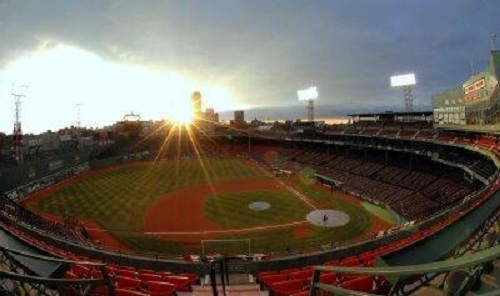
1. I’m heading to Boston and Fenway Park in a few hours to meet with two of my high school classmates and together pay our respects to the 1967 Boston Red Sox, the spiritual beginning of Red Sox Nation, and a group of men, then barely more than boys, who had as profound an effect on my life and view of it as anything I have ever experienced.

It’s the 50th Anniversary of that amazing team and the heart-stopping pennant race it won against all odds, in a four team race that came down to the final game of the regular season. I mean heart-stopping literally: the team wasn’t called “The Cardiac Kids” for nothing. TWO of my father’s colleagues at the Boston Five Savings Bank died of heart attacks while attending Red Sox games, during one of the 9th inning desperation rallies for which the team was famous. The only reason I didn’t perish in like fashion is because I was just 16 years old.

Why was this team, and that summer 50 years ago, so important to me? I don’t have time or space to answer that question well, and you’d probably wonder what I was babbling on about anyway. A 2017 film by Major League Baseball called “The Impossible Dream” does a fair job of explaining it, but it’s too short to do the job right.

I had listened to, watched or attended every Boston Red Sox game for five years, as the team lost and lost. From those bad teams, followed weakly by the city in those days, in a crumbling old park that seemed destined to be abandoned and torn down, I learned that winning wasn’t everything, that loyalty wasn’t easy, that Hemingway was right, and that baseball was about courage, humility, perseverance, doing your job every day, sacrifice, and hope, as well as usually losing at the end. That summer of 1967 taught me that hope is worth the effort even though hope is usually dashed by the ice water of reality, that you should never give up, that miracles do happen, and that nothing is as wonderful as when a community is united in a single, inspirational goal, no matter what that goal might be…and that you should never be afraid to give everything you have in pursuit of a mission, even when it is likely that you will fail.

I learned difficult, discouraging lessons, too. When an errant pitch hit Red Sox right-fielder Tony Conigliaro in the face on August 18, 1967, it was the beginning of a lesson that revealed its tragic last chapter 23 years later. That one taught me that life is horribly, frightening unpredictable, and that we envy others at our peril. It taught me that we need to do what we can to accomplish as much good as we can as quickly as we can, because we may lose our chance forever at any moment.

Tony C, as he was and is known as, was a beautiful, charismatic, local kid, the idol of Boston’s huge Italian-American community,  in his fourth season with his home town team at the age of 22. He dated movie stars; he recorded pop songs; he had a natural flair of the dramatic, and was destined for the Hall of Fame. One pitch took it all away. Although he had two comebacks and played two full seasons facing major league fastballs with a hole in his retina and his field of vision, Tony was never the same. After his final attempt to keep playing failed at the age of 30, he became a broadcaster, and at 37 was seemingly on the way to stardom again in 1982 when he suffered a massive, inexplicable heart attack—Tony  did not smoke, and had no family history of heart problems– that left him brain damaged until his death in 1990.

As Henry Wiggin, the star pitcher protagonist of the novel, play and movie “Bang the Drum Slowly” observes as he  reflects on the death of his catcher and roommate, everyone is dying, and we have to remember to be good to each other. But it’s so hard. Ethics is hard. The ethics alarms ring faintly when we are about the task of living, or not at all…

At the end of the story, the narrator, the best friend of the catcher (but not really that close a friend) recalls how quickly everyone on the baseball team went back to their selfish ways after their teammate went home to die Even the narrator, who was the leader of the effort to make the catcher feel loved and appreciated in his last days, ruefully recalls his own failing. The catcher had asked him a favor, just to send him a World Series program (the team won the pennant after he had become too ill to play), and he had forgotten to mail it until it was too late. How hard would it have been, the narrator rebukes himself, to just put it in an envelope and mail it? Why are we like that, he wonders?

1967 was the beginning of my exploration of that mystery too.

So I am going to Boston for the 30 minute ceremony. I can’t even stay for the game; I have a seminar to teach tomorrow morning, and the last flight out of Logan is at 9 PM. There will probably be just a small contingent from the Cardiac Kids: most of them are dead now, or too infirm even to walk onto the field. But Yaz will be there, and Gentleman Jim Lonborg; Rico Petrocelli, Mike Andrews, and maybe even Hawk Harrelson  and Reggie Smith. I will be there to say thank-you, that’s all.

And to show that I remember. Continue reading

Morning Ethics Warm-Up, Charlottesville Aftermath Edition: 8/14/2017

Charlottesville, Virginia.

Good Morning?

1. Just a side note before the serious stuff: WordPress spell-check thinks “Charlottesville” is misspelled. It says the correct spelling is “Chancellorsville.”

And you wonder why I have so many typos…

2. Either one believes in, supports and will fight for freedom of speech, expression and assembly, or one does not. Those who do not also do not genuinely believe in democracy, the Constitution, civil rights or the core principles of the United States of America. This group, which has been slowly—not so slowly, really—taking over the progressive movement and the Democratic Party, and with them that party’s institutional allies, the U.S. education system and journalism, is far, far more dangerous than the alt-right, racist fools who tried to exercise their own rights over the weekend.

At the center of the implicit rejection of the freedom to say, express, demonstrate for and hold whatever wise, creative, idiotic or hateful opinions and ideas a U.S. citizen chooses were the despicable and anti-American comments of Virginia Governor Terry McAuliffe, ( WordPress thinks I should spell his name “Cauliflower”) who told a group of U.S. citizens that they were not welcome in his state, and that there was no place for them in the United States of America—you know, like the German Nazis told the Jews. Pathetically and dispiritingly, knee-jerk defenders of McAuliffe have spun this as mere “opprobrium,” a deflection that we technically refer to as “baloney.” When the leader of a government points to any group and says, “Get out!” based solely on what the group says and believes, that’s totalitarian oppression. It also paints a bullseye on the backs of every member of that group. Continue reading

Ethics Observations On The Charlottesville Riots

  • Is there a clear, complete, objective account of what happened in Charlottesville? I can’t find one. I have read about “clashes” between protesters and “counter-protesters,” who we are told outnumbered the white nationalist group protesting the removal of General Lee’s statue by about 2-1. What does that mean? Was the white nationalist rally peaceful, regardless of the racist slogans they were hurling? Were the counter-protesters just shouting back, or more physical? I see references to the “fray.” What fray? The key word seems to be that the white nationalists “sparked’ violence by marching. Do we now say that the civil rights marchers in Selma sparked the violence, and not the counter-protest racists. or is the theory that which ever group has the less popular position “sparks” the violence?

My suspicions are that the vagueness of the news media reports is a deliberate effort by the news media to avoid assigning any responsibility to Antifa thugs for the escalation into violence.

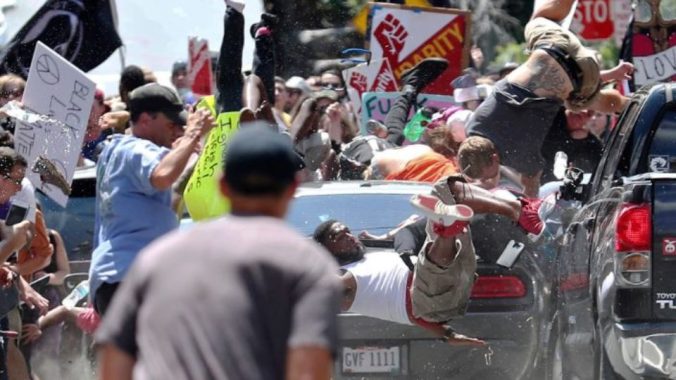
  • Obviously the automobile driven into the anti-white nationalist, counter protest crowd was a criminal act. Since this was done by the racists, it became the focus of all news reports, as if this was the only violence.

Was it? Somehow I doubt that.

  • Again, a counter-protest group “incites violence” as much as a protest group. The reaction from the news media and the political pundits appears to ignore the basic fact that Americans have the right to demonstrate and express their support for repugnant ideas as well as ideas most of us approve of. This was settled (I thought) with National Socialist Party of America v. Village of Skokie, 432 U.S. 43 (1977).

Apparently not.

  • President Trump’s statement regarding the riot was this:

“We condemn in the strongest possible terms this egregious display of hatred, bigotry and violence, on many sides. On many sides. It’s been going on for a long time in our country. Not Donald Trump, not Barack Obama. This has been going on for a long, long time…We ALL must be united & condemn all that hate stands for. There is no place for this kind of violence in America. Lets come together as one!”

The immediate reaction by the newsmedia was that the statement asserted a false equivalency. CNN’s Chris Cillizza wrote,

“Both sides don’t scream racist and anti-Semitic things at people with whom they disagree. They don’t base a belief system on the superiority of one race over others. They don’t get into fistfights with people who don’t see things their way. They don’t create chaos and leave a trail of injured behind them. Arguing that “both sides do it” deeply misunderstands the hate and intolerance at the core of this “Unite the Right” rally. These people are bigots. They are hate-filled. This is not just a protest where things, unfortunately, got violent. Violence sits at the heart of their warped belief system.”

Both sides do “do it,” however, and when “it” is violence and refusal to allow a group with opposing views make their statements, there is no high ground. The starting point from the left is “the white nationalists are wrong, so they don’t deserve the same rights we do.” Yes, they do, and among those rights is the opportunity to protest whatever they choose without being attacked. “These people are bigots.” So what? They have the right to express their views. “They are hate-filled.” And the counter-protesters were not “hate-filled”? Or was the President supposed to distinguish that as good hate? Continue reading