Seth MacFarlane’s Outrageous Oscar Mistake (At Least, I Hope It Was A Mistake)

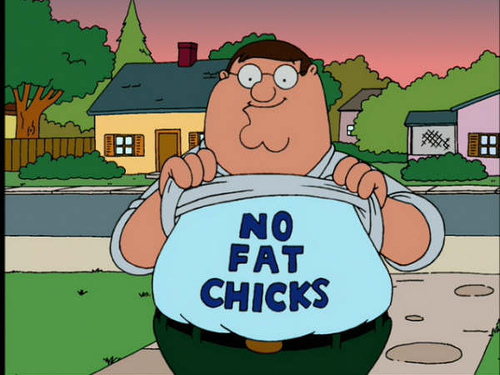
"The Family Guy" in a typical moment of sensitivity.

“The Family Guy” in a typical moment of sensitivity.

The viewing public was severely divided regarding “Family Guy” creator Seth MacFarlane’s performance as Oscar host, with approximately half appreciating his trademark juvenile and politically incorrect schtick (and being impressed that the guy can sing and dance rather well too), and the rest, including the majority of TV critics, finding him boorish, amateurish and unfunny. Personally, I thought he did a reasonably competent job in an impossible assignment (unless, it seems, you are Johnny Carson or Bob Hope, who are long gone, or Billy Crystal, who is seriously past his pull date), made more so by the misconceived show he had to host.

Then I read Katie McDonough’s essay in Salon. Continue reading

Jonah Lehrer Shows Us A Level One Apology: Remorse, Regret, Contrition. Sincerity? Who Knows…

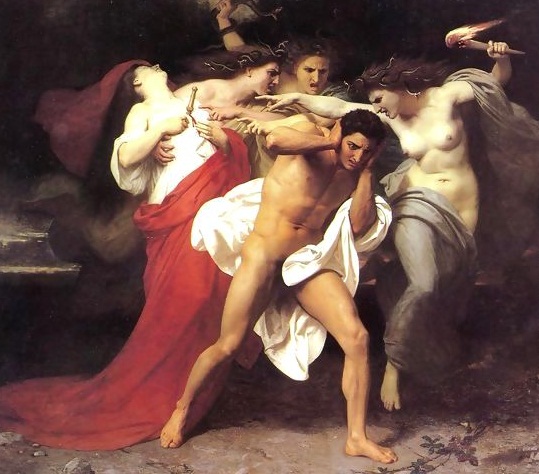
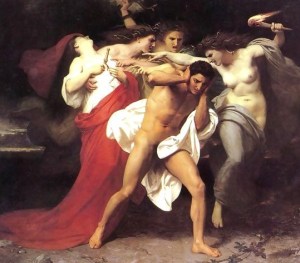
The-Remorse-Of-OrestesWhen we last looked in on writer Jonah Lehrer last summer, he had detonated his career and credibility with a series of incidents of serious professional misconduct that led to his ignominious firing from The New Yorker, where he once was regarded as a rising star. First he was caught plagiarizing himself, recycling a previously published work as an original  essay for the magazine. That led to an investigation showing that this was not the first time he had taken such an unethical short-cut. Finally, it was discovered that he had fabricated Bob Dylan quotes in his best-selling book about, ironically enough, creativity. When confronted about this, Lehrer lied. Soon he was out of a job and condemned to the limbo reserved for writers who deceive their readers: Jason Blair, Stephen Glass, James Frey, Janet Cooke, and others. It is not a pleasant or profitable place to be.

Lehrer was recently invited to speak to a gathering at the Knight Foundation, and chose the forum to deliver an apology for his conduct. It would be difficult, I think, to deliver a better one. On the Ethics Alarms Apology Scale, the most ethical apology, at the top of the scale, is this one:

1. An apology motivated by the realization that one’s past conduct was unjust, unfair, and wrong, constituting an unequivocal admission of wrongdoing as well as regret, remorse and contrition, as part of a sincere effort to make amends and seek forgiveness.

That is exactly what Lehrer delivered to the Knight Foundation, and through his blog, the rest of us. He said…

“..I am the author of a book on creativity that contained several fabricated Bob Dylan quotes. I committed plagiarism on my blog, taking, without credit or citation, an entire paragraph from the blog of Christian Jarrett. I also plagiarized from myself. I lied to a journalist named Michael Moynihan to cover up the Dylan fabrications.

“My mistakes have caused deep pain to those I care about. I am constantly remembering all those people I’ve hurt and let down – friends, family, colleagues. My wife, my parents, my editors. I think about all the readers I’ve disappointed, people who paid good money for my book and now don’t want it on their shelves.I have broken their trust. For that, I am profoundly sorry. It is my hope that, someday, my transgressions might be forgiven.

“I could stop here. But I am convinced that unless I talk openly about what I’ve learned so far – unless I hold myself accountable in public – then the lessons will not last. I will lose the only consolation of my failure, which is the promise that I will not fail like this again. That I might, one day, find a way to fail better.

“The lessons have arrived in phases. The first phase involved a literal reconstruction of my mistakes. I wanted to have an accounting, in my head, of how I fabricated those Dylan quotes. I wanted to understand the mechanics of every lapse, to relive all those errors that led to my disgrace. I wanted to understand so that I could explain it to people, so that I could explain it in a talk like this. So that I could say that I found the broken part and that part has a name. My arrogance. My desire for attention. My willingness to take shortcuts, provided I don’t think anyone else will notice. My carelessness, matched with an ability to excuse my carelessness away. My tendency to believe my own excuses.

“But then, once I came up with this list of flaws, and once I began to understand how these flaws led to each of my mistakes, I realized that all of my explanations changed nothing. They cannot undo what I’ve done, not even a little. A confession is not a solution. It does not restore trust. Not the trust of others and not the trust of myself. What’s more, I came to see that my explanations were distracting me from the more important reality I need to deal with.

“Because my flaws – these flaws that led to my failure – they are a basic part of me. They are as fundamental to my self as those other parts I’m not ashamed of. This is the phase that comes next, the phase I’m in now. It is the slow realization that all the apologies and regrets are just the beginning. That my harshest words will not fix me, that I cannot quickly become the person I need to be. It is finally understanding how hard it is to change.

“Character, Joan Didion wrote, is the willingness to accept responsibility for one’s own life. For too long, I did not accept responsibility. And by not accepting responsibility – by pretending that all of my errors were accidents, that my carelessness was not a choice – I kept myself from getting better. I postponed the reckoning that was needed.

“There is no secret to good decision-making. There is only the obvious truth: We either confront our mistakes and gain a little wisdom, or we don’t and remain a fool.”

You can read the whole speech here. Continue reading

Unethical Quote of the Week: Lance Armstrong

“I deserve to be punished. I’m not sure I deserve the “death penalty.”

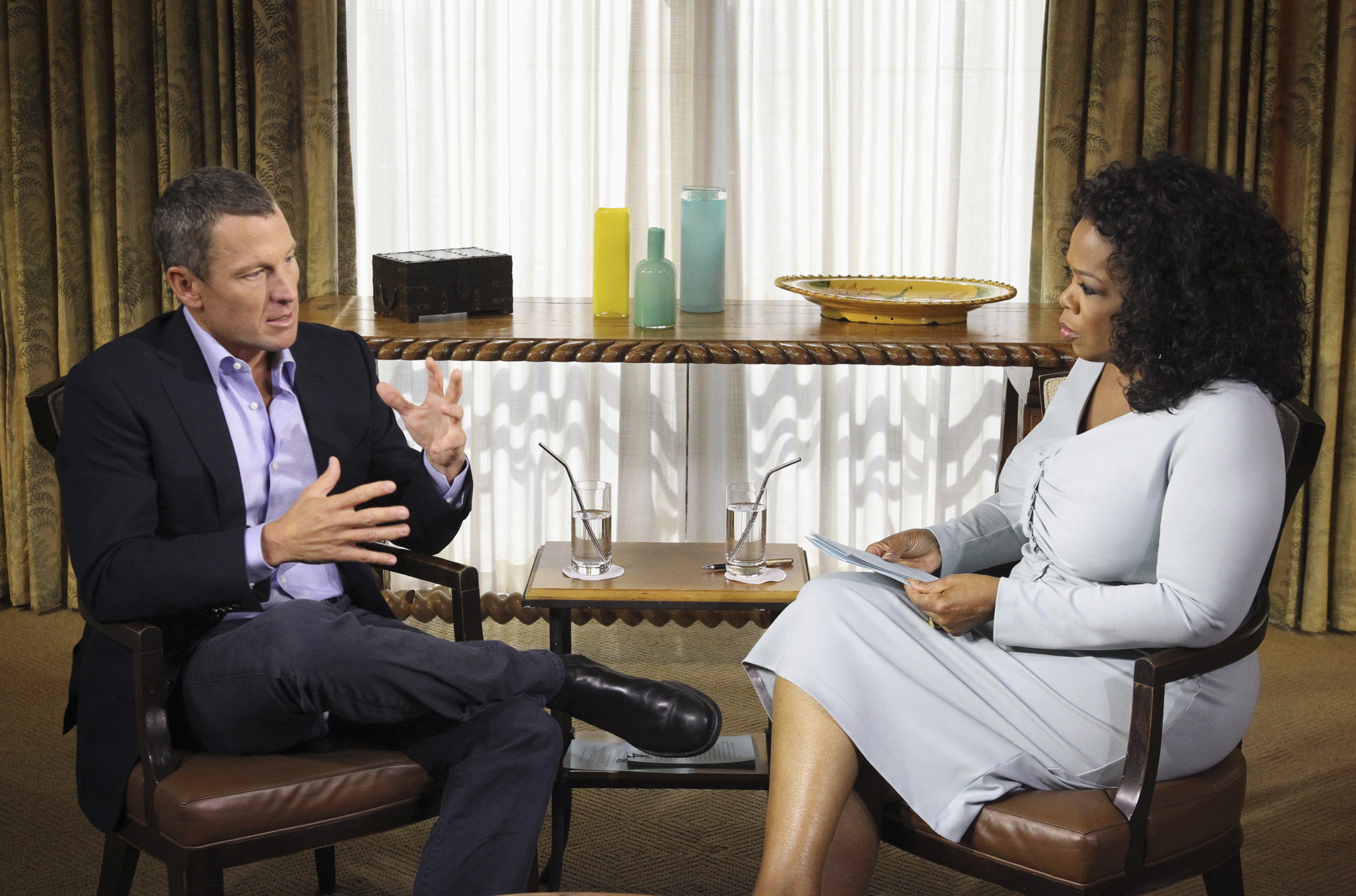
—- Lance Armstrong in his confessional with Oprah Winfrey.

In a word: Astounding.

Sure, why should you be punished any more than any other cyclist..wait, did you really just say that?"

Sure, why should you be punished any more than any other cyclist..wait, did you really just say that?”

Most of the second segment of Oprah’s interview with Armstrong was an anti-climax to the first, with one shocking exception.

Armstrong noted that all of the former team-mates who testified against him made deals that netted them, at most, six month suspensions from competition. Now that he was coming clean to Oprah, Armstrong implied, he deserved a similar deal. “I’m not saying [ how Armstrong is being treated] is unfair…but it’s …different,” he said. Then he uttered the statement about the “death penalty”—his lifetime ban from any professional athletic competition, biking or otherwise.

Armstrong “isn’t sure” that cheating to win the most important competition in his sport seven times, corrupting other cyclists, lying—defiantly, pugnaciously, flamboyantly— for almost two decades…bullying anyone who tried to tell the truth about his deceptions…using his money, influence and power to intimidate and silence…accepting millions of dollars in sponsorships based on lies and fraud…embarrassing sponsors and supporters by linking them to a conspiracy of lies and drug peddling…and arguably worst of all, building a charitable foundation on those lies, while inducing children and cancer survivors to embrace him as a hero…deserves a lifetime forfeiture of trust, not just as an athletic competitor, but as a business partner, associate, and friend?

Despite all his assurances to Oprah that he is a changed man, and that he is truly sorry, and that he understands the enormity of his betrayals, Lance Armstrong hasn’t learned a thing.

Lance Armstrong and Oprah: First Impressions

Lance Armstrong, Oprah Winfrey

I just finished watching the first installment of the Lance Armstrong-Oprah interview–almost twice, in fact. I’ll be watching tomorrow’s installment too (I am scheduled to talk about Lance on NPR’s “Tell Me More” on Monday, to be broadcast Sunday) and maybe it will alter some of my initial impressions.

But I doubt it.

Impressions:

1. Armstrong is not apologetic in the least, in any way, despite the occasional nod to apology-like langauge. He is not somewhat like, but exactly like, a mob hit man testifying before a Senate committee on organized crime. He is doing what he has to do, and if there is any genuine regret or contrition, I couldn’t discern it. Frankly, I am stunned at how unapologetic he is.

2. Most damning moment: Right off the bat, Oprah asks Lance “Why now?” It’s a superfluous question; everyone knows the answer is “Because I’m trapped; because the lies don’t work any more; because this is my best chance of persuading some people, the gullible ones, but we know how many of them there are, to give me a second chance.” I didn’t expect Armstrong to be that candid, of course, but I did expect him to have an answer, probably a contrite, self-serving one, prepared. He didn’t. “That’s a great question,” he said, stalling. Incredibly, he said he didn’t really have a good answer. “I know it’s too late,” he offered. Yes, I’d say thirteen years, marked by lying, doping, posturing and attacking is too late. That’s the best Armstrong could muster. Heck, if he just kept up with current movies, he would have had some great answers, like Denzel Washington, in the climax of “Flight,” confessing a career of flying commercial airlines drunk by saying, (I’m paraphrasing) “I just couldn’t stand telling one more lie.” Or that old stand-by, “It was the right thing to do.”

The sign of a completely unethical person is that they can’t even imagine what thinking ethically is like. On the evidence of this interview, that’s Lance Armstrong.

3. Most telling quote: while explaining that his 2009-2010 comeback is what opened the floodgates of attention and investigation that led to the explosion of his long campaign of deception and lies, Armstrong said, “Without the comeback, I wouldn’t be here now.” Translation: “Without the comeback, I would have gotten away with it, and I sure as Hell wouldn’t be sitting here spilling the beans to you.” He then terms his comeback a “mistake.” Armstrong is sorry he let himself be caught, and he is sorry for the consequences of his lies being discovered.

Continue reading

The Fourth Annual Ethics Alarms Awards: The Worst of Ethics 2012 (Part 2)

reid

The 2012 Ethics Alarms Awards for the Worst in Ethics continues (you can catch up with Part I here , and the Best is here), and yes, it gets worse…

Worst Friend and Relative

Lori Stilley, who faked cancer to get sympathy, favors, parties and money from those who cared about her.

Most Unethical Advice

Emily Yoffe, Slate’s “Dear Prudence,” wins for a year of bad advice in kinky situations, the bottom of the barrel being when she advised a daughter who observed her mother illegally filling out her invalid grandparents’ 2012 absentee ballots to reflect the mother’s electoral preferences to do nothing about this combination of elder abuse and voter fraud.

Shameless Bad Character Division Continue reading

Ethics Hero: Grand Hotel Dallas

This is how it is done: the perfect way to handle organizational misconduct.

hotellobbysignConsumerist blew the whistle on the Grand Hotel in Dallas for blatantly attempting to bribe patrons into posting  favorable reviews of their stays there online. A reader had alerted the consumer hawk website to a sign displayed in the hotel’s lobby offering $3 to $5 to guests who wrote raves on travel sites like Expedia, Priceline, and others. The sign required “immediate proof of review,” said the bribe amount would vary according to the number of websites that posted it, and noted that all must be “positive, favorable” reviews” approved by mgmt.”

The web site soon learned that the whole scheme had never been “approved by mgmt.” The hotel’s representative sent this e-mail to Consumerist: Continue reading

The Ethics Attic: Notes From Around The Web

messy attic

[I’m still feeling lousy, so in an effort to conserve some energy while keeping the torch high, I’m presenting a few links that the ethics-minded might enjoy visiting. Normally I would write about some of these, so consider yourselves lucky.]

  • Historian Paul Finkleman delivers that harshest verdict yet on the hypocrisy of Thomas Jefferson regarding civil rights and slavery. You should then read David G. Post’s splendid contra essay here. (The last two sentences in Finkleman’s op-ed are pretty much indefensible.)
  • A fascinating reflection, inspired by the movie “Lincoln,” on Utilitarianism and “the ends justifies the means.”
  • In fact, the program is a benign one, but considering the issue raised in my last post, it is hard to imagine more perfect symbolism for the American public trading self-sufficiency for government protection than the trade described here.
  • If you missed the recent George Will column, a frightening one, about the assaults of free speech and thought around the campuses of American universities, you have another chance to read it, here.
  • I only recently learned that 3-D copiers are a reality, and Dr. Chris MacDonald, on his always excellent Business Ethics Blog, has some insight on their ethical implications here.
  • Once again this year, I have an essay in The 2013 Hardball Times Baseball Annual, and publisher Dave Studenmund references my analysis of the Stephen Strasburg affair here.
  • Finally, thanks to Mary Wright on the HR Gazette for posting the Ethics Alarms Apology Scale.

The Ethics Agony of Angus T. Jones

How could such a lucky kid complain?

Angus Jones, the “Half” of CBS’s resilient sitcom “Two and a Half Men, ” is receiving heavy doses of criticism and mockery in entertainment circles (and Blog World, of  course) for being so ungrateful and graceless as to post a YouTube video condemning the very TV show that has made him rich and famous over the last nine years, taking him from childhood to majority. The video was posted by the Alabama-based church Forerunner Chronicles, which apparently Baptized Jones recently. “You cannot be a true God-fearing person and be on a television show like [‘Two and a Half Men’]. I know I can’t. I’m not okay with what I’m learning, what the Bible says, and being on that television show.” He goes on to say,

“I’m on ‘Two and a Half Men’ and I don’t want to be on it. Please stop watching it. Please stop filling your head with filth.”

Is this disloyal and ungrateful conduct toward a show, a cast and employers that have given Jones wealth, celebrity and fame? Undoubtedly. If he had come by this station in life through his own efforts and fully informed choices, I would agree with the Hollywood chorus accusing the 19-year-old of “biting the hand that feeds him.” Jones, however, was indentured to “Two and a Half Men” at the age of ten, which is to say that he had little say in it or his life path so far. His parents, like the parents of most child actors, decided that his innate performing talent was worth a lot of money to them and him, and that this was reason enough to launch him into a field with a century-long track record of turning children into dysfunctional celebrity addicts, often setting them on the road to addiction, isolation, depression, failure, and death. Continue reading

A No Tolerance Rule For Cabinet Members: Don’t Threaten Reporters

Intolerable.

I’ll make this simple, and get right to the point: any Cabinet member who threatens a reporter with physical violence for doing the job journalists are supposed to do should be fired. No exceptions. Moreover, that should be obvious and beyond debate.

Ken Salazar, the Secretary of the Interior, didn’t like a question he was asked by Colorado Springs Gazette reporter Dave Philipps. The investigative reporter had tried to reach Salazar for months through his press secretary seeking a comment on a story Philipps had written about how a Colorado man with business connections to Salazar had been sold hundreds of federally protected wild horses that have subsequently vanished. The man is under investigation, and one of his businesses is slaughtering horses, not that any of this is germane to how Salazar treated Phillipps.  When Philipps began asking Salazar about the program and possible personal ties he had to the wild horse buyer now under investigation, Salazar abruptly ended the interview. He then pushed The Gazette’s camera aside, got nose to nose with the reporter, and said, pointing, “Don’t you ever…you know what, you do that again… I’ll punch you out.” Continue reading

Full Disclosure and Apology: The Horror

Me, apparently.

It appears that I owe readers here an apology, and my psychiatrist a visit. Yesterday I ran across a website that analyzes one’s prose and informs writers whose style among those in the pantheon of famous novelists their literary efforts most resemble. I gave the site two selections from Ethics Alarms to assess.

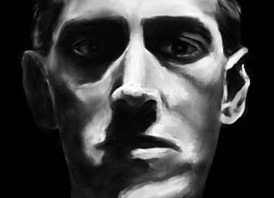
The verdict? The novelist my writing evokes is none other than H.P. Lovecraft, but with fewer typos.

Lovecraft was an iconic horror writer, wrote like nobody else who ever lived, or so I thought, and was almost certainly insane. If you haven’t had the pleasure of experiencing H.P., here is a typical passage…

“The nethermost caverns are not for the fathoming of eyes that see; for their marvels are strange and terrific. Cursed the ground where dead thoughts live new and oddly bodied, and evil the mind that is held by no head. Wisely did Ibn Schacabao say, that happy is the tomb where no wizard hath lain, and happy the town at night whose wizards are all ashes. For it is of old rumour that the soul of the devil-bought hastes not from his charnel clay, but fats and instructs the very worm that gnaws; till out of corruption horrid life springs, and the dull scavengers of earth wax crafty to vex it and swell monstrous to plague it. Great holes are digged where earth’s pores ought to suffice, and things have learnt to walk that ought to crawl.”

Regarding this disturbing discovery, I want to say…

  • I’m so sorry.
  • Why didn’t anyone tell me?
  • You can check out your own prose here, at I Write Like. Be sure you let me know what you find out. I’m hoping that it thinks everybody writes like Lovecraft.
  • “Evil the mind that is held by no head” is the new motto of Ethics Alarms.