Ethics Batting Practice, 7/21/ 2020: Baseball Zoom Hangover Edition.

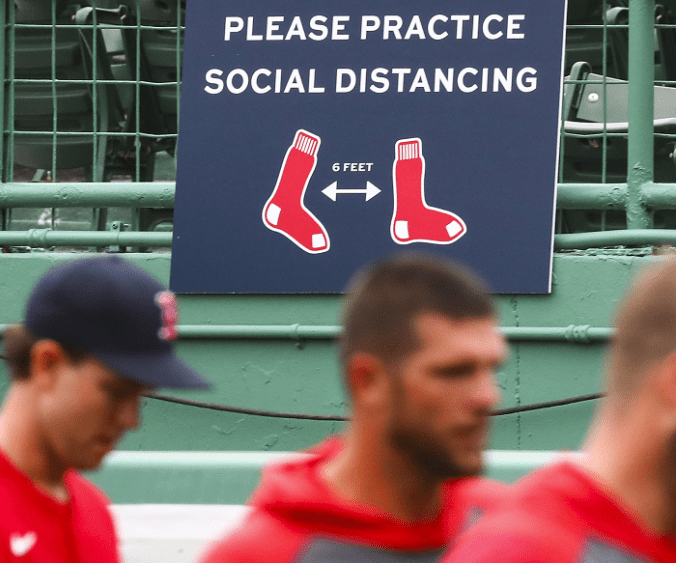
Isn’t that only TWO feet??

Last night’s Smithsonian Associates presentation on baseball and American culture went well, I guess. Presenting on Zoom is like acting in a closet: no connection to the audience, no way to gauge what is working and what isn’t, or whether the invisible viewers are engaged. It did give me  a chance, during the section on baseball cheating, to read one of my favorite passages from Philip Roth’s baseball allegory/satire,”The Great American Novel.” Roth’s narrator, mad sportswriter Word Smith, tells the sad tale of the legendary “Spit” Baal, a master of the spitball, the mucous-ball and other trick pitches aided by surreptitiously applied substances. After such adulterations of the ball were banned in 1920, Baal found his career in tatters, since he could no longer use his signature pitch. (In the real world, the National league and American league allowed acknowledged spitball specialists to continue to throw the pitch legally under a grandfather clause, but Roth’s fantasy  is about a third major league, wiped from history and record books in the Fifties following the discovery that it had been infiltrated by Communists.) One day, again seeing his dry pitches clobbered and realizing that he could no longer get batters out legally, “Spit” has a psychotic break on the mound that ends his career in spectacular if unsanitary fashion:

And so before twenty thousand shocked customers  including innocent children — and his own wide-eyed teammates, the once great pitcher, who was  washed up anyway, did the unthinkable, the unpardonable, the inexpiable. He dropped the flannel  trousers of his uniform to his knees, and proceeded  to urinate on the ball, turning it slowly in his hands  so as to dampen the entire surface. Then he hitched  his trousers back up, and in the way of pitchers,  pawed at the ground around the mound with his  spikes, churning up then smoothing down the dirt  where he had inadvertently dribbled upon it. To the  batter, as frozen in his position as anyone in that  ball park, he called, “Here comes the pissball, shithead — get ready!”

For years afterward they talked about the route that ball took before it passed over the plate. Not  only did it make the hairpin turns and somersaults  expected of a Baal spitter, but legend has it that it  shifted gears four times, halving, then doubling its  velocity each fifteen feet it traveled. And in the end,  the catcher, in his squat, did not even have to move  his glove from where it too was frozen as a target .Gagging, he caught the ball with a squish, right in  the center of the strike zone…

1. So this graph would seem to indicate that the news media is scare mongering, right? Continue reading


Ethics Warm-Up, 7/19/2020: And The Hits Just Keep On Coming!

1. Final plug, as the bat above (and in my hands) reminds me: If you are set up with Zoom (it’s free, you know), you still have time to register for the Smithsonian Associates program  tomorrow evening (at 6:45 pm, EST) wherein I hold forth on how baseball has influenced American culture, values and history. Yes, it’s $35 bucks, but it goes to a good cause, and may help the Institute hire more competent employees who don’t peddle junk like the chart on “whiteness.” You’ll be able to ask questions, and I’m storing these experiences for the Ethics Alarms Zoom experience to come. Read all about it here…

2. If a left-wing dim bulb like Jonathan Chait can figure this out, surely more are to follow. He writes in New York Magazine…you know, where Andrew Sullivan was regarded as too conservative?

The ideology of the racism-training industry …collapses all identity into racial categories. “It is crucial for white people to acknowledge and recognize our collective racial experience,” writes [ Robin DiAngelo, of temporary White Fragility” fame,] whose teachings often encourage the formation of racial affinity groups. The program does not allow any end point for the process of racial consciousness. Racism is not a problem white people need to overcome in order to see people who look different as fully human — it is totalizing and inescapable. Of course, DiAngelo’s whites-only groups are not dreamed up in the same spirit as David Duke’s. The problem is that, at some point, the extremes begin to functionally resemble each other despite their mutual antipathy…. In some cases its ideas literally replicate anti-Black racism.”

Ya think??? Continue reading

Friday Evening Ethics Gallimaufry, 7/17/2020: SCOTUS, Di Blasio’s Delusion, And DiMaggio’s Luck

Speaking of gallimaufry, “A Heavy Dragoon” is one of the best Gilbert and Sullivan “list” songs, but you seldom hear it. Erudite is the listener who can identify all the historical figured named! The song is from “Patience,” the firs show I ever directed, and still one of my favorites. The singer in the clip above, Darrell Fancourt, played the part of the Mikado more times than anyone, and even dropped dead while playing the role.

1. In baseball history, it’s Moral Luck Day. On July 17, 1941, New York Yankees center fielder Joe DiMaggio didn’t get a hit against the Cleveland Indians, in great part due to a pait of great plays by Cleveland third baseman Ken Keltner, finally ending his historic 56-game hitting streak, the longest in MLB history then and now. Largely on the basis of the streak, though it helped that the Yankees won the pennant, DiMaggio was awarded the American League MVP award, despite the fact that Boston’s Ted Williams hit .406 that season, nearly 50 points higher than DiMaggio. In fact, Williams outhit the Yankee during the same 56-game period.

The end of The Yankee Clipper’s amazing streak was luck, and the streak itself was luck. All hitting streaks are. Baseball is the  sport most governed by random chance, especially hitting: a well-hit ball can become an out if it happens to be hit within a fielder’s reach, and a ball barely touched by the bat can dribble down the  baseline for a cheap hit. DiMaggio was undeniably a great hitter, but many players in baseball history were better; he just was lucky—good, but lucky—for a longer stretch of games than anyone else. Yet of all his many achievements, the 56 game streak in 1941 is the first thing baseball fans cite when assessing  the greatness of Joltin’ Joe DiMaggio.

2. It isn’t what it is! Yesterday, New York Mayor Bill de Blasio said that releasing prisoners onto the city’s streets to avoid their infection by the Wuhan virus  in jail had made New York City safer, saying, “We now have fewer people in our jails than any time since World War II and we are safer for it and better for it.”  De Blasio’s office announced  that more than 1,500 inmates had been released from city jails in three weeks, reducing the number of prisoners to its lowest level in 70 years.

The problem is that his assertion is ludicrous. De Blasio’s boast that the prisoner release made the city safer defied  the evidence of the results of the prisoner release the NYC Bail reform law required in January 2020. Of those who committed felonies that were no longer eligible for bail, 19.5% were re-arrested at least once after an initial non-bail eligible felony arrest, 1,798 of 9,227 individuals were re-arrested. 2020 recidivism resulted in 1,452  major crime arrests (murder, non-negligent manslaughter, rape, robbery, felony assault, burglary, grand larceny, and grand larceny of a vehicle) vs. 681 in 2019. Meanwhile,  shootings in the city were up 205% in June  compared to a year earlier. Continue reading

Sunday Ethics Warm-Up, 7/5/2020: Post-Fourth Hangover Edition

Except it’s not alcohol, it’s all the anti-America agitprop that has me groggy…

1. One last Fourth of July resource: here is one of many annotated versions of the Declaration. Here is another.

2. The downside of paying baseball players so much. Major League Baseball is plunging forward with a season of sorts, only 60 games long and with some hopefully temporary rules, such as a universal Designated Hitter and an extra-inning stunt so revolting that I don’t even want to think about it. The players are getting a pro-rated salary, but the Players Union insisted that any player could opt out of the season for a legitimate health related reason, such as being at in a  high risk group, and collect his salary, or for ny reason, and waive his salary.

It has been fascinating to see some players decide to not play, thus leaving their teams in the lurch, because its just not worth the effort. Take, for example, Dodgers starting pitcher, fresh off of a trade by the Red Sox. He announced that he won’t be playing, and will forfeit 11 million dollars (of his usual 30 million dollar a year salary)for the privilege. Felix Hernandez, another former ace now with the Braves, also opted out, though he loses far less, since he was working on a minor league contract while trying to keep his recently declining career going. In both cases, however, the pitchers are taking a major risk, because sitting out a full season for older players often makes returning to action difficult. In addition, especially in the case of Price and some of the other opt-outs, the decision not to play harms his team and team mates. But David Price has earned about 250 million dollars in his career, and will earn another 50 million whether can pitch or not. Hernandez has already earned more than 200 million.

Love of the game? For the good of the team? Never mind. The players are motivated only by money, and once enough is in stocks and bonds, even that isn’t motivation enough.

3. Surprise! It turns out that police are necessary after all.  Any hope that a reasonable and practical answer to Question 13 (“What is the “systemic reform regarding race in America” that the George Floyd protests purport to be seeking?”) vanished when the first substantive measure embraced by the mob was “Defund the police.” That this was even floated, much less executed (as in Minneaplois and New York City) was signature significance for a level if ignorance and recklessness justifying this standard Ethics Alarms clip:

Chris Rufo explains at City Journal just how stupid: Continue reading

Comment Of The Day: “Statue-Toppling, The Ethics Incompleteness Principle, And Calvin Griffith, Part Two”

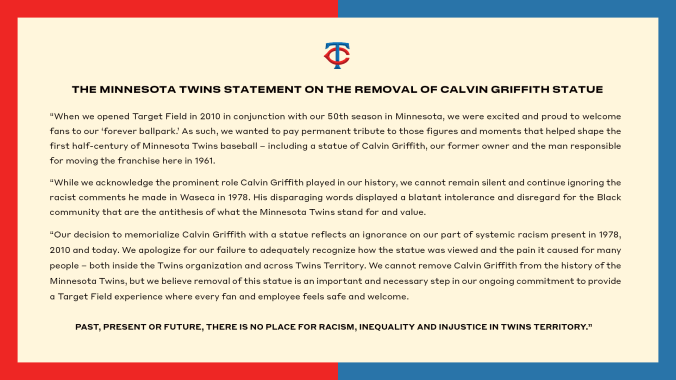
Having just banned a commenter for a useless and obnoxious comment on this same post, it it is a wonderful tonic to be able to post  JutGory’s masterful Comment of the Day critiquing the Minnesota Twin’s statement explaining their removal of Cal Griffith’s statue. It is a fine fisking of the kind of disingenuous babble we  have been getting from organizations of late.

The poll on Cal’s statue so far:

Here is JutGory’s Comment of the Day on the post, “Statue-Toppling, The Ethics Incompleteness Principle, And Calvin Griffith, Part Two”:

Jack: “Taking all of that together, I believe that the Twins are justified in taking down Griffith’s statue, and that it would have been unethical for the team not to.”

Apart from the whole statue-removing thing, here is my problem with this:

Their statement said:

“When we opened Target Field in 2010 in conjunction wit h our 50th season in Minnesota, we were excited and proud to welcome fans to our ‘forever ballpark.’”

Fair enough. Good start. Then:

As such, we wanted to pay permanent tribute to those figures and moments that helped shape the first half-century of Minnesota Twins baseball.

PERMANENT. That is a strong word. But, that is what they intended. Permanent Tribute.

– including a statue of Calvin Griffith, our former owner and the man responsible for moving the franchise here in 1961.

Including the man who moved them to Minnesota. Seems fitting. But for him, they wouldn’t have moved to Minnesota. And, why did he move the franchise? Because of the same racist attitudes that they condemn.

“We cannot remain silent and continue ignoring the racist comments he made in Waseca in 1978.”

I see. So, the permanent tribute was made while ignoring the racist comments you knew about. Continue reading

Statue-Toppling, The Ethics Incompleteness Principle, And Calvin Griffith, Part Two

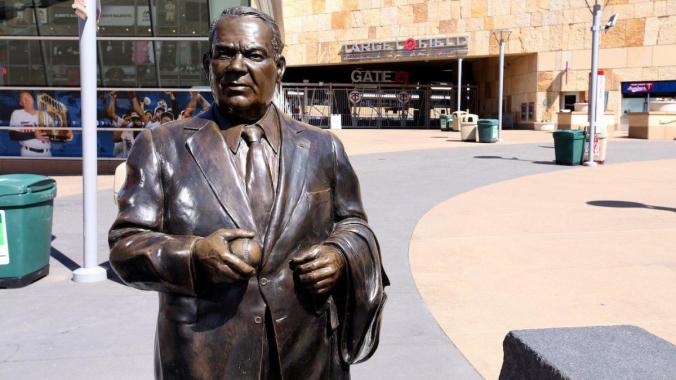
Where Cal Griffith’s statue once stood…

Here is what Calvin Griffith said in the 1978 remarks that led the Minnesota Twins to remove his statue in from of the team’s stadium, Target Field.

Griffith was invited to speak to the Lions Club in Waseca, a small city in southern Minnesota. Taking questions from the audience after his planned speech, someone asked Griffith  why he brought the Twins to Minnesota from Washington, D.C., in 1961. Griffith lowered his voice, asked if there were any blacks around, and  looked around the room. Apparently confirming that his audience was all white,  Griffith said,

“I’ll tell you why we came to Minnesota. It was when I found out you only had 15,000 blacks here. Black people don’t go to ball games, but they’ll fill up a ‘rassling ring and put up such a chant it’ll scare you to death. It’s unbelievable. We came here because you’ve got good, hardworking, white people here.”

It’s hard to get more racist than that, at least short of a Klan rally. I’ll poll this at the end of the post, but I believe that this is a case where the Ethics Incompleteness Principle applies, and the usually valid ethical objections to pulling down the statues of problematic, controversial or subsequently disgraced historical figures have to yield to other considerations, which are these: Continue reading

Statue-Toppling, The Ethics Incompleteness Principle, And Calvin Griffith, Part One.

The Ethics Incompleteness Principle, a core concept on Ethics Alarms, holds that even the most convincing ethics rules, moral codes, laws and principles have exceptions. The inspiration for this observation was the work of Czech-born mathematician Kurt Gödel, whose two Incompleteness Theorems, which relate to mathematical proofs, are his most famous contribution to civilization and science. A linguist as well as a scientist,  Gödel unintentionally delivered an essential blow against the ethics absolutism of Kant and rigid morality when he proved that human language is not sufficiently precise to define rules that will work as designed in every instance. The logical extension of Gödel’s theorems, which he applied only to mathematics and, by extension, physics, tells us that there will always be anomalies on the periphery of every normative system, no matter how sound or well articulated it is. If one responds to an anomaly by trying to amend the rule or system to accommodate it, the integrity of the rule or system is disturbed, and perhaps ruined. Yet if one stubbornly applies the rule or system without amendment to the anomaly anyway, one may reach an absurd conclusion or an unjust result. [ Here is an online discussion of the application of Gödel to ethics, which appeared years after the Ethics Incompleteness Theorem was posited on Ethics Alarms.]

The Ethics Incompleteness Principle suggests that when a system or rule doesn’t seem to work well when applied to an unexpected or unusual situation, the wise response is to abandon the system or rule—in that one anomalous case only— and use  basic ethics principles and analysis to find the best solution. Then return to the system and rules as they were, without altering them to make the treatment of the anomalous situation “consistent.”

Much as we would like it to be otherwise, for life would be so much simpler if it were so, no system or rule is going to work equally well with every possible scenario. This is why is why committing to a single ethical system is folly, and why it is important to keep basic ethical values in mind in case a pre-determined formula for determining what is right breaks down.

When a reader and frequent commenter sent me this announcement from the Minnesota Twins a few days ago, my reflex reaction was as you would expect: Continue reading

Lunchtime Ethics Appetizers, 6/16/2020: ALS, Artistic Freedom And Arrogance [UPDATED]

Bon Appetite!

1. Today’s fake news note from the New York Times: “A Trump justice delivers an LGBT ruling that demoralizes the Right.” This completely fabricated observation, a variety of fake news I refer to as “psychic news,”purports to, first, characterize the “Right” as a monolithic, anti-LGBT mob, in the way the Left really is a monolithic, anti-Trump mob, and second, claim an extreme reaction to the decision that just doesn’t exist. The Times front page says the 6-3 decision was one “few expected.” That’s deceit: most analysts I read reached the same conclusion I did, which was that a 5-4 decision supporting the interpretation announced yesterday had at least a 50-50 chance of coming down. I did not expect the vote to be 6-3, but anyone familiar with how these things line up shouldn’t be shocked. Once he realized that the majority was going to hold that discrimination against gays and transgender individuals illegal, Justice Roberts may have joined the majority so that he could assign the opinion to Justice Gorsuch, for example.

President Trump has never indicated any animus towards gays or same sex marriage (Pence is another story); the presumption that the President’s supporters are horrified that discrimination against gays and transsexuals wasn’t upheld is just another version of the “deplorables” slur. Moreover, I believe the decision, and the fact that Justice Gorsuch joined with the Left wing of the court to cement it makes the President look good to all but reflex Trump-haters. His job is to appoint competent, open-minded justices, and he has. Gorsuch was never a conservative ideologue, though the Democrats who opposed him in the Senate falsely represented him as one. The decision also makes the Supreme Court look good by once again proving that it is not the lock-step partisan body Democrats claim, and that Chief Justice Roberts has correctly denied. It would be even better if the Court’s block of four liberals were as open-minded and non-partisan as Roberts, Gorsuch, and in other recent cases, Kavanaugh have shown themselves to be. Continue reading

Oh Joy! A Baseball Ethics Story! Alex Cora Finally Speaks Out!

While the players union and Major league Baseball bicker over the terms under which the American Pastime will have a limited season in 2020, the specter of the ugly ethics scandal that closed out the off-season came out to say “Boo!” Alex Cora, fingered in the Commissioner’s report as the mastermind behind the Houston Astros 2017 sign-stealing scheme, which apparently extended into the play-offs and World Series (which the cheating Astros won), finally talked about the episode, which promises to haunt the Astros, baseball and him for a long time. Cora was suspended for a year and lost his job as manager of the Boston Red Sox. Carlos Beltran, the Astros player who was found to be Cora’s partner in crime, was fired from his new position as manager of the New York Mets, and both the manager and the general manager of the Astros were suspended and fired.

Cora, to my surprise, was cleared in an investigation of the allegations that his Red Sox team in 2018 was also stealing signs. The MLB report faulted a single coach and determined that the sign-stealing was sporadic and relatively minor. I fully expected Cora to be found as the culprit in a second major cheating scandal, and to perhaps be banned from baseball entirely. Well, good: I’m relieved. he’s not the Bad Seed I feared he was.

Back when I was certain Cora was facing the end of his baseball career—and he still might be—I proposed a 12 Step Program for him to regain the trust of fans and his sport. The steps, which are described in detail here, were… Continue reading

Fake History Ethics, Baseball Division.

Yesterday was the anniversary of a famous day in baseball and American race relations history. From Nationalpastime.com:

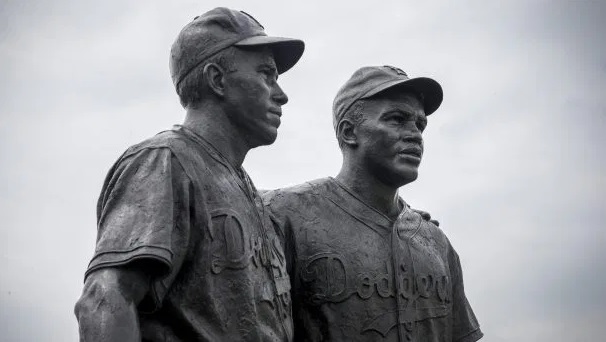
May 13, 1947: During the pregame infield practice, a barrage of racial slurs is directed at Jackie Robinson by the Cincinnati fans during the Dodgers’ first visit to Crosley Field this season. Brooklyn shortstop Pee Wee Reese, a Southerner from Kentucky with friends attending the game and captain of the team, engages the black infielder in conversation, and then put his arm around his teammate’s shoulder, a gesture that stuns and silences the crowd.

This  episode in the well-known saga of Jackie Robinson breaking the color line in baseball has taken on the status of legend. It is in the (excellent) biopic about Robinson, “42.” It was re-told in Ken Burns’ documentary “Baseball.” Most enduring of all, the moment is memorialized forever in the statue outside Dodger Stadium—well, forever until Robinson or Reese is cancelled because something unforgivable is unearthed in their past, whereupon UCLA students will pull the thing down as progressives cheer.

I’m preparing a program for the Smithsonian Associates on how baseball has influenced American values, culture, politics, language and society, so it is of special interest to me that there is considerable controversy over whether Reese’s mid-game gesture ever happened. Writes much-lauded baseball essayist Joe Posnanski,

“There is no mention at all of the embrace in the newspapers. Quite the opposite, in fact. The Cincinnati Enquirer wrote that very day that Robinson “was applauded every time he stepped to the plate.” Meanwhile, there is no mention of it in the black press either; Burns insists that the embrace had happened, the black papers “would have done 15 related articles.” There is no photo of it. Robinson’s 1948 book about his first season called “Jackie Robinson: My Own Story” does not mention any such incident….There isn’t a single contemporary account of the embrace in any of the newspapers or magazines.”

Theories abound. The episode happened on a different date. It happened, but not in view of the fans. It is a story that accurately describes what Reese’s support of Robinson—Reese was a white southerner and a team leader, and he and Robinson did become close friends—meant to the black rookie as he battled abuse and racism in that first season of 1947, but there was no literal arm around the shoulder.  Craig Calcaterra, recycling  the controversy yesterday on his NBC blog, theorized, Continue reading