Statue-Toppling, The Ethics Incompleteness Principle, And Calvin Griffith, Part Two

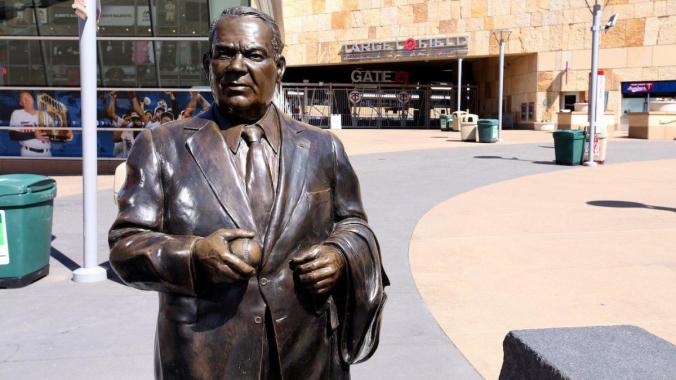
Where Cal Griffith’s statue once stood…

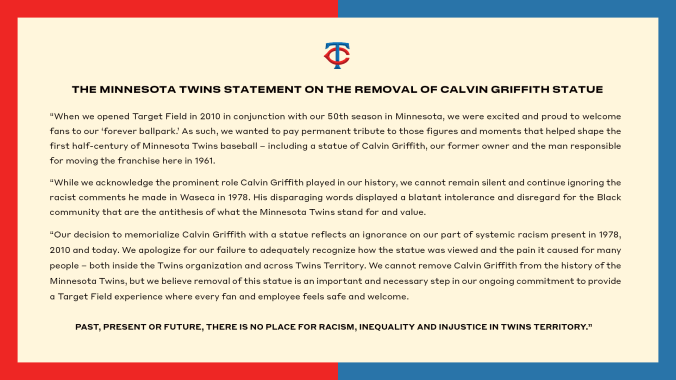
Here is what Calvin Griffith said in the 1978 remarks that led the Minnesota Twins to remove his statue in from of the team’s stadium, Target Field.

Griffith was invited to speak to the Lions Club in Waseca, a small city in southern Minnesota. Taking questions from the audience after his planned speech, someone asked Griffith  why he brought the Twins to Minnesota from Washington, D.C., in 1961. Griffith lowered his voice, asked if there were any blacks around, and  looked around the room. Apparently confirming that his audience was all white,  Griffith said,

“I’ll tell you why we came to Minnesota. It was when I found out you only had 15,000 blacks here. Black people don’t go to ball games, but they’ll fill up a ‘rassling ring and put up such a chant it’ll scare you to death. It’s unbelievable. We came here because you’ve got good, hardworking, white people here.”

It’s hard to get more racist than that, at least short of a Klan rally. I’ll poll this at the end of the post, but I believe that this is a case where the Ethics Incompleteness Principle applies, and the usually valid ethical objections to pulling down the statues of problematic, controversial or subsequently disgraced historical figures have to yield to other considerations, which are these: Continue reading

Statue-Toppling, The Ethics Incompleteness Principle, And Calvin Griffith, Part One.

The Ethics Incompleteness Principle, a core concept on Ethics Alarms, holds that even the most convincing ethics rules, moral codes, laws and principles have exceptions. The inspiration for this observation was the work of Czech-born mathematician Kurt Gödel, whose two Incompleteness Theorems, which relate to mathematical proofs, are his most famous contribution to civilization and science. A linguist as well as a scientist,  Gödel unintentionally delivered an essential blow against the ethics absolutism of Kant and rigid morality when he proved that human language is not sufficiently precise to define rules that will work as designed in every instance. The logical extension of Gödel’s theorems, which he applied only to mathematics and, by extension, physics, tells us that there will always be anomalies on the periphery of every normative system, no matter how sound or well articulated it is. If one responds to an anomaly by trying to amend the rule or system to accommodate it, the integrity of the rule or system is disturbed, and perhaps ruined. Yet if one stubbornly applies the rule or system without amendment to the anomaly anyway, one may reach an absurd conclusion or an unjust result. [ Here is an online discussion of the application of Gödel to ethics, which appeared years after the Ethics Incompleteness Theorem was posited on Ethics Alarms.]

The Ethics Incompleteness Principle suggests that when a system or rule doesn’t seem to work well when applied to an unexpected or unusual situation, the wise response is to abandon the system or rule—in that one anomalous case only— and use  basic ethics principles and analysis to find the best solution. Then return to the system and rules as they were, without altering them to make the treatment of the anomalous situation “consistent.”

Much as we would like it to be otherwise, for life would be so much simpler if it were so, no system or rule is going to work equally well with every possible scenario. This is why is why committing to a single ethical system is folly, and why it is important to keep basic ethical values in mind in case a pre-determined formula for determining what is right breaks down.

When a reader and frequent commenter sent me this announcement from the Minnesota Twins a few days ago, my reflex reaction was as you would expect: Continue reading

Lunchtime Ethics Appetizers, 6/16/2020: ALS, Artistic Freedom And Arrogance [UPDATED]

Bon Appetite!

1. Today’s fake news note from the New York Times: “A Trump justice delivers an LGBT ruling that demoralizes the Right.” This completely fabricated observation, a variety of fake news I refer to as “psychic news,”purports to, first, characterize the “Right” as a monolithic, anti-LGBT mob, in the way the Left really is a monolithic, anti-Trump mob, and second, claim an extreme reaction to the decision that just doesn’t exist. The Times front page says the 6-3 decision was one “few expected.” That’s deceit: most analysts I read reached the same conclusion I did, which was that a 5-4 decision supporting the interpretation announced yesterday had at least a 50-50 chance of coming down. I did not expect the vote to be 6-3, but anyone familiar with how these things line up shouldn’t be shocked. Once he realized that the majority was going to hold that discrimination against gays and transgender individuals illegal, Justice Roberts may have joined the majority so that he could assign the opinion to Justice Gorsuch, for example.

President Trump has never indicated any animus towards gays or same sex marriage (Pence is another story); the presumption that the President’s supporters are horrified that discrimination against gays and transsexuals wasn’t upheld is just another version of the “deplorables” slur. Moreover, I believe the decision, and the fact that Justice Gorsuch joined with the Left wing of the court to cement it makes the President look good to all but reflex Trump-haters. His job is to appoint competent, open-minded justices, and he has. Gorsuch was never a conservative ideologue, though the Democrats who opposed him in the Senate falsely represented him as one. The decision also makes the Supreme Court look good by once again proving that it is not the lock-step partisan body Democrats claim, and that Chief Justice Roberts has correctly denied. It would be even better if the Court’s block of four liberals were as open-minded and non-partisan as Roberts, Gorsuch, and in other recent cases, Kavanaugh have shown themselves to be. Continue reading

Oh Joy! A Baseball Ethics Story! Alex Cora Finally Speaks Out!

While the players union and Major league Baseball bicker over the terms under which the American Pastime will have a limited season in 2020, the specter of the ugly ethics scandal that closed out the off-season came out to say “Boo!” Alex Cora, fingered in the Commissioner’s report as the mastermind behind the Houston Astros 2017 sign-stealing scheme, which apparently extended into the play-offs and World Series (which the cheating Astros won), finally talked about the episode, which promises to haunt the Astros, baseball and him for a long time. Cora was suspended for a year and lost his job as manager of the Boston Red Sox. Carlos Beltran, the Astros player who was found to be Cora’s partner in crime, was fired from his new position as manager of the New York Mets, and both the manager and the general manager of the Astros were suspended and fired.

Cora, to my surprise, was cleared in an investigation of the allegations that his Red Sox team in 2018 was also stealing signs. The MLB report faulted a single coach and determined that the sign-stealing was sporadic and relatively minor. I fully expected Cora to be found as the culprit in a second major cheating scandal, and to perhaps be banned from baseball entirely. Well, good: I’m relieved. he’s not the Bad Seed I feared he was.

Back when I was certain Cora was facing the end of his baseball career—and he still might be—I proposed a 12 Step Program for him to regain the trust of fans and his sport. The steps, which are described in detail here, were… Continue reading

Fake History Ethics, Baseball Division.

Yesterday was the anniversary of a famous day in baseball and American race relations history. From Nationalpastime.com:

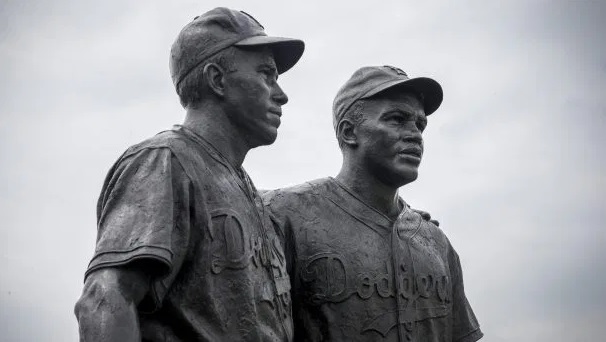
May 13, 1947: During the pregame infield practice, a barrage of racial slurs is directed at Jackie Robinson by the Cincinnati fans during the Dodgers’ first visit to Crosley Field this season. Brooklyn shortstop Pee Wee Reese, a Southerner from Kentucky with friends attending the game and captain of the team, engages the black infielder in conversation, and then put his arm around his teammate’s shoulder, a gesture that stuns and silences the crowd.

This  episode in the well-known saga of Jackie Robinson breaking the color line in baseball has taken on the status of legend. It is in the (excellent) biopic about Robinson, “42.” It was re-told in Ken Burns’ documentary “Baseball.” Most enduring of all, the moment is memorialized forever in the statue outside Dodger Stadium—well, forever until Robinson or Reese is cancelled because something unforgivable is unearthed in their past, whereupon UCLA students will pull the thing down as progressives cheer.

I’m preparing a program for the Smithsonian Associates on how baseball has influenced American values, culture, politics, language and society, so it is of special interest to me that there is considerable controversy over whether Reese’s mid-game gesture ever happened. Writes much-lauded baseball essayist Joe Posnanski,

“There is no mention at all of the embrace in the newspapers. Quite the opposite, in fact. The Cincinnati Enquirer wrote that very day that Robinson “was applauded every time he stepped to the plate.” Meanwhile, there is no mention of it in the black press either; Burns insists that the embrace had happened, the black papers “would have done 15 related articles.” There is no photo of it. Robinson’s 1948 book about his first season called “Jackie Robinson: My Own Story” does not mention any such incident….There isn’t a single contemporary account of the embrace in any of the newspapers or magazines.”

Theories abound. The episode happened on a different date. It happened, but not in view of the fans. It is a story that accurately describes what Reese’s support of Robinson—Reese was a white southerner and a team leader, and he and Robinson did become close friends—meant to the black rookie as he battled abuse and racism in that first season of 1947, but there was no literal arm around the shoulder.  Craig Calcaterra, recycling  the controversy yesterday on his NBC blog, theorized, Continue reading

Morning Ethics Warm-Up, 5/14/2020: Only One Pandemic Note Out Of Five!

Good morning!

I am disgusted with this brain-dead talking point: perhaps my most Trump Deranged Facebook friend posted a rant–at least he wrote his own this time rather than searching the web for the latest from established “resistance” pundits (Dana Milbank, Paul Krugman, Joe Scarborough, about a hundred others)—making the “point” that President Trump wasn’t “elected to do heart surgery,” so the argument that Dr. Fauci’s opinions on the Wuhan virus shouldn’t dictate policy because “he wasn’t elected” were foolish. How did people like my friend get this way? He is obviously amazingly receptive to Democrat-crafted narratives, and probably hypnosis as well, so I guess I should be glad he doesn’t think he’s a chicken.

We elect leaders to consider and weigh many opinions of advisers, experts and specialists in narrow fields to balance those among other considerations in deciding what is in the best long and short term interests of the nation. That’s why, among other reasons, the we have a civilian in charge of the armed services. This increasingly popular (and tiresome) claim from the Left that if the recommendations of scientist aren’t followed, it is proof of ignorance and recklessness is logically, historically and politically unsupportable. If it’s sincere rather than a partisan tactic, it is ignorant  as well.

Scientists aren’t accountable to the public for their opinions; if they are wrong, they just come up with new theories and conclusions.  Scientists and health care specialists also, as we have said here many times, operate within the tunnel vision and priorities of their own specialties. All Dr. Fauci focuses on is the likely (as they appear at any given point) health consequences of national policy. Economic, security, political consequences are not his concern, nor should they be. Arguing that his position on the best national policy must be accepted by the President is irresponsible as well as incompetent, and this is true without even considering the fact that Fauci and the “experts” have been repeatedly wrong about the pandemic already, as Senator Paul pointed out this week.

1.How sports teaches character. I am going to have to take two hours out of my day because the MLB channel, improvising like crazy to come up with programming without any baseball games to cover, is replaying the 1975 World Series between the Boston Red Sox and the Cincinnati Reds, best known for Game 6, when Carlton Fisk hit a walk-off home run in the 12th inning of arguably the most exciting World Series game ever played. I was at Game Six and two more in that seven game series (thanks to the generosity of my late law school friends and classmates Mitch and Myron Dale, whose father was then president of the Reds), but it was one I didn’t see in person, Game 4, that was the Ethics Game.

Red Sox pitcher Luis Tiant, with his team facing a daunting three games-to-one deficit if it lost, pitched a nerve-wracking, complete game 5-4 victory, protecting a one-run lead for most of it despite lacking his best stuff against the toughest line-up in baseball. Nearly every inning, the Reds had men on base and threatened to take the lead; over and over again Sox manager Darrell Johnson trudged out to the mound to replace Tiant, only to have his ace shake his head, insist that he would get the job done, and demand that his boss return to the dugout. TV closeups of the Cuban’s grim and sweat-covered face showed pure determination as he took the fate of the team on his own back fearlessly and without hesitation. Tiant, an old man in baseball years, threw over 180 pitches that night in the era before they counted pitches; today, starters are seldom allowed to throw more than 100. Even more than the famous Curt Schilling “bloody sock” game in 2004, that athletic performance epitomizes for me the ethical virtues of professionalism, honor, perseverance, accountability, fortitude, courage and sacrifice. I have pictured Luis Tiant’s face  many times since when I have been under pressure to succeed, or facing a challenge while not feeling at my best. Continue reading

Now THIS Is Moral Luck And Chaos Theory! How An Unethical Practical Joke Got Its Target a Plum Job, And Pete Rose Banned From Baseball

Yes, this one is about baseball. Trust me, I can find baseball ethics stories even when there’s no baseball. It is also about moral luck, how unethical conduct can have good results and vice-versa, and Chaos Theory, which posits that in complex systems, even insignificant changes can  set into motion unpredictable chain reactions, and where they stop, nobody knows.

On Oct. 2, 1983, the Boston Red Sox said goodbye to Carl Yastrzemski at Fenway Park. I was there, along with my wife, thanks to the kindness of a good friend  (who eventually real-life de-friended me over a political disagreement in an episode I will never understand. I don’t like to think about it,) Yaz got a great send-off for his final game, with an hour-long pregame ceremony, the retirement of his No. 8 jersey and a letter, read aloud to the crowd, from President Reagan. Yaz, memorably, rounded the park, touching the hands of the fans, and dramatically ripped off his jersey as he went down the steps of the dugout for the last time as a player. I’ll never forget it.

Since the retirement of a Red Sox legend after 22 years was the biggest story in the city as well as in baseball,  the Boston sports talk radio show “The Sports Huddle” on WHDH decided to play a little joke. Let me interject here that “The Sports Huddle” was always a vile feature of the sports scene in Boston, uncivil, unfair, with loutish hosts and the kinds of callers who epitomized the worst stereotypes of Boston fans.  It’s gone now, and good riddance. But I digress….

The show decided it would be funny to ignore Carl Yastrzemski, who the show and its callers had been generally vicious about for a decade, and to devote its four-hours on Yaz’s day to a joke tribute to as unremarkable a baseball figure as they could find. The producers settled on the first-base coach of  the Montreal Expos,  55-year-old Vern Rapp, who had once managed the St. Louis Cardinals without distinction, and who had announced that he would end his baseball career at the end of the the 1983 season. Of course, only the most hard- core baseball fans in Boston would have any idea who Vern Rapp was.

The Sports Huddle jerks decided to play it all straight, presenting a solemn ,extended tribute to the mediocre, obsure,Expos coach. They tracked down former minor league teammates of Rapp’s,  friends  from his time in St. Louis, and  Cardinals broadcaster Mike Shannon, interviewing them all about Rapp’s fine qualities as a baseball man and human being, and how much baseball would miss him. Then they interviewed Rapp himself. Nobody suspected that it was all a put-on.

At least nobody dumped a bucket of blood on his head, like they did to Carrie White. Continue reading

Baseball May Be Missing, But Baseball Ethics Marches On; The MLB Verdict On The Boston Red Sox Sign Stealing Allegations

If you are just joining us, the Houston Astros (if you don’t know that’s a baseball team, then none of this will make sense to you, and neither does the United States in all likelihood) were slammed by Major League Baseball after it was determined that the team, primarily through the efforts of then-coach Alex Cora and veteran player Carlos Beltran, systematically utilized cameras at home games to steal catchers’ signs to opposing pitchers and relay them to Astros batters during their at-bats. This, the investigation found, continued through the 2017 season, post-season and World Series, which the Astros won. (Ethics Alarms covered the cheating scandal from many aspects, here.) The punishment meted out to the Astros was substantial, though not as severe as some, including me, would have liked. I think the team should have been stripped of their 2017 World Championship.

Shortly after the Astros scandal was first revealed by the baseball news media, the next year’s World Champions, the Boston Red Sox, were accused of another sign stealing scheme during 2018, one that involved using the team’s video replay equipment, which is near the dugout during games, to study the opposing team’s signs and relay them to batters. This seemed especially ominous since the bench coach  who had been identified as the mastermind behind the Astros scheme in 2017 was the manager of the Red Sox in 2018, and had led them to a record-setting World Series run.

MLB interviewed Red Sox players and management in a mysteriously long investigation, and only yesterday revealed the results and the sanctions. Boston’s video replay system operator J.T. Watkins was suspended without pay for one year, and banned from holding that same position with any team. Boston was stripped of the  its second-round draft pick in the2020  amateur.  Alex Cora, who was fired by the Red Sox in January after the revelations from the Astros investigation,  was suspended for this year, but only for his Astros conduct in 2017. The investigation exonerated him of any role in the Sox matter, which MLB found to be confined to Watkins acting on his own intermittently, and a few players. Continue reading

Morning Ethics Warm-Up, 4/7/2020: Is It Just Me, Or Does Anyone Else Feel Like They Are In A “Twilight Zone” Episode?

A really boring one.

Zombies would be an improvement…

1. More on my mask photo ethics conflict...I wrote about this in a comment on the post last night about Rep. Lee, but I’m still obsessing about it because I still don’t know what the ethical course is. When I saw that photo of Rep. Lee wearing her mask with her nose exposed (this makes her a nose-breathing idiot rather than a mouth-breathing idiot; it was also upside down), I was going to post it with two other photos showing elected officials doing the same thing. At literally the last second, an ethics alarm sounded. The other two officials, a city mayor and a member of Congress known to be, shall we say, an unlikely “Jeopardy!” contestant, were both black. In the case of Lee, who is the chair of a task force on the national response to the epidemic,the validity of pointing out the visual evidence that she’s an epic boob (we knew that, but still) is unassailable, perhaps even by the race-baiting standards of the Congresswoman herself, who  repeatedly attributed any criticism of Barack Obama to racism.

Objectively, however, when accompanied by two other photos of African-American political figures making fools of themselves, would not the array appear to be a racist “dog whistle”? I don’t need to be tarred as a racist—I already have lost considerable income because I dare to oppose the anti-Trump mobs—and this would invite that result. Moreover, as I also commented last night, conservative sites were stinking with racist comments about the Lee photo. (“If you let blacks vote, you get blacks in power over you. This applies to every other non-American race and culture too,” wrote one commenter on Instapundit.) Thus the Second Niggardly Principle seemed to be triggered:

“When an individual or group can accomplish its legitimate objectives without engaging in speech or conduct that will offend individuals whose basis for the supposed offense is emotional, mistaken or ignorant, but is not malicious and is based on well-established impulses of human nature, it is unethical to intentionally engage in such speech or conduct.”

In the narrow context of my post, I’m confident that this is the right call. In a larger context, however, the Third Niggardly Principle seems to apply:

When, however, suppressing speech and conduct based on an individual’s or a group’s sincere claim that such speech or conduct is offensive, however understandable and reasonable this claim may be, creates or threatens to create a powerful precedent that will undermine freedom of speech, expression or political opinion elsewhere, calls to suppress the speech or conduct must be opposed and rejected.”

Indeed Ethics Alarms has made a recent Third Niggardly Principle stand, refusing to accept the widespread ban on any designation of the virus that references its origins and the Chinese government’s role in turning it into a pandemic. I have done this even though the Chinese connection has led some thugs to attack Asian-Americans. I believe the principle that facts and words must not be suppressed because some may misconstrue them or react irrationally is a crucial one, and a principle that the totalitarian Left is working hard to deconstruct.

So in light of all the factors, what was, or is, the ethical way to handle this conflict?

2. Speaking of polls, here’s where the last one sits. Polling is still open, and you can vote as many times as you want, for different candidates. The poll asks you to choose which Democratic Presidential candidates would endorse withholding online classes from all public school students because poor students didn’t have WiFi access:

3. And speaking of masks, here’s what NBC Washington tweeted along with a photo of Virginia Governor Ralph Northam demonstrating the right way to wear a mask: Continue reading

Baseball Movie Ethics:The New York Times Comes Up With A Perfect List

There are three reasons for this post:

#1 is that I criticize New York Times reporters and writers so often for bias and incompetence that it is only fair that I give credit when one of them does something not only right, but exactly as I would have done it.

#2 is that the “something” is a list of the best baseball movies to watch while trying to endure both the anxieties of the Wuhan virus disruption and the delay of the baseball season.

#3 is that I am trying to scale down Part 2 of the Ethics Alarms inspirational films list (Part I is here), and this helps: I can remove the baseball movies now.

Times film critic Bruce Fretts picked what he called the ten best baseball films of the last 50 years. I would call them the best baseball films of all time. The one borderline pick he left out would be “The Lou Gehrig Story,” which is more a biography than a true baseball movie, and it’s also sad. Only two films on Fretts’ list are sad. Baseball movies shouldn’t be sad, though I agree with him on the exceptions.

I would add two more baseball movies if it was a Top 12: “The Sandlot” (1993), which brings back memories of my own pick-up baseball gang (and my late English Mastiff, Patience) and “Fever Pitch” (2005), which perhaps is more of a Red Sox movie than a baseball movie. (It had me from the moment Jimmy Fallon kissed his hand and deposited the love on a picture of Tony Conigliaro.) These, however really are the ten best.  Fretts listed them alphabetically, and I wouldn’t try to rank them. Continue reading