Late Morning Warm-Up, 1/22/2020, Because I Wasted Two Hours Arguing With Trump Deranged Lawyers On Facebook, And Yes, I’m An Idiot

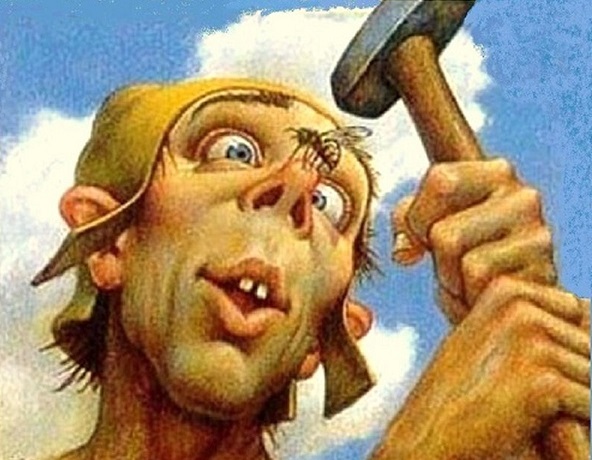
That’s me. The bee is Facebook…

Bah!

A really low blow (among the other low blows, like the jerk who accused me of getting all of my ideas from Drudge) came from a former commenter here, who accused Ethics Alarms of being an “echo chamber.” That truly ticks me off. If the Trump Deranged don’t have the wits or open minds to test their biases where intelligent, informed, articulate adversaries are likely to  respond, that’s not my fault, and it’s exactly what the left side of the blog’s commentariat did. They didn’t rebut the position here, proven correct, that the Justice Department’s handling of The FISA warrants were part of a dangerous effort to undermine the Trump campaign and his election: they just accused me of “drinking the KoolAid” and quit, or were insulting. They never tried to argue away the smoking gun evidence of the soft coup plans A through S that I have meticulously documents since 2016, they just act as if the current impeachment excuse is justified and offered in good faith, when it is so clearly not. It’s all denial, spin, dishonesty and mob mentality. I ended up in today’s piranha tank by pointing out to a lawyer that the the fact that Trump was intemperate at a meeting of generals was not sufficient to trigger the 25th Amendment, and that lawyers, like her, shouldn’t be misleading the public by making such lame arguments. I posted the amendment, and said that “Unable” to perform the duties of the office doesn’t mean, as she and others are arguing, “Unable to perform the duties that way she and other would prefer them to be performed” and stating that approval polls do not reflect the degree to which the impeachment charade is helping to re-elect Trump.

These are the smart Deranged. Imagine what the others are like.

1. Resistance porn. “A Very Stable Genius” is the latest “tales out of school” anti-Trump book. In this it is no different from those that have gone before, from Omarosa’s tell-all on up the ethics evolutionary scale. This one was authored by Pulitzer Prize winning journalists, so naturally the news media is celebrating it as if it is somehow different. What it is a collection of mostly anonymous accounts of people who have axes to grind and scores to settle against Donald Trump, and are violating basic professional ethics to do it. Are all of the stories true? I’m sure some are, maybe most—they don’t sound out of line with what we knew about this President before he was elected. Yet they are by very nature distorted by the theme of the book and the presumed anti-Trump bias of the book’s audience. What is so alarming about Trump’s eagerness to have a meeting with Putin?  So what if he questions why U.S. businesses shouldn’t be allowed to engage in bribery abroad, when it is the accepted norm in many countries? There’s an answer to the question, but it’s not a dumb question; in fact, its one international ethicists still debate. And do you really think Trump saying to Indian prime minister Narendra Modi,  “It’s not like you’ve got China on your border” wasn’t a joke?  Taking it as otherwise is classic conformation bias and disrespect. It sure sounds like a typical Trump joke to me. Continue reading

What’s The Ethical Response When Your Life And Reputation Collapses, And It’s Your Fault? My 12 Step Program For Alex Cora

I have been thinking a  lot about what I would do if I were Alex Cora.

In the past, people who have had the kind of precipitous public fall from grace that Cora has had often committed suicide. That’s neither an ethical nor reasonable response for the former Boston manager, but what is an ethical and reasonable response?

If you don’t know: Alex Cora was, until recently, one of the most popular, secure and successful young managers in Major League Baseball. His present was bright—he had a contract that paid him $800,000 a year, he was one of the faces of the Boston Red Sox, a storied franchise with a fanatic following, he was seen as a role model and an an inspiring  figure who represented the game, his city and his team, as well as his Puerto Rico home. His future was if anything, brighter: more money, perhaps even greater success with a talented and wealthy club, endorsement contracts, upper management, books, broadcasting…and of course, adulation, celebrity and fame.

Then, in the span of days, it was all gone. Cora was named as the mastermind of a sign-stealing cheating scandal that devastated the Houston Astros, and as the likely one responsible for another cheating scandal in Boston. He was fired as Boston’s manager, and the fans, and sports media are furious. Cora is certain to be suspended without pay for two years, and to be pronounced persona non grata in baseball for the foreseeable future. No baseball team will want to be associated with Alex Cora even after his official punishment is over.

So far, Cora has not addressed all of this in public; presumably he is awaiting the MLB report after its investigation of Boston’s sign-stealing in 2018. He has not yet apologized nor acknowledged wrong-doing. What is the most ethical way for him to proceed?

If I were hired to give Cora professional guidance about the way to proceed in the most ethical manner possible, what would it be? Cora still has to earn a living. He has to go on living too: he has a family. He has responsibilities.

Here are the 12 steps—it just turned out that way, I swear. Okay, when I got to ten and realized I was near the end, I did think, “Surely this can be jiggered to have 12 steps..”—that I would urge Alex Cora to follow: Continue reading

Lunchtime Ethics Snack, 1/17/2020: Dirty Money, Dirty Baseball, And “Parasite”

Yum or Yecchh?

1. And the baseball cheating scandal is still roiling! I feel sorry for ethics enthusiasts who are missing out on this fascinating episode because they shut down when baseball is mentioned. One emerging issue that focuses on “woke” (and in some quadrants, sadly, female) leadership models has become evident. The two managers fired in the sign-stealing scandal were part of the “new wave” of “collaborative” baseball managers that teams embraced in recent years. They are sensitive to the players’ needs; they don’t give orders as much as set flexible boundaries; they are not confrontational, and they absorb and guide the culture of the clubhouse rather than dictate it. Then we learn, in MLB’s report on its investigation, that when Houston’s A.J. Hinch discovered (in 2017) that his bench coach and his players were operating an elaborate sign-stealing operation that he knew violated the rules , he made it known that he disapproved, but never ordered them to stop. Now baseball commentators are saying that the Astros need to hire an “old school” manager (like the ones who have been put out to pasture over the last five years) who will be leader, who will lay down the law, and who won’t shy away from confrontation for fear of not being “collaborative.”

Duh. How did anyone come to think effective leaders should do otherwise? Leaders need to lead. Leading doesn’t have to be autocratic, but a leader who acts like Hinch did in this matter is no leader at all.

In another revelation regarding the scandal, the report by Baseball Commissioner Rob Manfred states that when Manfred put teams on notice in a Sept. 15, 2017 memo that using electronic means to steal and relay opposing teams’ signs during games would henceforth be  severely punished, Houston General Manager Jeff Luhnow “did not forward the memoranda and did not confirm that the players and field staff were in compliance … Had Luhnow taken those steps in September 2017 it is clear to me that the Astros would have ceased both sign-stealing schemes at the time.”

This is gross managerial negligence, and it puts Lahlow’s self-serving statement that he had no involvement in his team’s cheating in perspective. Continue reading

Ethics Dunce: ESPN Baseball Commentator Jessica Mendoza

(Jessica giggles too much too...)

This answers a question I’ve had ever since softball player Jessica Mendoza was added to the ESPN Sunday Night Baseball broadcast team: how can a nice, all-American girl like Jessica not gag having to work with Alex Rodriguez, one of the most loathsome personalities in baseball history?

Rodriguez, after all,  was caught twice using banned  PEDs (performance enhancing drugs), lied repeatedly throughout his career to the public, the press, and team authorities, was handed one of the longest suspensions ever given to a player, and was caught cheating in various ways whenever he thought he could get away with it. (My personal favorite was when he shouted “Mine!” as he ran from second to third while a pop-up was over the infield, causing the opposing shortstop to let the ball drop because he thought a team mate had called for the ball. ) His odious presence in the ESPN booth is why I  usually refuse to watch games broadcast by the trio of A-Rod, Jessica and play-by-play man Matt  Vasgersian—well, that and the fact that they are terrible, habitually engaging in inane happy-talk that often has nothing to do with what’s happening on the field.

Yesterday Mendoza appeared on ESPN Radio’s “Golic and Wingo” show to discuss the baseball’s sign-stealing scandal that has—so far, because more is coming— led to the firing of three teams’  managers, the dismissal of a successful general manager, and  cast a long shadow on the World Championships of the Houston Astros in 2017 and the Boston Red Sox in 2018. Oakland A’s pitcher Mike Fiers made himself a likely permanent pariah in his sport by blowing the whistle to the press on his former team, the 2017 Houston Astros, who engaged in an elaborate sign-stealing scheme via hidden cameras, electronic relays and, uh, trashcan banging for the entire 2017 season and post-season. The consensus, at least in public, around the game is that Fiers did the right thing for the long-term integrity of baseball.

Jessica disagrees. Her basic position is the same as inner city gangs and the Corleone Family: don’t be a snitch. She told Golic, Continue reading

Apologies And Other Fallout From The Baseball Cheating Scandal (Updated, And Updated Again)

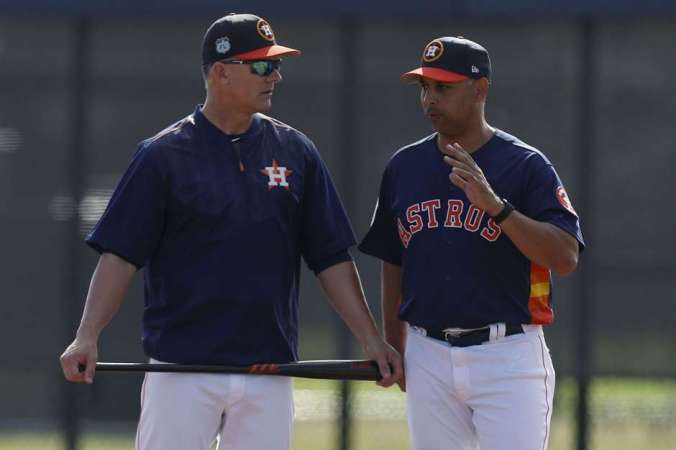
Ex-Astros manager Hinch and “dead man walking” Alex Cora, the cheating mastermind.

Since I posted the initial commentary on Major League Baseball’s tough punishment of the Houston Astros for their illegal sign-stealing (there are legal ways to steal signs too), there have been some interesting developments with ethical implications.

The full MLB report  can be read or downloaded here.

  • One promising development is the widespread discussions of organizational culture that have been taking place in the media. When Astros owner Jim Crane announced that he was firing GM Jeff Luhnow and manager A.J. Hinch, both suspended for a year by the Commissioner of Baseball, he made it clear that the team needed to reform its culture, which had metastasized from  “play to win”  into a “win by any means necessary.”  There were signs of this in Houston long before the sign-stealing was known, when in 2018 the team traded for relief pitcher Robero Osuna while he was suspended for domestic abuse and facing trial—even though the Astros had previously announced a “no-tolerance” policy regarding players and domestic abuse. The team really needed a closer, you see.

The Astros culture, we now can see, was thoroughly compromised by ethics rot, and eliminating one or two managers won’t fix the problem immediately.

  • A prime enabler of that rot was Jeff Luhnow, who traded for Osuna. After he was fired yesterday, he issued this apology:

Continue reading

Breaking: Major League Baseball Clobbers The Houston Astros For Their Sign-Stealing Scheme, And Red Sox Manager Alex Cora Is In The Cross-Hairs

In November, I proposed that the Houston Astros should be punished severely for their sign-stealing during the 2017 and 2018 seasons, the first of which resulted in a World Series Championship. Major League Baseball’s investigation is complete, and today the wrath of the Baseball Gods rained down on the team. MLB didn’t take my advice (stripping the team of its titles), but the actions it dis take were surprisingly and appropriately tough.

The Astros, you will recall,  used illegal cameras and video monitors to steal the signs of opposing catchers at Houston’s Minute Maid Park, then signal those signs to their hitters before pitches by banging on trash cans. This occurred throughout the 2017 regular season and postseason, and during the 2018 season as well. Baseball’s Commissioner Rob Manfred suspended Astros Manager A.J. Hinch and General Manager Jeff Luhnow, fined the team $5 million (the most allowed under the MLB rules)  and took away the team’s top two draft picks in both 2020 and 2021. Hours after the announcement, the Astros fired both Hinch and Luhlow, with owner Jim Crane  saying, “We need to move forward with a clean slate. [We] will not have this happen again on my watch.”

All of this is as it should be. The MLB investigation indicated that Hinch had not been involved in the sign-stealing, but was aware of it and allowed it to continue.

Now the saga moves on to, <sigh>, the Boston Red Sox. Continue reading

In The Dead Of Winter, Welcome Baseball Ethics News

The Athletic’s Jayson Stark reports  that automated ball and strike calling is now inevitable, and we may see it as early as 2022. He writes, “The mental games used to inch the strike zone this way or that has long been a tool of the game’s best – from the hitters whose impeccable eye define it, to the pitchers’ whose pinpoint control push to expand it – but an automated zone will all but abolish the in-game politicking of the strike zone, giving hitters a new advantage they have long been without: certainty. Robot umpires will define the strike zone with better precision than their carbon-based forerunners – but first the humans must decide what they want that strike zone to be. For those particularly fond of strike zone drama, appreciate it now, because deciding on the parameters of the automated zone might be one of the last great strike zone debates before the robots take over.”

Good.

Once computer graphics allowed TV viewers to see blatantly botched ball and strike counts in real time, this development became a serious matter of trust and integrity. The baseball Luddites who continue to argue that missed ball and strike calls are part of baseball’s charm and should be retained  as “the human factor” have sounded progressively more desperate and ridiculous as the seasons pass.

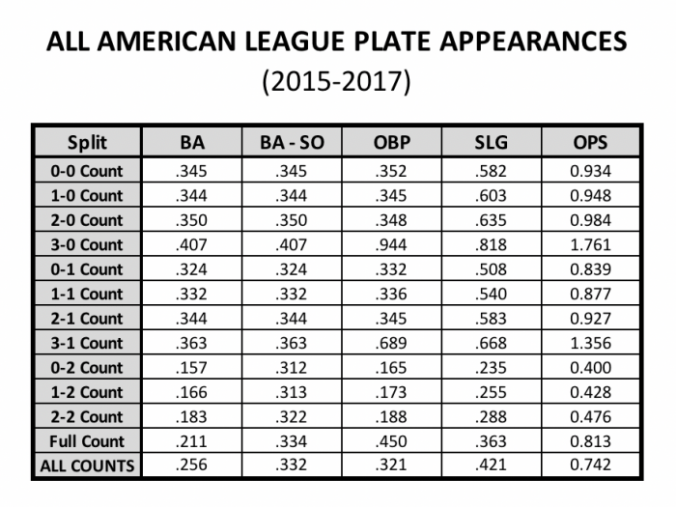
Statistical analysis has shown decisively how much a bad ball or strike call even early in the count can change the outcome of an at bat and a game. Look at this chart:

Continue reading

Morning Ethics Warm-Up, 1/7/2020: Oh, Great, A Red Sox Ethics Scandal….

Bad Morning.

1. Fire this copy writer: Boll and Branch sheets informed me this morning that their product is “loved by THREE American Presidents.” Well, that settles it: I’m running right out and buying these sheets if Presidents—well, three, anyway, love them. Actually, I’m making the sheets an early target of my new rule to personally boycott any product that insults my intelligence with their ads or packaging.

So much for Chex-Mix.

2. I just realized what climate change hype is like. I’m slow, I guess. I was reading a typical Paul Krugman column about how we are doomed by climate change and only the mean, stupid Republicans refuse to accept it. (The runaway brush fires in Australia, he said, can’t be proven to have come about by climate change, the brilliant economist said, but everybody knows its climate change. All Democrats, anyway.) It then hit me: climate change is like all the reflex explanations for bad things that primitive civilizations, cults and Machiavellian leaders have used to relieve public fears of  random misfortune since the beginning of time. The devil, angry gods, witches, Jews…anything to be able to rationalize events that otherwise have no explanation.  If you sacrifice people to the gods, hang the witches or exterminate the Jews, you’ll feel better—you’re doing something by addressing the cause of all your pain. Of course, these imaginary “causes” aren’t really responsible for what’s happening, but its comforting to “do something.” In the case of climate change, the proxy trouble-makers are capitalism, personal liberty and democracy. Just get rid of them, and everything will be all right again.

I don’t know why it too so long for me to figure this out. I think it’s because I persist in the romantic notion that we all get smarter over time. I certainly don’t. Continue reading

Day Before The Night Before Christmas Ethics Package, 12/23/2019, Now UPDATED With The Meme I Stupidly Didn’t Post Despite Polling On It (Sorry!)

Merry Christmas!

TWICE yesterday store employees returned my “Merry Christmas!” with  a “Happy Holidays!” that was delivered in a tone that to my ear was intended to convey, “No, THIS is what you should say.” Both times, I was tempted to call them on it, but did not. Maybe I was being hypersensitive, maybe that wasn’t their intent…but of course it was. The next clerk or cashier who does that to me might get a “No, Merry Christmas. Do you have a problem with that?” back.  I’m that close…

1. ARGHH! “Baseball” censorship! Here’s another nauseating example of the capitulation to the word-banners. The MLB TV channel, which, like its satellite radio counterpart, is challenged to come up with programming this time of year. (The radio version held a quiz last week in which we were challenged to identify expressions of despair and horror as either coming from Cleveland Indians fan tweets about the trading of ace pitcher Corey Kluber, or from reviews of “Cats.”) Yesterday the channel was showing Ken Burns’ terrific documentary “Baseball.” In the segment on Ty Cobb, we were told about in infamous incident in which Cobb jumped into the stands to beat up an abusive fan, who, it turned out, had no hands. When the crowd shouted this fact at the infuriated player, he reportedly replied that he’d throttle anyone who called him “that” even if he had no legs. What was “that”? Why, it was that Cobb was a “half-BEEEEEEEEP!” Yes, a loud, high-pitched beep was injected into the narration instead of the word itself, which was in Burns’ original work (I own a copy.) Morons. If the word is  discernible from the context, then the beep equals the word, so just use the word. If it isn’t clearly indicated—and while I was pretty sure, knowing the story, but uncertain enough that I had to check—then it is incompetent to leave viewers wondering. Half-crazy? Half-wit? Half-lizard? Half-breed? No, Cobb was called “half nigger,” and the exact word is essential to understand the incident but also a key component of Cobb’s character. Did Burns approve the marring of his soundtrack? I doubt it.

This has got to stop.

2. Great: colleges are now free to bribe students to renege on their promises. In a proposed agreement announced this month in response to Justice Department antitrust accusations, the National Association for College Admission Counseling said it would allow its member college and university counselors to recruit students even after they have committed to another school and would permit members to encourage students to transfer after they have already enrolled. From the Times:

Now, colleges will be free to offer perks, like special scholarships or priority in course selection, to early-decision applicants, students who are less likely to need tuition assistance and use the process to secure a spot at their first-choice schools. …Institutions will also be able to continue recruiting students beyond a widely applied May 1 deadline that is typically imposed for students who have applied through a regular decision process and are considering offers based, at least in part, on financial aid packages.

The promises to commit to a school that gave you an early admission were never legally binding, just ethically binding. And they still are. Any college whose applicant reneges on such an agreement after being seduced by another college should send a letter telling him or her, “Thank you for voluntarily withdrawing your acceptance. Our school wants only students of good character, who are trustworthy, honest, and value integrity. Now that we know that you do not honor commitments, we realize that we erred in accepting you. We’re sure you will fit right in at the school you chose, however, and wish you the best in your years there.” Continue reading

In The Baseball Dead Of Winter, An Old And Unresolved Ethics Problem Glows Bright

From left to right: MLB, players, and the union.

…as Major League Baseball ignores it, as usual.

Ethics alarms test: Scott Boras, lawyer and player agent, represents two Washington Nationals free agents in their prime. One is Stephen Strasburg, one of the best and most sought after starting pitchers in the game. He was seeking, on the advice of his agent, a long-term contract of more than 30 million dollars a year. Another is Anthony Rendon, third-baseman, and the Nationals’ best player in 2019, their championship year. He also is seeking a salary of at least 30 million per year, over many years. He is a fan favorite in Washington, D.C., and obviously enjoys playing there. Contrary to popular belief, however, Major League baseball teams do not have endless supplies of money, though they have a lot. Mike Rizzo, Washington Nationals general manager, told the sports media and Washington fans that the team could not afford to sign both Strasberg and Rendon at the rates they were demanding and the marketplace dictated.

Is there a problem, and if so, what is it?

You shouldn’t need much time to answer, but then again, thousands of baseball sportswriters and the entire baseball establishment havn’t figured this out over many years, do I’ll give you a “Jeopardy!” period of reflection:

OK, contestants,what’s your answer? Continue reading