Breaking: Major League Baseball Clobbers The Houston Astros For Their Sign-Stealing Scheme, And Red Sox Manager Alex Cora Is In The Cross-Hairs

In November, I proposed that the Houston Astros should be punished severely for their sign-stealing during the 2017 and 2018 seasons, the first of which resulted in a World Series Championship. Major League Baseball’s investigation is complete, and today the wrath of the Baseball Gods rained down on the team. MLB didn’t take my advice (stripping the team of its titles), but the actions it dis take were surprisingly and appropriately tough.

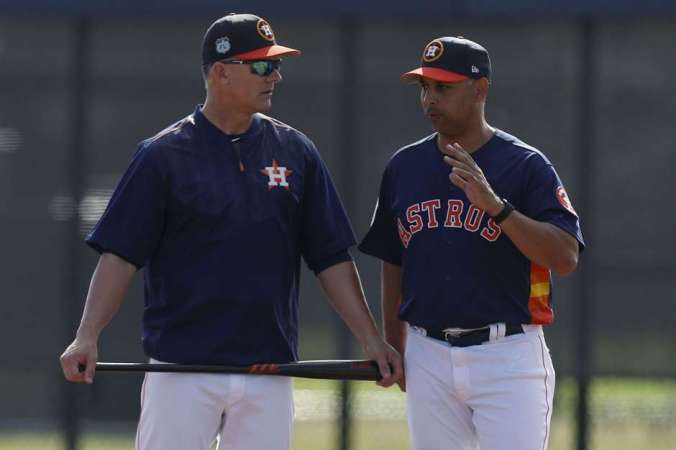
The Astros, you will recall,  used illegal cameras and video monitors to steal the signs of opposing catchers at Houston’s Minute Maid Park, then signal those signs to their hitters before pitches by banging on trash cans. This occurred throughout the 2017 regular season and postseason, and during the 2018 season as well. Baseball’s Commissioner Rob Manfred suspended Astros Manager A.J. Hinch and General Manager Jeff Luhnow, fined the team $5 million (the most allowed under the MLB rules)  and took away the team’s top two draft picks in both 2020 and 2021. Hours after the announcement, the Astros fired both Hinch and Luhlow, with owner Jim Crane  saying, “We need to move forward with a clean slate. [We] will not have this happen again on my watch.”

All of this is as it should be. The MLB investigation indicated that Hinch had not been involved in the sign-stealing, but was aware of it and allowed it to continue.

Now the saga moves on to, <sigh>, the Boston Red Sox. Continue reading

In The Dead Of Winter, Welcome Baseball Ethics News

The Athletic’s Jayson Stark reports  that automated ball and strike calling is now inevitable, and we may see it as early as 2022. He writes, “The mental games used to inch the strike zone this way or that has long been a tool of the game’s best – from the hitters whose impeccable eye define it, to the pitchers’ whose pinpoint control push to expand it – but an automated zone will all but abolish the in-game politicking of the strike zone, giving hitters a new advantage they have long been without: certainty. Robot umpires will define the strike zone with better precision than their carbon-based forerunners – but first the humans must decide what they want that strike zone to be. For those particularly fond of strike zone drama, appreciate it now, because deciding on the parameters of the automated zone might be one of the last great strike zone debates before the robots take over.”

Good.

Once computer graphics allowed TV viewers to see blatantly botched ball and strike counts in real time, this development became a serious matter of trust and integrity. The baseball Luddites who continue to argue that missed ball and strike calls are part of baseball’s charm and should be retained  as “the human factor” have sounded progressively more desperate and ridiculous as the seasons pass.

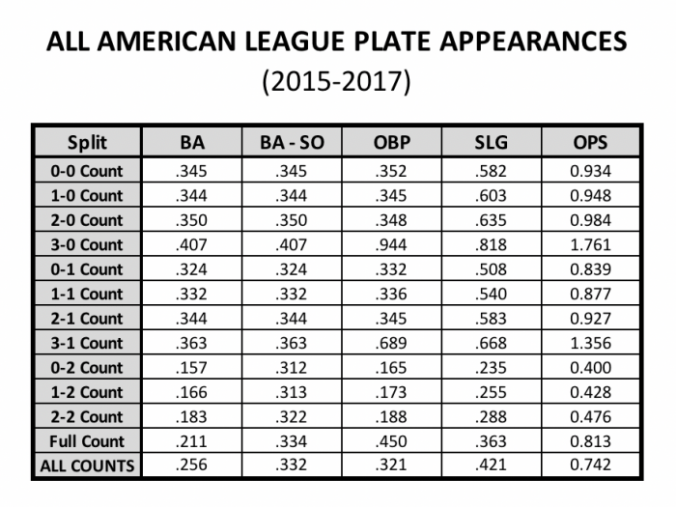
Statistical analysis has shown decisively how much a bad ball or strike call even early in the count can change the outcome of an at bat and a game. Look at this chart:

Continue reading

Morning Ethics Warm-Up, 1/7/2020: Oh, Great, A Red Sox Ethics Scandal….

Bad Morning.

1. Fire this copy writer: Boll and Branch sheets informed me this morning that their product is “loved by THREE American Presidents.” Well, that settles it: I’m running right out and buying these sheets if Presidents—well, three, anyway, love them. Actually, I’m making the sheets an early target of my new rule to personally boycott any product that insults my intelligence with their ads or packaging.

So much for Chex-Mix.

2. I just realized what climate change hype is like. I’m slow, I guess. I was reading a typical Paul Krugman column about how we are doomed by climate change and only the mean, stupid Republicans refuse to accept it. (The runaway brush fires in Australia, he said, can’t be proven to have come about by climate change, the brilliant economist said, but everybody knows its climate change. All Democrats, anyway.) It then hit me: climate change is like all the reflex explanations for bad things that primitive civilizations, cults and Machiavellian leaders have used to relieve public fears of  random misfortune since the beginning of time. The devil, angry gods, witches, Jews…anything to be able to rationalize events that otherwise have no explanation.  If you sacrifice people to the gods, hang the witches or exterminate the Jews, you’ll feel better—you’re doing something by addressing the cause of all your pain. Of course, these imaginary “causes” aren’t really responsible for what’s happening, but its comforting to “do something.” In the case of climate change, the proxy trouble-makers are capitalism, personal liberty and democracy. Just get rid of them, and everything will be all right again.

I don’t know why it too so long for me to figure this out. I think it’s because I persist in the romantic notion that we all get smarter over time. I certainly don’t. Continue reading

Day Before The Night Before Christmas Ethics Package, 12/23/2019, Now UPDATED With The Meme I Stupidly Didn’t Post Despite Polling On It (Sorry!)

Merry Christmas!

TWICE yesterday store employees returned my “Merry Christmas!” with  a “Happy Holidays!” that was delivered in a tone that to my ear was intended to convey, “No, THIS is what you should say.” Both times, I was tempted to call them on it, but did not. Maybe I was being hypersensitive, maybe that wasn’t their intent…but of course it was. The next clerk or cashier who does that to me might get a “No, Merry Christmas. Do you have a problem with that?” back.  I’m that close…

1. ARGHH! “Baseball” censorship! Here’s another nauseating example of the capitulation to the word-banners. The MLB TV channel, which, like its satellite radio counterpart, is challenged to come up with programming this time of year. (The radio version held a quiz last week in which we were challenged to identify expressions of despair and horror as either coming from Cleveland Indians fan tweets about the trading of ace pitcher Corey Kluber, or from reviews of “Cats.”) Yesterday the channel was showing Ken Burns’ terrific documentary “Baseball.” In the segment on Ty Cobb, we were told about in infamous incident in which Cobb jumped into the stands to beat up an abusive fan, who, it turned out, had no hands. When the crowd shouted this fact at the infuriated player, he reportedly replied that he’d throttle anyone who called him “that” even if he had no legs. What was “that”? Why, it was that Cobb was a “half-BEEEEEEEEP!” Yes, a loud, high-pitched beep was injected into the narration instead of the word itself, which was in Burns’ original work (I own a copy.) Morons. If the word is  discernible from the context, then the beep equals the word, so just use the word. If it isn’t clearly indicated—and while I was pretty sure, knowing the story, but uncertain enough that I had to check—then it is incompetent to leave viewers wondering. Half-crazy? Half-wit? Half-lizard? Half-breed? No, Cobb was called “half nigger,” and the exact word is essential to understand the incident but also a key component of Cobb’s character. Did Burns approve the marring of his soundtrack? I doubt it.

This has got to stop.

2. Great: colleges are now free to bribe students to renege on their promises. In a proposed agreement announced this month in response to Justice Department antitrust accusations, the National Association for College Admission Counseling said it would allow its member college and university counselors to recruit students even after they have committed to another school and would permit members to encourage students to transfer after they have already enrolled. From the Times:

Now, colleges will be free to offer perks, like special scholarships or priority in course selection, to early-decision applicants, students who are less likely to need tuition assistance and use the process to secure a spot at their first-choice schools. …Institutions will also be able to continue recruiting students beyond a widely applied May 1 deadline that is typically imposed for students who have applied through a regular decision process and are considering offers based, at least in part, on financial aid packages.

The promises to commit to a school that gave you an early admission were never legally binding, just ethically binding. And they still are. Any college whose applicant reneges on such an agreement after being seduced by another college should send a letter telling him or her, “Thank you for voluntarily withdrawing your acceptance. Our school wants only students of good character, who are trustworthy, honest, and value integrity. Now that we know that you do not honor commitments, we realize that we erred in accepting you. We’re sure you will fit right in at the school you chose, however, and wish you the best in your years there.” Continue reading

In The Baseball Dead Of Winter, An Old And Unresolved Ethics Problem Glows Bright

From left to right: MLB, players, and the union.

…as Major League Baseball ignores it, as usual.

Ethics alarms test: Scott Boras, lawyer and player agent, represents two Washington Nationals free agents in their prime. One is Stephen Strasburg, one of the best and most sought after starting pitchers in the game. He was seeking, on the advice of his agent, a long-term contract of more than 30 million dollars a year. Another is Anthony Rendon, third-baseman, and the Nationals’ best player in 2019, their championship year. He also is seeking a salary of at least 30 million per year, over many years. He is a fan favorite in Washington, D.C., and obviously enjoys playing there. Contrary to popular belief, however, Major League baseball teams do not have endless supplies of money, though they have a lot. Mike Rizzo, Washington Nationals general manager, told the sports media and Washington fans that the team could not afford to sign both Strasberg and Rendon at the rates they were demanding and the marketplace dictated.

Is there a problem, and if so, what is it?

You shouldn’t need much time to answer, but then again, thousands of baseball sportswriters and the entire baseball establishment havn’t figured this out over many years, do I’ll give you a “Jeopardy!” period of reflection:

OK, contestants,what’s your answer? Continue reading

Afternoon Ethics Notes, 12/17/2019: Miller, Hillary and the Duke [CORRECTED]

Hark!

1. Lesson: Don’t underestimate the Duke! It looks like John Wayne is stronger than the cancel culture after all.  Earlier this year the Woke Avengers tracked down an old Playboy interview where the actor made some inflammatory remarks about blacks and Native Americans (I thought then and I think now that the Duke was deliberately trolling his liberal critics, but it was still a bad interview.) Predictions were rife that the most enduring, influential and popular screen icon of all time had reached the end of his run. It doesn’t appear so: at least two cable channels are running John Wayne film marathons on or around Christmas.

2. The ethical response: feel compassion for Hillary. There are people who get run over and squashed by life, their own failings, and bad luck. We don’t have to like all of them, but the Golden Rule argues that we should feel some pity and compassion for them, even though many have brought some of their misery on themselves.

I think about this when I see, for example, Marcia Clark, the losing prosecutor in the O.J. Simpson case, and her desperately tucked and altered face as she transitioned into a B-media personality. The earliest example of this syndrome that I can remember noticing was perennial Republican Presidential candidate Harold Stassen, with his dazed expression and bad toupee, who once thought he was going to be President. Dubbed the “Boy Wonder,” Stassen was only 41 when he seemed to be on his way to winning the Republican nomination for President for the 1948 election in which President Harry Truman was widely regarded as both a lame and dead duck. Stassen lost the convention battle, however, to Thomas Dewey, of subsequent “Dewey Defeats Truman!” fame. After that, Stassen ran for President in 1952, 1964, 1968, 1980, 1984, 1988, and 1992 , gradually becoming a laughing stock. (He also ran unsucessfully for Governor of Minnesota,  the United States Senate twice, Governor of Pennsylvania twice, Mayor of Philadelphia once; and U.S. Representative). I just thought he was a buffoon until my father told me about his many accomplishments before his dreams were crushed. He was one of the founders of the United Nations, for example.

As I made pretty clear in 2016, when I wrote almost as many critical posts about her and her generally awful ethics as I did about our current President when he was a candidate, I am not a fan of Hillary Clinton. I’ve continued to write critical commentary about her, because she continues to operate with wildly malfunctioning ethics alarms. She is stuck now, in Kübler-Ross terms, in the first three stages of grief: denial, pain and guilt, and anger and bargaining because she lost the election she was certain she was going to win. (So is the entire Democratic Party.)

Now look at her:

3. Marvin Miller makes it into the Hall of Fame. Yecchh. Marvin Miller was described in his obituary as “an economist and labor leader who became one of the most important figures in baseball history by building the major league players union into a force that revolutionized the game and ultimately transformed all of professional sports.” I have no quarrel with any of that. Miller was a labor activist who did his job extremely well. I would put him into a labor leader’s Hall of Fame—-I’m sure one would get at least a hundred or so visitors a year—without blinking. He no more belongs in the the Baseball Hall of Fame in Cooperstown, NY than I do, but he was posthumously elected to that Hall of Fame last week.
Continue reading

In Sports, Discretion Is The Enemy Of Integrity

The Denver Bronchos last second win over the San Diego Chargers last weekend was one more game decided by a controversial pass interference call. That rule, with which the NFL has been tinkering and which is now complicated by a video review system, is becoming increasingly controversial this season. Wrote Times football columnist Ben Shpiegel,

[E]very week across the N.F.L.’s vast empire one player interferes with another before a pass arrives — and goes unpunished for it. In these moments, when yellow penalty flags remain lodged in officials’ pockets, aggrieved coaches weigh emotion against reason: Do they challenge the non-call, hoping that by sheer luck it will be overruled by the new video review mechanism? Or do they stew on the sideline, red flag pocketed, and resign themselves to the unlikelihood of a reversal?…After 12 weeks of wasted challenges and lost timeouts, of inconsistency and obfuscation, the league’s erratic application of the defined standard for overturning an on-field decision — “clear and obvious visual evidence” — has made the football masses yearn for simpler times, such as when no one knew what constituted a catch. Over all, through Week 12, 15 of 77 reviews of pass interference were overturned, though nearly half of those reversals — seven of 15 — were initiated by the officials in the replay booth, who are responsible for challenges in the last two minutes of the half… The questionable calls have dented confidence in a mechanism ostensibly intended to restore it after a mess of an N.F.C. championship game, in which Rams cornerback Nickell Robey-Coleman, without consequence, walloped Saints receiver Tommylee Lewis before the ball arrived.

The dilemma isn’t restricted to football. In any sport where an official’s judgment plays a big role in game results, the interjection of technology and the universal broadcast of games has created an integrity crisis. Before multiple camera angles and the  possibility of replays, umpires and referees could blow a crucial call and nobody would be the wiser, or at least would be able to prove that the game was decided by a non-player’s botch. Now, bad calls are there, on a big screen, then the internet, for all to see over and over. The Luddite argument that missed calls are the “human element” and “part of the game” made sense when there was nothing to be done about it. It is ridiculous now. Continue reading

Ethics Catch-Up 11/14/2009: Better Late Than Never

Good morning!

Good Afternoon!

Good Night!

I started this post at about 10 am, and again, and again, and each time another post topic intervened, pushing the daily Warm-Up from the beginning of the day to the end of it…

1. Yet another shield becomes a sword…Add caller ID to the list of useful developments ruined by unscrupulous technology. I was recently tricked by what my phone said was a call by the Social Security Administration, and it included a phone number that I had recently received a legitimate call from, via an agent. This call was a scam. Investigating, I found that there are inexpensive apps available at the Android and Apple app stores with no limitations on who can purchase them that have few if any legal of legitimate purpose. SpoofCard, TraceBust, Fake Call Plus and more  allow a caller to enter any ID they choose, and any number. They also offer menus of background sounds, various voice pitches and other features to facilitate fraud.

When ethics fail, the law must step in, and these apps should be illegal.

2. Mona Lisa Ethics. “Leonardo’s painting is a security hazard, an educational obstacle and not even a satisfying bucket-list item. It’s time the Louvre moved it out of the way” shouted a New York Times sub-headline.” It’s hard to argue with the article’s conclusion….or its author’s contempt.  Here’s a photo of the typical crowd in the Louvre’s room where the Va Vinci painting is exhibited:

The Times observes…

Content in the 20th century to be merely famous, she has become, in this age of mass tourism and digital narcissism, a black hole of anti-art who has turned the museum inside out…Relocated to the Richelieu painting wing, the Mona Lisa reduced the museum’s Flemish collection into wallpaper for a cattle pen, where guards shooed along irritated, sweaty selfie-snappers who’d endured a half-hour line. The overcrowding was so bad, the museum had to shut its doors on several days. “The Louvre is suffocating,” said a statement from the union of the museum’s security staff, who went on strike…[The author] went up with the crowds recently. Things were no better. Now, you must line up in a hideous, T.S.A.-style snake of retractable barriers that ends about 12 feet from the Leonardo — which, for a painting that’s just two and a half feet tall, is too far for looking… visitors…could hardly see the thing, and we were shunted off in less than a minute. …Pathetic new signs [read]: “The Mona Lisa is surrounded by other masterpieces — take a look around the room.”

Morons. These are the fruits of celebrity culture and the spread of the sick addiction to self-celebration. Taking selfies of an art masterpiece only has the objective of proving an idiot was there, for other idiots who are impressed. Meanwhile, those who might really appreciate the painting are  prevented from doing so. Continue reading

The Houston Astros Cheated In Their 2017 Home Games On The Way To The World Championship. MLB Should Strip Them Of That Title.

I’ve thought a lot about this since learning that the Houston Astros, baseball’s best team over the last three seasons and this year’s World Series losing team, has been exposed as cheating by using technology to steal signs during the team’s 2017 Championship season, and perhaps in subsequent seasons as well. Former Astros pitcher  Mike Fiers revealed this week that the Astros deployed a secret center-field camera during home games to help steal signs from opposing catchers, and relaying them to Astros batters. Here is the background to consideration of the ethics question this raises, which is, simply put, “Now what?”

Sign-stealing in baseball is the act of decoding an opponent’s signs, usually the catcher signaling which pitch to throw. Traditional and legal sign-stealing involves a runner on second base decyphering the signs and relaying them to the batter by some kind of physical signal. Using out-of uniform personnel, like employees with binoculars in the stands, or hidden cameras, to steal and relay signs is not legal. It is forbidden, and considered cheating.

Fiers said the Astros had a camera set up in their stadium’s center field with a feed sent to a television monitor in the tunnel next to the Astros’ dugout. Astros players and team employees could watch the live feed and would relay the pitch by banging loudly on a garbage can in the tunnel. Reporters at “The Athletic” confirmed his account. So far, the only part of the scheme that has been proven is the Astros regular season home games in 2017, not the post-season or World Series (although it would be strange if the team suddenly stopped cheating when the games counted most) and not the 2018 or 2019 seasons, though it is a rebuttable presumption that if the Astros were successful doing this in one season, they would continue the practice.

MLB issued a memo clarifying the ban on technological cheating to steal signs in 2019, but no team was under the misconception that using a camera to steal signs wasn’t flagrant cheating long before 2019. Undoubtedly, the Astros will try to use the fact that the MLB guidance came out in 2019, after the team’s 2017 conduct, as a mitigating factor.  It isn’t. Continue reading

Ethics Warm-Up, 11/8/19: “People Who Need To Leave” Edition

1. Clean-up on the baseball aisle! Last April, I wrote a post urging Baltimore Orioles first-sacker Chris Davis to retire and save his desperate team some money, since it is clear that he can no longer play at a major league level despite being paid 23 million dollars in 2019, with a similar amount due him through 2022. At the time, Davis Davis was 0-for-23 with 13 strikeouts and  hitless in 44 at-bats since the previous season, when Davis batted .168, the worst in major league history for a regular, with a horrible .539 OPS (On base percentage plus slugging percentage), and a -2.5 WAR, meaning that the Orioles would have won 2.5 more games with a borderline major leaguer from the minors playing in his place.

Several readers have emailed me asking how things turned out for Davis, who did eventually get a hit, and who was still in the starting line-up frequently enough to hurt the team. The answer is that Davis was better than he was in 2018, but he was still horrible. He batted only .179, with a -1 WAR, and an OPS of  .601. He earned more than $418,000 per hit.

He’s earned almost 119 million dollars in his career, yet appears willing to continue to embarrass himself and hurt his team and team mates for three more sure-to-be-ugly seasons in order to collect another 69 million.

Yechhhh.

2. More on Joy Behar’s terrible, no good, very bad week: The highlight of Donald Trump Jr.’s visit to “The View” came after Behar recited the typical and overly-familiar talking points about Trump Sr.: “[President Trump] called some Mexicans rapists [Correction: He referred to illegal immigrants from Mexico as rapists who were rapists] , he attacked the handicapped, [No, Joy, he mocked a single handicapped reporter, and there is some evidence that he didn’t even do that], he bragged about it” [Huh?], and “We heard the ‘Access’ tape, where he bragged about grabbing women by their genitalia.” [No, he never said that he had personally grabbed any women “by the pussy.” Boy, am I sick of THIS narrative..] Rather than quibble with her, DJT Jr, had come armed and ready, and replied, “We’ve all done things that we regret, I mean, if we’re talking about bringing a discourse down, Joy, you’ve worn blackface.” Continue reading