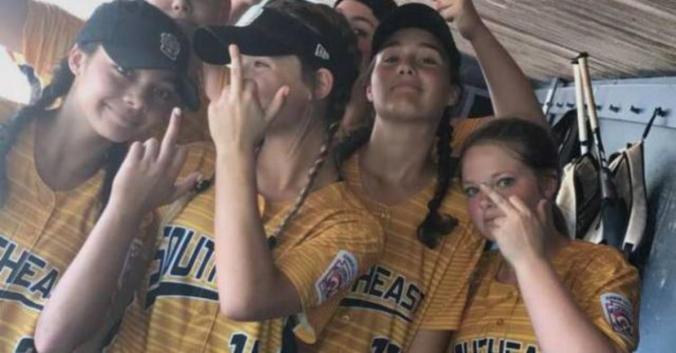
Ten Further Thoughts On The “The Taunting Girls Softball Team”

Well! I returned from my seminar to find an excellent discussion underway regarding this Morning’s Ethics Warm-up, wholly devoted to the Virginia girls softball team that was hammered mercilessly for the raised middle fingers of six teammates to send off their vanquished foes in the semi-finals. Here are some further thoughts after reading the comments:

1. There is no question that the conduct of the girls concerned the game, the sport, and the League. They were in uniform. The message directed the “up yours” gesture to the other team. This is not a case where personal expression via social media was punished by an outside authority. Ethics Alarms has been profuse in its rejections of efforts by schools to punish students for their language, ideas or other expression on platforms like Facebook and Snapchat. Those are clearly, in my view, abuses of power, parental authority and free expression. This is not like such cases in any way. If a cheerleader squad, wearing the uniforms, colors and emblems of a school, behaved like these girls, punishment by the school would be appropriate, right up to the “death sentence” of dissolving the squad.

2. Would the reaction to the photo be different if it were a boy’s team? I just don’t think so.

3. The comparison has been made to the earlier post about Matt Joyce, a major league player, being suspended by the league for a comment made to one fan during a game in a heated exchange. For the life of me, I cannot figure out what anyone would think is similar about the two episodes, the primary difference being the fact that in one case, an adult was disciplined for professional misconduct on the field of play, and in the other, children were disciplined for breaching conduct their sport and organization exists in part to teach, reinforce and convey. The punishment of the player was $60,000 in lost income for a single word, not broadcast via social media. The team was not punished except to have to play without his services for two games, but then it was not colorably a team offense by any stretch of the imagination. I don’t even want to think about what an MLB team would do to six players who, in uniform, made the same gesture the girls did to “our fans.” They might all get released. Continue reading
More Speech Policing In The Service Of Political Correctness: The Matt Joyce Affair

“GET HIM! He used a bad word!!!”

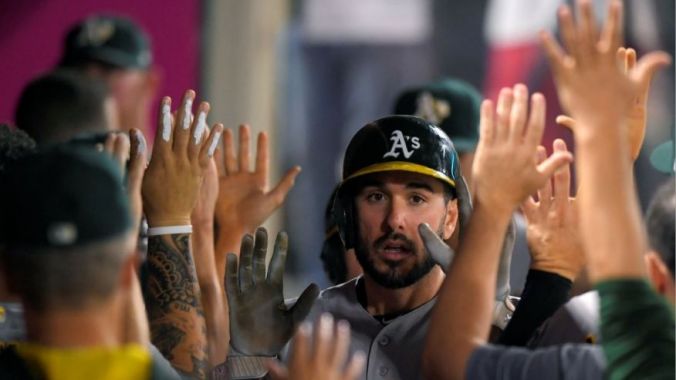
An obnoxious fan was verbally abusing Oakland A’s player Matt Joyce during 8-6 loss to the Los Angeles Angels, and he responded in kind, or perhaps worse than in-kind, since what the fan was saying has not been reported. In his angry exchange with the fan, however, Joyce used what is only described as an “anti-gay slur,” which I assume to be “fag” or faggot.” If it was “cocksucker,” which I don’t believe is an anti-gay slur as used by athletes and others, then the description is misleading.

I have no problem with the fact that Joyce was disciplined for this. He’s a professional, and major league players have to put up with fans, even those who behave despicably. (Harassing a player with abusive verbiage is unethical, and the fan should have been ejected.) However, the player’s offense was a single word, and the punishment was two games suspension, which in Joyce’s case is about a $60,000 fine. $60,000 for a single word hurled in the midst of an argument is cruel and unusual punishment. Worse, Major League Baseball required that Joyce now participate in an outreach program with PFLAG, a “family and ally organization” supporting the LGBTQ community. That’s indoctrination, and an abuse of authority. The issue is incivility, not insufficient sensitivity to a minority group.

Joyce grovelled and apologized all over the place on Twitter, as if he had condemned the entire LGBT community. He needed to apologize to the fan he used the word on. That’s all. As we discussed in the case of a previous ballplayer, Kevin Pillar, disciplined this year for using the same term during play, this appears to be virtue-signalling by MLB, and unfair. Would Joyce have been suspended for, say, calling the fan “fuckhead”? Would he have to go to Fuckhead Sensitivity Training?

I wrote, Continue reading

Al Luplow And The Duty To Remember


A culture is defined by what it chooses to remember and what it chooses to forget. Ideally, a culture would remember everything, because knowing the past, as Santayana famously observed, was insurance against repeating its mistakes.  But time is a huge eraser, as Shelley told us:

I met a traveller from an antique land,
Who said—“Two vast and trunkless legs of stone
Stand in the desert. . . . Near them, on the sand,
Half sunk a shattered visage lies, whose frown,
And wrinkled lip, and sneer of cold command,
Tell that its sculptor well those passions read
Which yet survive, stamped on these lifeless things,
The hand that mocked them, and the heart that fed;
And on the pedestal, these words appear:
My name is Ozymandias, King of Kings;
Look on my Works, ye Mighty, and despair!
Nothing beside remains. Round the decay
Of that colossal Wreck, boundless and bare
The lone and level sands stretch far away.”
This is why historians have such a crucial role to play in preserving our culture, by preserving stories, lives and memories along with the inspiration and wisdom they can provide.Sometimes a lost memory is rescued from neglect. Today we remember Colonel Joshua Chamberlain as one of the central heroes of the Battle of Gettysburg for his desperate stand with the 20th Maine Volunteer Infantry Regiment at Little Round Top, culminating in his using his knowledge of military history (he was a college professor) to improvise the bayonet charge that held his position and turned defeat into victory. That was not the case for almost a century, however, until the historical novel “The Killer Angels” retold the story so vividly that Chamberlain’s entire career became the object of new scholarship and admiration. This was truth emerging, but it was also justice. Chamberlain deserved to be remembered.

Unfortunately, Chamberlain is an exception. Once a life, a deed, a remarkable moment is forgotten, it is usually gone. That is a tragedy for the culture. The duty to remember, which I have discussed here before, is the duty to protect the culture and its riches. It is also based on the Golden Rule. We all would like our lives to be remembered as long as possible, especially when we accomplished something that future generations could and would appreciate or benefit from recalling.

This brings us to Al Luplow.

Two nights ago, in an outrageously antic and entertaining game between the Cleveland Indians and the Boston Red Sox, Indians outfielder Austin Jackson robbed Hanley Ramirez of a home run by leaping in the air at the right centerfield bullpen fence reaching over it mid-air to catch the ball, and tumbling over it. He still held on to the ball—he could have easily broken his neck—and the home run became an out.

Although outfielders have fallen over that fence from time to time, notably in the 2013 play-offs…

Continue reading

Ethics Hero: The Chicago Cubs Organization

This was a wonderful gesture of kindness and reconciliation. It won’t mean much to those who don’t follow baseball, and that is Reason #478,653,222 why it’s a mistake not to follow baseball.

I’ve written about the Steve Bartman fiasco several times.  I am not in the “Steve Bartman was an innocent victim of circumstance” camp, though he was a victim of moral luck. He was an  incompetent baseball fan, not paying sufficient attention to the game and interfering with it as a direct result. On the other hand, for members of the 2003 Cubs to use him as a scapegoat for their blowing a lead,  the game, and the play-offs, and for Chicago fans to hound him out of town and into hiding, was far worse than his negligence, the most disproportionate and vindictive treatment of a fan in sports history.

Here was my summary of the saga to date before the Cubs finally won the World Series after more than a century of failure:

Bartman, for those of you who have lived in a bank vault since 2003, was the hapless young Chicago Cubs fan who unintentionally interfered with a foul ball that might have been catchable by Cubs outfielder Moises Alou in the decisive game of 2003 National League Championship Series. In a perfect display of the dangers of moral luck, Bartman’s mistake—it didn’t help that he was wearing earphones and watching the ball rather than the action on the field—began a chain of random events  that constituted a complete collapse by Chicago in that very same half-inning, sending the Miami Marlins and not the Cubs, who had seemed comfortably ahead, to the Series. Bartman, who issued a sincere and pitiful apology, was widely vilified and literally run out of town. He then became part of Cubs and baseball lore, one more chapter in the sad saga has been called “the Billy Goat Curse,” the uncanny inability of this team to win it all.

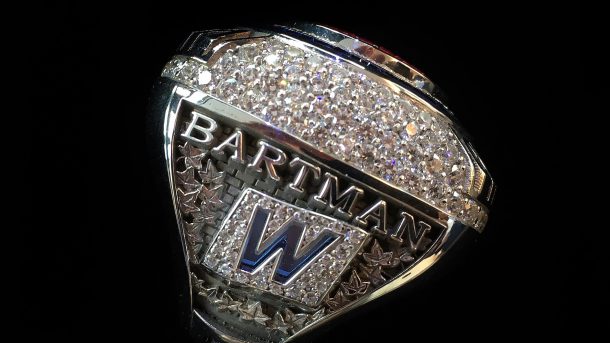
Yesterday the Cubs announced that the team had privately awarded Bartman  an official Chicago Cubs 2016 World Series Championship ring as a special gift from the the Cubs organization. These things contain 214 diamonds at 5.5 karats, three karats of genuine red rubies and 2.5 karats of genuine sapphires, and are worth about $70,000. Even so,  the symbolism is worth far more.

Tom Ricketts, the Cubs owner, issued a statement: Continue reading

Morning Ethics Warm-Up: 7/31/17

Good Morning!

1. If you want an instant reading on someone’s ethics alarms, or a quick diagnosis of whether he or she is a jerk, ask their opinion on yesterday’s episode in which New Jersey Governor Chris Christie got in the face of a Cubs fan who was harassing him during the Brewers-Cubs game. Instead of ignoring the fan, who was shouting insults at him, Christie walked over to him and said, among other things, “You’re a big shot!”

“Appreciate that,” the fan gulped.

It’s rude, uncivil and cowardly to shout insults at anyone who just happens to be attending an event as a private citizen. It doesn’t matter who the target is. The fan, Brad Joseph, assumed that he was insulated  by the crowd and the setting from any consequences of being a jackass by setting out to make Christie’s visit to the ball park unpleasant. Bravo to Christie for behaving exactly as any other non-weenie would when subjected to such abuse. Brad was adopting the same false  entitlement the “Hamilton” cast assumed when it harassed Mike Pence, though in lower case. Elected officials have an obligation to listen to the public’s complaints and positions. They do not have an obligation to accept outright abuse, and shouldn’t.

Joseph, heretofore to be referred to as “The Jerk,” or TJ, told a radio station, “I called him a hypocrite because I thought it needed to be said.” Then walk up to the Governor like a man, look him in the eyes, and say it, you chicken. Shouting from a crowd is a hit-and-run tactic, and you know it. You depended on it.


“This is America and I think we have the right to say what you believe as long as it’s not crude or profane,” Joseph then said. Wrong, Hot Dog Breath. You do have a right to be crude and profane, but as with those abuses of free speech, harassing someone, anyone, at a ball game is still unfair and unethical.

2. Then there were the ad hominem attacks on the Governor in the comments to the story. Did you know Christie was fat? Did you know that being fat proves his unfitness for public service or removes his human right to be treated decently when he goes to a ball game? These were the conclusions of easily 75% of all commenters, proving informally that 75% of internet commenters have the ethical instincts of 10-year-olds.

The news media was hardly better: check which sources make a big deal about the fact that Christie was holding a plate of nachos when he stared down TJ. This non-essential detail was even in some headlines. Newsweek, which is really just a left-wing supermarket tabloid now, actually headlined the story “Chris Christie confronts fan who wouldn’t let him eat nachos in peace.”

That’s not just fat-shaming, that’s an endorsement of fat-shaming. The problem with Chris Christie isn’t that he’s fat; the problem with him is that he is corrupt and sold out his principles and his country to help make Donald Trump President, none of which justifies abusing him when he’s at a baseball game.

Or watching “Hamilton. Continue reading

Law vs. Ethics In Baseball: The Great On-Deck Circle Controversy!

What’s going on here?

During last night’s Texas Rangers, in a crucial moment with the bases loaded, Rangers third baseman Adrian Beltre, waiting for his turn at bat,  suddenly turned up within a few of yards of home plate, watching a pitcher he wasn’t familiar with to give Beltre an edge when he got to the plate. Baseball’s rules, however, require that the next batter remains in the on-deck circle provided, which is closer to the dugout and not behind home plate. Reasons for this include making sure that on-deck batters don’t interfere with play, can’t relay stolen signs to the batter, and aren’t killed by foul balls.

The home plate umpire called time and told Beltre to get back in the on-deck circle. Beltre then moved the on-deck circle to where he had been standing.

The umpire threw him out of the game, and rightfully so. Continue reading

From The Law vs Ethics Files: The July 24, 1983 Pine Tar Incident, When Baseball Chose Ethics Over Law, And Was 100% Wrong

I have written on this topic before, but this is the famous incident’s anniversary, and I have come to believe that the lesson learned from  the pine tar incident is increasingly the wrong one, and the consequences of this extend well beyond baseball.

On July 24, 1983, the Kansas City Royals were battling the New York Yankees at Yankee Stadium. With  two outs and a runner on first in the top of the ninth inning,  Royals third baseman George Brett hit a two-run home run off  Yankee closer  Goose Gossage to give his team a 5-4 lead.  Yankee manager Billy Martin, however, had been waiting like a spider for this moment.

Long ago, he had noticed that perennial batting champ Brett used a bat that had pine tar (used to allow a batter to grip the bat better) on the handle beyond what the rules allowed. MLB Rule 1.10(c) stated: “The bat handle, for not more than 18 inches from the end, may be covered or treated with any material or substance to improve the grip. Any such material or substance, which extends past the 18-inch limitation, shall cause the bat to be removed from the game.” At the time, such a hit was defined in the rules as an illegally batted ball, and the penalty for hitting “an illegally batted ball” was that the batter was to be declared out, under the explicit terms of the then-existing provisions of Rule 6.06.

That made Brett’s bat illegal, and any hit made using the bat an out. But Billy Martin didn’t want the bat to cause just any out. He had waited for a hit that would make the difference between victory or defeat for his team, and finally, at long last, this was it. Martin came out of the dugout carrying a rule book, and arguing that the home run shouldn’t count.  After examining the rules and the bat, home-plate umpire Tim McLelland ruled that Brett used indeed used excessive pine tar and called him out, overturning the home run and ending the game.

Brett’s resulting charge from the dugout (above) is video for the ages. Continue reading

Morning Ethics Warm-Up: 7/21/17

Good Morning!

1. There was one of those moments in a Major League Baseball game yesterday that teaches life lessons in character, and ethics for anyone who is paying attention.

The Boston Red Sox were playing the Toronto Blue Jays in an afternoon game at Fenway Park. Boston led 3-1 in the second inning, but the Red Sox pitcher,  veteran Doug Fister, was struggling with an uncharacteristic control lapse: he walked his third batter in the inning, and also had given up a couple of hard-hit balls that suggested that a gaggle of runs and a blown lead were inevitable. Then, mirabile dictu, Fister caught a break. The next Toronto batter swung mightily and lofted an easy, lazy pop-up to the infield. If there had been one out rather than two, it would have been called an automatic out under the Infield Fly Rule. Everyone, including Fister, who is fighting to preserve his spot on the Sox roster as well as his flagging career, breathed a sigh of relief. The Toronto batter slammed his bat to the ground. Settling under a pop-up not any more difficult than those he had successfully caught as a Little Leaguer was Red Sox utility man Brock Holt, a second baseman this day. He is much admired for his versatility, energy and reliability. Holt is also trying to revive his career after a frightening, season-long battle with vertigo, as well as to show the team that he can fill a yawning void at third base.

Holt dropped the ball. It bounced off his glove, as the Toronto baserunners were charging around the bases at the crack of the bat, since there were already two outs. Two of them scored, and later two more after Fister surrendered hits in te lengthened inning, making the bounty bestowed by Holt’s muff four runs. Fister was soon out of the game, and was charged with his team’s eventual two-run loss by an 8-6 score. (Today’s headline in Boston: “Doug Fister’s Future As Starter Uncertain After Loss To Jays”).

Yet Fister never shot an angry glance at Holt. He’s played the game; he knows how mistakes and random bad luck can turn everything around in an instant. He probably has dropped a similar ball in a crucial situation: I know I’ve done it, at second base, losing a company soft-ball game. Holt trotted to the dugout, got supportive pats on the back and fanny from his team mates, and played the rest of the game with his head high and his skills on display. There is no doubt that he felt terribly about the play, but Holt  didn’t hide under a rock, rend his garments, or make a big display of anger and frustration to signal to the hometown crowd—which didn’t boo or jeer him at any point in the game.

That’s life, as my father used to say, and this is how ethical people handle life. Disaster strikes out of a confluence of factors (a very bright sun undoubtedly helped Holt miss the ball, but professional ballplayers learn to cope with the sun) and all we can do, if we are competent at life as well as fair, responsible and brave, is to accept responsibility, not make excuses, and not allow such events to diminish or destroy us. Both Fister and Holt displayed the character necessary to do that. Neither blamed the other, and no one blamed them. Tomorrow is another day.

Play Ball!

2. Professional troll Ann Coulter is having a public spat with Delta Airlines that reflects badly on both of them. Continue reading

A Life Ethics Lesson: The Washington Nationals And The Duty To Improve

Tex Ritter’s much-covered recording about the soldier whose deck of cards reminded him of the Bible has a parallel for me in the relationship of baseball to ethics. Like cards, baseball is a pastime, a game, but if you pay attention, there are profound lessons in ethics to be gleaned from the history, characters, and events of the game. In my official bio that I use for speaking engagements, I suggest that intensely following the travails of the Boston Red Sox since I was 12 was a major factor in sparking my lifelong interest and fascination with ethics. And it is true.

I live in the Washington, D.C. area now (unfortunately), and the local team is the Montreal Expos in exile, the Washington Nationals. The Nats’ mission is to bring Washington its first MLB World Championship since Walter Johnson was pitching and Coolidge was President. So far this goal has been elusive. That 1924 World Series-winning team, with the best names any team has had ever (Muddy Ruel, Ossie Bluege, Goose Goslin, Joe Judge, Nemo Liebold, Firpo Marberry, Mule Shirley, Pinky Hargrave, Curly Ogden, and more) has faded into forgetfulness while two Washington Senators franchises fled (to become the Minnesota Twins and the Texas Rangers, respectively) after decades of failure. The Washington Nationals, not nick-named Senators on the theory that the name was cursed, have proven cursed themselves. Despite having won more games over the last five seasons than any National League team, and having won the National League Eastern Division three times, the team has never sniffed the World Series, having lost repeatedly in the first round of the play-offs.

This season the Nats were loaded from the start, and even after terrible injuries to two of their best players, they have the best offense in the league, the best hitter (Bryce Harper) and arguably the best starting pitcher (Max Scherzer).  They are also in a lousy division where they don’t need to be great to win it without breaking a sweat.

But like the gorgeous woman with a wart on her nose, there is an obvious imperfection. The Nationals have no closer, that pitching specialist whose job is to get the last three outs (and sometimes more) to lock down victory in a close game.  This is not a new development, by any means. After the team decided to let last season’s (excellent) closer to leave via free agency, fans and sportswriters wondered how and when the team would replace him. One by one all of the established closers available by trade and free agency were snapped up, and it became clear that the Nationals ownership’s position was, “Never mind. The team is good enough. Maybe we’ll get lucky and some pitcher will surprse us, but even if we don’t, this team is good enough to win anyway. And we can save ourselves a bunch of money.Continue reading

Ethics Hero: Scott Steffel

Only 8 players in Major League Baseball history had hit 600 home runs, and last weekend the number became 9 as Los Angeles Angels slugger Albert Pujols reached the impressive milestone with a grand slam in the fourth inning of the June 3 game in Anaheim. Cal State Fullerton student Scott Steffel, a 23-year-old lifelong Angels fan, caught the ball in his glove. Such a souvenir is a collector’s dream, and catching it a baseball fan’s once-in-a-lifetime dream-come-true.

Yet Scott Steffel gave the ball back to Albert Pujols, the man who hit it. He didn’t ask for money or a truck-load of autographed bats and gloves.   He didn’t think about how much money Pujols had )millions and millions) and that the ball was figuratively made of gold. He just gave it back, saying that he didn’t feel it belonged to him, but Pujols:

“It’s not my ball, it’s his. He deserves it. He’s one of the best baseball players right now. Of all time.”

Bravo.