The Miami Marlins Are Selling Fake Memories

 Through June 3, 2017, there have been 296 no-hitters officially recognized by Major League Baseball, 252 of them in the modern era starting in 1901. Seeing one in person is a joy and a treat for any baseball fan, and even the close-but-no cigar games are memorable, as every out, every great play and every batter creates excitement, anticipation, and dread. No sport has anything like no-hitters. 

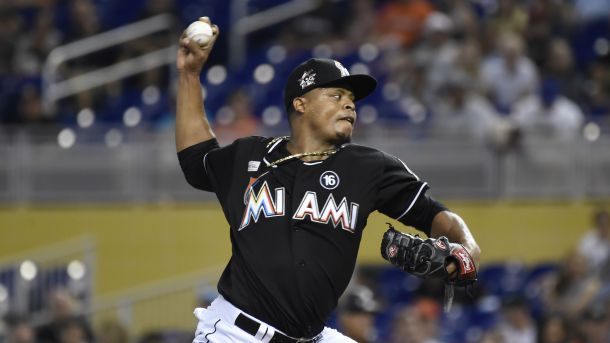
On that June 3 date, four days ago, Edinson Volquez tossed the first no-no ( as they are colloquially called) this season, and the sixth no-hitter in Miami Marlins history,  defeating the Arizona Diamondbacks. It was an unusual version of the breed because Volquez, a journeyman starter, had two baserunners who reached on walks and saw them erased by double plays. He needed only 98 pitches  to complete the masterpiece.

This comes at a good time for the sad-sack Marlins, who have attendance problems, trust issues (the team twice dismantled a championship team to save money), bad luck (rising superstar pitching ace Jose Fernandez died in a boating accident at the end of last season), hero problems (Fernandez was driving the boat,  he was drunk and on coke, and he killed two of his friends) and ownership uncertainty, for the team is for sale.

A friend living in Florida writes,

“The Miami Marlins selling tickets to a game that’s already been played? I suppose so you can frame them and claim you were at the no-hitter a Marlins’ pitcher threw on June 3rd. From the email they sent me, since I live in Florida and do attend three or four Marlins games a season:

“For those of you who missed attending the game but want to own a souvenir piece of history, unsold tickets from the game are still available by clicking here. Online purchases will be printed and mailed. Fans can also purchase tickets in-person at the Marlins Park Ticket Office.”

Continue reading

The Kevin Pillar Suspension: What Exactly Are The Current Societal Standards Regarding Homophobic Slurs, Civility, And Free Speech? I’m Confused.

In the seventh inning of the Atlanta Braves’ 8-4 win over the Toronto Blue Jays on Wednesday, Braves reliever Jason Motte “quick pitched”  Jays outfielder Kevin Pillar, striking him out. Quick-pitching isn’t illegal except in extremes, in which case it is called a balk.  It is, however, considered a bush-league tactic. Tempers were flaring in this game already, and Pillar was so upset by the pitch that yelled “Faggot!” at Motte. A “benches-clearing incident” ensued, called such because baseball players seldom really fight.

Nobody in the stands heard what Pillar said,  and most of the players didn’t either.  It was later lip-read off of the videotape of the game. There is no evidence that Motte is gay, so this was just a spontaneous utterance intended to mean “I don’t like you,” or something. If Motte were gay, and Pillar called him a faggot, this would be personal denigration based on a characteristic.

I mention this because calling a woman a bitch is not sexual harassment in the workplace; it’s just uncivil. Calling a man a bitch, however, has been found to be sexual harassment, as an innuendo about sexuality rather than character. It seem pretty clear  that Pillar was not making a sexual allegation.

After the game, sensing what was to come, Pillar issued an apology to Motte, saying, “It was immature, it was stupid, it was uncalled for. It’s part of the game.” Is there any doubt that athletes saying vulgar things to each other (and umpires) on the field is part of the game? I have seen players, managers and coaches clearly say “fuck,” “shit,” and “son of a bitch” for decades, too many times to count. One of my all-time favorite players, hippie former Boston lefty Bill Lee, was once caught by a face-on camera as he sparked a real baseball fight by pointing at the Yankees’ Greg Nettles and articulating, “HEY FUCKHEAD!” Lee wasn’t suspended or fined, and this was thirty years ago.

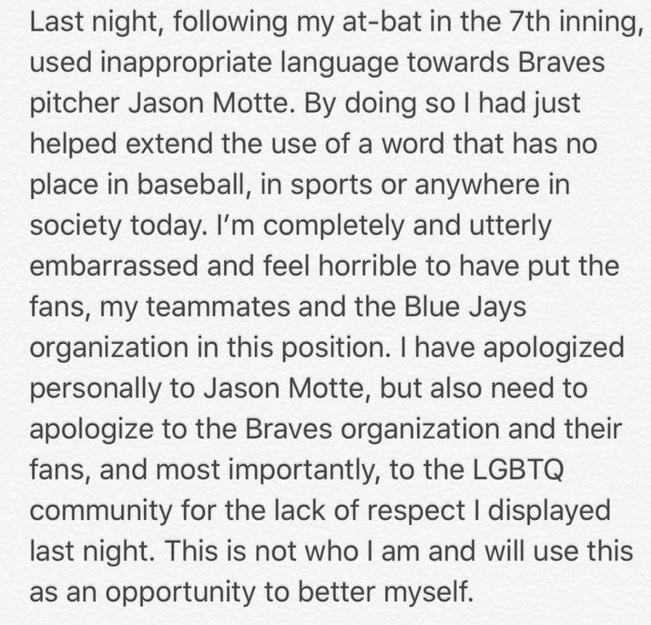
But Major League Baseball launched an investigation of Pillar. Of words. On a baseball field.   Pillar issued a more complete apology on his Twitter account:

He apparently guessed what was coming, or had been tipped off. Yesterday, the Toronto Blue Jays suspended Pillar for two games. Pillar isn’t yet in the highly-paid star category: he makes “only” $521, 000. A two game suspension will cost him about $6433 for a one syllable expletive. MLB has not taken any action, and apparently won’t.

Now, the Blue Jays, like any employer, can make any rules it chooses regarding the workplace. Obviously slurs cause bad feelings and are not the kind of things a professional sport wants its young fans to associate with its heroes. Still, any time people get punished for mere words my ethics alarms go off, and they also go off when so many people don’t seem to have ethics alarms regarding chilling speech and expression. Therefore I have some questions: Continue reading

Ethics Quiz: The Boston Red Sox And “Hate Speech”

SHHHHHHHH!

I don’t know why it is that the Boston Red Sox are leading all of baseball in ethics controversies, but here’s the story:

The Red Sox have been playing the Orioles the last four days, in a series marked by rancor arising from an incident last week that has metastasized into an exchange of words, accusations and attempted beanballs.  After the first game in this series,  Orioles’ outfielder Adam Jones claimed that he had heard racial epithets from the stands, and a bag of peanuts had been thrown at him.  Boston  and the Red Sox in particular have a dubious racial history (the team was the last in baseball ito have a black player), so this immediately became a big story, with the Sox, MLB, the city, and even the governor expressing horror, regret, and outrage. No fan or Orioles player has stepped  forward to substantiate Jones’ accusations. I don’t doubt him, but that is relevant, because in the entire episode as it unfolded, conclusive evidence has been deemed unnecessary. Accusations alone confer guilt. In the next game, Fenway gave Jones a long standing ovation on his first trip to the plate, saying, in essence, “We’re sorry you were treated this way, and we reject that disgusting conduct.” Good. That is the Fenway Park I know.

Then it was reported that another fan who was in the crowd at Fenway  the next night has been banned for life by the Red Sox. Team president Sam Kennedy said that the fan received the lifetime ban for using a racial slur to to describe a Kenyan woman who sang the National Anthem before the game, in a conversation with another fan.

Calvin Hennick, a Boston resident bringing his son to his first Red Sox game as a present for his sixth birthday, wrote on Facebook and confirmed to the Associated Press  that a  fan sitting near him used “nigger” when referring to the National  Anthem singer that night. Hennick asked the man to repeat what he had said, and when he did,Hennick summoned security. The Fenway security ejected the offending fan, who denied using a racial slur….you know, like Giles Corey denied being a witch.

Kennedy thanked Hennick, who is white, for coming forward. Says NBC baseball writer Craig Calcaterra, who once was a lawyer and presumably understood basic principles of justice, process, and fairness, “Kudos to the Red Sox for acting so swiftly.”

The Red Sox acted swiftly, all right.

Your Ethics Alarms Ethics Quiz of the Day is this...

Is it fair, proportionate, reasonable and just to ban a baseball spectator for life under these circumstances?

Continue reading

Baseball’s Childish Ethics: An Embarrassing Case Study

It is often said that baseball is a child’s game, but that doesn’t excuse professional baseball players holding on to childish traditions regarding the “right way to play the game” that are not right, frequently dangerous, and mind-numbingly stupid to boot.

Last week, beginning a weekend series in Baltimore, the Boston Red Sox were enmeshed in a close game., losing 2-0, with time running out. With the Orioles batting and Manny Machado (Non-baseball fans: he is the very young, very large, very talented O’s third-baseman, a joy to watch and already a super-star) on first, Sox shortstop Xander Bogaerts fielded a slowly bouncing ground ball and flipped a weak throw to Dustin Pedroia (Non-baseball fans: he is the small, cocky, excellent Sox second baseman, the best fielder at his position in 2016, a former MVP, and the acknowledged leader of the team now that David Ortiz has retired). Pedroia caught the ball in a first baseman’s stretch, awkwardly, just in time to force out Machado: a double play was out of the question. Machado, however, came into the base hard, sliding late, and barreling right over the bag with his spikes raised. (It looks on the tape as if one foot was elevated  when it hit the base.) Machado’s momentum took him into Pedroia, knocking him down and spiking him, as well as injuring his knee and ankle. Machado appeared to try to catch the Sox player after he passed over the base.

There was no question that Machado was out, but the Red Sox manager argued that the slide was illegal: since last year, runners are not allowed to try to break up double plays by intentionally sliding at opposing fielders. Late slides, slides not intended to allow the runner to get to second base, and sliding past teh base to upend the second baseman or shortstop will be called as obstruction, and the batter is then called out to complete the double play. The umpires disagreed with Farrell, and that is still being debated; it’s not relevant here. Pedroia, meanwhile, was led off the field, obviously injured.

After the game, Red Sox TV analysts and former players Jim Rice (Sox Hall of Fame Sox slugger) and Steve Lyons (an opinionated jackass) chuckled about what was coming. Ancient baseball tradition required, they explained, that the Red Sox “protect their player” who was injured by a careless, inept, or intentionally illegal slide. This meant, they explained, that a Red Sox pitcher in the next game was obligated to hit Machado with a pitch in retaliation. “He knows it!” said Rice. “He’ll be expecting it.” Lyons nodded and laughed. (Full disclosure: I hated Steve Lyons as a player, and I loathe him as an analyst.)

This is indeed an “unwritten law” of baseball, and one of the most unethical. I have seen it countless times, and the result is often fights and injuries, as well as suspensions for the pitcher’s involved and outright beanball wars. The theory is that you can’t let a team “intimidate” you, so a message must be sent. The message is “tit for tat” or “Mob Ethics”: you hurt one of ours, we hurt one of yours. Sometimes the situation requires a pitch directed at other team’s star player, when that team’s scrub injures the pitcher’s team’s star. In this case, the target was an easy call, for Machado was both the miscreant and is also the Orioles best player. Continue reading

The Umpire’s Botched Call, Moral Luck, And When Using Technology Becomes Ethically Mandatory

The Washington Nationals beat the Atlanta Braves on Tuesday, but if they hadn’t, we might be seeing the beginning of tidal wave of public opinion demanding that available technology be employed to avoid catastrophic umpire incompetence.

Washington had a 3-0 lead entering the bottom of the ninth. The Braves mounted a rally,scoring one run and then loading the bases with only one out. At that point Nationals manager Dusty Baker  removed struggling closer Blake Treinen  for Shawn Kelley

Kelley got his first batter to foul out, and then appeared to strike out Chase d’Arnaud, swinging. The game was over: the Nationals came out to congratulate each other, and the ground crew moved onto the field. d’Arnaud, however, argued to home plate umpire C.B. Bucknor that he had foul-tipped the ball into the dirt before the Nat’s catcher caught it. Bucknor agreed, and everyone was called back onto the field.

Kelley struck out d’Arnaud again, so no harm was done. But  videos of the “foul tip”  showed that the batter hadn’t come close to hitting the ball on the pitch Bucknor ruled a foul tip. He missed it by a foot.

If d’Arnaud, given an unearned second chance, had cleared the bases with a ringing double, the baseball world would be going nuts right now; that he didn’t was just moral luck. It went kind of nuts anyway. Bucknor is a terrible umpire, as his awful calls showed throughout the game, which was a typical performance for him. If the botched foul tip call had occurred later in the season during a crucial game, or during the post-season,  it might finally prompt Major League Baseball to use available technology and have balls and strikes called electronically, or at least have a fail-safe review system where an umpire viewing pitched on a TV monitor could instantly overrule a terrible, obvious, game changing call by the home plate umpire.

At this point, it is irresponsible for MLB not to use the Bucknor botch as impetus to make these changes now, before a disaster, realizing that a lucky near-miss shouldn’t be treated any differently. It won’t, however. It will wait until the horse has not only escaped the barn, but escaped the barn and trampled some children, before putting a lock on the door.

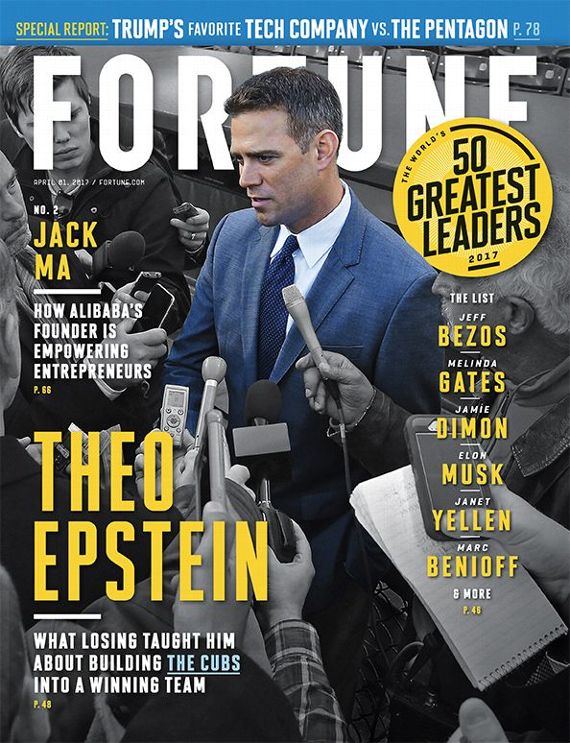
Ethics Quote Of The Month: Chicago Cubs President Theo Epstein

“That is ridiculous. The whole thing is patently ridiculous. It’s baseball–a pastime involving a lot of chance. If [Ben] Zobrist’s ball is three inches farther off the line, I’m on the hot seat for a failed five-year plan.”

—-Theo Epstein, president of the Major League Baseball’s 2016 World Champion Chicago Cubs, upon learning that Fortune Magazine had chosen him #1 among “The World’s Greatest Leaders” in a click-bait list released last week.

Thank-you, Theo, for explaining moral luck and the perils of consequentialism to the public. When it came down to the final innings of Game 7 in last year’s World Series, it looked for a while like Cubs manager Joe Maddon was about to blow the chance to win an elusive title after over a century of frustration by keeping his clearly gassed closer on the game. That his risky decision didn’t make Maddon a goat for the ages and Epstein one more name in the long list of Cubs saviors was pure moral luck—the element of chance that often distinguished heroes from villains. winners from losers and geniuses from fools in the public’s mind—and gross consequentialism, judging decisions by their uncontrollable results rather than their objectively judged wisdom and ethics at the time they were made.

If the Cleveland Indians had won that crucial game in extra-inning, no matter how, Epstein might have made Fortune’s list (I doubt it), but he would have been nowhere near the top. Continue reading

President Trump Will Not Throw Out The First Ball Of The Baseball Season

News Item: Donald Trump has declined the Washington Nationals’ invitation to throw out the first pitch when the Nats begin the 2017 season. The club said that the White House blamed a “scheduling conflict.”

Observations:

1.  In the abstract, this is too bad—for baseball, for the Presidency, for the country. Traditions are healthy for cultures. Thirteen U.S. Presidents have thrown the season’s ceremonial first pitch at either a Nationals or Senators catcher  since 1910.: William H. Taft (1910-11), Woodrow Wilson (1912, ‘14), Warren Harding (1921-22), Calvin Coolidge (1924, ‘27-28), Herbert Hoover (1929-32), Franklin D. Roosevelt ( 1933, ‘35-41), Harry S. Truman (1946, ‘48-50, ‘52), Dwight Eisenhower (1953-58, ‘60), John F. Kennedy (1961-63), Lyndon Johnson (1964-65, ‘67), Richard Nixon (1969), George W. Bush (2008), and Barack Obama (2010).” The rest since 2010 found time to throw out at least one opening day pitch in other ball parks.

2. President Trump’s pass is wise, unfortunately. Herbert Hoover was roundly  booed every time he threw out the first pitch, and it was a profound embarrassment. (He kept coming back, though. Bravo. Guts.) Hoover, however, didn’t have to deal with endless videos, internet cruelty, TV show comic mockery, and a political party dedicated to undermining him and respect for his office. Washington DC voted against Trump by a 96%-4% margin. People in D.C. want the President to throw out the first pitch purely so they can abuse him. He has a duty to protect the office and his dignity. The President was right to decline, even though it represents handing another victory to those who want to isolate him, “otherize him,” and undermine his leadership. Trump could be defiant, but it would spoil the tradition. Sometimes the assholes win. This is one of those times. Continue reading

Ethics Quiz: Is Jose Fernandez: A Fallen Hero or A Dead Asshole?

When Miami Marlin pitching star Jose Fernandez died, along with two friends, in the night crash of a speedboat he owned, the city of Miami and Major League Baseball was thrown into a state of extended grief. Not only was the 24-year old pitcher the super-star of the Miami Marlins franchise, but, we were told, was a young man of extraordinary character as well. He had the brightest future imaginable. Fernandez was expected to earn between 300 and 500 million dollars during what was expected to be a Hall of Fame caliber career. His girlfriend was pregnant. He was already a role model and a celebrity.

After his death, the team mourned their fallen star with dignity and emotion. This season, the Marlins to honor plan his memory in various ways.

But.

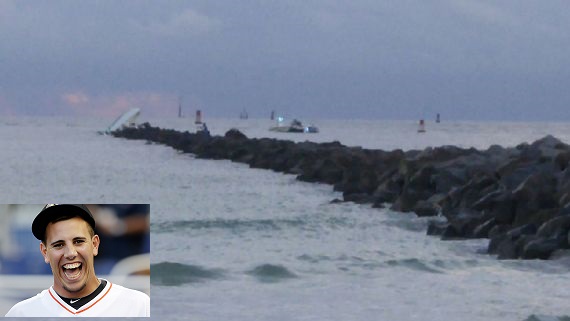
After nearly six-month investigation, The Florida Fish and Wildlife Conservation Commission’s report on the accident  concluded  that Jose Fernandez was driving the speed  boat when it crashed. killing the pitcher, Eduardo Rivero and Emilio Macias  in the early morning of Sept. 25, 2016. Fernandez’s blood alcohol level was .147 and there was “noted presence of cocaine,” according to the Miami-Dade Medical Examiner’s toxicology report.

The speed of the 32-foot vessel during the impact of the crash on the north side of a jetty was 65.7 miles per hour, far too fast for the conditions and the area. The report concludes:

“Fernandez operated V-1 with his normal faculties impaired, in a reckless manner, at an extreme high rate of speed, in the darkness of night, in an area with known navigational hazards such as rock jetties and channel markers.”

Your Ethics Alarms Ethics Quiz of the Day:

Is it ethical, responsible and right for the Miami Marlins, or anyone, to honor Jose Fernandez in light of these revelations?

Continue reading

Screwing Over Mexico In The World Baseball Classic: Now THAT’S A Stupid Rule…

Rationalization #30. The Prospective Repeal: “It’s a bad law/stupid rule,” is a widely employed ethics dodge, used by everyone from drug dealers to tax cheats. It doesn’t mean that many rules are not bad and stupid however. The World Baseball Classic just demonstrated its management’s incompetence with one of them. As is often the case when bad rules and laws prevail, injustice is the result.

Sixteen national teams are competing in the World Baseball Classic, a relatively new baseball tournament played during MLB’s  Spring Training. There are five pools of teams in an elimination tournament. The competitors this year (the tournament is held every four years, sometimes three—never mind, they are still working it out) are Japan, Taiwan, China, SOUTH Korea (the first version of this post erroneously said “North”—wishful thinking on my part), Mexico, Cuba, Columbia, Puerto Rico, the Dominican Republic, Venezuela, Australia, Italy, the Netherlands, Canada, the U.S., of course, and…Israel. Pool competition just ended (the US is moving on to the next round) and Mexico, Venezuela and Italy all finished with records of 1-2 in their pool games. The tournament doesn’t have time for extended play-off games, so a tie-breaker was triggered.

Under Classic tiebreaker rules, the two teams with the fewest runs allowed per defensive inning in games played between the teams tied during the tournament play an elimination game, and the other is eliminated. The calculation of runs allowed per inning includes “partial innings.” (Hold that thought.) Major League Baseball announced that Venezuela (1.11 runs allowed per defensive inning) and Italy (1.05 runs allowed) will play an elimination game, with Mexico (1.12) out of the tournament. Here is how it stacked up: Continue reading

Why Shouldn’t Baseball Star Jose Abreu Be Deported?

No,no,no! Not “passport to eating,” EATING A PASSPORT!

There was a trial, still ongoing,  in a Federal court in Miami last week, where sports agent Bartolo Hernandez and baseball trainer Julio Estrada were tried before a jury for alien smuggling and conspiracy. Prosecutors say they operated a ring that took Cuban players from the Castros’ island to other countries where they could established residency and sign lucrative Major League Baseball contracts.  The big surprise in the trial came when star Chicago White Sox first baseman Jose Abreu told a Miami federal jury Wednesday how he ate his fake passport while flying to the U.S. to cover up the fact that he was arriving illegally as a prime participant in the smuggling operation.

Abreu said he ordered a beer on an Air France flight from Haiti to Miami and used it to wash down the section of his passport showing a false name with  his photo. The reason the unique meal was urgent? Money. Abreu was about to  miss an October 2013 deadline that would forfeit the $68 million agreement he had in place withe White Sox.

“If I had not been there on that particular day, the deadline, then the contract would not be executed and would no longer be valid,” Abreu told jurors. “We had to be in Chicago to sign the contract.”

Ah. Then that’s all right, then!

Abreu the was American League Rookie of the Year in 2014. He  testified under a grant of limited immunity, meaning he wouldn’t be prosecuted if he told the truth on the witness stand.  Jurors learned that the slugger got the fake passport in Haiti, where he and his family had escaped to from Cuba by speedboat in August 2013. One of the associates of Hernandez and Estrada—naturally, the smugglers got a cut of Abreu’s contract—obtained the fake passport and booked the Air France flight, telling the ballplayer to destroy the document on the plane. .

He did not tell him to eat it. Continue reading