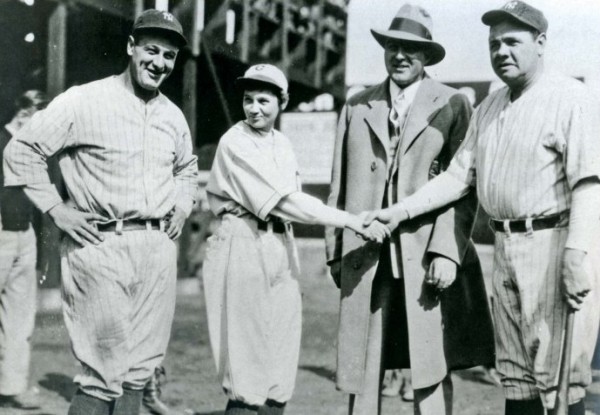
Jackie Mitchell, The Girl Who Struck Out Ruth And Gehrig: A Legend And Ethics Conundrum

jackie-mitchell

The Jackie Mitchell saga is a great, feel-good story ruined by ethics rot. On one level, it is exactly the kind of tale that compels the treatment recommended by the old newspaper editor in John Ford’s “the Man Who Shot Liberty Valence”: “When the legend becomes fact, print the legend.” On another, it is an ethics mess, which might explain why I had never heard of Jackie Mitchell, once a proto-feminist icon, until I cracked open my new issue of Smithsonian Magazine.

Mitchell was a Depression era Chattanooga teenager who had been taught how to pitch by her friend and neighbor, Major League ace Dazzy Vance. A star on local women’s baseball teams, the tomboy southpaw was signed to a pro contract by the promotion-minded owner of a local AA level minor league team, the Lookouts, in 1931. Her big moment came when the New York Yankees came through Chattanooga from Spring Training on the way to opening the season up North. Lookouts owner Joe Engel arranged for two exhibition games against the Bronx Bombers, who, you baseball fans should know, included Babe Ruth and Lou Gehrig. Engel promoted the game as a David and Goliath showdown with Jackie playing David, and he was rewarded with a full stadium. Then this happened: Continue reading


And This, Craig, is Why Barry Bonds Should Only Get In The Hall Of Fame With A Ticket

Blame Barry, Chris.

Blame Barry, Chris.

In Baltimore, a young, slugging first baseman is leading the charge to get the Baltimore Orioles into the American League play-offs. He is on a home run pace that could net him 60  or more, and fans voted him the starting first baseman on his league’s All-Star team. Because his production this year far exceeds anything he had accomplished before, however, Chris Davis’s emergence isn’t being celebrated as much as it is being suspected. Another steroid scandal looms over major league baseball, one which threatens to engulf two former MVPs, as well as other players. Fans and sportswriters don’t trust players any more, or their power totals, not since Mark McGwire and especially Barry Bonds juiced and injected their way to shattering the game’s home run records.

This bothers lawyer/baseball blogger Craig Calcaterra, and it should., as someone concerned with justice. Of the smearing of Davis, he calls it…

“…utterly baseless speculation; Davis has always had tremendous power but is now, in the past year, matched it up with better plate discipline — is the product of a media landscape which has decided that every power hitter is a ‘roider. Jose Bautista got this treatment a couple of years ago. Davis is getting it now. Everyone who engages in this business does so because they’ve been convinced by the baseball media that such speculation is not just justified but necessary. It’s neither of those things. The drug testing system put in place had avoiding these parlor games as one of its primary justifications. But that’s not good enough for some, apparently.” Continue reading

Unethical Website and Post Of The Month: Rant Sports And Its “Top 25 Athletes Turned Actors of All Time.”

Maybe #1---but that would take some research.

Maybe #1—but that would take some research.

It is true that you cannot trust everything, indeed most things, that you read on the web, and thus should approach all supposedly factual statements with skepticism and ready access to Google. That does not excuse websites that recklessly and irresponsibly spread misinformation however, or that through their own laziness and ignorance spread ignorance among others.

A slick sports website called Rant Sports provided a particularly galling example this week, when it presumed to post a list it called “Top 25 Athletes Turned Actors of All Time.” All the sports sites draw traffic with this kind of trivia-mongering, but even trivia-mongering demands a modicum of research, care, and fact. This may be an opinion piece, but it isn’t the opinions that are problematical. Renae Juska, the fraud who created the list, obviously engaged in no research at all, so her”Top 25″ really was “First 25 I was able to jot down on a piece of paper.” As I will now demonstrate, Juska, on a site dedicated to sports, made an assertion that is demonstrably and objectively false, and under color of authority, misleading readers but just as wrongly, unfairly neglecting many athletes who would have to be ranked on any such list that was given the amount of research expected of a seventh-grader’s term paper.

Here are some examples of how misleading and poorly researched the list is:

  • To begin with, all but one of the “top athletes” are male. Wrong. One of the greatest athletes-turned actresses died just last month, the great Esther Williams, a record-setting competitive swimmer who was unable to compete in the Olympics because of World War II. She was an athlete IN her movies, the most famous of which were aquacade spectaculars featuring Williams swimming, diving, doing what was later called synchronized swimming (she is credited with helping to create the sport), all while smiling and looking drop-dead gorgeous in a one-piece bathing suit. Does Williams qualify as a “Top Actor” over Number 16 on Juska’s idiotic list, the immortal Stacy Keibler, the only woman he deems worthy? Here are her credentials, as Juska cites them: “She began acting in 1998 and was a professional wrestler from 1999-2006. Her most well-known appearances have been in WWE Judgement Day, Summerslam and WrestleMania XX. She has also had guest appearances on How I Met Your Mother, Mayne Street and Samurai Girl.”  Esther’s credits are here, and you can see her in action here:

To say there is no contest is not an opinion, it is fact. Of course, Juska probably never heard of Esther Williams, which means that she has no business making this list at all.

Believe it or not, it gets worse… Continue reading

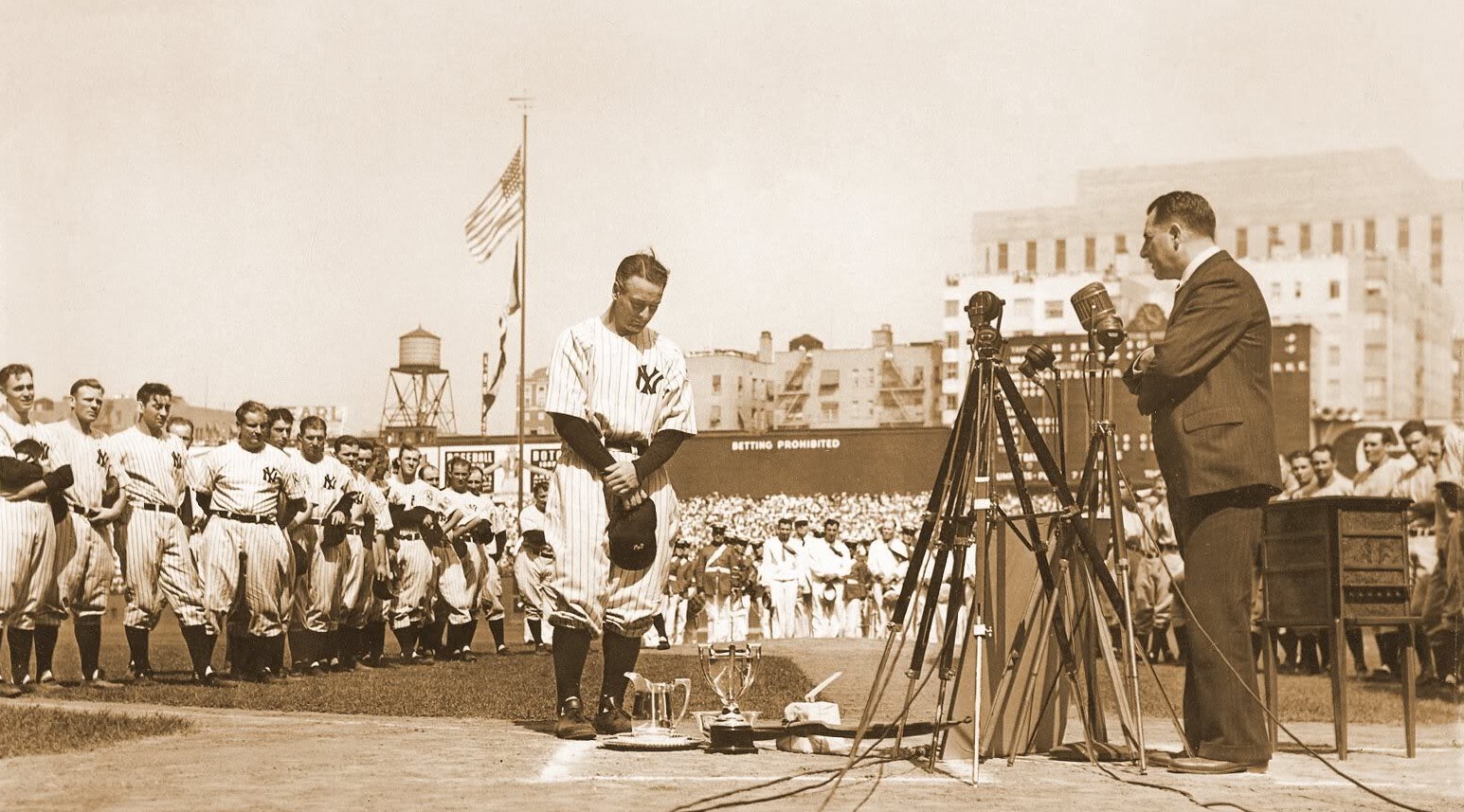
Ethics Quote Of The Day: Lou Gehrig, July 4, 1939

“Fans, for the past two weeks you have been reading about the bad break I got. Yet today I consider myself the luckiest man on the face of this earth.”

—-Baseball great Lou Gehrig, beginning his farewell speech to Yankee fans on July 4, 1939, as they filled Yankee stadium to say farewell to “the Iron Horse,” who was retiring from the game after being diagnosed with the incurable disease, amyotrophic lateral sclerosis (ALS), known forever after as “Lou Gehrig’s Disease.”

Lous Farewell

Lou Gehrig was only 36 years old when he learned that he was dying. ALS is a terrible wasting disease that has no cure, and in 1939 there was little treatment or assistance that could be offered to a victim as his body slowly ceased to function. It is an especially cruel disease for a professional athlete to face, and even more so one, like Gehrig, who was renowned for his endurance and seemingly indestructible body. When the progress of the illness, still then undiagnosed, caused Gehrig to remove himself from the New York Yankees line-up on May 1, 1939, it ended his amazing streak of 2,130 consecutive games, a baseball record that stood until broken by Cal Ripken, 56 years later.

Gehrig’s speech was from his heart. He was an educated and articulate man, but he had not planned on speaking at the moving ceremony to bid him farewell, as current former team mates, some of the greatest players ever to take the field, gathered to pay their respects. But the Yankee Stadium crowd of more than 60,000 began chanting his name, and after initially refusing, Gehrig moved to the microphone. Continue reading

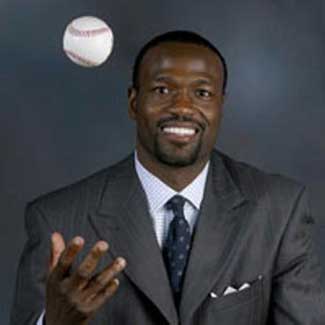
Why Your Child Should Watch “MLB Now”

…other than the fact that teaching your child to understand and enjoy baseball is one of the greatest gifts a parent can give, that is.

Don't be like Harold, son.

Don’t be like Harold, son.

No, the best reason to watch “MLB Now,” a program on the cable MLB channel, has nothing to do with baseball. It does have to do with preparing your child for life, showing him the danger of bias, and teaching her that remaining open to new ideas and information is essential, not only to ethical conduct, but to rational conduct as well.

The show features two commentators, Brian Kenny and Harold Reynolds, debating various baseball questions while coming from different disciplines and perspectives. Reynolds, a former player of some note with the Seattle Mariners, is “old school,” meaning that he belongs to that dwindling cadre of people, in the game and out of it, who rely on traditional wisdom, misconceptions, myths, false assumption and, most of all, their own gut level observations to interpret the deceptively complex game and evaluate its players. Thus he extolls doing the “little things that win,” like bunting and stealing bases, talks a lot about “protection” in the line-up, prattles on about clutch hitting and “pitching to the score,” and other similar thoroughly debunked nonsense that was regarded as cant back when John McGraw was managing but now is about as outdated as the assertion that women can’t drive. Kenny is thoroughly versed in the art of sabermetrics, the statistical measurements of baseball pioneered in the 1980’s by Bill James and others. Sabermetrics has transformed how baseball is watched, operated and played, greatly aided by the availability of computers. They can show how a pitcher with a losing record is both better and more valuable than one who wins twenty games, the traditional measure of excellence. They can prove that a batting champion is actually less of a positive offensive force than some obscure, .270 hitting player few have ever heard of. Sabermetrics can prove that managers with the reputation of being geniuses were really lucky dimwits. They can, that is, if you are willing to learn and pay attention. Continue reading

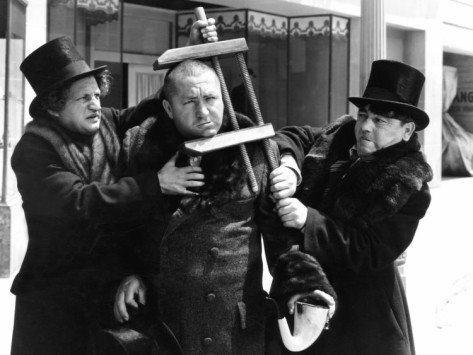
“Hello, Hello, Hello…Hello!” An Ethics Dunce Trio: Newspaper, Sportswriter, President

the-three-stooges

I have a lot of catching up to do with ethics issue backed up as far as the eye can see, so I will try to deal efficiently with the three Ethics Dunces that confronted me this morning:

Ethics Dunce #1 : The Washington Post Continue reading

Ethics and “Casey At The Bat”

casey-at-the-bat-1888-granger

Today is the 125th anniversary of the publication of “Casey at the Bat,” arguably the most popular and famous of American poems, the creation of humorist Ernest L. Thayer in 1888.

The poem carries many  lessons relevant to ethics and life within its tale of the hometown hero who fails spectacularly just when heroics are most needed and anticipated, such as…

  • Don’t promise what you cannot be sure of delivering.
  • Good faith failure isn’t unethical, a sin or a crime, but it still carries with it the need for someone to accept responsibility for it.
  • The focus of disaster is always on the last individual who might have prevented it, but that is neither fair nor logical. The Mudville Nine lost the game, not Casey.
  • Expecting miracles, last-minute rescues, heroic intervention and infallible rescuers is foolish and irresponsible.
  • Respect your adversaries, for your own sake as well as theirs.
  • “Pride goeth before a fall.”

Today, however, I am struck by how neatly the poem reminds us that in baseball there is no spin, no rock to hide under and no Fifth Amendment to claim. When a player fails, or makes a mistake, or misbehaves, it is usually all out on the field, watched in person by thousands, seen on TV by millions, and recorded forever. There is usually no way to deny or hide responsibility, and indeed part of the professionalism of baseball is accepting that, facing the media and the public, and saying, “That was on me. I failed. I’ll do better next time.”

Most of the time, that’s all the crowd asks after failure. Honesty and accountability.

As long as Casey doesn’t keep striking out, that is.

Here’s the poem, recited by the now-forgotten Bob Hope sidekick Jerry Colonna, he of the rolling eyes:

________________________________________

Spark: Craig Calcaterra

Graphic: Fine Art America

Oh, Shut Up, Kate: Let’s End The Obligatory “God Bless America” Rendition

kate_smith-sings_god_bless_america

My father hated “God Bless America.” He particularly hated jumbo 40’s singer Kate Smith’s rendition of it, which he believed exploited patriotism and combined it with sentimentality and schmaltz to get ratings and sell records. Smith had an unadorned clarion belt that particularly suited Irving Berlin’s blunt melody, and for 30 years she used the song as her signature, as much as Judy Garland used “Somewhere Over the Rainbow.” Whenever Smith appeared on a TV variety show like The Hollywood Palace, he would order me to change the channel (yes, I was the family remote) for fear that he would have to hear her sing that song.

I assumed that was the reason why I have felt queasy about Major League Baseball’s 7th inning stretch ritual, installed in 2001, of having a recording of Kate or a live singer ring out the Irving Berlin standard at every major league baseball game since the Twin Towers fell.  In today’s Washington Post, however, a Methodist minister—my father was also a Methodist, as much as he was anything—explained why he refuses to stand for the song. He nailed it.

James Marsh writes, Continue reading

“Who Cares?” Ethics: The Key Question…Was This Employee Fired?

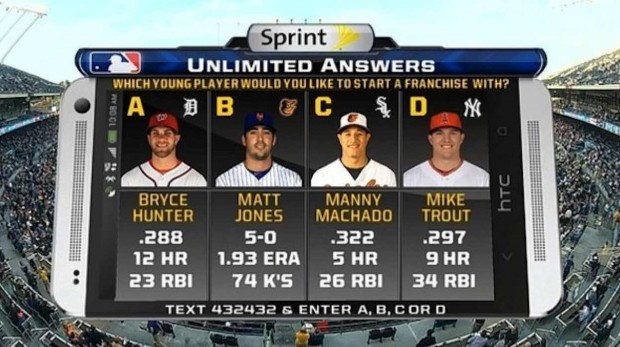
During a Kansas City Royals broadcast this week, the following graphic was displayed for the TV audience:

Mistake Screen

It has the following mistakes: Continue reading

Angel Hernandez’s Botched Home Run Call, Continued: Now THIS Would Justify Over-Ruling It

"You blew that call deliberately! Didn't you? DIDN'T YOU???"

“You blew that call deliberately! Didn’t you? DIDN’T YOU???”

Yesterday I wrote about the terrible, tomato-worthy botch of a home run call by Angel Hernandez in an Oakland-Cleveland baseball game, and how as bad as it was, the rules of the game don’t permit such rules to be over-turned, and thus over-turned they must not be, lest the game’s integrity be damaged. But on the Dan Patrick radio sports show today, renowned baseball writer Peter Gammons theorized that Hernandez may have refused to credit Adam Rosales of the A’s with a home run, despite the instant replay proving to anyone with eyes that it was not a double as he had ruled, because he, like many if not all major league umpires, hates the concept of allowing instant video replay to over-rule umpire judgments.

And, of course, Hernandez has a well-earned reputation as a spiteful jerk.

Hernandez would never admit to so unprofessional an act, but I think Gammons’ speculation is fair, and also very possibly correct. The alternative is to conclude that Hernandez literally can’t see, which seems unlikely. What seems far more likely is that he and his umpiring crew decided to register a nasty and unprofessional protest over the gradually expanding trend in Major League Baseball of letting technology do better what umpires have traditionally done well. Continue reading