Morning Ethics Warm-Up, 11/16/17: Keeping the Public Ignorant About Unethical Lawyers, Sugar Lies, And A Terrible Trump Tweet…

Good Morning, John!

Sing us into the first item, would you?

1 “Is anybody there? Does anybody care?” Everywhere I go, lawyers are talking about the David Boies scandal, which I wrote about here. I haven’t seen much media discussion about it at all. We have now seen one prominent hack lawyer, Lisa Bloom, and one prominent, skilled and respected lawyer, Boies, demonstrate high profile professional conduct that should receive serious sanctions from their profession, and it appears that most of the public and the media neither knows this nor cares.

Bloom is just a venal, incompetent, bad lawyer. The real crisis is when top lawyers blithely engage in wildly unethical conduct in a high profile case, but I doubt the public sees the difference. Very little commentary on Boies’s betrayal of the New York Times  focused on the throbbing black-letter ethics violation involved.  Today, a front page story in the New York Times about Black Cube, the sinister investigative crew hired by Boies to gather dirt on the Times before it blew the whistle on Harvey Weinstein completely missed this crucial element of the story. It also makes it near-certain that no one will read the report who need to know how poorly legal ethics are enforced.

Here’s the headline in the print edition: “Sleuths for Weinstein Push Tradecraft Limits.”  Tradecraft? Online: “Deception and Ruses Fill the Toolkit of Investigators Used by Weinstein.” Nowhere in the article are readers informed that lawyers are forbidden, without exception, from using any contractor that regularly uses deception.

Here is the kind of thing Black Cube specializes in, from the Times piece:

“Earlier this month, a former hedge fund employee was flown from Hong Kong to London for a job interview. Around the same time, a current employee of the same Toronto hedge fund was also flown to London for interviews. The company courting them was fake. Its website was fake. There were no jobs to be had, and the woman who set up the interviews was not a recruiter but an agent working for an Israeli private investigative firm.

This was not an episode of “Homeland” or the latest “Mission: Impossible” installment. Interviews and court papers show that these deceptions were part of a sophisticated and expensive investigative operation. The objective, according to one filing, was to gather proprietary information held by the hedge fund. The agent worked for Black Cube.”

Every single jurisdiction in the United States declares in its legal ethics rules, usually in the rule about misconduct, 8.4 (bolding mine):

It is professional misconduct for a lawyer to:

(a) Violate or attempt to violate the Rules of Professional Conduct, knowingly assist or induce another to do so, or do so through the acts of another;

(c) Engage in conduct involving dishonesty, fraud, deceit, or misrepresentation…

How much clearer can it be? It is unethical for a lawyer to employ someone or an organization that he or she knows routinely and reliably engages in “dishonesty, fraud, deceit, or misrepresentation.” Yet that’s the only reason anyone hires Black Cube. Conclusion: Boies breached a major ethics requirement, perhaps the most serious one there is. And why?  Because a client paid him to. Continue reading
From The “Ethics Movies That Drive Me Crazy Because I’ve Watched Them Too Often” Files: “Field Of Dreams”

The end of the baseball season is hard for me, although it dovetails nicely into the hell of the holidays. The whitewater rush of our wedding anniversary, Thanksgiving, my birthday, pre-Christmas, Christmas, and New Years, along with the ethics business’s dead income period and resulting Marshall cash flow anxiety at the end of every year pretty much has me distracted until January, and Spring Training starts just six weeks after that. Early November has me in withdrawal, however, so I yielded to temptation and watched the 1989 baseball fantasy “Field of Dreams.” It is also an ethics movie of sorts, exploring the complexities of family, fathers and sons, forgiveness, sacrifice, faith and redemption.

Ethics Alarms has highlighted the annoying ethics problems in two classic films, “White Christmas” and “It’s a Wonderful Life.” Now it’s “Field of Dreams'” turn. Oh, I’m still a sucker for one of the most shamelessly manipulative movies ever, don’t get me wrong. I cannot, and I’ve tried, stop myself from getting choked up when Ray Kinsella (Kevin Costner) says to his incredibly gorgeous hunk of a father (Dwier Brown), long dead but miraculously returned to corporeal form and younger than his son,”Hey, dad? Wanna have a catch?”

See? I got choked up just typing that! (Damn movie.). From an ethics perspective, however, the film makes even less sense than the plot.

I’m going to assume, if you continue reading this, that you’ve seen the film. If you haven’t, see it. Don’t let my jaded observations spoil it. It sure works the first time.

Here are the aspects of “Field of Dreams’ that now drive me nuts.

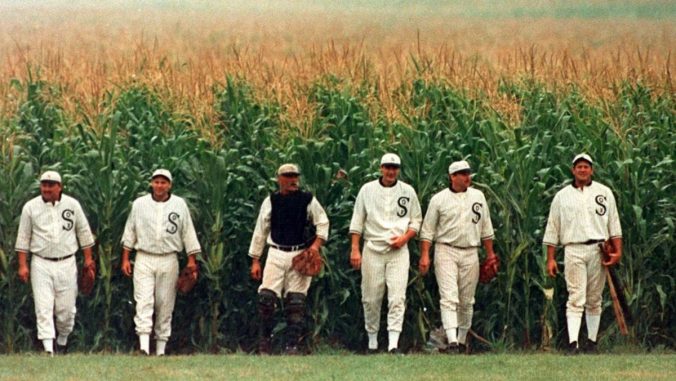
  • Ray Kinsella is a reluctant and unenthusiastic Iowa farmer who lives with his wife, Annie (Amy Madigan), and daughter, Karin (Gaby Hoffman). In the opening narration, Ray explains his estrangement  from his father, John Kinsella, who was a baseball fanatic and who idolized Shoeless Joe Jackson, the disgraced star of the infamous Chicago Black Sox, who threw the 1919 World Series. By the end of his father’s life, Ray hadn’t seen his father for years. He is still feeling remorseful for refusing to play catch with his father, because rejecting baseball was a way to hurt his dad.

The Problem: The whole film’s premise (and that of the novel, “Shoeless Joe,” it was adapted from) is based on the popular fiction that Joe Jackson was unjustly banned from baseball for being part of the gamblers’ plot to fix the Series. This is untrue. Jackson accepted a bribe. He did not inform authorities. He knew his seven similarly-bribed team mates were trying to lose. He did nothing to stop them. he allowed the Series to be fixed, the fans to be betrayed and the fame itself to be brought to the brink of destruction. Jackson, who was illiterate and from all accounts appears to have had an IQ of about 85, argued that he tried to win despite taking the bribe. First, the evidence is questionable on that point.Although he  batted .375 against the Reds in the series, he failed to drive in a single run in the first five games, four of which the White Sox lost. That’s how you throw games without looking like you’re throwing games. Second, he was making the argument that stealing money from bad people isn’t still unethical. Joe probably believed that, but then he was an idiot.

  • . While walking through his cornfield one evening, Ray hears a whispering voice saying, “If you build it, he will come.” He decides, after the voice keeps pestering  him, that he is supposed to build a baseball field—with lights!—in his corn field, and that if he does, Shoeless Joe Jackson will return from the dead and play there. Or something.  Annie is dubious–ya think?—but lets him do it. After the field is finished and nothing happens for months, we see Ray and Annie going over their financial records:

RAY: How bad is it?

ANNIE: Well, given how much less acreage we have for corn, I’d say we’ll probably…almost break even.

RAY: Jesus.

ANNIE: We’ve spent all our savings on that field.

RAY: So what are you saying? We can’t keep the field?

ANNIE: t makes it real hard to keep the farm, Ray.

The Problem: And I said Shoeless Joe was stupid. NOW they are having this conversation? This is so irresponsible and incompetent, it defies description. Ray has a family. They have a little girl. Spending their savings on Ray’s whim and a ghostly and ambiguous whisper is the ethical equivalent of parents blowing their money on drugs. Through it all, Annie, who proudly styles herself as a Sixties veteran, is relentlessly cheery regarding her husband’s lunacy, and once Shoeless Joe appears on the cornfield diamond she’s all in. What, honey? Another voice is telling you to drive to Boston (from Iowa, remember) and talk famous recluse novelist Terrance Mann ( J.D. Salinger in the novel) to join your fantasy? You want to leave while we are trying to stay out of bankruptcy? Sure, go for it!

At the very least, they could have skipped the lights. None of the 1919 White Sox ever played in a night game; there were none then.

Continue reading

On The Way To Bali, An Unethical Conduct Cascade

One unethical act often opens the floodgates to many, in in unexpected, and unexpectable ways. An ethics alarm failure triggers another, then another. But who would expect that an extramarital affair would cause a passenger plane to have to make an emergency landing, for example?

All the moe reason to keep those alarms in working order.

The distaff side of a couple on the way to a vacation in Bali on a Qatar Airways flight apparently had reason to be suspicious of her husband, so when he fell asleep, she oh-so-carefully  manipulated his snoozing thumb to unlock his smartphone with its print, and did some snooping.

Ah HA! The bastard had been cheating on her!

So calmly, maturely, she began screaming and beating on her dastardly spouse so violently that the pilot had to divert the flight and land.

Cascade re-cap:

  • Triggering unethical act: Marital infidelity.

1 to 10 Betrayal of Trust Scale score, with 1 being a forgivable lie and 10 being treason, I rate this an 8.

  • Secondary unethical act: Appropriating the body of another while he is incapacitated, and doing so to invade his privacy. (No credit for discovering above triggering unethical act.. That’s consequentialism: the result of an act cannot retroactively justify the act.)

Betrayal of Trust Scale score: 6

  • Culminating unethical act: Physical violence on a plane endangering innocent passengers, forcing the plane to land, inconveniencing many.

I don’t have a scale for that.

But it was the most unethical of all.

What a fun couple!

Ethics Dunce: Donna Brazile, But Not For The All The Obvious Reasons…

“Now, it’s my understanding that as a CNN contributor, you won’t make me follow any of that ethics crap, right, Jake?”

In her new book, “Hacks: The Insider Story of the Break-ins and Breakdowns That Put Donald Trump in the White House,” Suddenly Ethical Donna Brazile takes a moment  to slam Jake Tapper because he harshly criticized her after a leak reveealed that she had used her CNN position to procure debate question and pass them along under the table to Hillary. (Of course, if Clinton had any integrity, she would have refused—what am I SAYING?).

She wrote,

“The next day, even Jake Tapper took a swing at me, calling me unethical and ‘journalistically horrifying’ during a radio interview with WMAL even though I worked for CNN as a commentator not a journalist.When I called him on this, he did not apologize. His attack on me was really about him. He wrote in an email, ‘I don’t know what happened here except it undermines the integrity of my work and CNN … you have to know how betrayed we all feel.”

OH! Donna was a contributor, not a journalist! That changes everything! So as an individual who was contributing to a journalism product, as well as paid to do so, and being relied upon by journalists in a journalism-supplying entity to inform their audience honestly regarding what journalism covers by definition, Brazile as a paid contributor should not have been expected  not required to tell the truth, be fair, maintain standards of integrity, state her biases and conflicts up front, or indeed engage in ethical conduct at all!

Is that the new definition of what “contributor” means? Boy, I think CNN needs to clarify this; I always assumed that if a network employed a “contributor,” that individual was being presented as someone who would be held to the same standards of professionalism as other on-screen employees. Continue reading

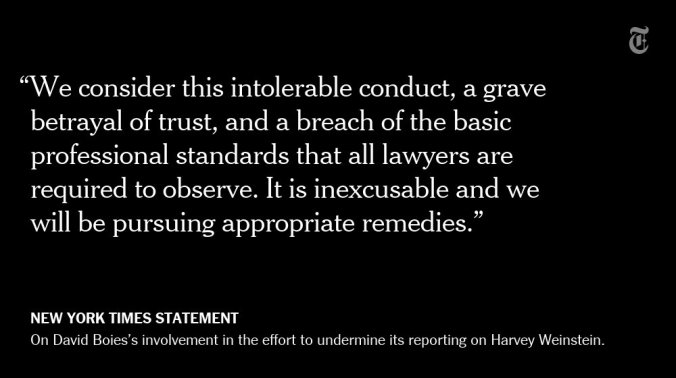
Ethics Quote Of The Week: The New York Times, Regarding Legal Ethics Dunce David Boies’s Ride On The Harvey Weinstein Ethics Train Wreck

There are a lot of ethics issues, legal and otherwise, flying around in the shocking—this really is shocking—revelation that lawyer Al Gore’s Supreme Court lawyer (and loser) David Boies was working to help Harvey Weinstein intimidate and discredit the women who were preparing to accuse him of sexual harassment, sexual assault, and rape.

The New Yorker reports in an investigative reporting piece that the Boies firm was retained by Weinstein, and on his behalf hired Black Cube, an investigative company run by former Israeli intelligence agents to prevent the publication of abuse allegations by creating profiles on the targeted accusers, often using pretexting–that is, lies— to gain access to proprietary information. Black Cube’s work included psychological profiles and sexual histories of the potential Weinstein accusers. The engagement with Black Cube  was presumably run through Boies Schiller Flexner  to place the shady matter under attorney-client privilege.

David Boies personally signed the contract with Black Cube, which, according to the New Yorker, was to obtain ” intelligence which will help the Client’s—that is, Weinstein’s— efforts to completely stop the publication of a new negative article in a leading NY newspaper” and to “obtain additional content of a book currently being written [that] includes harmful negative information on and about the Client.”

Did you see “Michel Clayton,” where George Clooney played a law firm’s “fixer”? That’s what Boies was doing here. “Fixing.” And fixing is a dirty business.

That “leading NY newspaper” was and is the New York Times, which, as we now know, was readying its own sensational story regarding the accusations against Weinstein.The New York Times was also a client of Boies Schiller Flexner, though on unrelated matters, hence the statement above. Unsurprisingly, the Times has sacked Boies and his boys.

[Aside: Here’s a lawyer ethics practice tip. If a client asks you to contract with a company called “Black Cube,” “CHAOS,’ “The Legion of Evil,” “The Black Hand,” or “Murder, Inc.”, just say no.]

Some ethics questions and answers: Continue reading

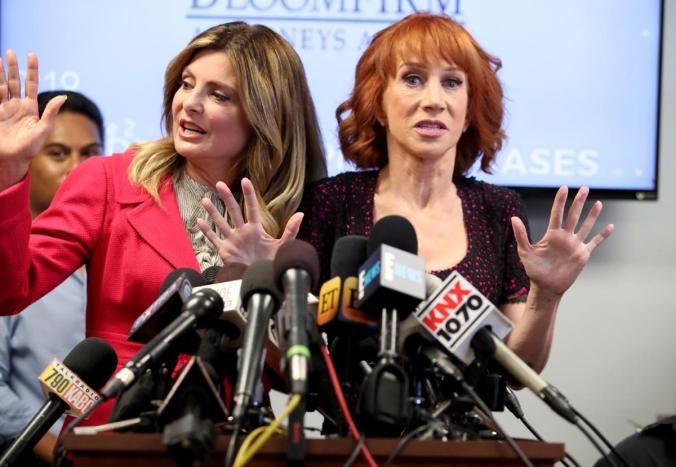
Dear Lisa Bloom, You Unethical Hack: Stop Making Me Defend Kathy Griffin!

I had to get this post up before the Morning Ethics Warm-Up, because it warmed ME up by almost exploding my head.

Lisa Bloom, the daughter of feminist muck-raking celebrity attorney Gloria Allred, has already shown the she has either no regard for legal ethics, or is spectacularly ignorant of them. She has publicly breached the duty of loyalty, attacking her former client, Harvey Weinstein; she took on Weinstein in the teeth of a blatant conflict of interest that she also publicized, as if it was something to be proud of. Yesterday, she showed that she is unfamiliar with, or perhaps just doesn’t give a damn about, the core legal ethics principle of confidentiality, perhaps the most important legal ethics duty of all.

Her latest ex-client to be the victim of Bloom’s unprofessional conduct and disloyalty is Kathy Griffin, she of the severed head. Griffin announced that she had fired Bloom, and wasn’t nice about it—but then when is Griffin ever nice?—saying, “Yes, I got Bloomed. Yes, I didn’t have a good experience with her. Yes, I feel that she and her husband exacerbated my personal situation.” Disaffected clients can say anything they choose about their lawyers. They can do it on Yelp, on the lawyer consumer site Avvo,  to the Hollywood Reporter or hire a skywriter. What a client says, mean or not, untrue or not, still  does not alter a lawyer’s continuing ethical obligations one whit. A lawyer cannot get into a public fight with a former client over what did or did not occur during the representation. Every lawyer knows this, or is supposed to.

Yet Bloom—I would say “incredibly” had we not seen other examples of her professional ethics cluelessness—released this statement on Twitter:

[My head told me in a statement that it would have exploded over this but determined that doing so over Kathy Griffin and Lisa  Bloom was demeaning to head-explosions. I concur.]

The fact that Bloom had prepared Griffin’s remarks for the press conference, the fact that they worked on them together, the fact that Griffin discarded them, the fact the performer “ad-libbed” and “extemporized” are all client confidences. For all we knew, Griffin’s claim during the press conference that she was ignoring her notes was part of a pre-planned strategy.  I assumed it was; Griffin is an actress. “It’s best if you show that you are talking from the heart, Kathy,” is advice I would expect Griffin’s lawyer to give. A lawyer cannot tell the public that a client ignored her advice. Only the lawyer and the client know that. Revealing it is to disclose information the lawyer learned during the course of the representation that will harm or embarrass the client, a serious ethics violation and betrayal of trust Continue reading

Wait, WHAT? I Don’t Understand This Case At All: The Louisiana Lawyer’s Betrayal

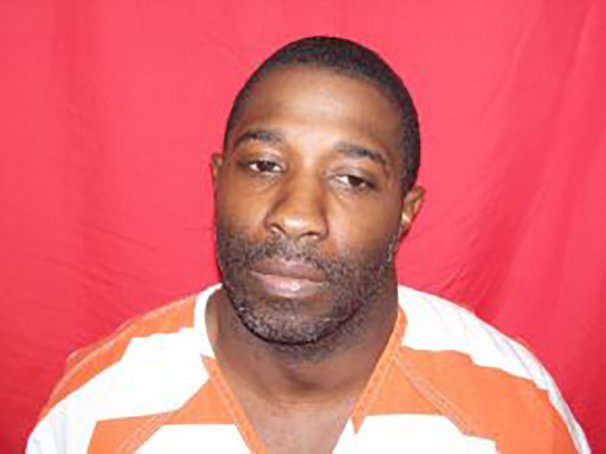
Robert McCoy (above), facing trial for a triple murder in Louisiana, told his lawyer, Larry English, that he was innocent. Someone else had killed the victims, he insisted. English, however, knew better. He wasn’t buying any of it.

“I met with Robert at the courthouse and explained to him that I intended to concede that he had killed the three victims,” Mr. English stated in a sworn statement. “Robert was furious and it was a very intense meeting. He told me not to make that concession, but I told him that I was going to do so….I know that Robert was completely opposed to me telling the jury that he was guilty of killing the three victims,” Mr. English said. “But I believed that this was the only way to save his life.”

English’s theory was that in the state’s two-phase trail system, he would lose credibility with the jury if he insisted McCoy was wrongly charged in the face of overwhelming evidence He wanted to have the trust of the jurors in the second phase, when he would have to argue that they should spare Mr. McCoy’s life.

After the meeting, Mr. McCoy tried to fire his lawyer, saying he would rather represent himself—So would I— but Judge Jeff Cox refused to let English off the case. So, as promised, English told the jury during his opening statement that his client was a triple murderer. McCoy objected in court, protesting, “I did not murder my family, your honor ! I had alibis of me being out of state. Your honor, this is unconstitutional for you to keep an attorney on my case when this attorney is completely selling me out.”

The objection was over-ruled.  McCoy’s lawyer, the judge apparently believed, knew better than his client what his client’s best interests were.

He didn’t though. McCoy was convicted and sentenced to death despite all of that supposed good will, credibility and trust English had built up by throwing his own client under the criminal justice bus.  The victim of this Bizarro World representation appealed the conviction to the Louisiana Supreme Court, saying his lawyer had turned on him. The court ruled against him,  holding that

“Given the circumstances of this crime and the overwhelming evidence incriminating the defendant admitting guilt in an attempt to avoid the imposition of the death penalty appears to constitute reasonable trial strategy.”

Now the United States Supreme Court is going to consider the case, McCoy v. Louisiana, and the question of whether a lawyer who disregards a client’s explicit instruction to plead not guilty has breached the Constitutional right to counsel.

I am stunned.  What question? Apparently this is a thing in Louisiana. “Counsel’s strategic choices should not be impeded by a rigid blanket rule demanding the defendant’s consent,” Louisiana’s lawyers  wrote in a brief urging the court to pass on the case. Since 2000, the Louisiana Supreme Court has allowed defense lawyers to concede their clients’ guilt in four other capital cases over the clients’ express objections.

Good grief. Continue reading

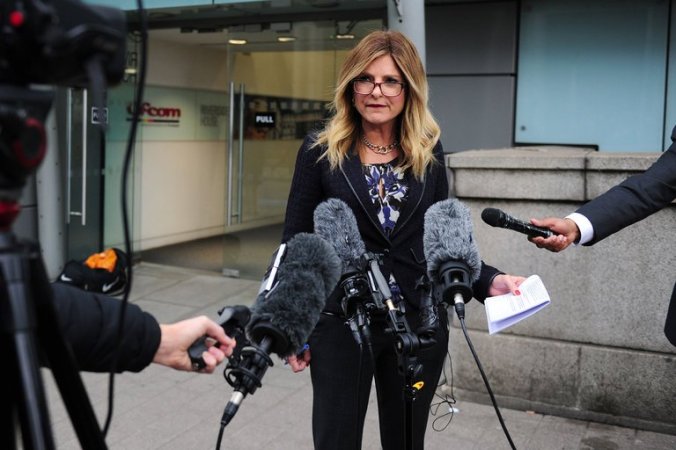
That Settles It, If It Wasn’t Obvious Already: Lisa Bloom Is An Unethical Hack (But I Could Be Wrong…)

Now, don’t sue me, Lisa! Remember what it says in the “About” section (above), this is all just my opinion. When I say you are a stunningly unethical lawyer, that’s just my analysis; it’s true I know something about legal ethics, teaching and consulting on it full time, but I can’t assert my opinion as fact. I can’t read your mind or slog through your soul. I don’t know what a bar disciplinary committee would decide, though I know this is a famously gray area in legal ethics, so unethical conduct is unlikely to be punished.  And when I say you’re a hack, remember that “hack” isn’t a description subject to objective proof, any more than, say, “asshole.” Perhaps your definition of “hack’ is different from mine. In fact, I’m sure it is.

That said, your conduct is a professional disgrace. I think. Who knows? I may be wrong.

In an interview with BuzzFeed News published this weekend, Bloom, speaking of her recently terminated representation of Harvey Weinstein, said

“I can see that my just being associated with this was a mistake. All I can say is, from my perspective, I thought, ‘Here is my chance to get to the root of the problem from the inside. I am usually on the outside throwing stones. Here is my chance to be in the inside and to get a guy to handle this thing in a different way.’ I thought that would be a positive thing, but clearly it did not go over at all.”

Bloom added that she will no longer represent men accused of sexual misconduct, “even those who convincingly tell me they are innocent….I will just make the best choices I can out of every situation. I have clearly not been successful. I think anybody who does big bold things fails. And I definitely failed on this one.”

What Bloom has failed at is called “being a trustworthy and competent lawyer.”

The next day, during an appearance on Good Morning America, Bloom even more explicitly threw her former client under the metaphorical bus:

“It’s gross, yeah,” Bloom told GMA. “I’m working with a guy who has behaved badly over the years, who is genuinely remorseful, who says, you know, ‘I have caused a lot of pain.’”

Did Bloom actually graduate from law school, or did she just apprentice in her mother’s office (she is Gloria Allred’s daughter) and somehow get an honorary license? Did she never learn about the a lawyer’s duties of loyalty and confidentiality? She obviously didn’t know about conflicts of interest, since she represented Weinstein while agreeing to let him turn her book into a TV miniseries.

Ethics Alarms has previously criticized lawyers who have publicly undermined their former clients. The most recent example  was last year, when a former Trump lawyer used his experiences while representing the future Presidential candidate decades earlier to write a scathing mid-campaign attack on his former client in the Huffington Post. I wrote,

There is strong disagreement in the profession about whether the answer to “Is this unethical?” should be an outright yes. The status of loyalty among the legal ethics values hierarchy is as hotly contested now as it ever has been. If a lawyer wants to attack a former client in a matter unrelated to the representation and no confidences are revealed in the process, is that a legal ethics breach? If it is, it would be a very tough one to prosecute. I think it’s a general ethics breach, as in wrong and unprofessional. It is disloyal, and clients should be able to trust their lawyers not to come back years later, after a client let the lawyer see all of his or her warts, and say, “This guy’s an asshole.” It undermines the strength of the public’s trust in the profession.

Continue reading

Ethics Dunce: The NAACP. A Really Bad One…

The NAACP, once a heroic and invaluable champion of civil rights, has apparently completed its devolution into a hyper-partisan, race-baiting collection of venal, divisive  hacks. It has been said that every cause inevitably becomes a racket, and the NAACP is now a prime and tragic example.

How do we know this? We know this because the organization has called the decision (finally) by Dallas Cowboys owner Jerry Jones to command his player to stick to what they are paid for—football and only football—when they are on the playing field, and to stand for the National Anthem “a public commitment by an NFL owner to violate his players’ Constitutional right to free speech.”

This is more than merely ignorant, though if genuine the statement would be unforgivably ignorant for a civil rights organization: a civil rights organization that doesn’t know what civil rights are and what the Bill of Rights means is useless as well as without credibility.

That, however, is impossible. The NAACP has lawyers; their lawyers aren’t idiots. They know that the First Amendment has no relevance or connection to the silly NFL players’ kneeling stunt during the National Anthem. The lawyers had to have informed the NAACP leadership of this, as if that was necessary, which it almost certainly was not. The leadership has to know better than to make this junior high school level civics mistake. No, in this case the NAACP is lying. It is deliberately misinforming the people who depend on it to lead on civil rights, and who trust the organization to be able to support its position with facts and law. It is doing this to inflame passions and worsen the racial divide. What other reason could there be? Continue reading

From The “Stop Making Me Defend Lawrence O’Donnell!” Files: The Golden Rule

A video has gone viral, mostly thanks to conservative websites and blogs, of MSNBC host Lawrence O’Donnell having an extended meltdown during the taping of his show, full of vulgar, expletive-laden explosions at his staff. Mediaite, the media gossip and news site, first released the video, and stitched together the multiple tantrums to make O’Donnell look especially ridiculous.

The tape resembles some classic moments from “SCTV on the Air,” the satirical syndicated ensemble comedy show ( with John Candy, Eugene Levy, Andrea Martin, Catherine O’Hara, Ric Moranis, Joe Flaherty and Dave Thomas) that chronicled the mishaps of a struggling, fictional local TV station. It is indeed funny watching a news anchor lose it, and once he blows his gasket, O’Donnell is spectacular

You will not see Ethics Alarms criticizing O’Donnell, however. Nor will I link to the video.  (The clip of Steve Martin In “Planes, Trains, and Automobiles” erupting at an airport rental car employee is as close as I will get.)  I know that I would be humiliated if one of my own bad moments during my work day, or after it, were surreptitiously videotaped and then leaked to the individuals I would least want to see it. I have had episodes, in the sparsely populated ProEthics offices, when stress, frustration, a series of horrible events and my own ineptitude have caused my emotions to boil over, and the resulting displays have not been something I would want shown to my grandchildren. If there is anyone who hasn’t had such episodes, I am awash in admiration.

I came close to having one today, in fact, after a string of annoyances was capped by the receipt of a summons from a deranged former commenter here, who is suing me for defamation because he says I was mean to him (I was; he deserved it) and wants me to pay him $100,000.  The suit is groundless and pure harassment, but I have better things to do with my time than deal with such things, and that did it for me.

My tirades are much more creative and active than O’Donnell’s. Also louder. Ask my wife.

There are few talking heads that I admire less than Lawrence O’Donnell. He is nasty, perpetually angry, and so left-biased that his head probably doesn’t turn to the right. I have been in the dark place where he was, however, and will be again. The only difference is that I do not have working with me the kind of unethical, vicious, back-stabbing  subordinates who would leak a video just to hurt me and my career. Continue reading