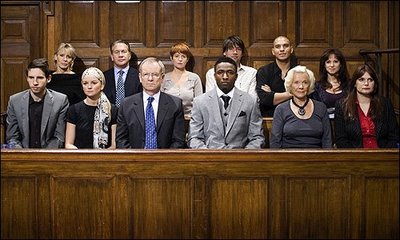
“Worlds Are Colliding!” If You’d Like To Meet The Ethicist And Blogger, Come See “Twelve Angry Men” And Meet The Director

12show_men

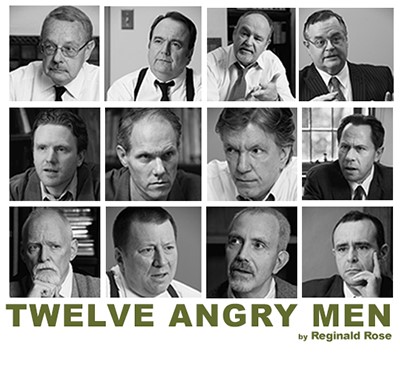
I’ve now received sufficient inquiries from readers to justify the risk of colliding my worlds as a professional stage director, an ethicist and a blogger.

The final production of my quixotic theater company in Arlington, Virginia, “Twelve Angry Men” by Reginald Rose, is playing through August 8. After that, the American Century Theater closes its metaphorical curtains (we perform in a black box theater, in the round for this show) forevermore after 2o rewarding, daring, frustrating years. I know a lot of Ethics Alarms readers live in the Washington D.C, area, and I would love to meet you face to face for a change, which, if you come to a performance, is easy (though you have to let me know when—I don’t see every one.)

You can get information and make reservations here; there are some representative reviews of the show here and here.  Some background on the theater’s closing is here. I’ve written about some ethics issues in the movie (which is the script I directed for the stage) here, here and here.

For many reasons, this is as good a version of the story as you are ever likely to see, and in all honesty and modesty, that includes the classic movie. The script is better live on stage than on film (it is about all the jurors and the jury as a unit, not just Henry Fonda), it cannot be done justice on a proscenium stage; the cast is superb, and the director is a lawyer, an ethicist and a successful stage director who has studied the script for 30 years and directed it three times before to work the kinks out.

If you come, I’ll seat you myself.

Hope you can make it.

Update: You can hear a podcast, hosted by me, about the production here.

Ethics Hero: The “Lone Juror,” Adam Sirois

Juror 8

Two lone jurors…

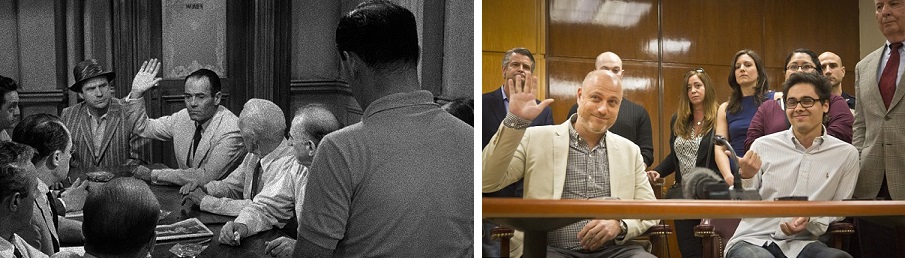
In a remarkable example of life imitating art, a single juror, a 41-year-old health care worker, refused to vote guilty with the rest of the jurors deliberating on the case against the accused murderer of Etan Patz, a little boy whose disappearance in 1979 focused national attention on the child predator problem.  The defendant, Pedro Hernandez, had delivered an elaborate confession to police, then revoked it. For 18 days, Adam Sirois battled the eleven other jurors, who told him that they were convinced by the evidence beyond a reasonable doubt. Sirois, however, said he had doubts, too many to send a man to prison for life. In the end, the vote was 11-1. Yesterday, the judge in the case pronounced the jury deadlocked—hung— and declared a mistrial.

Sound familiar? If Sirois was made the hero of a cable TV  adaptation, it would be considered a shameless knock-off of “12 Angry Men,” the iconic 1957 jury film that originated as a live TV drama by the late Reginald Rose: Continue reading

Comment of the Day: “Pop Ethics Quiz: Welcoming Rev. Talbert Swan, Late Passenger On The Trayvon Martin-George Zimmerman Ethics Train Wreck”

"OK, you can go, but we want everyone to know that the US Government thinks you're a racist and a murderer."

“OK, you can go, but we want everyone to know that the US Government thinks you’re a racist and a murderer.”

The Justice Department’s press release  yesterday regarding the final rejection of a civil rights charge against George Zimmerman was despicable and unprofessional, political, as everything Holder’s department has done from the beginning, unethical,and an abuse of its power and influence.

Raising this  issue adeptly is reader J. Houghton in his Comment of the Day on the post, Pop Ethics Quiz: Welcoming Rev. Talbert Swan, Late Passenger On The Trayvon Martin-George Zimmerman Ethics Train Wreck. He ends with a question; I’ll return to answer it.

I am curious about the statement by Acting Assistant Attorney General Vanita Gupta that: “Our decision not to pursue federal charges does not condone the shooting that resulted in the death of Trayvon Martin and is based solely on the high legal standard applicable to these cases.” It seems almost like an unnecessary statement of the obvious, like, yes of course; this is a tragedy; mistakes were made; bad judgment happened; and somebody died needlessly. Of course, we all would hope that such tragedies “do not occur in the future” as the JD press release stated… ever! this is a most wonderful thought.

However, what exactly is it that the Justice Department does “not condone” ? Is it possible that General Gupta is suggesting that the Justice Department does not buy into the basic idea of shooting someone in self-defense if believed necessary to protect ones self, or perhaps she questions the basic idea of being legally allowed to carry a concealed handgun by permit for self-defense? Or is she questioning the wisdom of the Neighborhood Watch program which might encourage citizens to… God forbid… watch too closely the goings on in their neighborhoods? What exactly is it that the Justice Department does “not condone” in this particular case?

Not to say that the claim of “self-defense” is always justified… because it most assuredly is not. Nor am I defending in any way Zimmerman for the events that unfolded with very unfortunate results. But I am wondering about the chill this incredibly long and ultimately fruitless federal investigation might put on the fundamental right of self defense to protect ones self or others who might find themselves in the position of facing a real threat. Are citizens going to possibly face federal prosecution in the future for becoming “too involved” in the security of their own neighborhoods, or for protecting themselves or their neighbors if the unlawful aggressor and righteous defender in a specific incident happen to be of the “wrong” ethnicity or race?

Just asking…

Continue reading

Pop Ethics Quiz: Welcoming Rev. Talbert Swan, Late Passenger On The Trayvon Martin-George Zimmerman Ethics Train Wreck

George Zimmerman memes

Quick:

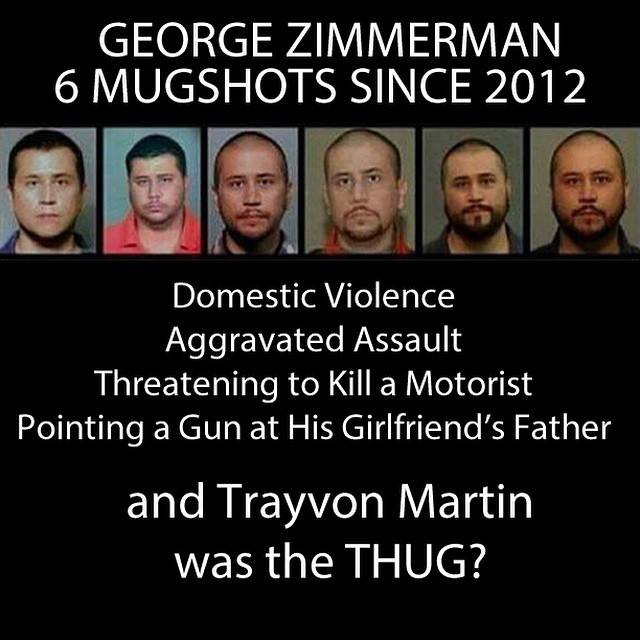
Name everything ethically and logically wrong with this meme.

While you’re making your list, I’ll explain.

It comes courtesy of Talbert Swan–website here, Facebook page here-— who tweeted it to his many followers, lots of whom then dutifully posted it on Facebook. Swan describes himself as a “public figure.”  He is, we learn, an activist, pastor, author, radio talk show host, NAACP president, National Chaplain, Iota Phi Theta Fraternity, Inc. Assistant General Secretary of the Church Of God In Christ. He is also, on the evidence of circulating this meme, a divisive race-baiter who is ignorant of the law, ethics and logic.

Swan sent out this graphic offal with all the typical hashtags: #Trayvon…#MikeBrown…#Ferguson, #Blacklivesmatter and the rest. I would normally just ignore it—I see idiotic memes every day—but this one was posted with approval by a Facebook friend of mine who is objectively brilliant and educated, and justly respected by many, including me. His comment ended with “Case closed!”, and immediately dozens of people “liked” it, many of them undoubtedly then spreading the meme further to make others more ignorant and stupid too. This is affirmatively harmful. Since I know my friend is a good person, the ethics breach is that of responsibility, competence, fairness, and citizenship, the latter because I think promoting racial distrust is being a bad American.

Have you tallied up all the things wrong yet? Here’s my list: Continue reading

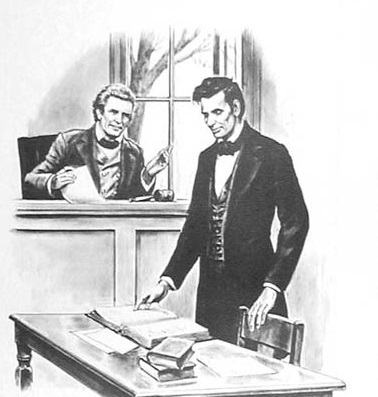
Abraham Lincoln: Good Lawyer, Bad Lawyer, Conflicted Lawyer

Lincoln in trialI recently quoted a fairly well-known section from some notes Abe Lincoln made for a lecture he was to present to young lawyers in 1850. Some of you asked if would post the whole document, which I am happy to do. Here it is:

I am not an accomplished lawyer. I find quite as much material for a lecture in those points wherein I have failed, as in those wherein I have been moderately successful. The leading rule for the lawyer, as for the man of every other calling, is diligence. Leave nothing for to-morrow which can be done to-day. Never let your correspondence fall behind. Whatever piece of business you have in hand, before stopping, do all the labor pertaining to it which can then be done. When you bring a common-law suit, if you have the facts for doing so, write the declaration at once. If a law point be involved, examine the books, and note the authority you rely on upon the declaration itself, where you are sure to find it when wanted. The same of defenses and pleas. In business not likely to be litigated, — ordinary collection cases, foreclosures, partitions, and the like, — make all examinations of titles, and note them, and even draft orders and decrees in advance. This course has a triple advantage; it avoids omissions and neglect, saves your labor when once done, performs the labor out of court when you have leisure, rather than in court when you have not. Extemporaneous speaking should be practised and cultivated. It is the lawyer’s avenue to the public. However able and faithful he may be in other respects, people are slow to bring him business if he cannot make a speech. And yet there is not a more fatal error to young lawyers than relying too much on speech-making. If any one, upon his rare powers of speaking, shall claim an exemption from the drudgery of the law, his case is a failure in advance.

Discourage litigation. Persuade your neighbors to compromise whenever you can. Point out to them how the nominal winner is often a real loser — in fees, expenses, and waste of time. As a peacemaker the lawyer has a superior opportunity of being a good man. There will still be business enough.

Never stir up litigation. A worse man can scarcely be found than one who does this. Who can be more nearly a fiend than he who habitually overhauls the register of deeds in search of defects in titles, whereon to stir up strife, and put money in his pocket? A moral tone ought to be infused into the profession which should drive such men out of it.

The matter of fees is important, far beyond the mere question of bread and butter involved. Properly attended to, fuller justice is done to both lawyer and client. An exorbitant fee should never be claimed. As a general rule never take your whole fee in advance, nor any more than a small retainer. When fully paid beforehand, you are more than a common mortal if you can feel the same interest in the case, as if something was still in prospect for you, as well as for your client. And when you lack interest in the case the job will very likely lack skill and diligence in the performance. Settle the amount of fee and take a note in advance. Then you will feel that you are working for something, and you are sure to do your work faithfully and well. Never sell a fee note — at least not before the consideration service is performed. It leads to negligence and dishonesty — negligence by losing interest in the case, and dishonesty in refusing to refund when you have allowed the consideration to fail.

There is a vague popular belief that lawyers are necessarily dishonest. I say vague, because when we consider to what extent confidence and honors are reposed in and conferred upon lawyers by the people, it appears improbable that their impression of dishonesty is very distinct and vivid. Yet the impression is common, almost universal. Let no young man choosing the law for a calling for a moment yield to the popular belief — resolve to be honest at all events; and if in your own judgment you cannot be an honest lawyer, resolve to be honest without being a lawyer. Choose some other occupation, rather than one in the choosing of which you do, in advance, consent to be a knave.

This is uniformly excellent, and justly cited to show Lincoln’s high ideals as a man and a professional. This quote, however, is also cited for that purpose, and I am not so fond of it. Since it comes to us second-hand, a.k.a as hearsay, from Lincoln’s law partner, friend and biographer William Herndon, I hesitate to hold it against him too much, for it may be a misrepresentation. I am more concerned with the fact that what follows is sometimes packaged with the notes above, as if they are equally worthy of emulation. No, they are not. Continue reading

Ethics Dunce: Republican Governors Association…And An Integrity Test For Chris Christie

This ugly beast keeps raising its head out of the muck, and it is the duty of every citizen, Republican or Democrat, who believes in justice and due process under law to beat it back with heavy clubs.

The Republican Governors Association is defending one of its own, South Carolina Gov. Nikki Haley, with a series of ads attacking state Sen. Vincent Sheheen, an attorney who is her Democratic opposition in the gubernatorial race. The message of the ad, as summarized by  a voice-over, is that “Sheheen defended violent criminals who abused women and went to work setting them free.”

False. Continue reading

Update: “The Kidneys of Orlac”

He will die, not with his boots on, but with his kidneys in...

He will die, not with his boots on, but with his kidneys in…

One of the best threads Ethics Alarms has ever hosted occurred in response to the November 2013 post, “The Kidneys of Orlac,” which discussed the strange case of the Ohio death row resident who wanted to donate his organs to ill relatives. The issue generated an Ethics Quiz, a follow-up poll (“The Amityville Kidney”) involving the related issue of whether the recipient of a murderer’s organs had a right to know their creepy origin, and a terrific Comment of the Day, which was just one of the COTD-worthy submissions.

I had forgotten about the story until Mark Draughn raised it again at Windy Pundit in the context of criticizing bioethicists, one of whom had what Mark considered a particularly misbegotten argument against the transplants (I agree with Mark about that argument, but I also oppose giving condemned prisoners the privilege of donating organs to loved ones, or anyone at all.) This led me to review original post, which led me to re-read the comments.

I also discovered the resolution of the dilemma, which occurred at the end of last month. Ronald Phillips will not be allowed to donate his organs, because he wouldn’t have enough time to recover from the operation before his execution.  Ah, yes, the old “You have to be in tip-top shape before we can kill you, or it isn’t really punishment”  Catch 22! Ethics, you see, had nothing to do with the bureaucratic resolution here, just the letter of the law, rules, and bureacrats refusing to look for the best solution in an anomalous situation, rather than the one they could reach on auto-pilot. As a result, nobody made a reasoned determination about what is right, or what capital punishment really signifies, or apparently even tried. That is how so many government decisions are made, and that, my friends, is far scarier than having the kidneys of a killer.


The “Too Handsome To Rape” Defense

Sharper, Mathis, Ted Bundy.

Sharper, Mathis, Ted Bundy.

For whatever reason, there have been a lot of attacks on the legal profession lately—and some from within the legal profession—because of so-called “disgusting” and “frivolous” arguments by lawyers who are zealously representing their clients. These range from outrage over the so-called “affluenza” defense (which, it apparently does no good to point out, was explicitly rejected by the judge in that case), to the law suit against the Glendale, California memorial to women forced into sexual slavery by the Japanese in World War II, to the argument that Red Sox broadcaster Jerry Remy was complicit in his son’s allegedly murdering his girlfriend because Remy hired a lawyer who mounted a vigorous defense in the son’s earlier domestic abuse arrests.

Lawyers are ethically obligated to advance whatever non-frivolous arguments and theories that are most likely to achieve their clients’ objectives, whether it is avoiding prison or rationalizing the crimes of the Japanese army. That is their job and societal function, and it is essential to our avoiding a jack-boot system where any of us could be thrown in jail by popular opinion or government edict. The laws are there to be used by every citizen, even when the citizen’s objectives are unethical, or when the citizen is a cur.

Our rights are all protected well by this principle, and it’s high time we stopped bitching about it.

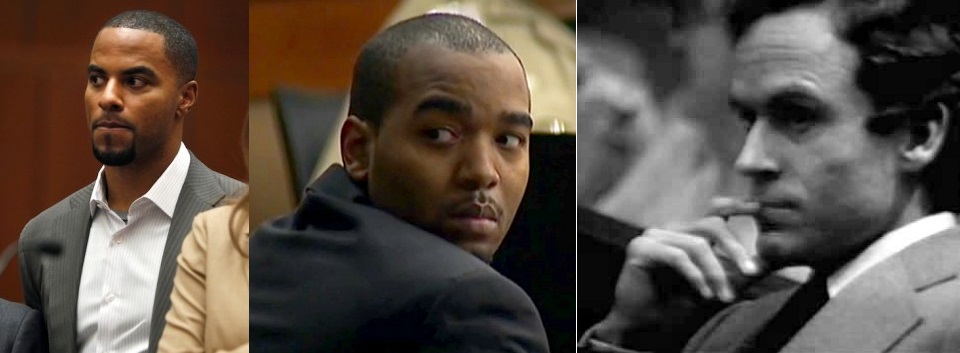
Undeterred by this, however, yet another defense attorney is being savaged in the news media and blogosphere, as well as by women’s rights advocates, for making an argument in defense of his client that they find offensive. In Georgia, Darriuos Mathis and his legal team are making the argument, among their efforts to show that the evidence against him is not sufficiently conclusive, that Mathis is too attractive--fit, handsome, sexy– to have to resort to kidnapping and raping a 24-year-old woman two years ago, which is what he charged with.

Continue reading

Ethics Note To CNN’s Don Lemon: “Beyond A Reasonable Doubt” Is A Stringent Standard And The Jury Knows Best…And I’m Withdrawing My Endorsement For President

Stop blaming the juries!

Stop blaming the juries!

Once again, a criminal trial with racial overtones has caused an outbreak of criticism over a jury verdict and the jury system, by those who have a professional obligation to know better.

This time, it’s the so-called “loud music case,” that just ended with the accused, Michael Dunn, convicted of four charges (three of attempted second-degree murder) with the fifth charge, first-degree murder, resulting in a jury stalemate. Dunn claimed that he acted in self-defense when he repeatedly fired a gun at an SUV containing four African-American teens in 2012, over an altercation regarding their playing music too loudly. One of those teens, unarmed 17-year-old Jordan Davis, was killed by his gunfire.

CNN news anchor Don Lemon, in a series of rants on his show and also on Twitter, announced to his audience that Dunn should be convicted of first degree murder, and that Lemon would be outraged if he was not. Continue reading

Thank You, Washington Post “Fact Checker” Glenn Kessler For Being The Best Ethics Alarms Ethics Dunce EVER!

I must say, this is the sort of thing that makes the heart of an ethicist, or at least this ethicist’s, swell with joy as the strains of “Ah, Sweet Mystery of Life At Last I Found You!” take control of his brain, and the song bursts, full-blown and soaring, from his lips…You’ll have to excuse me…

Glenn Kessler’s “Fact Checker” column in today’s Sunday Post is a cornucopia of wonderful topics, including…

  • The dishonest conduct of media “fact-checkers” in using their columns not to dispute facts but to take issue with opinions, usually on partisan grounds, with which they disagree.
  • The misuse of “lies” and “lying” to describe either mistakes or opinions, neither of which are lies.
  • People who lie themselves while accusing others of lies.
  • Fact-checkers who misstate facts while accusing others of misstating facts.
  • The common misunderstanding that “consent” makes a boss’s sexual relationship with his or her subordinate ethically acceptable.
  • Rand Paul!
  • Bill Clinton!
  • Rand Paul attacking Bill Clinton!
  • ANYONE defending Bill Clinton’s conduct involving Monica Lewinsky.
  • The news media’s already evident intent to defend against all attacks, direct or oblique, on the liberal establishment’s choice for President in 2016, Hillary “The First Enabler” Clinton.

It just doesn’t get much better than this.

Let us begin with the root of Kessler’s  column and his inspiration, this statement by Sen. Rand Paul (R-Ky): Continue reading