From “Psychology Today”: How To Be A Better Liar—And A Negligent Endorsement Of Deceit

Tommy Flanagan

“Psychology Today” has tips for Tommy Flanagan and the other aspiring liars out there.

Jeff Wise provides what he calls “The Ten Secrets of Effective Liars” on the “Psychology Today” website. I have some problems with his list, among them that despite his protestations to the contrary, it sure reads more like a handy-dandy self-help list for the George Costanzas, Tommy Flanagans and Bill Clintons among us.

My main objection, though, is to his #3 on the list, #3 Tell the truth, misleadingly. He correctly points out that a statement that is technically true will often be the most effective way of misleading others, but writes, “Technically, it’s only a prevarication – about half a sin.” I don’t know or care about how it ranks on the sin scale, but he is describing deceit, and deceit is a lie, period, no question about it. Wise is passing on a misconception himself, one that allows the most effective and destructive liars among us deceive routinely and then rationalize that they “really weren’t lying.” Spreading this common, popular and useful—to liars—myth does more damage than any of the supposedly beneficial results of his list could make up for.

Among the sinister results of promoting deceit as only half a lie, and therefore twice as forgivable as a “real” lie, is that it gives deceit masters (like Clinton) an effective excuse when they are caught. “Oh! Oh, I’m sorry! When I said ‘I didn’t have sex with that woman,” you thought I meant that I didn’t use my superior power and influence to persuade my young female intern to give me a hummer! I should have been clearer!” Right. Thus the liar switches the real blame onto the listener who was originally deceived. If that listener likes the liar and was inclined to trust him (or her), the rationalization that it was all a big misunderstanding will often be enough to allow the party deceived to keep trusting the liar…and be set up to be deceived again. Continue reading

Stop Picking On Mike Tyson

This time, it wasn't your fault, Mike.

This time, it wasn’t your fault, Mike.

“Law & Order: SVU” cast former heavyweight boxing champ Mike Tyson as a prisoner and past victim of child abuse victim, who murdered one of his abusers. The episode bombed for the NBC show during the crucial “sweeps” ratings period, and Washington Post TV writer Lisa De Moraes attributes the failure to the show’s insensitivity in casting Tyson.  She wrote in today’s Post,

“Before the episode aired, about 7,000 people signed a petition asking NBC to recast the role. The petition was created by an ardent “SVU” fan who is a rape survivor and who said she felt betrayed by the stunt casting. Among those who signed the petition: “NCIS” star and abuse survivor Pauley Perrette. Tyson was arrested in 1991 and charged with raping then-18-year-old Miss Black America pageant competitor Desiree Washington; he was convicted and served three years of a six-year prison sentence.”

If the “Law and Order” producers erred in casting Tyson, it was in under-estimating the fecklessness, bias and hypocrisy of the viewing public.  Continue reading

Ethics Catch-Up: The Revolting Hillary Clinton Testimony

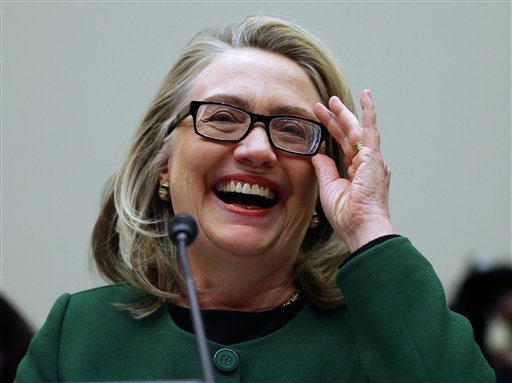
No wonder she's laughing.

No wonder she’s laughing.

I know I neglected my duty to highlight a truly nauseating example of American political shams at their worst with last week’s dual appearances by outgoing Sec. of State Hillary Clinton on the Hill, where she was ostensibly going to inform Americans what really happened in Benghazi, and why. I apologize. I was preoccupied with the earth-shattering matter of  Beyonce’s lip-syncing, and also, I admit, was having a hard time enduring both Lance Armstrong’s act and a Clinton performance in such close proximity. I’m only human, after all. Still, I need to go back a week and examine, if briefly, the ethics stinker that was Hillary on the Hill:

1. Members of this administration keep using the word “responsibility,” but to paraphrase Inigo Montoya, I don’t think the word means what they think it does. Clinton had stated unequivocally that she “accepted full responsibility” for the Benghazi tragedy in October, reiterated that statement last week, and then repeatedly shifted the blame to others or otherwise denied responsibility. She wasn’t responsible for the decisions regarding security, she said. It wasn’t her fault that she didn’t know about cables from Ambassador Stevens’ a month earlier requesting more protection, because “1.43 million cables come to my office. They’re all addressed to me.” Well, who’s “responsible” for a system in which urgent, perhaps life and death messages not addressed to the Secretary of State never reach her desk? She blamed a lack of funding ( a claim that appears to be untrue) was also responsible for the tragedy, and naturally, she can’t be held responsible for that. Clinton’s definition of “responsibility” reveals itself during her testimony as meaning responsible for fixing the problems and systemic failures that led to the deaths of the four Americans, but not really accepting responsibility for what happened–responsibility, in other words, without accountability. Continue reading

The Newtown Massacre Ethics Train Wreck Picks Up An A-Lister!

I know—I need to settle on a consistent name for this particular train wreck. I’ve used at least three. Luckily, it is clearly going to be rolling along, causing ethics havoc in its wake, long enough for me to be consistent.

Hey, everybody! Bubba's on board!

Hey, everybody! Bubba’s on board!

Wow! They must be all-tingly on the Newtown Massacre Aftermath Express–Bill Clinton! The architect of one of the great ethics train wrecks of American history has deigned to come on board! What other A-listers will follow? Oprah? David Letterman? Even the President himself! Now, anything is possible.

The nation’s grandmaster liar bought his ticket with this Newtown-inspired statement, uttered at the Consumer Electronics Show in Las Vegas, Jan. 9, 2013

“Half of all mass killings in the United States have occurred since the assault weapons ban expired in 2005, half of all of them in the history of the country.”

This was classic Bill, false and self-glorifying. After all, that ban that expired had been signed into law by Bubba himself. But as the Washington Post’s fact-checker, Glenn Kessler confirmed, his striking “fact” was a whopper. Continue reading

Lance Armstrong and the Sociopath’s Dilemma: When Honesty Is No Longer Ethical

Welcome to the club, Lance.

Welcome to the club, Lance.

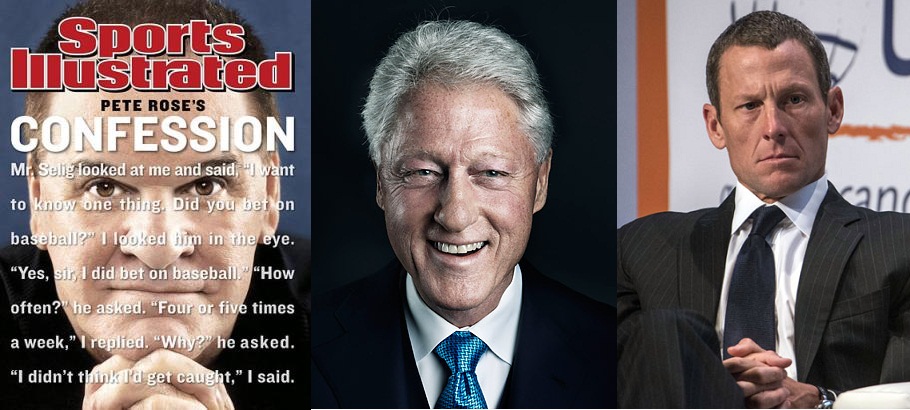
Rose

In 2004, 15 years after he had been banned from baseball after a finding by the Major League Baseball’s Commissioner’s Office that he had violated the games rules against betting on Major League Games, Pete Rose publicly admitted that his denials over that time were all lies. Yes, he had bet on baseball, and he was very, very sorry. Rose’s admission did little to change the verdict in and out of baseball that he was a rogue and a liar. His confession was obviously part of a cynical and calculated strategy to get reinstated in the game, after the strategy of denial and waiting proved ineffective. In addition, Rose needed money, and the confession was part of the hook for his new autobiographical book, which was released at the same time he withdrew his protestations of innocence.

For Pete Rose, honesty was not an ethical value that he respected or returned to in penance after years of straying. It was just another means to an end.

Clinton

In 1998, President Bill Clinton was in the midst of the Monica Lewinsky scandal, denying that he had ever “had sex with that woman.” He called up his old friend, advisor and pollster, Dick Morris, and asked what he should do. Together they decided that Morris ought to take a poll to see what the public’s reaction would be if Clinton retracted his denials and admitted the affair. Morris reported back, after taking such a poll, that while the public would forgive the sexual relationship, anger over the President’s untruthful denials might sink his administration. Clinton decided that honesty would not work to his advantage, and continued to lie.

To Bill Clinton and Morris, honesty was just one of several tactical options to solve a political crisis. If had nothing to do with ethics, or doing the right thing.

Armstrong

It is 2013, and the New York Times reports that Lance Armstrong, now stripped of all his cycling titles, banned from athletic competition worldwide and separated from his commercial sponsors and the cancer charity that bears his name,

“has told associates and antidoping officials that he is considering publicly admitting that he used banned performance-enhancing drugs and blood transfusions during his cycling career, according to several people with direct knowledge of the situation. He would do this, the people said, because he wants to persuade antidoping officials to restore his eligibility so he can resume his athletic career.”

Armstrong, it is clear, is traveling in the well-worn and slimy footsteps of Rose and Clinton, fellow sociopaths to whom conscience, shame, contrition and remorse are alien concepts and for whom atonement and redemption are just games to win, with honesty being an indispensable, if unpleasant, tactic. When one is considering whether or not to be honest and admit what one has long denied based on cold calculations of personal costs and benefits, truth-telling is no longer a matter of ethics, or doing the right thing regardless of consequences. It is merely another weapon, along with lies, manipulation, deceit and posturing, in the arsenal of one of the lifetime predators whose sole goal in life is to prevail and profit over the rest of the trusting suckers who share the Earth with them, and who will do anything, even to the extent of briefly embracing ethical principles, to get what they want.

Should he decide to finally admit what everyone knows and he has long denied, even to the extent of suing those who declared his guilty, Lance Armstrong should be seen as no more ethical or noble than the criminal who pleads guilty in court on the advice of his lawyer, because the evidence is overwhelming, conviction is certain, and confession is the only route to a lighter sentence.

Individuals like Pete Rose, Bill Clinton and Lance Armstrong defile ethical values by their brief embrace of them.
Most Cynical and Hypocritical Statement of the 2012 Campaign: Bill Clinton

 “Who wants a president who will knowingly, repeatedly tell you something he knows is not true?”

—-Bill Clinton, speaking at an Obama rally in Pennsylvania.

Unbelievable shamelessness, even for Clinton.

Yeccch.

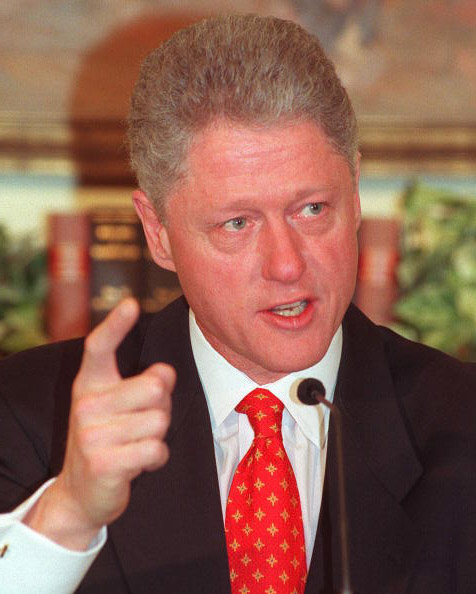
Gee, I don’t know why I picked this particular photo. I just like it, I guess. I wonder what Bill was saying?

I don’t know who disgusts me more, the impeached ex-president who has the gall to utter this after repeatedly lying about Monica Lewinsky, or the values-challenged fools that would listen to him insult their intelligence like that and not walk away laughing.

Democrats disgrace themselves by allowing this man to represent them, and that applies to the President as well.

“The Girl” and the Hitchcockian Horrors of Sexual Harassment

“Mr. Hitchcock requests your company in his hotel room over dinner.”.

HBO’s original film “The Girl” has premiered, and has garnered mixed reviews from critics, in part because they recoil from the film’s disturbing portrait of iconic director Alfred Hitchcock, played here by the great Toby Jones, who is almost as uncanny evoking Hitch as he was reincarnating Truman Capote in “Infamous.”  It tells the well-documented story of how Hitchcock chose newcomer Tippi Hedren as his latest blonde obsession (placing her in line behind Grace Kelly, Kim Novak, Ingrid Bergman, Janet Leigh and others) and then relentlessly pursued a sexual relationship with the actress during the filming of “The Birds” and “Marnie.” Hedren, not surprisingly, found him about as alluring a potential sex partner as Hermione would regard Dobby the house elf. Less so, probably. Unlike so many actresses subjected to that kind of extortion as their final obstacle to stardom, however, Hedren refused to submit.

The movie is the most powerful and harrowing, portrayal of sexual harassment I have ever seen, and whatever its fate as a dramatic work, “The Girl” has a future, if anyone’s paying attention, in workplace training sessions. Continue reading

Why Journalists Can’t Shoot Straight

George probably wasn’t lying, but Bill sure was.

The issue in the Washington Post’s weekly Outlook section concerned the virtues and dangers of honesty in a Presidential campaign, a matter that interests me from the perspective of ethics, presidential history, and citizenship. Two Post reporters were given the assignment of creating sidebars to the main article, one on candidates who told the truth and were punished for it, the other on campaign lies that came back to haunt the Presidents involved.

These are not difficult assignments, by any means. Either would be a legitimate term paper topic for a high school senior’s history class; both would be rejected as a history major’s thesis topic as overly simplistic. Yet both Rachel Weiner and Aaron Blake botched their tasks, and would have earned D’s at best in high school history, and that’s only because of grade inflation. The reasons for their failures exemplify the inadequacy of the mainstream media for the job we need it to do during a Presidential election.

Continue reading

When Your Genius Is A Dunce: The Depressing Self-Outing of Rays’ Manager Joe Madden

I trusted you, Joe. You broke my heart..

Organizations and institutions tell us a lot about themselves by the individuals they hold up as exemplary. To cite an example much on my mind these days, the conservative blogosphere’s canonization of the late Andrew Breitbart, master of the intentional half-truth, makes me dubious about its reliability and integrity. On  the other side of the spectrum, the fact that so many Democrats, and especially Democratic women, worship Bill Clinton reflects horribly on their values and tolerance for hypocrisy. Now, in the wake of Roger Clemens’ well-deserved acquittal for denying under oath acts that he almost certainly did, we have strong confirmation that a prominent individual Major League Baseball holds up as exemplifying, in the immortal and irritatingly pretentious words of “Terence Mann” about that corn field in Iowa, “all that once was good and it could be again”* is in truth an Ethics Dunce, and a big one at that. His name is Joe Madden, the American League’s 2011 Manager of the Year, and I am disappointed and depressed. (Yes, I have named Joe an Ethics Hero in the past.) Continue reading

Why We Shouldn’t Elect Liars

You can’t tell from the picture, but Senator Kirk’s pants are on fire.

It took a great deal of restraint for me not to write a post after reading the Daily Beast’s Micahel Tomasky’s infuriating essay about the “media witch hunt” against Elizabeth Warren. If there ever was a piece destined to send me over the edge, that was it: not only did Tomasky express indignation that anyone would use Warren’s pose as a minority to impugn her integrity, but he ridiculed concern over her plagiarism as well. Here, however, was the capper: he compared criticism of Warren to the attacks on Bill Clinton during the Monica fiasco, writing,

“The situations are in fact almost precisely the same. You had then a press pack that had decided that whether Bill Clinton was telling the truth about Monica was a question on which the fate of the republic hinged. The press became self-righteously consumed with its search for The Truth. Meanwhile, outside the Beltway, and outside of Wingnuttia (it existed then, just at about half of its current GDP), nobody cared what the truth was. The media kept producing revelations; surely, now, swore Maureen Dowd and Michael Kelly, America will see this man for the reprobate he is! America looked, yawned, told the press to start acting like grownups, and continued to approve of the job Clinton was doing as president at rates near 70 percent and to oppose impeachment at similar levels.” Continue reading