A Fan’s Obligation: 12 Life Lessons From Being a Red Sox Fan

Thanks Carlton. I won't forget.

This is not going to be a fun day.

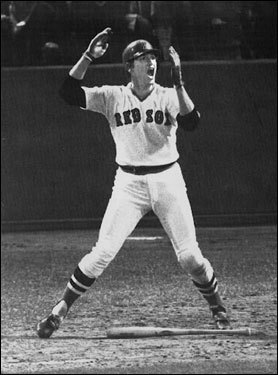
The Boston Red Sox, the baseball team to which I have devoted a remarkable amount of my time, passion and energy over a half-century, are threatening to complete late season collapse of embarrassing and historic proportions. A spectacularly bad month of September has the team holding on to its once assured post-season play-off slot by its fingernails, and the squad appears to be dispirited and unhinged. Today the Red Sox play a double-header with the New York Yankees, the team’s blood-foe, and its prospects don’t look good. I, of course, must watch both games.

Following a losing baseball team is emotionally hard—I listened to or watched every game the Red Sox played in a six year period in which they never had a winning season— but following a collapsing winning team is much, much worse. It feels like a betrayal, yet at the same time the fan feels guilty for being angry with the players, who undoubtedly are suffering more than you are. This is, after all, their career. Still, you have had your hopes raised over many months; you have, if you are a serious fan, attached your self-esteem to your team’s fortunes. Watching it tank is like watching a presidential candidate you have argued for, and gone to rallies for and contributed to make an ass of himself in a debate. (And no, I’m not a supporter of Rick Perry.) Continue reading
Unethical Quote of the Week: Rep. Michele Bachmann

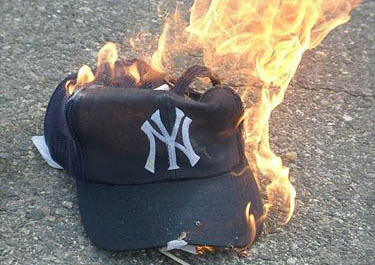
I think Hurricane Irene was sent by God to help the Red Sox. Hear me out! It makes mores sense than Michele's theory!

“I don’t know how much God has to do to get the attention of politicians. We’ve had an earthquake; we’ve had a hurricane. He said, ‘Are you going to start listening to me here?’ Listen to the American people because the American people are roaring right now. They know government is on a morbid obesity diet and we’ve got to rein in the spending.”

—-Rep. Michele Bachmann, GOP presidential hopeful and shameless demagogue, joining the discredited ranks of Pat Robertson, Glenn Beck and others to assert that weather conditions constitute proof that God agrees with her.

You can read my views on this arrogant, manipulative species of idiocy here, here and here.  I’ve written about it too much, and as an American living in the 21st Century, I’m embarrassed that I should have to write about it at all. Continue reading

All-Star Election Cheaters: The Boston Red Sox and the San Francisco Giants

The Major League Baseball All-Star Game team voting by the fans is hardly a model of fair democracy. Most fans vote for their favorites rather than the best qualified players, and are not very informed even about their favorites. They also are guided more by loyalty than analysis, choosing local heroes over more accomplished players from another team. In other words, it’s basically the same as political elections.

Well, there are other factors that make the All-Star Game voting less than admirable. You can vote up to 25 times from each e-mail address, giving an edge to computer geeks. The teams in the biggest cities and with the best attendance have an advantage over the rest, because there are more of their fans voting. And players on teams like the Phillies, Dodgers, Red Sox, and Yankees that are on national TV a lot, along with last season’s World Series adversaries, the Texas Ranger and the San Francisco Giants, have more name recognition nationwide, giving their players another unfair edge.

Still, it is an election, the votes count, and the various franchises should be trying to uphold whatever minuscule smidgen of integrity the current system has. The Boston Red Sox and the San Francisco Giants, however, don’t think they have enough advantages in the  All-Star voting already, and have found a loophole in the rules that allows them to cheat. Continue reading

Comment of the Day: “Schadenfreude, Ethics, and Those Fanatics Inside Us All”

Maybe "The Broadcaster" was all Harry had inside...

Rick elaborates nicely on the theme of my post on handling those fanatic personas that reside in each of us, and in the process takes the ethical measure of an iconic baseball broadcaster whose charms always escaped me…the late Harry Carey.

“It strikes me that there’s another part of the equation, which you only hint at here, but which you have mentioned in other posts. That’s the “ethics alarm” (to coin a phrase) that goes off, or should, when the director or the Red Sox fan or whoever That Guy is says or does something unethical. Part of it is “heat of the moment” stuff: the egoism that slips out in a moment of excitement. No, of course you didn’t want Thurman Munson to die, but yes, he did play for the hated Yankees, and their team just got worse. You’re forgiven the fist-pump. Once. And provided you (Jack, as opposed to Red Sox fan) didn’t mean it.

“I was watching a Cubs game on WGN sometime in the mid-1980s when news came over the wire that Montreal Expos infielder Hubie Brooks had suffered a season-ending injury. Brooks had been a favorite of mine when he’d played for the Mets (“my team”), and I continued to follow his career with some interest, so the news was doubly sad for me: a player had been seriously injured, and that player was Hubie Brooks.

“In contrast, Cubs announcer Harry Carey proclaimed “well, if it helps the Cubs win, it’s OK by me.” I remember the exact words 25 years later. What struck me was not that they were uttered, but that no one—not Carey himself, not his broadcast partner, no one—made the slightest attempt to walk them back. That was the official verdict: a season-ending injury (Brooks was never the same again, by the way) was a good thing if it happened to somebody in a different uniform. I mentioned the incident to a couple of friends—Cubs fans—and they laughed and said “oh, that’s Harry.”

“Everyone understood that Carey was a Cubs fan first and an announcer second. That was, I am told, part of his charm—I never saw it, but others did. Still, I was sort of hoping that there would be a human being in there somewhere. On that particular day, at least, I was disappointed. We lived in WGN country for another seven years. I never watched another Cubs game without turning off the sound.”

Schadenfreude, Ethics, and Those Fanatics Inside Us All

NBC baseball blogger Craig Calcaterra recently raised the sensitive issue of sports fan Schadenfreude*, something that I have been afflicted with from time to time. The occasion was the recent injury to San Francisco Giants catcher Buster Posey in a particularly gruesome collision at home plate. His comments made me think about the obsessed and narrow personas in all of us, and how we should regard their occasional callousness.

Posey was the 2010 National League Rookie of the Year; he is also a cornerstone of the Giants’ recent success: the team is the reigning Major League Baseball World Champion. The collision with Florida Marlins’ Scott Cousins simultaneously broke Posey’s leg, ended his season, jeopardized the career of an exciting young player (players often return from such injuries permanently diminished) and dealt a serious blow to the Giants’ chances of returning to the World Series in 2011.  Reacting to a blogger who suggested that the injury caused most non-Giants fans to  give “a little fist-pump”… because “their team’s chances of dethroning the Giants as World Series champions just got a little bit better,” Calcaterra wrote… Continue reading

Manny Ramirez’s Perfect Exit

The most unethical baseball player since the Black Sox

From  Major League Baseball:

“Major League Baseball recently notified Manny Ramirez of an issue under Major League Baseball’s Joint Drug Prevention and Treatment Program. Rather than continue with the process under the Program, Ramirez has informed MLB that he is retiring as an active player. If Ramirez seeks reinstatement in the future, the process under the Drug Program will be completed. MLB will not have any further comment on this matter.”

Perfect. Perfect.

Manny Ramirez was an impressively talented baseball player with discipline of an untrained Irish Setter, and the selfishness of a six-year-old. Throughout his career, he was a textbook example of the management fallacy known as the star principle, in which an extremely talented individual is allowed to break the rules and defy an organization’s culture in direct proportion to his perceived value. Continue reading

Ethics Quote of the Week: San Diego Padres First Baseman Adrian Gonzalez

“In essence, if I take what you call a San Diego discount then I’m affecting their market. I’m affecting what they are going to make. It’s a lot like real estate. That’s the reason why. The way the game of baseball is set up, we have to protect each other. We have to do what’s best for each other.”

—-San Diego Padres superstar first baseman Adrian Gonzalez, explaining to an interviewer why he would sign with the highest bidder when he becomes a free agent next season, rather than stay in San Diego, his home, for a lesser salary.

If you don’t follow baseball, you might not know who Adrian Gonzalez is. He is a phenomenal young (28) superstar who has yet to earn the mega-millions that his skill would demand on the open market, because he has yet to fulfill his obligation to the team that brought him to the majors, the San Diego Padres. His time is coming, however: he will be a free agent after the 2011 season. The Padres, a small market franchise without a spendthrift owner, can’t and won’t pay as much to keep their best player as large market predators like the Yankees, Red Sox, Angels or Phillies will pay to acquire him. Gonzalez will be able to demand in the vicinity of 20 million dollars a year from these teams. The only hope the Padres have would be if Gonzalez, a longtime resident of San Diego and active in the community there, will accept less money to stay where he has roots, what is referred to as a “home town discount.” Continue reading

Manny, Kanye, and the Farce of Self-Serving Apologies

Two habitual bad actors in the world of entertainment apologized this week, for similar reasons and with equivalent credibility.

First, baseball slugger Manny Ramirez issued an apology to his former team once removed, The Boston Red Sox, for forcing the team to trade him in the middle of the 2008 pennant race because Manny was faking injuries, refusing to hustle during game, assaulting employees, and poisoning team morale and discipline. “I think everything was my fault,” Ramirez said. “You’ve got to be a real man to realize when you do wrong. Hey, it was my fault, right? I’m already past that stage. I’m happy. I’m in a new team,” Manny told reporters. He was with a new team, all right: the Dodgers, his previous team, let him go to the Chicago White Sox for nothing because, well, he was faking injuries, dogging it in the field…same act, different stage. So what was the apology about?

Manny, or more likely his agent, realizes this most recent break with a team as the result of his habitually juvenile and unprofessional attitude might cost him a lot of money at contract time—Ramirez is a free agent after all. So contrition was called for—two full years after he laughed off any suggestions that he was at fault for the Boston debacle, and proved that he had been loafing on the field by playing in L.A. like he was on fire. This isn’t an apology; it’s damage control, and thus is a deceitful and dishonest apology that has nothing whatsoever to do with genuine regret. The big tip-off is that Ramirez felt he had to explain why his apology was so admirable. Yes, Manny, you have to be a real man to admit you’re wrong; a real jerk to fake an apology to fool a future employer into believing that you’ve turned over a new leaf, and real fool to believe anyone will fall for it.

Then there is rapper Kanye West. Continue reading

Tony C., Chaos, and the Ethics of Blame

“And then one night

The kid in right

Lies sprawling in the dirt.

The fastball struck him square—he’s down!

Is Tony badly hurt?”

Just about everyone who lived in Boston, Massachusetts in 1967 knows that bit of doggerel, an epic poem written to commemorate the Boston Red Sox miracle “Impossible Dream” pennant that year. Tony, “the kid in right,” was Tony Conigliaro, or Tony C. for short, the 22-year-old Italian stud from nearby Swampscott who was ticketed for the Hall of Fame. Tony had everything: looks, talent, an adoring hometown public and a flair for the dramatic—everything but luck. On August 19, 43 years ago today, an errant pitch from Angels starter Jack Hamilton struck him in the face, nearly killing him. The beaning began a series of events that turned “The Tony Conigliaro Story” from a feel-good romp to an epic tragedy. He was never quite the same after the beaning, though he bravely played three more seasons with a hole in his vision he never told anyone about. He quit, tried pitching, actually made a second comeback that was derailed by injuries, and quit again. He was about to become the Red Sox cable TV color man when he suffered an inexplicable heart attack that left him brain-damaged and an invalid until his death, at only 45, in 1990.

Since 1967, there has been a storyline connected with Tony C.’s beaning, and it resurfaces every year. Let’s have an enthusiastic Red Sox blogger tell the tale: Continue reading

The Ethics of Booing Manny Ramirez

As it so often does, the world of sport is presenting us with a clear ethical conflict tomorrow night—one of those times when we have to prioritize ethical values, and decide which is more important in our culture, because if we meet one, we violate another.

Manny Ramirez will be returning to Boston’s Fenway Park in a Dodger uniform, as Boston hosts Los Angeles in an inter-league contest. Continue reading