Tom Yawkey, J. Edgar Hoover, Political Correctness and Gratitude

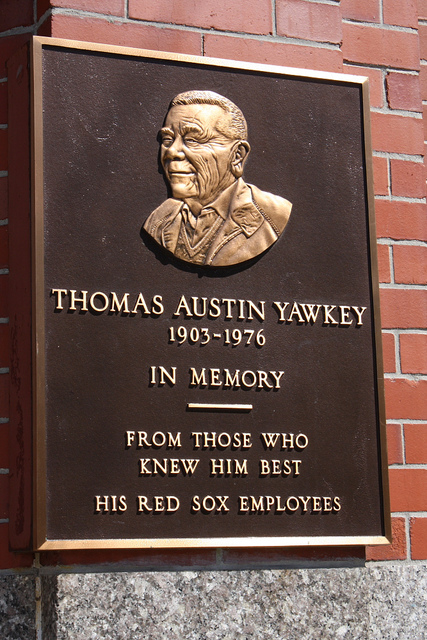
Yawkey TributeIt’s not often that I am called upon to rebut a web post that relies on one of my articles for its unethical conclusions, but that is the position that Ron Chimelis has placed me in with his recent essay, Why the Boston Red Sox should rename Yawkey Way.

To catch you up quickly: Tom Yawkey was a lumber tycoon and baseball enthusiast who owned the Boston Red Sox from 1933 to 1976, making him the longest-tenured team owner in the sport’s history. Yawkey was almost certainly a racist; if he was not a racist, his team’s policies certainly were for many years. The Red Sox were the last major league team to integrate, and blacks did not have a significant place on the team’s roster until the late 1960s, two decades after Jackie Robinson broke the color line. From the beginning, Yawkey ran the Red Sox as a public utility, paying little attention to the bottom line as he tried to build a winner out of the franchise that had been a perennial loser since selling Babe Ruth to the Yankees in 1919. After his death, Yawkey’s wife Jean continued the family tradition, running the Red Sox, except for a few years, until her own death in 1992.

When Tom Yawkey died, the City of Boston re-named Jersey Street, which runs past the entry to Fenway Park where the Red Sox play, Yawkey Way in his honor.

In the unerring clarity of hindsight bias, Chimelis argues that Tom Yawkey is undeserving of any recognition by the city that he devoted much of his life to representing, enhancing, serving, inspiring and entertaining because racism is the ultimate crime, and anyone possessing that vile state of mind should be consigned to shame forever. It is a common point of view, and an unfair one. Continue reading

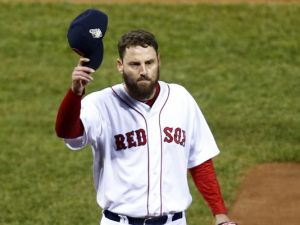
World Series Ethics: He Tipped His Cap

What would Ted Williams have done? We know the answer to THAT question...

What would Ted Williams have done? We know the answer to THAT question…

The Boston Red Sox won the World Series last night, making me happy. Something else happened too.

Some background is in order. The great Ted Williams used to give Boston baseball fans the biggest hat tip in baseball as they cheered him after a home run. This was when he was first known as “the Kid’ and indeed was one, as his Hall of Fame trajectory was obvious from the moment he stepped on a major league field in 1939 at the tender age of 19. Gradually but rapidly, a vicious local press and some ugly incidents in response to a few jackasses in the stands caused the Kid to sour on the admission-paying mortals who booed him when he struck out, and he decided to ignore their cheers, refusing to extend the traditional courtesy of a hat tip to the fans as he rounded the bases after a home run—which, since he was Ted Williams, happened frequently. Williams  spent his whole career in the city of Boston playing before those fans who offended him in his twenties, but right up to and after his final home run, which he hit, famously, in his last at bat, the Red Sox fans got no hat tip from Ted. He rounded the bases the final time as they cheered themselves hoarse, and never looked up or acknowledged their praise. Screw ’em.

That was Red Sox pitcher John Lackey’s attitude toward the current generation of Fenway fans, for similar reasons. He had been signed to a rich, long-term contract in 2010 to be a Red Sox mound ace, but arrived in Boston with his arm deteriorating and his abilities diminished. 2010 was a disappointing season for Lackey and 2011 was worse, as he pitched in pain for a team that was short of hurlers. The 2011 Red Sox became infamous for their late-season collapse and underachieving starting pitchers, and no one on that team was jeered on the field or savaged in the call-in sports shows like John Lackey. He missed the entire next Red Sox season recovering from arm surgery after the 2011 collapse, and thus missed the 2012 debacle that was even worse. In 2013, however, Lackey returned with a renewed right arm, a fit body and a fierce determination to finally live up to the big contract. He did, too. He pitched well all season, and became a key factor in the Boston charge to the World Series, as they rose from last place in their division in 2012 to first.

In 2013, Lackey received nothing but cheers from the surprised and grateful Boston fans. Nevertheless, he adamantly maintained the Kid’s attitude—“Screw ’em”—all season long. As he walked into to the Red Sox dugout after being relieved in another fine pitching performance and the Boston fans saluted him, Lackey refused to reciprocate with the traditional hat tip, all season long and through the play-offs. The fans were fickle hypocrites, and their loyalty conditional. They booed him when he was valiantly pitching hurt and embarrassed in 2011, and he wasn’t going to forget it. They were going to get snubbed like they deserved, and that was the way it was going to be.

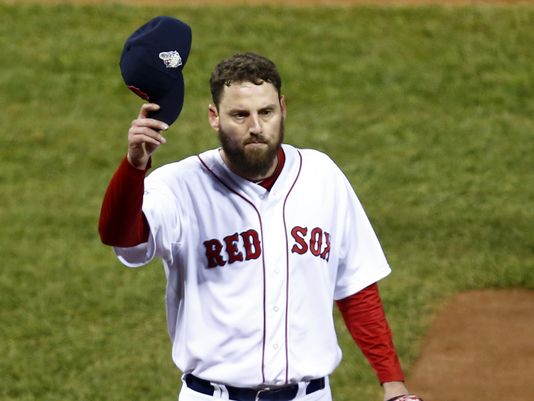
Last night the Boston Red Sox won their third World Series in the last ten years. It was the first time the home team fans had been able to witness the deciding game since 1918 (as the Fox announcers informed the presumably senile audience over and over and over again), and John Lackey was the pitching star for the home town team. The night was a love fest for Boston baseball fans, as they cheered every move of their frequently star-crossed and quirky team, and no Red Sox player was cheered more loudly than John Lackey, as he walked off the field for the final time in 2013 in the 7th inning, with his team safely ahead by five runs. They stood and applauded and chanted his name, as he moved deliberately to the Boston dugout, head down, grim, just like Ted on that gray day in 1960 when he hit homer number 521.

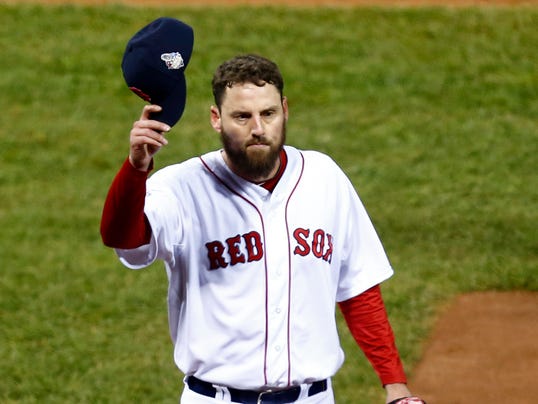
Then he tipped his cap.

It was a small thing, the smallest really, only a gesture and for most players, most of the time, an automatic one…except that it symbolized the ethical virtues of grace, forgiveness, gratitude, humility and fairness. This memorable, wonderful night for the Boston Red Sox and the grand old city it represents—my home town– was no time to let bitterness and resentment prevail. Unlike Ted Williams (who wouldn’t make his peace with Boston fans until years later, when he returned as an opposition manager), John Lackey found the strength and decency to let it go.

It was, as I said, a small thing. But it took character, and it was the right thing to do.

______________________________
Graphic: USA Today
Ethics Hero: Glen James

Glen James, role model.

Glen James, role model.

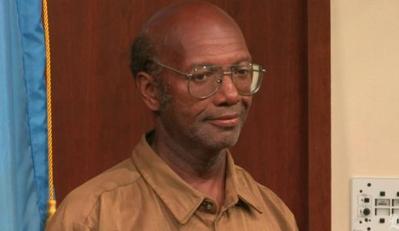
This is straightforward: Glen James, a Boston man who lives in shelters and has no money, found a backpack over the weekend that contained $2,400 in cash, $39,500 in traveler’s checks, passports, and other personal items. James flagged down a passing Boston police officer and gave him the backpack.  As is often the case with stories like this, he doesn’t think what he did was a big deal: after all, isn’t this what anyone would do?

We all know the answer to that question. Continue reading

Slate’s Unethical “Redskins” Blackout

You know what Redskins really means, don't you? It means standing up to political correctness bullies.

You know what Redskins really means, don’t you? It means standing up to political correctness bullies.

Via the usually rational reporter David Plotz, we learn that Slate has decided that the Political Correctness Gods will no longer allow the on-line magazine to use the name of Washington’s NFL team when it is reporting on Washington’s NFL team. This is, of course, presumptuous, arrogant, and lousy journalism. It is not the media’s job to re-make the world into what pleases them. Slate doesn’t like the Redskins name so it’s not going to publish it. This seems to be the current mode of operation in the media today–it is no longer dedicated to reporting and commenting on the news, but rather reporting and commenting on the news it doesn’t find “offensive.”

The Redskins, as a team nickname, is certainly the strongest case for those who believe in censorship of team names with ethnic or national origins. The NCAA has already gone way beyond any rational execution of that mission however, and even in the case of Redskins, an unquestionably racist term when applied to Native Americans, the objection to a sports  team name with supposedly negative historical implication has a lot of the “a chink in the armor” nonsense about it. For in Washington, D.C. and in football bars and Sunday afternoon gatherings, Redskins is not a slur, and does not refer to native Americans. It is the name given to a squad of NFL players who play pro football in the name of Washington, D.C., and a franchise that is worshiped in the city. When the name is used, it is not aimed at Native Americans or intended to denigrate them. It does not refer to Native Americans, and not intended to give offense. It is intended to designate the football team, because that is the team’s name. How can someone be offended at the use of a name that is not intended and is not a slur in the context of the use in question? There two answers to this: 1) Most people, including rational Native Americans, aren’t, and 2) Because such people want to be offended.

The name “Redskins” was never intended as a slur, as I have explained here before. Continue reading

Magazine Cover Ethics: The Cute Terrorist and The Rolling Stone Boycott

tsarnaev-rolling-stone-feature

Is it just my flawed impression, or are Americans increasingly less supportive of free speech, free thought, and artistic expression? If so, that is a worrisome development for our democracy and its culture, and if so, yes, I believe the willingness of our government and its leaders to maneuver around the Bill of Rights in “ends justify the means” conduct has fueled the trend.

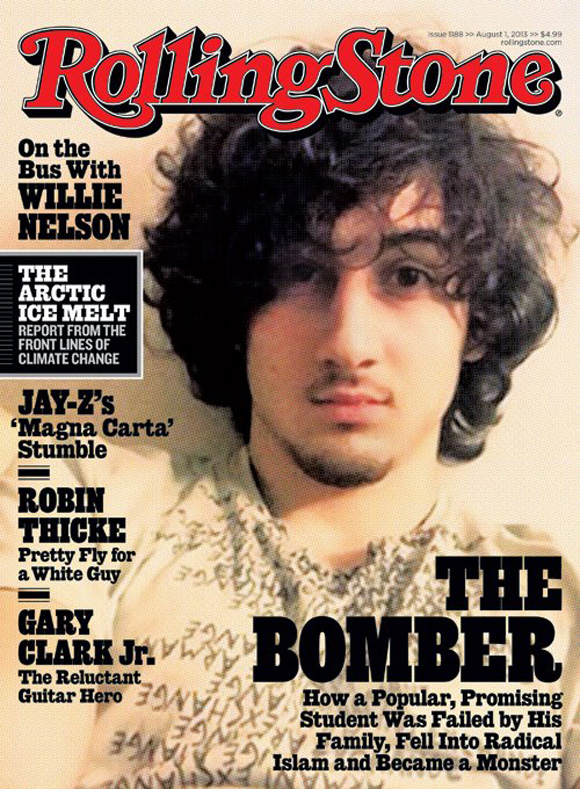
Now Rolling Stone is the target. The Sixties magazine icon had the nerve to place Boston Marathon bomber Dzhokhar Tsarnaevon its latest edition’s cover, looking like a male model, and, we hear, the families of the victims are outraged and their communities prefer their sensibilities over liberty. Jumping on the bandwagon, retailers have decided to make all publications afraid to challenge its readers by announcing that they won’t sell the issue in Boston, and there are hints of an advertiser boycott.

Unfair, un-American, dangerous and silly. Continue reading

Ethics Hero: Neil Diamond


Kansas City Royals v Boston Red Sox

The pop singer whose ear-worm of a 60’s hit, “Sweet Caroline,” inexplicably became a Fenway Park crowd sing-along tradition made a surprise appearance at the Red Sox-Royals game this afternoon, apparently voluntarily and at his own expense, to contribute to the festivities as Boston celebrated the end of a violent and frightening week. The song has been played at other ballparks in recent days, even at Yankee Stadium, in a show of solidarity with the besieged city and its residents.

Neil Diamond flew to Boston and contacted the Red Sox slightly before game time, saying he was eager to sing along with himself in the seventh inning. Surprised club officials assented. So he wandered out onto the field, looking paunchy, old and happy, and sang into a microphone while his ancient record played—since this was all impromptu, there was no other accompaniment available. And the crowd loved it: you can watch and listen here.

Unlike David Ortiz, Diamond didn’t have to resort to obscenity to give his appearance emphasis. He gave an unsolicited  gift to Boston and Red Sox fans, lending his talents to the celebration without compensation because it was a caring and classy thing to do. It didn’t matter that singing along with his 44 years younger self was hardly flattering, or that the sound was lousy, or even that “Sweet Caroline” is hardly Gershwin or even Billy Joel (I always preferred “Cracklin’ Rosie,” myself).  A big, wealthy recording star simply helped the city’s  healing along by a generous gesture when there was nothing in it for him.

Neil Diamond is a good guy.


Unethical Quote Of The Week: Boston Red Sox Star David “Big Papi” Ortiz

“This is our fucking city!”

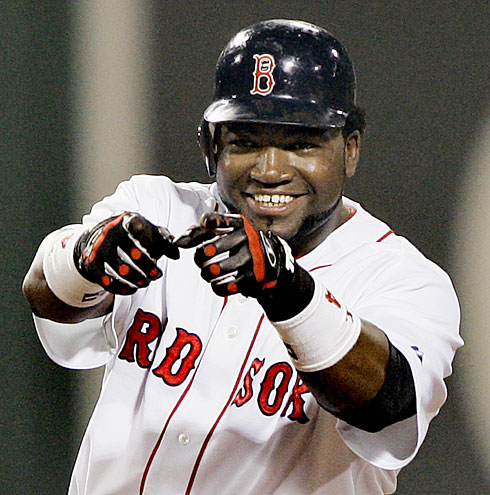
—Boston Red Sox designated hitter and icon David Ortiz, aka “Big Papi”, representing the team in a pre-game ceremony at Fenway Park honoring Boston in the wake of the past week’s violence, heroism and travails.

"Big Potty-Mouth"

“Big Potty-Mouth”

I love you, David, and you got us past the Yankees in 2004, but your choice of words  was classless, crude and unnecessary.

There were children in that crowd and watching on TV, as I was. You are a role model, and locker room language belongs in the locker room, not in public events. Your obviously calculated incivility moves the culture one more step away from public manners and toward obscenity as standard expression.

I’m disappointed in you, and you also embarrassed your sorority sisters at Delta Gamma.

Ethics Hero: Dick Hoyt

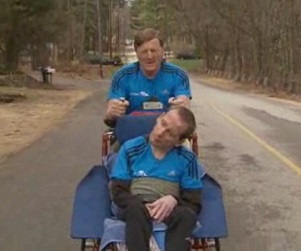
hoytsI don’t think I’ll have to explain why Dick Hoyt is an Ethics Hero.

Rick Hoyt has cerebral palsy and has been a quadriplegic since childhood. When he was in middle school, he told his father, Dick, that he wanted to compete in a charity marathon for a basketball player who had been paralyzed in an accident. Dick Hoyt agreed to push his son’s wheel chair in the race. When it was over, Rick told him, “Dad, when I’m ‘running,’ it feels like I’m not handicapped!” Touched and inspired, Dick Hoyt, 72, went on to push his son, now  51, in 1,091 events, including 252 triathlons, 70 marathons, 94 half marathons, and 155 five-kilometer races. They have never finished last. The father-son team is preparing to compete in their 31st Boston Marathon next week.

When they compete in the triathlons, Dick pulls his son in a boat tied to a cord as he swims, and pedals for him on a tandem bicycle for the cycle round. In 1989, the family set up the Hoyt Foundation which has the goal of helping disabled youths participate in activities that their disabilities would normally preclude.

Rick says his only wish is that he could make his dad sit in the chair and push him for once.

Every now and then, I learn about people whose kindness, selflessness and ethical instincts place me in awe.

Dick Hoyt is such an individual.

__________________________________

Facts and Graphic: Opposing Views

Political Correctness, Abuse of Power, the Redskins, and Spite

I’m sure glad I don’t own the Washington Redskins.

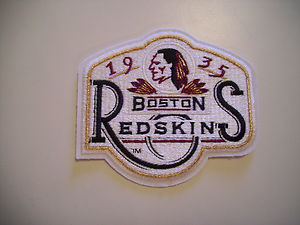
Boston RedskinsI say this without even considering the current problem of having a head coach who let the franchise player ruin his knee. I’m glad I’m not Dan Snyder because the annual sniping about his team’s unfortunate name pulls me in opposite directions ethically and emotionally, and I don’t enjoy being Rumpelstiltskin.*

If I owned the Washington Redskins and was being pragmatic as well as ethical, I’d just bite the bullet (oops! Is that phrase banned now?) and change the team’s name. The debate is stupid, but it’s a distraction no sports franchise needs. I would dig in my heels against political correctness zealots who demand that the Atlanta Braves, Kansas City Chiefs, Chicago Blackhawks and other Native American-themed names get tossed in the ash heap of history, but “redskins” is undeniably a term of racist derision, despite the fact that it isn’t that in the context of football. In football, it just means those NFL players in red and gold that a whole city worships year round.

If, however, I wanted to take a much needed stand against the unethical tactics of political correctness bullies everywhere, refuse to yield to an argument that is as dishonest as it is illogical , I might well do what Snyder has done so far out of pure orneriness and spite, which is to say to the team’s critics, “Stick it!” Continue reading

Ethics Quote of the Week: Ken at Popehat

“But the government doesn’t get to pick and choose what social causes are permissible, and any government actor who aspires to that power is a lowlife thug. What’s particularly alarming about Menino’s thuggery is how openly his referencing to licensing “difficulties” reveals how things really work in government: whatever rights you think that you have, practically speaking some bureaucrat can punish you for exercising them on a whim, and there’s very little you can do about it. Menino represents the ethos of government actors who think quite frankly that this is right and just and how it should be — that they, our masters, should be able to dictate what we think and do and say if we want to do business in their fiefdom”

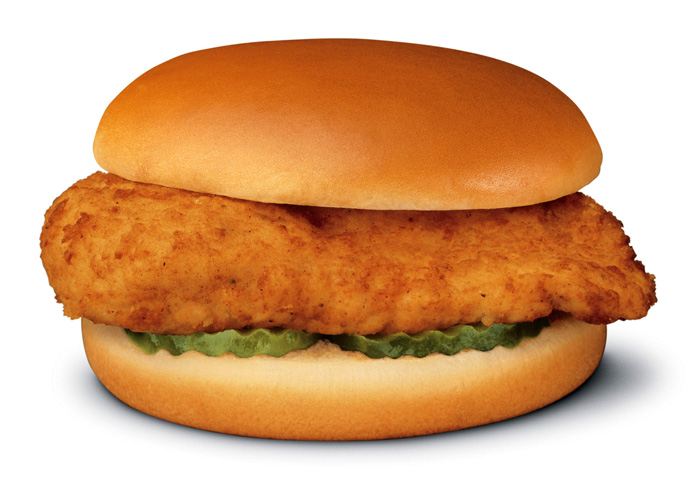
—-Ken, Ethics Alarms 2011 Blogger of the Year, on Boston Mayor Thomas Menino’s public attack on Chick-fil-A, the food outlet whose president openly opposes same sex marriage and contributes to anti-gay marriage organizations.

Banned in Boston

Some things never change, do they? Once my old home town used to ban books and plays that contained ideas and content the powers-that-were disapproved of, and now its mayor actually thinks its his job to decide what political and social views a business owner or any citizen can safely support without facing active government enmity and sanctions. Boston, which was the nation’s first cauldron of free thought and passionate dedication to governments allowing free thought to thrive, quickly came to exemplify the liberal hypocrisy of being so dedicated to freedom that it will punish and censor anyone who doesn’t adopt its virtuous and obviously wise and correct views of the world. Menino’s threatened abuse of power to compel Chick-fil-A’s ownership “think right” is a classic in this category. The mayor told the Boston Herald: Continue reading