Ethics Hero, If A Bit Late To The Party: Maryland Attorney General Brian Frosh

http://www.youtube.com/watch?v=rAe97xmVRhM

Horrified by this story in the Washington Post and others like it,  Maryland Attorney General Brian Frosh has filed suit against Access Funding and other viatical settlement companies, asserting that they take advantage of vulnerable victims of lead poisoning by purchasing their structured settlements at less than fair-market value.

Gee, ya think?

I have written about this many times and in other forums, and even been threatened by a few the despicable companies (“It’s your money!”…”I have a structured settlement and I need cash now!”) in this cruel and predatory industry. 

Few in the general public know about it or understand what’s going on. Structured settlement are annuities bought by insurance companies to ensure a regular flow of compensatory damages to personal injury and medical malpractice plaintiffs to cover their medical costs and living expenses. The settlements aren’t given out in lump sums because many such plaintiffs are poor and have no experience handling money. A large payment of millions of dollars guarantees that needy family members and friends will beg, plead for and demand loans and hand-outs, while the recipients themselves are tempted to buy luxuries they have long dreamed about with funds intended to cover lifetime cancer treatments.

As I wrote in a post almost seven years ago…

Once they are on their own, however, the compensated victims are targeted by viatical settlement companies, both those with cute opera-singing commercials and those without. They undermine the sound advice of the attorneys with slogans like “It’s your money!” and try to persuade the former plaintiffs to unstructure the structured settlement by selling the annuity’s income stream to the viatical settlement company at a deep discount. Result: the annuity company gets the regular income at bargain rates, and the victims get a new, smaller lump sum to dissipate in exchange. The statistics say that the customer of the viatical settlement company will run out of cash long before he or she runs out of the need for it. But for the company, it’s a sweet deal.
Continue reading

Ethics Hero: San Francisco 49ers linebacker Chris Borland,

concussions NFL

It is indeed strange to call someone an ethics hero for taking reasonable steps to save his own life. In the case of Chris Borland, however, it is appropriate.

Borland, one of the NFL’s top rookies in 2014, announced that he is retiring after just one season he does not want to risk the long-term effects of repetitive head trauma.

Borland, 24, said  he made his decision after consulting with  concussion researchers, and current and former teammates, as well as researching  the relationship between football and neurodegenerative disease.

“I just honestly want to do what’s best for my health,” Borland told ESPN.  “From what I’ve researched and what I’ve experienced, I don’t think it’s worth the risk.” Continue reading

NFL Commissioner Roger Goodell’s Super Bowl Deception

"Well, I may not remember any of it, but the Commissioner says I'll life a long life..."

“Well, I may not remember any of it, but the Commissioner says I’ll live a long life…”

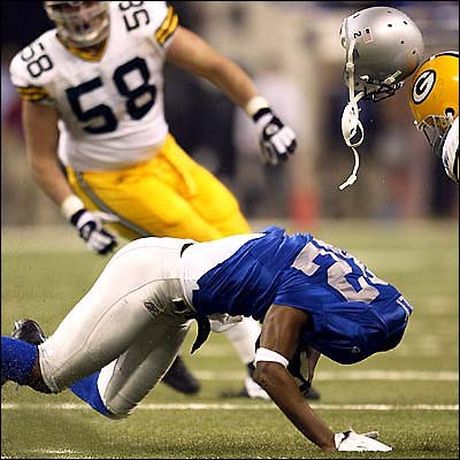
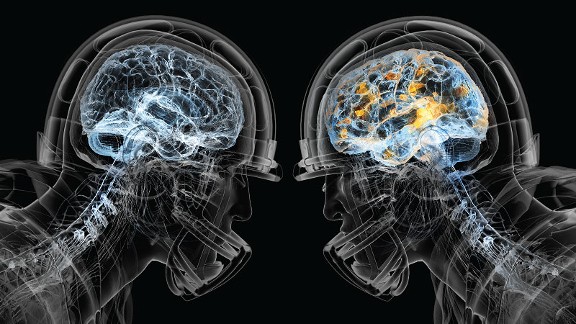
Today millions of Americans will gather around televisions, partying and cheering the spectacle of young men maiming and killing themselves for our entertainment pleasure during America’s most popular sporting event, the Super Bowl. An unknown but significant number of those athletes, we now know, are likely to be unable to recognize family members by the time they are 45, and several may take their own lives in despair.  Nonetheless, the official position of the National Football league is that all is well, and Commissioner Roger Goodell was touring the Sunday morning news shows to put out the propaganda claim that  pro football is good for everyone, even the players who accumulate concussions like the rest of us collect aggravation.

Presumably to appeal to the large proportion of the Super Bowl audience who know little about the sport, as well as the gullible fans who do, Goodell told Fox News Sunday host Chris Wallace (who, if he had the knowledge, wit and integrity,  should have stopped him and protested) in response to Wallace’s question about the NFL’s ongoing concussion scandal, that NFL players live longer and are on the whole healthier throughout their lives than the general population.

This is deception, and intentionally misleading.

Goodell is taking advantage of the fact that all the measures of the mortality of pro football players are flawed, which is why last year the NFL Players Union commissioned Harvard to do a 100 million dollar study of the health of ex-players and how to improve it.  The union claims that the average age of death of an ex-NFL player is 57 years, which would directly contradict Goodell’s claim.  This figure is supported by a 2011 study by the University of North Carolina, as well as insurance company actuarial statistics.

The figure, however, seems statistically unlikely.  Measuring the life expectancy of any group of adult men, even those engaged in risky behavior, will yield an average life expectancy that is better than the general population. Why? Because men in the general population die as infants, children, young adults, and before they would be old enough to play football. Thus the NFL and defenders of the brutal game continue to promote the 2012 study that found that NFL players outlive the general population. If accurate—and the players find the study difficult to believe, as do I—it can be argued that this study is also flawed. It compares apples—strong, affluent, college educated upper-middle class men—to oranges–everyone else, including the poor, unemployed, uneducated and poorly nourished. Attempting to get around this problem, one blogger compared the deaths of NFL players to other celebrities whose death notices were prominently published. His conclusion: there was no denying the fact that pro football players appeared to die sooner that non-football players from the same general class, but there was no justification to believethe mid-fifties mortality figure.

So do we know how much playing pro football lowers life expectancy, or even if it does? No….and neither does Roger Goodell. The studies are in conflict. However, we do know that a disproportionate number of the players who may live well into their golden years will do so unable to think clearly, remember their children’s names, or care for themselves, because they accepted big paychecks to allow their brains to be permanently bruised and catastrophically damaged. I don’t call that living or being healthy, and Goodell shouldn’t pretend that it is, or cite as fact what is a disputed contention at best.

Playing pro football isn’t good for you, and if the studies ultimately prove that ex-NFL players are really likely continue breathing as long as the rest of us despite their brain injuries, that just helps us understand why they have been killing themselves.

_________________________

Sources: CP24, Boston.com, Lotsa ‘Splaining, USA Today, Forbes

Ethics Heroes: NFL Owners

The less THIS happens, the better.

I was wrong about the N.F.L.

On Tuesday, the N.F.L. owners voted to move kickoffs back to the 35-yard line, where it was until 1994. The new rule will make the game less exciting but more safe. I didn’t think they’d do it.

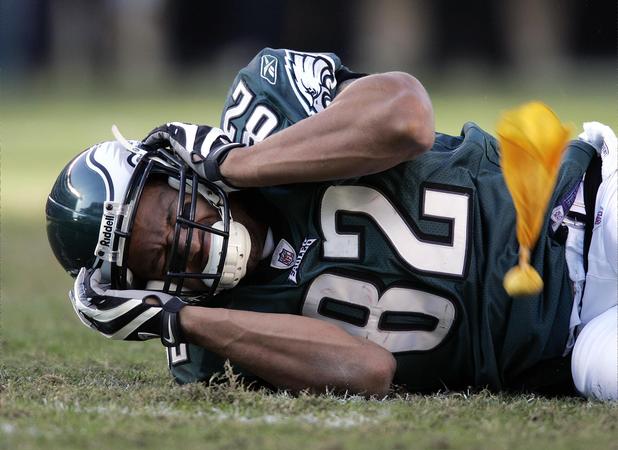
The league has a problem—I mean, other than the impasse in labor negotiations that threatens to disrupt the coming season and lose owners and athletes millions. Its game is more popular than ever, but little by little, the evidence is mounting that it is also lethal. Playing pro football injures the brains of a higher percentage of the athletes than anyone suspected, and far worse than suspected. Players are quite literally sacrificing their lives, or at least two or three decades of them, for the Sunday entertainment of America. Continue reading