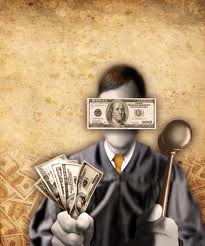
Senator Vitter Thinks Bribery and Extortion Are Ethical

"...and U.S. Senators..."

Interior Secretary Ken Salazar was initially restricted to a lower salary than other Cabinet members because he was a U.S. Senator when the salaries were raised. The Constitution bars members of the House and Senate from appointment to any U.S. office where compensation was increased during the lawmaker’s term. (Did you know that? I didn’t.)  President George W. Bush in 2008 signed legislation rolling back the Interior Secretary’s salary so that President Obama Salazar could appoint Salazar.

Once Salazar joined the Obama Cabinet, however, he was eligible for a raise. But Senator David Vitter (R-La.) saw a chance for some leverage. He wrote Salazar to inform him that he would place a hold on the bill to raise his salary until Salazar agreed to approve six new deep-water oil drilling permits every month. In effect, Vitter threatened to withhold over $19,000 in salary that Salazar had every right to receive in order to force him to take the actions Vitter favored. How does Vitter’s conduct differ from offering a bribe? No at all, as far as I can see. How does it differ from extortion? Not much. Vitter was trying to force a Cabinet officer make decisions motivated by his own financial interest rather than what he believed was in the best interest of the nation. He was creating an unethical conflict of interest. Continue reading

TV Payola and the Shameless Alison Rhodes

" 'Conflict of interest?' What's that?"

She’s not the only one, apparently. But consumer product reviewer Alison Rhodes (“The Safety Mom”), a frequent guest on national, syndicated and local TV shows, not only reviews products whose manufacturers have paid her to mention them, she is unapologetic about it.

Today’s Washington Post reveals that Rhodes, who can be seen on such shows as “Regis and Kelly”, “Today” and “Good Morning America!” as well as local news outlets around the country, raved on the air about a home electronic monitor and a backpack with a built-in alarm known as the iSafe bag without telling either viewers or producers that she had accepted payola from their makers. Rhodes, however, shrugs off the issue. She tells the Post that she doesn’t see any problem, because “I’m not going to take on any engagement with a client unless I believe in their product.”  Amazing. Meanwhile, the news programs the Post interviewed claim that they had no inkling that Rhodes was plugging the product of a client.

This brazen deception of the public is inexcusable, but the shamelessness—or ignorance— of Rhodes and the negligence of those who give her exposure are worse. Continue reading

Incompetent Elected Official of the Week: Maryland State Senator Ulysses Currie

"I am not a crook!" ---Richard Nixon; "I am not a crook, I am an idiot!"----Ulysses Currie

Blatantly incompetent elected officials stand as indictments of the ethics of more than the officials themselves. The fact that they are in high office reflects poorly on the political parties that support them, the voters who elect them, and the democratic system itself. It is difficult to imagine a more vivid example of this than: Maryland State Senator Ulysses Currie (D), currently standing trial on federal corruption charges. Continue reading

Ethics Bulletin To Camden, New Jersey: Money Isn’t The Solution To Everything

Just pay him to come to school, and he'll be a model student. No, really!

It’s not that surprising that the people who run the city of Camden think that money is the panacea to every problem. After all, that is the predominant message sent by our leaders in Washington, the media and the popular culture. Still, Camden’s new policy of  rewarding selected high school students $100 each to go to school in the first three weeks of the year displays ethical obtuseness rare even for school systems.

The idea is to fight truancy with a new program called I Can End Truancy (ICE-T). To receive their promised C-note, each of 66 targeted students must attend classes as well as conflict-resolution and anger-management workshops for the first three weeks of school. “We had talked about it [truancy] for a long time,” Camden Mayor Dana Redd told reporters. “We wanted to come up with an innovative model.” The required state minimum attendance rate is 90 percent, and Camden is threatening to miss it. After all, it’s the statistics that count, not whether the students actually pay attention in school, or learn anything. If this plan doesn’t work, presumably Camden will bring the required number of children to school at gunpoint, and drug them unconscious until the bell sounds. Continue reading

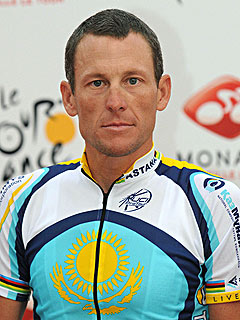
No Excuses and No Mercy For Lance Armstrong

Sorry, Lance…good guys don’t cheat.

Back when Barry Bonds was still playing baseball, a sportswriter mused about why it was that everyone assumed  Bonds was a performance-enhancing drug cheater despite his protestations to the contrary, while most Americans and sports journalists brushed away similar allegations regarding Lance Armstrong. Both competed in sports with acknowledged steroid abuse problems; indeed, the problem in bicycle racing was presumed to be more pervasive than in baseball. (A few years later, with the banning of multiple Tour winners, the presumption became a certainty.) Both athletes had improbable late career improvements in their performance to reach previously unimaginable dominance in their respective sports. Both had to explain or deflect multiple credible accusations of cheating and circumstantial evidence that suggested that they were doping. Both claimed they had never failed drug tests, and there were good reasons to doubt the denials.

So why was Bonds a villain by consensus and Lance an untouchable hero? The sportswriter explored many theories (Apologies: I cannot locate the article. If someone can, please send it), among them the greater popularity of baseball over cycling, Bond’s startling physical transformation into a behemoth while Armstrong remained cyclist-sinewy,  Armstrong’s inspiring story as a cancer survivor, Armstrong’s philanthropic work,and the fact that Bonds, unlike Armstrong, was black. The biggest difference, however, and to the writer the key one, was that Armstrong acted the role of a hero, while Bonds refused to. Armstrong was friendly and accommodating, while Bonds was angry, intimidating and antagonistic. Armstrong seemed like someone who played by the rules, and who lived his ethical values. Bonds seemed like a rebel, one who wouldn’t hesitate to break the rules for his own benefit. In short, the public wanted Armstrong to be the hero he seemed to be, so they ignored the evidence linking him to performance-enhancing drugs.

After last Sunday, the disparate public perception of Bonds and Armstrong, always illogical, became unsustainable. Continue reading

Appearance of Impropriety II: “Here’s Approval For That Deal You Wanted…What? Sure I’d Like to Work for You! Wow, I Never Saw THAT Coming!”

What's there to be suspicious about?

Meredith Attwell Baker, a member of the Federal Communications Commission who voted to approve Comcast’s takeover of NBC Universal in January, is leaving to  become senior vice president of government affairs for ….Comcast-owned NBC Universal.

Hey, why are you so suspicious, you jaded cynic, you? Comcast says it did not begin discussions with Baker about a possible job until after the takeover had her seal of approval. So it’s all on the up and up! Right? Right?

Okay, let’s say we believe that, since doing otherwise would amount to bribery. It doesn’t matter, and I don’t care. Taking a major job with  a company whose back you scratched with a favorable ruling as a government regulator looks terrible, promotes public distrust, erodes faith in regulatory structures, and is unethical. There are other jobs in the world for people with Baker’s credentials; she doesn’t have to take one that makes the U.S.  government’s business regulatory apparatus look like it’s fixed.

A condition of any regulator’s employment with a federal agency should be a pledge that he or she will never accept a paid position for a company that has benefited from the regulator’s rulings…not in a year, not in a decade, not ever.

The Bonds Verdict: Fair Enough

The results of the Barry Bonds trial, which today concluded with the jury finding baseball’s all-time home run champion guilty of obstructing justice by misleading a grand jury investigating the distribution of illegal and banned steroid to professional athletes but unable to agree on the perjury charges, helps to balance the ethical scales. It should silence the shameless Bonds defenders who misused the “innocent until proven guilty” standard to maintain poor Bonds was being unfairly suspected of inflating his biceps, head, statistics and income through the marvels of chemistry, though it was blatant and obvious in dozens of ways. Now he has been proven guilty—not of everything, but for celebrity justice, in a trial where much of the most damaging evidence was withheld from the jury, enough—, so the claims of racism and unfair prosecution will ring even hollower now. Continue reading

Ethics Hero: New York Courts

Bravo!

New York’s court officials have decided to bar New York’s elected judges from hearing cases involving lawyers and others who make major financial contributions to their campaigns. The New York Times reports that the new rule of the state court system will be announced this week by Jonathan Lippman, the state’s chief judge. “It is believed to be the most restrictive in the country, bluntly tackling an issue — money in judicial politics — that has drawn widespread attention,” said the paper.

The new rule decrees that “no case shall be assigned” by court administrators to a judge when the lawyers or any of the participants involved donated $2,500 or more in the preceding two years. Continue reading

Ethics Dunce: The Ever So Tolerant Wisconsin Bar

Hot on the heels of the story about the New Jersey lawyer who managed to avoid interruption to his legal career after admitting forgery, we have more disturbing evidence that a profession that insists on self-regulation may have a rather different concept than the public about what constitutes “fitness to practice law.”

The professional ethics rules in every state declare that substantial dishonesty and especially failure to obey the law call into question a lawyer’s trustworthiness and are grounds for suspension of disbarment. Many states automatically disbar any lawyer convicted of a felony. But in Wisconsin, a local newspaper investigative report reveals, there are 135 attorneys continuing to practice law despite convictions for battery, theft, fraud and repeat drunken driving. Some even had active licenses even as they served time behind bars, giving a new meaning to the term, “jail house lawyers.” Another 70 of Wisconsin’s  attorneys-in-good-standing managed to avoid discipline by getting charges reduced or entering into deferred prosecution agreements. Continue reading

Campaign Contributions During Key Votes: Call It Bribery

The quote from Sen. Max Baucus’s spokeperson instantly becomes a leading candidate for “Lie of the Year.”

“Money has no influence on how Senator Baucus (D-Montana) makes his decisions,” Kate Downen told the Washington Post. “The only factor that determines Senator Baucus’s votes is whether a policy is right for Montana and right for our country.” Is there any American so naive as to still believe this, not just about Baucus but about any member of Congress? The Post reports that despite Senate and House rules forbidding it, campaign contributions routinely spike when important bills are about to be voted upon. The sources of the sudden gifts to the lawmakers? Individuals, organizations and corporations who will benefit from the law’s passage or defeat. Continue reading