“Drunk Girl In Public”: This Trend Will Ruin Trust, Spontenaity, Kindness and Fun, and There Is Absolutely Nothing We Can About It Except Complain

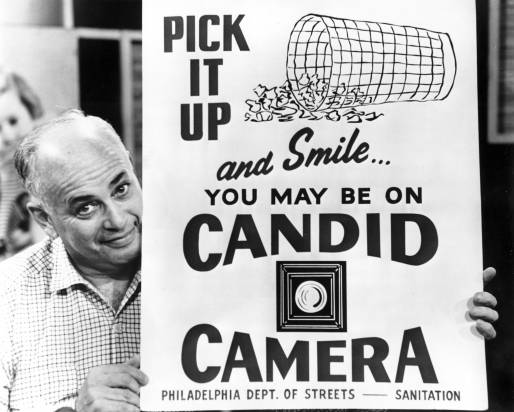
I guess it all began with Allen Funt.

If Allen knew what he would be starting, he would have opened a deli.

If Allen knew what he would be starting, he would have opened a deli.

Back in the Fifties, he came up with the idea of using a hidden camera to record the reactions of innocent bystanders “in the act of being themselves.” He staged situations, sometimes Twilight Zones set-ups like a door that opened for everyone but the target, and filmed the results, first for a guest segment on TV talk shows and finally on his own, long running hit, “Candid Camera.” Funt would never have dreamed of using actors and faking the reactions, because first, he didn’t need to; second, if he was caught, it would ruin him; and third, he was an honest professional. The idea, however, has thoroughly metastasized in all directions, to “practical joke shows,” reality shows, and such monstrosities as ABC’s “What Would You Do?” and James O’Keefe. Perversions were limited as long as the shows were restricted to television, but now YouTube makes everyone a potential producer, and among the thousands trying to create a viral video, there are many, perhaps most,  who are not decent, ethical professionals like Allen Funt, but just greedy jerks who will gladly cheat, lie to and humiliate others to gain fame and fortune. Continue reading

Roshomon, Good Citizenship And Ethics: The Case Of The Concerned Stranger And The Indignant Father

“O wad some Power the giftie gie us To see oursels as ithers see us!”

—Robert Burns bystander-effectJeff Gates, a writer and adoptive father, contributed a thought-provoking column in the Washington Post’s Outlook section this weekend, describing what seemed to him to be a traumatic experience at Cape May. It begins…

“After my family arrives on the Cape May ferry for our annual vacation to the Jersey Shore, I take pictures of our two daughters on the ferry’s deck as we leave the harbor. I’ve been doing this since they were 3 and 4 years old. They are now 16 and 17. Each photo chronicles one year in the life of our family and our daughters’ growth into the beautiful young women they have become….On that first day of vacation, the sea was calm and the sky a brilliant blue. As I focused on the image in my camera’s viewfinder, the girls stood in their usual spot against the railing at the back of the boat. I was looking for just the right pose…Totally engaged with the scene in front of me, I jumped when a man came up beside me and said to my daughters: “I would be remiss if I didn’t ask if you were okay.”

He goes on:

“It took me a moment to figure out what he meant, but then it hit me: He thought I might be exploiting the girls, taking questionable photos for one of those “Exotic Beauties Want to Meet You!” Web sites or something just as unseemly. When I explained to my daughters what he was talking about, they were understandably confused. I told the man I was their father. He quickly apologized and turned away. But that perfect moment was ruined, and our annual photo shoot was over.”

Many of us might laugh off the experience as a funny anecdote, but not Gates, and not his daughters. He is Caucasian and they are both of Chinese heritage, having been adopted as infants in China by Gates and his wife. He obsessed about the incident for a while, and worked up sufficient indignation to track down the man and confront him, saying “Excuse me, sir, but you just embarrassed me in front of my children and strangers. And what you said was racist.” Continue reading

Better Never Than Late: Steve Bartman’s False Exoneration

ALCS - Detroit Tigers v Boston Red Sox - Game TwoMy mind is much on the baseball play-offs today, an unavoidable hangover from last night’s amazing and exhilerating Red Sox-Tigers game, in which Boston went from hitless, five runs down and doomed in the 6th inning to miraculously victorious in the 9th thanks to a storybook grand slam by David Ortiz (you can see the immortal end result of that mighty blow in the photo to the left). It is 10 years to the day from when another remarkable play-off game occurred, infamous in Chicago, in which a fly ball foul that wasn’t caught by Cubs outfielder Moises Alou led to a furious rally by the Florida Marlins that resulted in the hapless Cubs being denied a trip to the World Series—the team’s first since 1935— that their fans thought was in the bag. The reason Alou missed the ball, or so the legend goes, was that a clueless Cubs fan wearing earphones reached out and deflected the ball. That fan, Steve Bartman, was awarded instant villain status. It was accompanied by media attacks and death threats, and poor Bartman left the city and may well have joined the witness protection program or jumped into a volcano. Nobody has heard from him in many years.

There is an ethics lesson in what happened to Bartman: one is never truly a bystander, and you have a duty to pay attention to your surroundings and to be ready to act. If you are present, you can make a difference, and might be needed, even it it is only to get out of the way. Call it the Duty of Life Competence.

The following post, however, is not about Bartman as much as it what happened to him, and how someone who could have come to his aid waited five years—too long—to do it. It was first posted on The Ethics Scoreboard in 2008:

Continue reading

Ethics Hero: Sergio Consuegra

Hero!

Hero!

The violent confrontation between a group of aggrieved bikers and the driver of a sports utility vehicle (with his family on-board) in Manhattan turned into an ugly incident that left both the driver and one of the cyclists seriously injured.  You can see the disturbing video of the attack—captured on one of the cyclist’s helmetcam—-here. Who precipitated the incident will have to be sorted out in court, but the there is little question that only the intervention of bystanders stopped further injury to the driver and perhaps his family—an inspiring example of witnesses to a wrong stepping in at personal risk to themselves and making a difference. One of the rescuers—there were others, not yet named—was Sergio Consuera. Continue reading

The Cabbie’s Ethics Tale

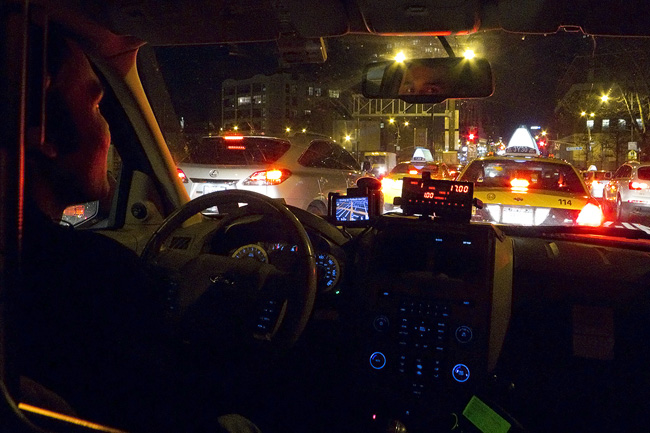
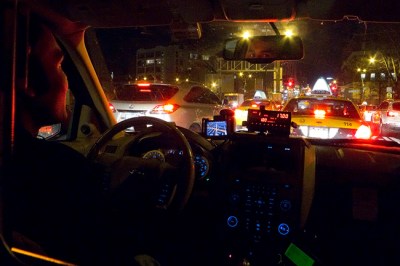
Back of a cab

A frustrating aspect of my business travel, other than that raw fact that travel itself is inherently frustrating, is that I accumulate a backlog of ethics issues but am often unable to take the time to write about them until I return home, where I am again free of airplane delays, unreliable internet connections, sleepless nights and dimly lit hotel rooms apparently designed for the comfort of Jose Feliciano. The occasional compensation arrives in the form of enlightening conversations with fascinating people.

One of these was a cab driver on my latest trip. We shared the same space on an interminable ride from the airport to the hotel, the last leg of a theoretical ninety minute journey that stretched into 6 horrible hours. He was an educated, articulate, lively minded man whose life story (so far) would make an entertaining, if inherently incredible, movie. An African American son of two wealthy academics, he misbehaved in a ritzy private school and was sent, as punishment, to finish his high school years in an inner city private school. There he encountered drugs, gangs, bullying and racism, and became a strong social conservative. He dropped out of high school, entered the military and ended up in the Special Forces in the Middle East; he returned, graduated from college, went into the financial industry, rose quickly, got rich. He told me that he saw all of the cheating and manipulation in his own company and the industry in general, but did nothing about it (the money was too good, he said). Then came the crash. He lost everything, including his wife and kids, in the carnage. Resolved, he said, to work for justice and ethics, my driver had just graduated from law school and flunked his first try at the bar exam. (So did my dad, who would have liked this guy a lot.)

We got on the topic of the “bystander syndrome” and our duty to intervene and sometimes confront wrongdoers even at some personal risk—-the subject came up in the context of the Brooklyn EMT who has  been cleared of criminal charges arising from her refusal to assist a pregnant woman who had a heart attack (The EMT was on break, you see. I wrote about that terrible incident here. ) My cabdriver was a large, burly man, but he said that every time he intervened to confront a wrong doer in public, he feared that he would be shot. Once, when he stopped a man in a wheelchair from beating the man’s apparent girlfriend, he told me, my cabbie found himself staring down the barrel of a .44. This story, however, had a very different resolution: Continue reading

The Steubenville Ethics Train Wreck: So Far, So Bad

steubenville

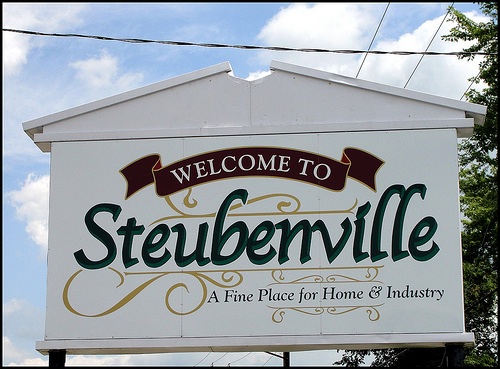
There has been no mention here of the awful Steubenville, Ohio rape case before today, and there was a reason for that. This is a massive ethics train wreck that is not only still rolling and accumulating passengers and victims, but is also too full of debris and wreckage to fully understand. At the end of this month, a grand jury will begin examining the looming question of whether others besides the two high school football players already convicted of the rape should be indicted.  The town is also doing an investigation of its own. These will help. My hesitation in diving into this gothic American nightmare is that recounting the obvious instances of miserable, heartless, ethically incomprehensible conduct by participants, observers, public officials and commentators doesn’t begin to make sense of it.  We will be analyzing and discussing this episode for a long time—we will have an obligation to do so. It is every bit as important and alarming as the Penn State scandal, and more significant than the infamous New Bedford pool table rape case, which was adapted into the Academy Award-winning film, “The Accused.”

The crucial cultural questions that will have to be answered are these: Continue reading

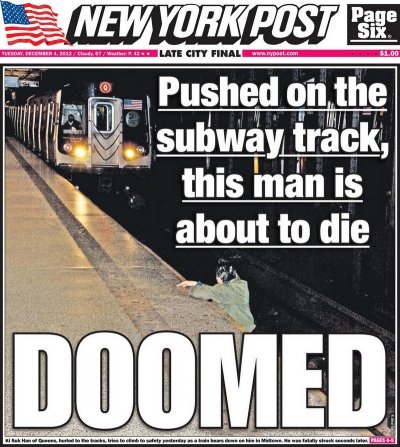
The Man On The Subway Tracks


Subway Headline

It is destined to become a classic case in photojournalism ethics. Someone pushed 58-year-old Ki Suk Han pushed onto a 49th Street station  subway track in New York City. R. Umar Abbasi,  a New York Post freelance photographer was  on the platform when it happened, and took a photo as the subway train bore down on the terrified man. He was killed, and the photo became a lurid, if dramatic, Post front page.

There have been many ethical questions raised about the incident. Let’s examine them.

Was it ethical for the New York Post run the photo?

This is the easiest of the issues: of course it was. The photo is dramatic, the incident was news, the paper had an exclusive, and readers were interested. The Post might have decided that it would be in better taste not to run the photo, and that decision might be praiseworthy. Still, there is no good argument to be made that such a photograph is outside the range of acceptable items for publication. By the ethical standards of 21st Century journalism, admittedly low, the Post’s call isn’t even close to the line. Objections to the photo on ethical grounds are pure “ick factor.” Continue reading

Comment of the Day: “Mike McQueary and Me”

Some recent Ethics Alarms commenters

Joseph Edward bought me some time with this superb Comment of the Day, because I am writing a post on the same topic. Mike McQueary’s conduct in the locker room, when he allegedly witnesses Jerry Sandusky raping a boy,  has generated some of the most self-righteous and, I may say, annoying comments I’ve encountered on Ethics Alarms, characterizing my commentary (in “Mike McQueary and Me”) on why McQueary might have acted as he did with excusing his conduct. Most of these, I’m relatively certain, are motivated by those who want to shift responsibility for the Penn State debacle away from Joe Paterno.

One particularly persistent and vociferous commenter has decreed that it was an “absolute moral obligation” for McQueary to physically intervene to stop the assault he witnessed. Joseph touches on that dubious contention; I’ll have more to say about it soon. Meanwhile, here is his Comment of the Day, on “Mike McQueary and Me”: Continue reading

Comment of the Day: “The Death of Ryamond Zack”

The story about the Alameda firefighters and police, as well as many citizens, standing useless on the shore as a suicidal man slowly drowned continues to receive  outstanding commentary. Here is the most recent, from Peter, doing some follow-up and pointedly critical analysis: 

“ABC asked Alameda Fire Division Chief Ricci Zombeck  whether he would save a drowning child and he said: “Well, if I was off duty I would know what I would do, but I think you’re asking me my on-duty response and I would have to stay within our policies and procedures because that’s what’s required by our department to do.”

“This quote essentially makes any indefensible defenses, or apologetics for how big and scary the victim was, moot. Perhaps they should make off-duty the new on-duty by assigning first responders to permanent off-duty roles. At least then they would go in after a drowning child. Continue reading

Comment of the Day: “The Death of Raymond Zack”

Raymond Zack

Buck Best, a Northern Virginia firefighter and supervisor, weighs in with his expert perspective and nuanced insight regarding my post on the Alameda, Cal. incident involving a suicide by drowning. His wife Lianne had another Comment of the Day earlier this week; if this keeps up, I will have to call the feature “Best Comment of the Day.”

“As an 18 year veteran of the Fire Dept. and the last ten years as the Officer of a Technical Rescue team that would be responsible for just such a rescue, let me offer another perspective to this ethical question. The Fire service much like many other organizations in recent history are governed by politics and litigation. The management of the organizations are always looking to the risk analysis of any potential situation based of the money that is available. The risk analysis is not based as much on the physical risk as it is on the financial or political risk. Continue reading