Explain The Reasoning Process Of This School System, Please…

Hate speech. Sorry. The lesson has to be "Some states fought the Union over something or other, waiving a flag that we can't show you because it's dangerous." Quiz tomorrow.

Hate speech. Sorry. The lesson has to be “Some states fought the Union over something or other, waiving a flag that we can’t show you because it’s dangerous.” Quiz tomorrow.

President Trump’s nominee for Secretary of Education is facing the closest Senate vote on any cabinet member ever, in part because two Republican Senators (what the Democrats say doesn’t matter, since they have decided not to cooperate in the governing process) question whether Betsy DeVos “understands the public schools.” In her defense, I don’t see how anyone could understand public schools, especially when they behave like this one…

In Folsom, California, the family of an African American 8th grader  filed a complaint against  Sutter Middle School history teacher Woody Hart.  Tyrie McIntyre’s son had asked Hart for a definition of equality during a discussion of the U.S. Constitution. The teacher  allegedly told his eighth-grade class, “When you hang one black person, you have to hang them all.  That is equality.” At least that is what Tyler McIntyre, 13, thought Hart said. Tyler, one of only a handful of black students in the class and school, felt embarrassed.

Hart, 70, didn’t deny his student’s account, but explained in an interview that he made the comparison because he was trying to make the discussion “interesting” and “express something that would catch students’ attention.”

“Here’s what I said: ‘If you hang black people in the South, that means that you hang any black person who comes from outside the state. ”

Hart also said that he has spent much of the year teaching his students about racial equality. If that’s the clarity, logic and accuracy with which he taught it, a remedial course, indeed several, may be required.

After the complaint, Principal Keri Phillips interviewed six students chosen at random, all of whom heard Hart give “hanging all blacks” as an example of how states treated individuals under the Constitution. She said that Hart has been told to henceforward  use examples “at a level that eighth graders can understand,” avoid stereotypes or culturally insensitive language, and must rely on “very simple analogies that do not focus on the controversy” during lessons involving challenging material.

McIntyre said that this doesn’t address his concerns. “My issue wasn’t the context,” he said. “It was the content. There was no way to justify the statement that he made.”

That’s exactly right, because the statement that “If you hang black people in the South, that means that you hang any black person who comes from outside the state” isn’t insensitive or “too complex” for an 8th grader.  It’s stone-cold stupid, bad logic, bad history, and bad teaching. An example that is “at a level that an 8th grader can’t understand”? I’m worried about anyone who thinks he does understand Hart’s example. That the teacher thinks it makes sense tells me that it is an unacceptable risk to allow Hart to teach any subject to anyone.

Nonetheless, Woody Hart was allowed to keep teaching, because public schools. Ah, but last month, he really crossed the line, or whatever it is that causes schools to ding teachers. Teaching the students about the Civil Way, Hart showed them…

A CONFEDERATE FLAG!!!

Continue reading

The Electoral College’s Day Of Reckoning, Part II: Dunces, Heroes, Villains, And Fools

The failure of the ugly Electoral College revolt scheme that ended yesterday—let’s ignore the coming storm of frivolous lawsuits for now, all right?—with the official, irreversible, like it or lump it victory of Donald Trump over Hillary Clinton also settled some distinctions, some desirable, some not.

  • Ethics Heroes: All of the Republican electors who resisted the harassment, propaganda, intimidation and bad arguments and did their duty, avoiding a crisis and foiling the attempts of Democrats to cheat, which is exactly what the effort to flip the electoral vote was. The faithful electors get bonus points for making so many Democrats and progressives look silly in the process, a fate they richly deserved.

Come to think of it, it was predictable that Democratic appeals to electors would persuade more Democratic electors than Republicans. Which leads us to…

  • Ethics Dunces: A bevy of Hollywood B-listers joined forces in an offensive video that, like Brezenoff’s petition, misrepresented history and the Constitution to gull star-struck electors into defying the public’s will and its trust that their votes would be respected by electors. Led by Martin Sheen, who has no credentials in government or political science but played a wily President on TV, Debra Messing, James Cromwell, B.D. Wong, Noah Wyle, Freda Payne (Quick: who is Freda Payne?), “Better Call Saul’s” Bob Odenkirk, J. Smith Cameron (?), Michael Urie, Moby, superannuated M*A*S*H stars Mike Farrell and Loretta Swit, Richard Schiff, Christine Lahti, Steven Pasquale, Emily Tyra and Talia Balsam tell the electors that they will be following the Founders’ intent by rejecting Donald Trump. This is flatly dishonest, as they are attributing the contrarian position of Alexander Hamilton, who detested popular democracy, to all the Founders, who rejected Hamilton’s proposals on how the government should be elected and structured.

“What is evident is that Donald Trump lacks more than the qualifications to be president. He lacks the necessary stability and clearly the respect for the Constitution of our great nation,” say the celebrities. Obviously it is NOT evident, since Trump’s voters won the day.  The Federalist accurately describes what was behind the video:

“The message is clear: the candidate for whom these celebrities spent months shilling lost the Electoral College, the metric granted ultimate primacy by Article Two of the Constitution. Now, as individuals with no substantial political background, these celebrities have organized en masse to produce content designed to “educate” our electors, chosen for their political pedigree, on their electoral duty. The whole situation reeks of condescension, dirisiveness, and social hubris. What these self-ordained celebrities are demanding is nothing short of the very opposite of what they claim to be purporting. They assert that they “stand with…all citizens of the United States,” yet admittedly only if those citizens agree with their political viewpoint. If said citizens disagree, then, unfortunately, these celebrities decidedly do not stand with them. In fact, they would prefer electors to actively oppose the wishes of these very citizens, so that the candidate they personally believe to be the best suited has a second shot at the presidency.”

That’s about the size of it, yes indeed. Continue reading

The Electoral College’s Day Of Reckoning, Part I: Revelations

crying-clinton-supporters

After all the protests, the petitioning, the grandstanding, the misinformation and bad law and false history, after all the harassment and intimidation aimed at getting state electors to violate their pledges, duty and the trust of theirs state voters, all designed to keep Donald Trump from attaining 270 electoral votes and thus forcing the Presidential election into the House of Representatives for the first time since 1876, the results were just another humiliation for the Democrats and Hillary Clinton. Donald Trump was officially elected President of the United States, and it wasn’t close.

Four Democratic electors in Washington, a state Clinton won, voted for someone else, giving her just eight of the state’s 12 electoral votes. They will be prosecuted, apparently, for breaking a Washington statute. Colin Powell, a Republican, received three of the faithless elector votes and Native American tribal leader Faith Spotted Eagle received one, apparently because one elector decided that rather than vote for Senator Elizabeth Warren, a real Native American was preferable. Single  electors in both Maine and Minnesota attempted to cast ballots for Bernie Sanders, but state laws requiring electors to follow the statewide vote invalidated both rebellious ballots. One Hawaii elector did vote for Sanders, an especially outrageous betrayal of the vote since Hawaii went to Clinton even more decisively than California.  Never mind: this unknown, unvetted, undistinguished citizen decided that no, he or she knew better. That’s the model Democrats were promoting.

The one Republican elector, Texas’s Christopher Suprun, of Texas, who had trumpeted his  intention  not to vote for Trump despite his state heavily favoring the President Elect voted for Ohio Governor John Kasich as promised, and another Texas elector defected to vote for Ron Paul. Thus the almost six week Democratic push to use the Electoral College to pull victory from the jaws of defeat had the net effect of increasing Trump’s Electoral vote advantage over Clinton by three, with Hillary Clinton becoming the candidate with most defecting electors in over 200 years.

George Will’s favorite phrase “condign justice” leaps to mind. First the Wisconsin recount increases Trump’s vote total, and now this.

Three Ethics Observations from one of the most embarrassing spectacles in U.S. election history: Continue reading

14 Ethics Musings On The Death Of Francisco Serna

keith-scott

Scott and Serna.

From The Washington Post:

Slightly after midnight on Monday, police in Bakersfield, Calif., received a call concerning a man thought to be brandishing a weapon in a residential neighborhood.

Shortly after police arrived, 73-year-old Francisco Serna — who family members said was suffering from the early stages of dementia — walked out of his home and into his driveway. When Serna, who was unarmed, did not comply with officers’ orders to remove his hands from his jacket pocket, one officer fired seven shots at him, killing him.

During a canvass of the premises that lasted at least until the following afternoon, police did not find a firearm on or near Serna. Instead, they found a crucifix.

Questions and Observations:

1. The shooting occurred two days ago, on December 12. There have been no organized protests, or community groups, family lawyers or anyone else suggesting that the shooting was murder, or an example of police animus toward the community. Why not?

2. The circumstances of the shooting were notably similar to the police involved shooting of Keith Scott in Charlotte, North Carolina, except that in the case of Scott, the officer believed the victim had a gun, and he did have a gun. Nonetheless, that shooting triggered two days of rioting. Why?

3. In the Scott shooting, both officer and victim were black. In the recent shooting in Bakersfield, officer and victim were white. Why did one shooting become a racial incident and the other not, when the conduct of the police officers were essentially identical, and the provocation for the shootings  were similar as well?

4. One difference in the two episodes is that in Charlotte, a false narrative was launched by a family member to make the shooting appear to be a case of excessive force with a police cover-up. Is it just felicitous that this did not occur in Bakersfield, or was the Charlotte episode different in some way that caused events to resemble the aftermath in the Ferguson and Freddie Gray police-involved deaths?

5. If Francisco Serna had been black and all other facts the same, is there any reason to believe that the aftermath, including recriminations, accusations and attacks on police, the justice system and the nation’s culture, would have been any different than they have been every time an unarmed black man, or a black man who was reported as being unarmed, has been shot by police? If there is not, what does that tell us? Continue reading

Judicial Ethics Quiz: The Cranky Judge

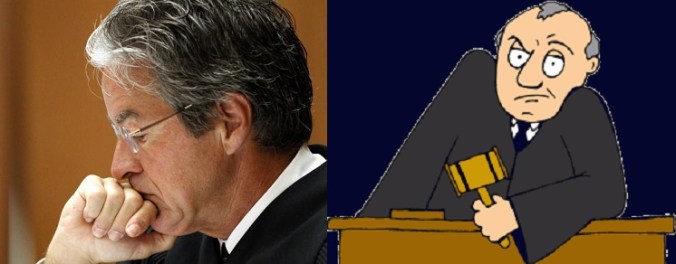
Judge Clarke (L) and artist's representation (R)

Judge Clarke (L) and artist’s representation (R)

A three-judge panel in California found misconduct in Judge Edmund Clarke, Jr’s treatment of one or more jurors in a jury pool for a murder trial.

Your challengeGuess which of the incidents was found to be an abuse of judicial power and authority.

A. Judge Clarke also told a potential juror who wrote that she had only $25 in her checking account that “every one of these lawyers spent more than that on lunch today.” He excused the juror, and after she left, Clarke told everyone in the courtroom how much the juror had in her account. When a second potential juror disclosed he had only $33 in his checking account, Clarke again announced the amount and said that his savings put the other juror “in the shade with that big account.”

B. Judge Clarke reduced another juror to tears reprimanding her after she appeared to change a form to indicate that she did not speak English, which he found incredible. She said  had lived in the United States for 25 years. Clarke said,

“Most people that have been in this country for 10 years have picked up enough English. [Twenty] or so, they’re moving right along. And 25 years is—so you better have a different reason why you want to be excused than that.” 

After she began weeping loudly because, she said later, she was ashamed because she didn’t speak English, he dismissed her from the panel.

C. Finally, Judge Clarke became annoyed at a juror who had written on her hardship form, “Having Severe Anxiety!!” next to her drawing of a frowny  face. “I work as a waitress and make minimum wages, plus I’m planning a wedding in two months and all of these things, especially this courthouse are aggravating my anxiety terribly. On the verge of a meltdown!” Clarke  excused her from jury duty,  but when she added that the clerk who was checking in potential jurors was “really disrespectful” to everyone, he  told the woman that she could stay in the hallway and tell him more at the end of the day. When the dismissed juror insisted that she had to leave, he said,

“No, you’re staying. You’re staying You’re staying on. I’ve been a judge for seven years. No one’s ever complained about my clerk. But I’ll be happy to hear your complaint at the end of the day. So go to the hall and stay and come in, act like an adult and you can face her and tell me everything she did wrong.”

The woman did as she was ordered and apologized to Clarke after waiting for an hour court to be adjourned. The judge  asked her how she would have felt if he came to the restaurant where she worked and criticized her in front of everyone, saying, 

“If you came here thinking that this was going to be Disneyland and you were getting an E Ticket and have good time, I’m afraid you have no sense of what is going on in this building. Now, seven years ago the first clerk that was assigned to me, she’s still here. The only clerk I’ve ever had. One juror, in all that time, out of thousands, has ever complained about her. That’s you. You can leave now knowing that’s what you accomplished.”

D. All of the above.

Take the poll, and then go to the answers after the jump.

Continue reading

Ethics Heroes: The California State Legislature And Gov. Jerry Brown

governor-brown

Usually, when Ethics Alarms headlines California’s lawmakers, it is because they have done something irresponsible, like in this postthis one,  and my personal favorite, this one, in which Governor Jerry Brown signed a minimum wage law that he admitted might not make economic sense, because it was consistent with partisan fantasies.

But a blind pig might find a truffle, every dog has its day, and even a stopped clock is right occasionally. California just passed a desperately needed law that no other state has had the courage to pass. Its purpose: take serious measures to stop prosecutorial misconduct that sends innocent people to jail, a problem that is rampant everywhere in the U.S., but particularly bad in the Golden State.

Brown just signed into law a new statute making it a felony for prosecutors to alter or intentionally withhold evidence that could be used to exonerate defendants. Violators could be sentenced to up to three years in prison. That’s not nearly enough punishment when the crime often robs innocent citizens of decades of their lives, but it sends an important, and one hopes an effective, warning…with teeth. Continue reading

Ethics Hero: “Mama Betty”

pitchess

In Los Angeles, six thousands of LA County prisoners are housed in Pitchess Detention Center, which is 50 miles from the inner city neighborhoods where most of the prisoners there live. Using public transportation, which is what most friends and family members must use to reach Pitchess, the journey can take up to five hours to visit an inmate for 30 minutes, through a glass window, with no physical contact. The closest bus stop is a mile away from the jail, and at the bottom of a steep hill.

For five years, a woman named Betty Peters, now 76, has picked up visitors at that bus stop and driven them to the prison. She also waits for the women (mostly) to finish their visits, and drives them back to the bus stop. The grateful visitors know her as “Mama Betty.”

This is an act of pure compassion and kindness, and not without its risks. If a visitor tries to smuggle in contraband, drugs or a weapon,Betty could be prosecuted as an accomplice. Nor does she know the character of those whom she ferries from the jail to the bus and back. Might she be at risk of harm herself? I would assume so. Those with criminals as friends and associates are more likely to be criminals themselves.

I hope this story has a happy ending, because every time kindness like this is returned with cruelty and exploitation, the number of Mama Bettys among us is diminished, and our society becomes a little more meaner, more callous, and less ethical.

Ethics Alarms salutes Betty Peters as an Ethics Hero…and worries.

You can hear a podcast about Mama Betty here.

________________

Pointer: Fred.

California Decides It’s The Government’s Function To Help Actors Pretend They Are Younger Than They Really Are

picture-of-a-birthday-cake-with-lots-of-candles

California increasingly appears to be hell bent on serving as the cautionary example of how the belief that government has an unlimited brief to meddle in everything leads to abuse and derangement.

Gov. Jerry Brown last week signed legislation that prevents  entertainment websites such as the Internet Movie Database (IMDb),from posting an actor’s age or birthday if the actor doesn’t want anyone to know how old he or she is.

The law, which becomes effective January 1, applies to entertainment database sites that allow paid subscribers to post resumes, headshots or other information for prospective employers. Only a paying subscriber can make a removal or non-publication request. The beneficial end that supposedly justifies  this unconstitutional and suppressive means is that age discrimination is allegedly rampant in show business.

“Even though it is against both federal and state law, age discrimination persists in the entertainment industry,” Golden State legislature Majority Leader Ian Calderon, D-Whittier, said in a statement. “AB 1687 provides the necessary tools to remove age information from online profiles on employment referral websites to help prevent this type of discrimination.”

Naturally the actor unions are all for this form of government censorship. “Gov. Jerry Brown today stood with thousands of film and television professionals and concerned Californians who urged him to sign AB 1687, a California law that will help prevent age discrimination in film and television casting and hiring,” said SAG-AFTRA President Gabrielle Carteris. You remember Gabby, don’t you? She was the brainy, non-sexy teen in the original “Beverly Hills 90210.” I’m sure she thinks the reason her career tanked as she edged into middle age was “discrimination.”

I’ve seen you act, Gabrielle. It wasn’t. Continue reading

California’s High Speed Rail Fiasco

The question posed by the unfolding California high-speed rail cataclysm is why the reaction to it should be a partisan or ideological issue at all. Are human beings capable of managing bias and learning hard truths from new information, or aren’t they?

High speed rail was promoted in California  as a green and virtuous way to propel commuters  from San Francisco to Los Angeles along at 220 miles an hour, completing the trip in a about  two and a half hours. It was going to involve minimal tax-payer cash,  with  billions arriving from private investors. It would be profitable, not requires state subsidies and be much less expensive than flying. Thus enthused and enlightened,  53.7 percent of approved the plan and a $9.95 billion bond.

It was a scam, a hustle, and a pack of lies.  Virginia Postrel writes at Bloomberg…

“California’s high-speed rail project increasingly looks like an expensive social science experiment to test just how long interest groups can keep money flowing to a doomed endeavor before elected officials finally decide to cancel it. What combination of sweet-sounding scenarios, streamlined mockups, ever-changing and mind-numbing technical detail, and audacious spin will keep the dream alive?”

Well said. I would add, “And will anyone learn from this fiasco?” Specifically, will anyone learn that ideologically-driven officials will always press policies in defiance of reality, if the public lets them, or more precisely, trusts them.

The Los Angeles Times published a stunning report on how corrupt this enterprise has been from the start. Here’s sample:
Continue reading

From The Ethics Alarms Double Standard Files: A Brock Turner Sentence For A Predator Teacher, And Everyone Shrugs

The predator teacher, who is much more deserving of a light sentence than Brock Turner, who should be killed, and the judge too, come to think of it...

The predator teacher, who is much more deserving of a light sentence than Brock Turner, who should be killed, and that judge too, come to think of it…

The lenient sentence Judge Aaron Persky handed to Stanford student Brock Turner for raping a drunken co-ed  enraged the social media and the public conscience, resulting in thousands of op-eds, protests from feminists and rape-culture activists, petitions, a recall effort, and most devastating of all, an Ethics Alarms post.

Last week, a 33-year old high school teacher named Lindsay Himmelspach pleaded guilty to repeatedly having sex with two minor students at the high school, and received the almost the identical sentence, from another California judge, as Turner. Himmelspach recieved three years probation and four months in jail.

I’m listening, but I hear no screams of outrage.

Huh.

The judge, Butte County Superior Court Judge James Reilley, administered the equivalent rap on the wrist that her Santa Clara colleague did on Turner because Himmelspach had no prior criminal record, she expressed remorse, and somehow he concluded that she’d never do such a thing again. (I’m sure it had nothing to do with the fact the she is hot, and the judge was thinking, “Those lucky bastards!”) Indeed, the judge didn’t even require the predator teacher to register as a sex offender, at least not yet. He’s keeping an open mind, and will decide after a separate hearing.

Hello?

Social media?

Continue reading