Clever! But Wrong: “Hoodies For Hobos”

Homeless advertisng

“Team ADD -A-BALL is proud to announce our new outreach program ‘Hoodies for Hobo’s’. All profits from sweatshirt and t-shirt sales go towards outfitting Seattle’s street people with some fresh gear. I will post a pic of every new bum we spruce up. Thanks everyone.”

—-Add-a-Ball owner Brad Johnsen, on his company’s Facebook page.

Yes, Brad, who casually refers to his walking billboards as “bums,” has what he sees as a perfect plan. Profits profits from all  T-shirt and apparel sales at Johnsen’s Seattle arcade will be used to outfit the city’s homeless “with some fresh gear,” all sporting the arcade’s name and logo. Everybody wins! He gets publicity and good will for this—wink, wink—“charity,” the homeless get spiffy new clothes, and he gets really cheap advertising.

So what if he robs the objects of his charity of their dignity, exploits them, and dehumanizes them into the equivalents of car bumpers? Hey, no plan is perfect! To his credit, sort of, Johnsen’s comments don’t exactly leave much room for doubts about his compassion and motives. “If it also encourages people to go play pinball and get drunk—all the better,” he says.

If he was interested in anything other than the cheap publicity…like, say, the welfare of the homeless, Johnsen would hand out clothes without the logo. I’m sure he wouldn’t understand why I say that. Or why paying the “bums’ who choose to wear the ones that advertise his business would be the ethical course, since it would compensate the homeless for their service and give them a sense of self-worth, rather than making them, in effect, unpaid sandwich-board wearers for the privilege of wearing a lousy hoodie.

I wonder how many people see nothing unethical Johnsen’s scheme. I’m a little afraid to find out.

[Addendum (4 PM 4/10/14): I should have mentioned in the original post that Kant would have agreed with me. This is a Categorical Imperative situation, using human beings as a means rather than an end: “Act in such a way that you always treat humanity, whether in your own person or in the person of any other, never simply as a means, but always at the same time as an end.”  The fact that the cynical ploy can be represented as a one that aims at clothing the homeless makes the label a little shaky, and I admit that the “Ick Factor” looms large here.]

________________________________

Pointer:  Drudge

Facts: Vocative


Unethical Website of the Month: “Smosh” OR “Let’s Give A Big Hand To The Hilarious Comedy of Will Weldon!”

Blurry face boy

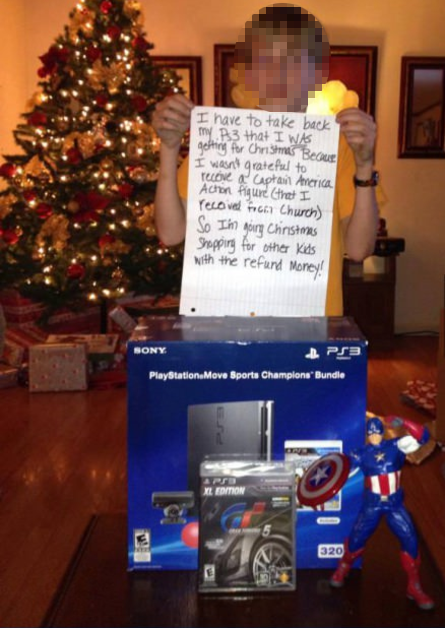
In a twist, this Unethical Website found me. Smosh’s despicable montage titled by the ethically clueless creep who concocted it, Will Weldon, “19 Funniest Examples of Kid Shaming” includes, among its hilarious examples, the photo above from an Ethics Alarms essay I posted about a year ago, with a link back here. Weldon appears to have stolen his post idea from an earlier version of it on the website Heavy, this by an equally warped wag named Elizabeth Furey. Heavy would have been an “Unethical Website of the Month” if I had known about its post last May, and everything I write about  Smosh applies to Heavey, just as everything I write about Will applies to Elizabeth.

In the linked Ethics Alarms post, I specifically condemned the practice of  parents forcing children to hold up a sign “confessing” some transgression, taking a photo of him or her*, and posting it on the web.  I wrote:

“I think any aspect of a punishment that outlives the effects of the offense and a continues to do harm long after the original wrongdoer has reformed is unfair, abusive and cruel. If, as seems to be the case, the boy’s parents added to his punishment of having to return his Play Station 3 by first photographing the kid holding a sign describing his transgression, and then memorializing his humiliation by posting it on the internet, they took the lesson into unethical territory. Punishing their child for his spoiled and ungracious behavior by taking away a cherished gift is a legitimate exercise of parental authority, if a bit excessive for my tastes, especially at Christmastime. Turning him into the web poster child for ungrateful and spoiled children everywhere is, I believe, an abuse of that authority.”

I was feeling uncharacteristically equivocal that day, it seems, infused as I was still by the holiday spirit. Let me be more assertive now.  Dog-shaming using this device is a “thing’ on the web now, and such photos can be funny. Needess to say…or rather, it should be needless to say, but apparently I need to say it for people like Will and Elizabeth…children are not dogs. Continue reading

This Is The Way It’s Done, Ethics Warriors….Well, ALMOST

Quit being distracting, Triana...

“Quit being so distracting, Triana…”

Deborah Brown Community School in Tulsa, Oklahoma forbids its students from wearing their hair in dreadlocks, afros “and other faddish styles.” Terrence Parker, a barber, challenged the rule by sending his 7-year-old daughter Tiana to class there wearing her hair in dreadlocks. She was told that she could not attend school with her hair in a (stupid and ignorant) rule-violating style. Tiana is now attending another school, while the story, reported on the web in various sources, is holding the school up to well-earned ridicule for a dress code that if not racist in intent, is racist in impact. Eventually, I would think, the school will be shamed into seeing the error of its ways, which is enforcing an inappropriately narrowly-viewed, culturally-biased interpretation of what constitutes a “presentable” hairstyle as opposed to one that might “distract from the respectful and serious atmosphere [the school] strives for.”

This is the way unethical rules get changed. Parker confronted the rule by violating it, and accepted the penalty while publicizing the unjust rule to the greater community, which is making its disapproval known. Continue reading

No, It’s Actually Allison Benedikt Who’s A Bad Person

Hang in there--the schools will be better in a few generations...

Hang in there–the schools will be better in a few generations…

There may be some persuasive arguments to be made for sending your child to a public school system you don’t trust. The obvious one is that you have no choice, which is true for many Americans. There are also some good reasons to write a “manifesto” called “If You Send Your Kid to Private School, You Are a Bad Person,” the best of which is to cause people to focus on the problem of the failing and unacceptable public school system, and what should be done about it. However, Allison Benedikt, who actually wrote an article with this title and presumably this intent, failed so miserably at making a coherent and persuasive argument of any kind that her provocative title amounts to an unethical assertion itself: if you are going to make a blanket indictment of the character of millions of people, you had better be able to produce an ethical argument or two, or at least demonstrate that you comprehend a little bit about ethics. Allison doesn’t. Based on this piece, I not only wouldn’t trust her (oh, by the way, Allison, the core objective of ethical conduct in your profession—any profession, actually—is trust) to provide advice about how to educate my child, I wouldn’t trust her to walk my dog. Continue reading

Mind Control? My Alarm Is Ringing. Should It Be?

Kirk Mind

Harvard researchers are on the way to perfecting brain-to-brain interfaces, permitting a human to control the behavior and eventually instincts and emotions of other creatures with thought alone. Continue reading

Why Photographer Arne Svensen Is An Unethical Creep

Photographer/artist/ Peeping Tom Arne Swenson as played by Jimmy Stewart in "Rear Window."

Photographer/artist/ Peeping Tom Arne Swenson as played by Jimmy Stewart in “Rear Window.”

“For my subjects there is no question of privacy; they are performing behind a transparent scrim on a stage of their own creation with the curtain raised high. The Neighbors don’t know they are being photographed; I carefully shoot from the shadows of my home into theirs.”

Believe it or not, this is how photographer Arne Svensen justifies his wildly unethical photographic peeping Tom excursions into his neighbor’s bedrooms for his own profit. This artist has provoked a controversy by 1) stalking the people who live in the New York apartment building across from his, 2) keeping a camera lens on them when they dare not to keep their windows shuttered as if they were vampires, 3) shooting photographs of whatever he sees that tickles his artistic sensibilities, fetishes or perversions, 4) choosing photos that do not show the faces of his subject victim, and 5) exhibiting and selling the results as artwork.

Amazingly, his neighbors object!

Let me cut to the chase here and be direct, because any minute now we are likely to find out that President Obama’s EPA has been secretly causing coal mine cave-ins and assassinating oil execs to forestall global warming, and that the President is outraged and just heard about it when we did, and will take strong action by telling the officials involved that they have to sit in the back during the next White House concert, and I’ll be distracted. Continue reading

When Is Human Cloning Unethical? When You Do THIS, For Starters…

Coming attraction at the San Diego Zoo.

Coming attraction at the San Diego Zoo.

Much of the ethics debate over cloning is and has always been pure “ick factor” confusion. Cloning is strange and unnatural, and to many people, that means it is immoral and wrong, as in, “If God had wanted us to be created from nose hairs, he wouldn’t have given us sex organs!” But there is nothing intrinsically unethical about cloning. The problem is that there are many theoretical applications of cloning that are monstrous (See: “The Island”), and too many scientists whose attitude is, “Why not?”

It is difficult to imagine a more perfect example of this than the news that Harvard Medical School geneticist George Church is plotting to create a Neanderthal human, if he can find, in his words, “an adventurous female human” willing to be Mommy to Alley Oop. Continue reading

Really? The Baby Mop?

No.

One of the Kantian categorical imperatives is that no human being should ever use another for his or her own selfish objectives. Another ethical principle that is close to absolute is that one should never  exploit children. A third is not to treat human beings as objects, or to denigrate, diminish or humiliate them without their informed consent. A fourth principle is that forced child labor is inherently unethical, and a fifth is that making individuals do work that benefits you without compensation is theft.

HEY! I’ve got a brilliant idea! Let’s help parents turn their babies into living, breathing, drooling mops! Continue reading

Comment of the Day: “Randy Cohen’s Scofflaw Cycling: How Did THIS Guy Ever Get To Be Called ‘The Ethicist’?”

Reader Lance Jacobs, a New York bicycle instructor, was moved by last month’s Ethics Alarms Post “Randy Cohen’s Scofflaw Cycling: How Did THIS Guy Ever Get To Be Called ‘The Ethicist’?” to write the New York Times about their scofflaw, erstwhile “Ethicist,” who had proudly confessed in a an essay that he routinely broke the law while cycling, and believed that he was right to do so. The Times didn’t print Lance’s letter, an open letter to Randy, and sadly, this blog does not (Yet! Yet!) have the circulation of the Times, but it is an excellent rebuff to Cohen, and a most deserving “Comment of the Day.”

Here it is:

“Dear Mr Cohen, Continue reading

Randy Cohen’s Scofflaw Cycling: How Did THIS Guy Ever Get To Be Called “The Ethicist”?

Stop means “stop,’ unless Randy decides it means “yield”—after all, he knows best.

Randy Cohen was the original author of the New York Times Magazine’s column “The Ethicist.” During his tenure he made a name for himself with lively and sometimes witty prose, and on Ethics Alarms, at least, a disturbing tendency to rationalize clearly unethical conduct when it suited his political agenda, which was unapologetically left of center. In one notorious example, he told a student whose wealthy and famous father was paying her college tuition that it would be ethical for her to cash a partial tuition refund check she received from the university to her mother and stepfather, who believed that the father had not paid his fair share of child support. Cash that check, advised Cohen….“You are entitled to this money not because he is successful while you struggle. Such rough justice would also encourage you to sneak into his house, swipe his sofa and sell it on some kind of furniture black market. That would be stealing; this is merely claiming what he owes you.”  Of course, this is also stealing: cashing a check not intended for you because you believe it should be used to settle a disputed debt between the owner and someone else is not honest or fair, regardless of the merits of that belief. But Randy is a class warrior: as “The Ethicist,” he routinely took the position that it was “ethical” for people to use dubious means to get an edge on the evil rich, which in his world apparently means anyone richer than him.

I don’t know what Cohen has been doing since the Times sacked him; it isn’t practicing ethics, as he didn’t do this before his tenure, and confessed when he left the job that writing about ethics didn’t make him practice ethics while he was “The Ethicist” either, something I found and still find incomprehensible. Now, he tells us in a recent Times piece, the Ex-Ethicist is riding around New York City on his bicycle, running stop signs and red lights.

He tells us, moreover, that this is ethical, though it is certainly illegal. “I roll through a red light if and only if no pedestrian is in the crosswalk and no car is in the intersection — that is, if it will not endanger myself or anybody else, ” Cohen says. “To put it another way, I treat red lights and stop signs as if they were yield signs. A fundamental concern of ethics is the effect of our actions on others. My actions harm no one. This moral reasoning may not sway the police officer writing me a ticket, but it would pass the test of Kant’s categorical imperative: I think all cyclists could — and should — ride like me.”

This is arrogant, fatuous, reckless and wrong. But that’s Randy.

Even Coehn’s reading of Kant is wrong. The categorical imperative says that an action is ethical only if it could be the universal rule without harm, and this, despite Cohen’s rationalizations, could not. Who says the cyclist’s judgment of when it is safe to run a red light or stop sign is correct or reasonable in every instance? Why couldn’t motorists also use this same justification for running red lights at will? Continue reading