“The Keepers,” The Catholic Church, And Bishop Fulton J. Sheen

I began watching Netflix’s new “true crime” series “The Keepers” last night. I may not last through all seven episodes. In addition to the documentary story-telling methodology, which moves at the pace of a slug-race, the story of how unsolved murder of a Baltimore nun might  be part of  (yet another) horrific cover-up by the Catholic Church made me so angry and frustrated that I quit in the middle of the third episode. The series makes the case that the nun, Sister Catherine “Cathy” Cesnik, was killed because she was about  to reveal ongoing sexual abuse of young teenage girls by the priest running the Archbishop Keough High School for girls.

The abuse and the extent of it is not speculation. As in so many other places, the Catholic Church in Baltimore eventually paid millions in damages to multiple victims of multiple predator priests who the Church moved around the  region—so they could molest and assault new victims—rather than handing them over to law enforcement. It is hard to imagine any priest worse than Father Joseph Maskell, however, if even some of the allegations against him are true. Victims say he used student files and illicit police connections to target teenage girls who were already being sexually abused. He manipulated them using a sick combination of religion, guilt, hypnotism and intimidation, sexually abused them, and even delivered some over to members of the Baltimore police department for more abuse.

The documentary focuses on the school’s Class of ’69, though there must have been equally abused girls before and after. The conspiracy of silence began to crack in 1992, when an especially  victimized member of the class suddenly realized that she had repressed memories of horrible experiences, and finally complained to the Baltimore Archdiocese, setting off the kind of despicable Church defensive strategies too familiar to anyone who has seen “Spotlight.”

This documentary isn’t good for my state of mind. It makes me wonder not only if all is lost, but also if all wasn’t lost long ago. I was raised in a largely Catholic community. I am not religious, but as an ethicist I recognize the important, civilizing role religion has played in teaching and enforcing moral principles for the majority of the public for whom ethical analysis is too challenging. Episodes like the Father Maskell scandal raise questions that I rebuke myself for asking, like “How can this be?” “Jane Doe,” the star witness in the documentary, is still a devout Catholic. Her immediate response to every dilemma is to pray. I don’t get it. She was savaged, threatened and abused by a priest that she knows the Church allowed to prey on the vulnerable students entrusted to him. Why would she still trust the Catholic Church?

Why would anyone? Continue reading
Pop Quiz: What Does U.S.A. Gymnastics Have In Common With The Roman Catholic Church?

Both are large, powerful organizations that facilitated the sexual abuse of children in order to protect their money and reputation.

Yes, you can add Penn state to that list too.

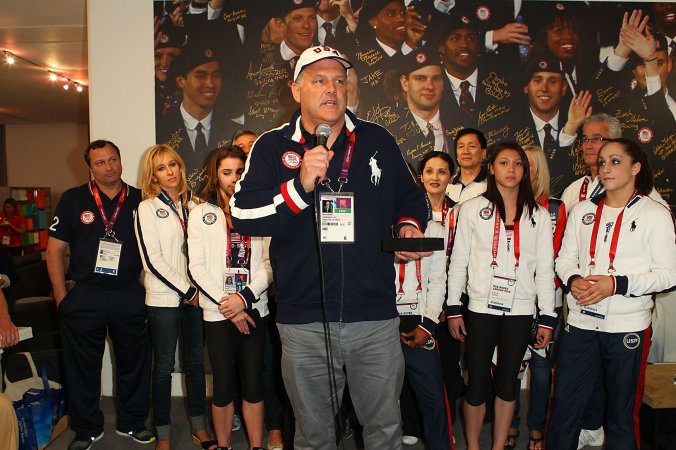
I’m really sick today, and it’s hard writing, thinking and especially typing, but maybe I don’t have to explicate this so much.  Larry Nassar, the national team doctor for USA Gymnastics, is accused of abusing dozens of female gymnasts. More than 80 victims have come forward to claim that he sexually assaulted them. Dr. Nassar was accused of 22 counts of first-degree criminal sexual conduct last month in Michigan. The scandal has also claimed Steve Penny (above), president of U.S.A. Gymnastics, who recently resigned after 12 years in the post.

A sport that has its priorities straight does not hire someone like Penny to lead it. He had been the director of media and public relations for U.S.A. Cycling in the early 1990s,promoting the sport and its superstar, Lance Armstrong. When he took the job at U.S.A. Gymnastics, one of his responsibilities there was to evaluate sexual assault accusations and determine if they warranted being reported to the police. Notes Juliet Macur in the New York Times,

“This is how the world of Olympic sports in the United States has operated for years: No one thought it strange that a sports marketer was in the role of sex crimes investigator.”

Is it any surprise that the culture of women’s gymnastics was poisoned with sexual predators? We had been told by Nadia Comenici that she had been abused, and the sport’s optics were, to use a technical term, oogie. All those tiny women-girls, their growth and maturation retarded by dieting and excessively rigorous training, being hugged repeatedly by bear-like coaches: I stopped finding the sport anything but disturbing years ago. (My feminist friends, who worshiped the little sprites—the ice-skaters too–told me I had a dirty mind.) Here is  a section of a recent column by former gymnastic champion Jessica Howard:

By the time I reached the World Championships in 1999, my hips hurt so badly that at times I could barely walk. That was the environment I trained in that I believe created an opening for Larry Nassar, the national team doctor for USA Gymnastics, to sexually abuse me…the first time I met “Larry” I immediately trusted him. He was the premier USA Gymnastics doctor with an international reputation, and I felt lucky to have been invited to the ranch to work with him.

For our first appointment, he asked me to wear loose shorts and no underwear. That seemed strange, but I obeyed. As in training, I wanted to be perfect. He began to massage my legs, and then quickly moved inwards on my thighs. He then massaged his way into me. I was rigid and uncomfortable, but I didn’t realize what was happening. I was confused, and thought that it must just be what had to happen. This scenario happened repeatedly over the course of my week at the ranch. At no time was there ever another adult in the room. Coming off of a difficult year of training, Dr. Nassar reached out as the good guy, supporting me emotionally and promising me relief from the pain. Now I know that in actuality he expertly abused me under the guise of “treatment.”

I trusted USA Gymnastics. But I was sexually abused, as were other elite athletes, including Jamie Dantzscher, a 2000 Olympian, and Jeannette Antolin, who was a U.S. national team member. And the abuse was not limited to Dr. Nassar. According to more than 5,600 pages of USA Gymnastics records released to the IndyStar on March 3 after a lengthy court battle, some of the 54 coaches with sexual abuse complaint files spanning 10 years weren’t banned from gymnastics until years after USA Gymnastics discovered they were convicted of crimes against children.

Other accounts tell how this was ingrained in the system: Continue reading

Ten Ethics Observations On The New Bill Clinton Sexual Assault Accusation

The late Leslie Millwee...VERY late.

The late Leslie Millwee…VERY late.

From Politico:

Leslie Millwee, a former reporter for local Arkansas TV station KLMN-TV, has accused former president Bill Clinton of sexually assaulting her three times in 1980, while Clinton was governor of Arkansas…Millwee told Breitbart she interviewed Clinton about 20 times publicly and also met with him in KLMN-TV’s newsroom. She said he groped her and rubbed his genitals on her while they were alone in KLMN-TV’s small editing room.

“He came in [to the editing room] behind me, started hunching me to the point that he had an orgasm,” she told Breitbart’s Aaron Klein. “He’s touching, trying to touch my breasts and I’m just sitting there very stiffly, just waiting for him to leave me alone. And I’m asking him the whole time, ‘Please do not do this. Do not touch me. Do not hunch me. I do not want this.’ And he finished doing what he was doing and walked out….Breitbart also interviewed three of Millwee’s friends, who said Millwee told them in the late 1990s about the alleged assaults.

…Millwee’s accusations are new, and Breitbart, which published a 19-minute video interview with Millwee, has been supportive of Trump and dismissive of the numerous women who have accused him of sexual assault. The site is led by Steven Bannon, who took a leave from Breitbart to serve as CEO of Trump’s campaign.Millwee said she considered coming forward in the late 1990s, during the Monica Lewinsky scandal, but she was intimidated after seeing how the media treated other women who accused Clinton of sexual assault.

“I almost came out during the Monica Lewinsky and Kathleen Willey situation,” she said. “I watched that unfold a little bit. I was very prepared to go forward then and talk about it, and I watched the ways the Clintons and Hillary slandered those women, harassed them, did unthinkable things to them, and I just did not want to be part of that. I had very small children at the time, I had a job at pharmaceuticals, it was a very conservative situation. I didn’t want to do anything to bring harm to my career and my family.”

Millwee said she decided to finally go public now because she believes that the media still has not held Clinton accountable for his alleged sexual assaults. A Breitbart spokeswoman said Millwee reached out to Breitbart on her own “months ago after Hillary’s ad that sex assault victims have a right to be heard.”

Observations:

Continue reading

Ethics Film of the Year: “Spotlight”

No spoiler alerts necessary; I’m not going to say much about the film’s plot. Just go see it.

Sure, I was predisposed to like “Spotlight.” It’s about Boston, my home town; Fenway Park even appears in it, Red Sox and all.  I had also followed the unfolding Catholic Church sexual molestation scandal there that the Boston Globe broke in 2002. This was the Globe’s momentous investigative journalism series which showed the extent to which high-ranking Church officials allowed child predator priests to continue harming trusting kids, as the Church paid for confidential settlements to victims and transferred the criminal priests to other parishes, where they could, and did, strike again. “Spotlight” tells the story of how a group of Globe editors and reporters finally exposed a local conspiracy of corruption that spread across institutions and professions, and that pointed to a world-wide scandal that still haunts the Catholic Church today.

It’s a better ethics movie than “All The President’s Men,” to which it will inevitably be compared. Whether it’s a better movie or not is a matter of taste. (I liked it better.) Where the movie really shines, however, is how it raises so many of the ethics issues we routinely cover here, such as…

  • Legal ethics: the duty of lawyers to represent clients, confidentiality, and when, if ever, human ethics require the breaching of professional ethics.
  • Ethics corruptors, and what happens when admired, trusted and powerful people and institutions require their followers to show their loyalty by ignoring, rationalizing or covering up wrongful acts.
  • Journalism ethics: the business of journalism’s conflict with the duty of journalists to find and publicize the truth; how ambition, personal biases and non-professional concerns can warp perspective and performance
  • Ethics and religion, hypocrisy, and the institutional utilitarian choice to protect the whole when it means sacrificing individuals
  • Rationalizations, including the Saint’s Excuse and the King’s Pass, in which prominence and “good deeds” seem to justify double standards.
  • Hindsight bias, Moral luck, and more.

Continue reading