Ethics Quiz: The Lottery Winner’s Sister-in-Law

_rich_man_poor_man“Dear Prudence” (a.k.a Emily Yoffe), my least favorite advice columnist (who answers weird questions from weird people at Slate), received an ethics quiz worthy query from a woman whose husband has had some business reverses and now, as he near retirement age, is looking at two jobs and tarnished golden years without a pension or vacations. Meanwhile, her husband’s brother (let’s assume this is true: it sounds like a hypothetical to me) won 50 million bucks in the lottery a few years ago, and is having a ball. The two brothers are on good terms and speak often. She asks,

“What I don’t understand is how he can stand to see his little brother so stressed and working so hard while he has more money than he could spend in a dozen lifetimes. Obviously he is under no obligation, but he does not seem to realize how hard it is to see how he spends his money on travel and amusements. I think he should help his brother out. What do you think?”

Prudence  thinks the poor brother should ask the rich brother for money, and that if he won’t, the wife of the poor brother should: Continue reading

Ethics Hero Sighting At The 7-11

7 eleven

They are out there—just good, kind, ethical people who quietly do what they can to make society a little better whenever they can.

I was just at a 7-11 in Alexandria, Virginia. I was sitting in the car, waiting for Grace to pick up some things, along with Rugby, who loves sticking his head out the window and flirting with people going in and out of the store. He’s shameless and adorable, and almost every time we go there one or more shoppers will come over to the car, pat him and talk with him…and sometimes even me.

As I waited, I noticed a grim, middle-aged African American man standing quietly to the side of the store front, apparently asking people for spare change as they left the 7-11. He wasn’t having much luck. Then an SUV pulled up by my car, and a jolly, pudgy, smiley guy with curly gray hair and wearing  baggy shorts, with a loud, boisterous manner, got out. He immediately greeted Rugby, asking his name, scratching him behind the ears. “Does he have water?” he asked. I explained that we were just minutes from home. “Bye, Rugby!” he shouted, and started to enter the store.

I saw him stop as he opened the door and eye the other man. “Hi, brother!” he said loudly. “How are you doing?”

“Not too good,” was the soft reply.

“Really? Hey, come on in,” the curly haired man beckoned. The sad-looking black man followed him into the store. Grace returned, but I lingered in the parking space a bit. Sure enough, the man who had been asking for change emerged a few minutes later carrying a plastic bag that held a hot dog, a bottle of coke and some other items.

And he didn’t look quite so grim.

Nice.

In fact, perfect.

They are out there, all right.

There is hope.

Just In Time For Christmas, Here Are All The Bad Arguments And Rationalizations Against Tipping So You Can Feel Self-Righteous About Being A Scrooge

See? The rest of the world knows how to deal with you sexist, racist, aristocratic poverty perpetuating, self-esteem destroying bastards!

See? The rest of the world knows how to deal with you sexist, racist, aristocratic poverty perpetuating, self-esteem destroying bastards!

Vox has published an entertaining screed against tipping, massing all the contradictory, facile rationalizations and faulty arguments against demonstrating one’s gratitude when someone serves you well. This is Vox, remember—Ezra Klein’s uber-progressive website with an agenda. Think about what the alternative to tipping is, and where the critics of tipping are going with these claims. Hint 1: It has nothing to do with democracy or individualism. Hint 2: The piece argues that tipping is classist, racist, sexist, “lookist”…the works.

The full illogical, ethically confused character of this junk has to be read to be fully appreciated, but here is a quick overview:

1. Hoary old quotes. There are these, for example:

English author Lynne Truss on visiting New York: “In this great financial capital … tips are not niceties: give a ‘thank you’ that isn’t green and foldable and you are actively starving someone’s children.” No, Lynne, you’re being cheap, that’s all.

The Village Voice’s Foster Kamer: “It reinforces an economically and socially dangerous status quo, while buttressing a functional aristocracy.”   Ah. You see, if lower paid service professions are treated like robots and underpaid, they will rise up and overturn this monstrosity called capitalism.

 Michael Lewis: “I feel we are creeping slowly toward a kind of baksheesh economy in which everyone expects to be showered with coins simply for doing what they’ve already been paid to do.” Who is being “showered with coins?”

2. “Tipping lets employers off the hook.” Translation: It gets in the way of the progressive “living wage” campaign. Mandatory salary levels drive businesses out of business and reduce jobs. Want to see all restaurants go to the iPad, self-ordering, system running rampant at airport restaurants—and no, I don’t tip a runner who just carried my food to the table—by all means, force restaurants to pay “a living wage.”

3.  “Tipping is undemocratic.” This is the George Orwell, “Peace is War” argument. The government should stop me from giving my money to whoever I want in the name of democracy. Continue reading

The Harvard Law Student’s Formula For An Ethical Life

Yes, I hate my job, and yes, my clients are the scum of the Earth, and yes, my life sucks. But think of all the kids I can help get de-wormed!

Yes, I hate my job, and yes, my clients are the scum of the Earth, and yes, my life sucks. But think of all the kids I can help get de-wormed!

When I heard about the Harvard Law Record’s essay by law student Bill Barlow titled “Want To Save The World? Do Biglaw,” I mistakenly  assumed that he had made a persuasive, or at least coherent, utilitarian argument. After all, some fairly distinguished blogs took notice, and set about rebutting him. I was shocked when I actually read the piece. From what I can tell, Barlow understands nothing he was writing about—not the profession of law, not charity, not careers, not values, not law firms, not ethics, not money, not life. Why is someone who thinks like this in law school? What are law schools accepting people capable of writing this? Why is Harvard allowing someone this naive and shallow to display a Harvard degree?

This is literally all there is of substance to the article:

“So there you have it—be a corporate lawyer, donate 25% of your post tax income to charity, and save 150 lives a year, or de-worm 25,000 kids.  Alternatively, go into Public Interest, Government, or Academia, and feel warm and fuzzy about yourself.  Sadly, when people at this school talk about public service, they mean the latter, rather than the former.  If only people applied the same amount of cognitive skill used in just one LSAT logic game to the most critical question of what to do with their law degree, hundreds of lives could be saved.”

Ugh. Where to begin? Continue reading

The Ethics Scrooge On The Starbucks Pay-It-Forward Ponzi Scheme

KONICA MINOLTA DIGITAL CAMERA

The Ethics Scrooge here.

If you think I’m going to get all misty eyed about the “random acts of kindness” fun and games Florida Starbucks customers have been amusing themselves with lately,  you are sadly mistaken.

The happy-talk story of the week—and I admit, the nation needed one—concerned a St. Petersburg, Florida Starbucks where an early morning customer at the drive-through window decided to “pay it forward” and buy coffee for the next person in line.That customer emulated the spirit of the Kevin Spacey weepie,  and bought a drink for the next person in line at the drive-through, and so it continued throughout the day, with 378 customers purchasing drinks for the strangers in line behind them, a so-called altruism chain that lasted 11 hours.

Awww. Continue reading

Ethics Dunce: Anyone Who Thinks Hillary’s “I Gave It All To Charity” Excuse Excuses Anything

Money-box-giftI apologize in advance for this, because I assume all of you are as sick of commentary on Hillary, her book promotion tour, and her endless stream of statements that validate everything her critics have been saying for over a decade. However, her latest ethically tone-deaf statement is a special category of dishonesty that I vowed long ago to flag every time it was tried by a public figure, and given a pass by the news media. So here we are.

Hillary responded to the growing controversy over her absurd speaking fees, which she charges to universities as well as corporations, by saying this to ABC’s Ann Compton:

“All of the fees have been donated to the Clinton Foundation for it to continue its life-changing and life-saving work. So it goes from a foundation at a university to another foundation.”

Giving money to another individual’s charity of choice is indistinguishable from giving money directly to that individual. If a lobbyist gives corporate money to a politician’s charity, for example, that’s a crime in most states, and should be. The charity dodge is a popular one with corrupt individuals, because the average member of the public, being among those whom Abraham Lincoln noted that you can fool all the time, and also possessing the ethics analysis skills of the typical whippet, just nod and say, “Oh. Okay!” Continue reading

Ethics Hero: NBA Clippers Owner Donald Sterling (And Yes, I Mean It)

When you think about it, the champion in this fight would almost have to be repulsive for a victory to mean anything.

When you think about it, the champion in this fight would almost have to be repulsive for a victory to mean anything.

The other shoe dropped, and however it may be intended, it’s an ethical shoe. Donald Sterling now says that he’ll refuse to pay the 2.5 million dollar fine levied on him by NBA Commissioner Silver and his fellow owners for what he said in his own bedroom.

Good. I was waiting for this, and hoping that would be his course of action. Ironically, a good, compliant, progressive billionaire, and one who was not, unlike Sterling, a repulsive asshole, who was nationally embarrassed as Sterling has been, would crawl quietly into a hole, periodically send out big checks and mea culpas to Al Sharpton, Jesse Jackson, and the NAACP, and in the process, take  big, bloody chunks out of our freedom to think and speak freely, and our personal privacy. Sterling is doing the right thing, although it is going to cause him to be even more vilified by the media and even more assailed as the personification of racism than he has been already—and that has already been disproportionate to his “crime.”

Fighting is also going to be expensive. Never mind. It is revolting to write it, or even think it, but he is fighting for all of us. Continue reading

All Aboard The Sterling Train Wreck: The Foolish, The Grandstanders, The Dishonest And The Irresponsible

Hypocrites

The question is, which is which?

I’ll let you puzzle it out; I’ll be busy retching:

And now, the latest and deplorable passengers on this distasteful Ethics Train Wreck…

Sen. Harry Reid

Reid saluted NBA Commissioner Adam Silver for his “work to swiftly move to stamp out bigotry in its ranks,” as if that had any thing at all to do with what Silver was doing. Reid’s endorsement, however, places a high elected official’s stamp of approval on the proposition that those with unpopular ideas and biases should be punished and have their property taken away from them. Reid said that the league has set a new standard for how professional sports leagues should respond to racism. Of course, Sterling did nothing racist at all, not did he attempt to, or publicly announce such intent. The “new standard” that Reid is applauding is economic penalties for non-conforming beliefs. Finally, Reid attempted to make the absurd parallel to the Washington Redskins’ controversial name: “How long will the NFL continue to do nothing — zero — as one of its teams bears a name that inflicts so much pain on Native Americans?” Reid asked Continue reading

Gift Horse Ethics: The Babe, The Splendid Splinter, and The Ethics Of Self-Promoting Virtue

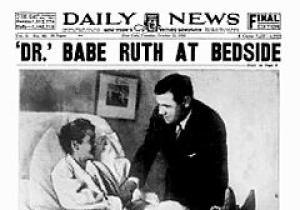
sick child and-babe-jpgBaseball slugger Babe Ruth was famous for visiting hospitals and orphanages to give kids a thrill. Babe always had reporters in too to record his noblesse oblige , of course. He was an orphan himself, and nobody should doubt the Bambino’s genuine dedication and generosity when it came to kids. He just wasn’t going to let his good deeds go unnoticed.

Other baseball greats, notably Ted Williams, made most of his visits without fanfare or publicity, and he didn’t tip off the press. “The Splendid Splinter” wasn’t visiting kids in cancer wards because he wanted his fans to know what a good guy he was. He did it because he wanted to make sick children feel better.

Was the Babe less ethical than Williams? Did his self=promotion take the ethical sheen off of his good deeds? This is the issue raised by the activities  of the  “Magician Prankster” who calls himself “Magic of Rahat” on YouTube and Twitter. He recently posted a video called “Homeless Lottery Winner” showing him playing  a prank on a homeless man, who ends up with $1,000. He is understandably grateful:

Slade Sohmer however, on HyperVocal, is hearing ethics alarms: Continue reading

Ethics Heroes: Senate Republicans

crack

Just say “No.”

Sneaking expensive entitlements into long-term national policy is craven, dishonest, and continues the dangerous trend of sloppy, election-driven legislating that has become virtually standard operating practice in recent years. Senate Republicans generated some hope for transparency and the future of honest debate on governing philosophy by using the threat of a filibuster to block yet another extension of the supposedly “short-term” extensions of unemployment benefits.

I’ve written about this recently, so I won’t belabor it, but there was nothing in Democratic rhetoric surrounding the extension to disprove my suspicion, which was  full-blown three years ago, that this is nothing but a strategy for embedding  a permanent government subsidy of unemployment without a national debate regarding the consequences of such a policy. A ‘temporary” benefit is permanent if elected representatives lack the integrity and courage to end it; for an example one need only look to the supposedly short-term “Bush tax cuts,” which a Democratic President and legislature, despite exorbitant rhetoric about how irresponsible they were (and irresponsible they were), extended, and they are in place still. There is not a single Democratic argument in favor of the supposedly temporary extension that would not apply to a policy of paying the unemployed forever. Here are some quotes from “The Hill” yesterday:

  • “We’re one Republican vote away from restoring benefits to 1.7 million Americans.  There is one Republican vote standing in the way of a lifeline to these 1.7 million people.”-Majority Leader Harry Reid (D-Nev.)

1.7 million, 1 million, 657,000…when would such benefits not qualify, in Reid’s words, as a “lifeline”? If the answer is never, and it is, why would anyone believe these are intended to be temporary benefits? Isn’t the money just as crucial to an unemployed worker whether he or she has 1.7 million companions in misery, or fewer? Continue reading