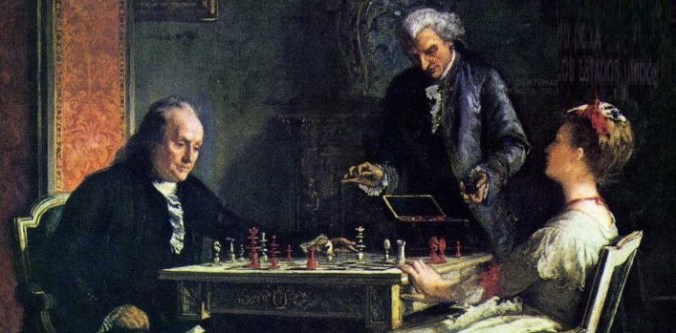
Chess Ethics, From Ben Franklin

Today is Super Bowl Sunday, as you know unless you live in a cave. I quit watching all football after the CTE scandal made it clear to me that this is a deadly sport and that the people who make money by paying young men millions to cripple themselves are ethics villains who deserve to spend eternity standing in a boiling lake of guacamole.

I was never that jazzed about football as a game anyway, and knew that the NFL was the most ethics-free sports organization in existence even as the NCAA worked hard to catch up. In addition to being a mob game on the field and off, it requires no intellectual engagement at all and the values it teaches are few. Later today I will post on Chuck Klosterman’s recent claims that the game is doomed, to which I will only note now by writing, “Good!”

I like all games and most sports. I believe that there are seven special games that everyone should learn to play because they all require special skills that are useful in other spheres of life, and teach ethical values as well. Those are, in no special order,

  • Go
  • Poker
  • Bridge
  • Diplomacy
  • Dungeons and Dragons
  • Scrabble, and 
  • Chess

I will save what each offers us ethically for another essay or six. However the last, which arguably should be first, is the immediate topic here. They used to teach chess in Soviet schools; perhaps they do still. It’s a wise policy. If Americans spent the time they spend watching football playing chess instead, this would be a far healthier country with infinitely stronger critical thinking and life competence skills.

I recently learned that our smartest, quirkiest and most versatile Founder, Benjamin Franklin, was a chess enthusiast. Ben was the ultimate polymath and didn’t have the time or dedication to master a single pursuit that is necessary to become a great chess player. Heck, I don’t understand how he had time and energy to accomplish 25% of what he did in his life. Nevertheless, Ben did take the time to write down his thoughts about the game in the following essay, in which he proposes principles of chess ethics.

I offer it to you now as an alternative to gathering black marks on your soul by supporting the NFL and its sponsors today. Here’s Ben…


Confronting My Biases, Episode 20: The Chessboard Tell

It’s been three years since I last mentioned this ethics pet peeve. I was triggered just yesterday by the commercial above, which I was inclined to favor because it includes my late father’s favorite dog breed (also one of mine), the majestic Irish Wolfhound. I have nothing new to say about the issue, but as I wrote in 2022, “If this post stops just one human being from making that stupid mistake, my life will not have been in vain after all.”

In the ad above, we twice catch glimpses of a garden chessboard, like those royalty once would use with human beings as the chess pieces. (Mel Brooks spoofs this recreation in his “History of the World, Part 1.”). I saw the ad several times before I realized the board was set up wrong. I would never buy a Range Rover Sport anyway, but if I were in the market for one, that inexcusable gaffe would ensure that I bought something else. Or took the bus.

Continue reading

Chess Ethics: The International Chess Federation Makes “Professionalism” Look Ridiculous [Updated!]

Did the world go nuts last week and I missed it? Curmie just sent me this crazy story, and I though it was a gag.

For those of you who don’t follow international chess (that is, all of you), the wonderfully named Magnus Carlsen is a five-time world chess champion from Norway. He has held the No. 1 position in the FIDE world chess rankings since July 1, 2011, indisputably making him one of the greatest chess players of all-time, right next to household names like Raul Capablanca, Ruy Lopez, and Emanuel Lasker. Yesterday he was kicked out of the World Rapid and Blitz Chess Championships in New York after chess’s governing body FIDE barred the Norwegian from participating in the tournament.

Why? He was wearing bluejeans.

Continue reading

Chess Ethics: Yeah, My Expert Opinion Is That Trying To Poison Your Opponent Is Unethical

I could be wrong…

Amina Abakarova, a 40-year-old female chess player and chess coach from the Russian Republic of Dagestan, poisoned another female player during a chess tournament in Makhachkala. This is unethical, cheating, and really poor sportsmanship.

Surveillance footage from the Dagestan Classical Chess Championship showed Abakarova spreading a substance later identified as mercury on the chess board and pieces that she knew would be touched by a rival, Umayganat Osmanova. CCTV footage revealed Abakarova walking to the table where Osmanova was about to play a match and smearing something on the chess board and pieces. See?

Osmanova began to experience nausea and dizziness just 30 minutes later after she began play on the poisoned board. She noticed that some foreign substance was on the pieces and suspended the game before she was too seriously affected, but she still had to be hospitalized.

Continue reading

The International Chess Federation Doesn’t Understand Its Own Game, Biology, And Who Knows What Else…

Funny, I thought chess players were supposed to be intelligent—observant, capable of long-term planning, adept at strategy, those kinds of things.

That’s one more stereotype to discard. The people who run international chess competitions have just outed themselves as morons. The International Chess Federation, or FIDE just banned transgender women from competing in men’s chess tournaments and stripped trans men of women’s chess titles they won. The body revealed its guidelines for transgender competitors this week, thus highlighting its long-running idiocy.

Okay, fine: defining the gender of chess players by their chromosomes would be a solution to a problem if there were a problem, but there isn’t. There is no reason to segregate female and male chess players except ancient prejudice and ignorance—well that, and if it is decided that the fewer little chess players conceived, the better.

Continue reading

Similar To The Transwomen Sports Scam, But Not Really: Cheating, But It Shouldn’t Be

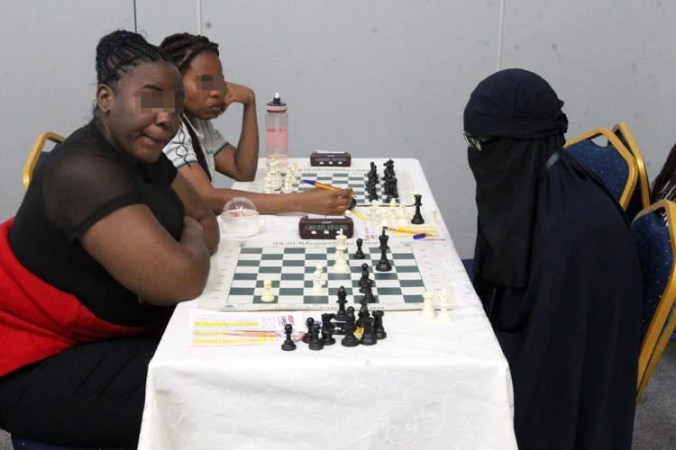
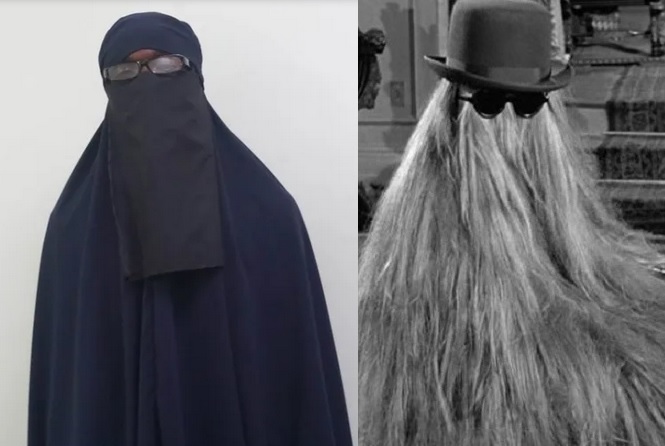
That photo above makes me laugh. It shows 25-year-old Stanley Omondi dressed in a burka as he attempted to win the $3,000 grand prize in a Kenyan women’s chess tournament by posing as female. He looks like Cousin It from “The Addams Family.” See?

Stanley’s black burka left only his feet visible, and he registered under the fake name of “Millicent Awour.” Nobody suspected anything, and the organizers didn’t want to challenge a player for wearing Muslim garb. But his victories against notable female players eventually raised suspicions. “It would be unlikely to have a new person who has never played a tournament to be this strong,” an official told reporters. It also seemed odd that “Millicent” never spoke, either to members of the tournament staff or other players. Eventually, after beating a very strong opponent in the fourth round, Stanley was confronted by officials. He quickly admitted his deception, saying that he was just trying to solve his financial woes.

Continue reading

A Chess Ethics Controversy!

And it’s a chess ethics controversy that I don’t understand, despite a relatively secure knowledge of chess. Here’s what happened:

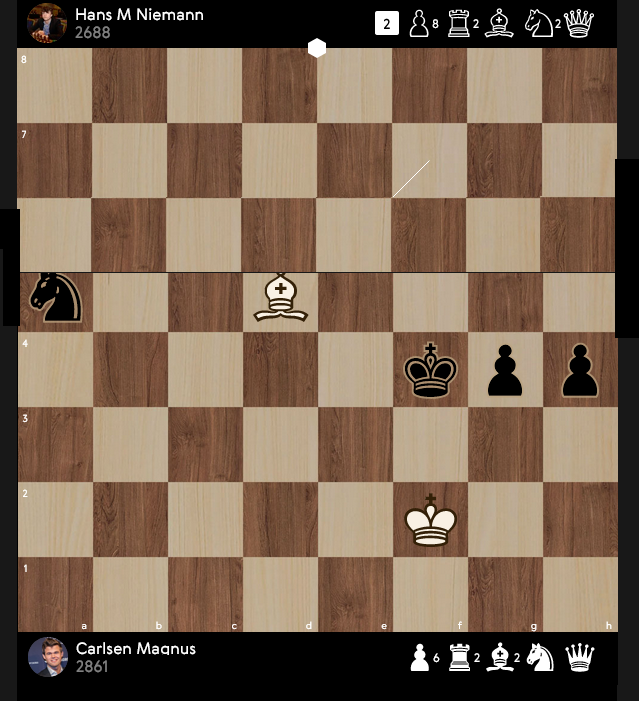
World Chess Champion Magnus Carlsen quit the annual, invite-only Sinquefield Cup chess tournament in St. Louis, Missouri, United States, a stop on the Grand Chess Tour, mid-match. His unprecedented exit sparked speculation that he was engaged in a silent protest after losing to Hans Niemann, regarded as an inferior player. Niemann was accused of cheating earlier in his career.

Opined WorldChess.com,  “Carlsen likely walked out because he felt that the organizers could not ensure fair play procedures.” This was the consensus of many chess fans and commentators as well. Chess Grand Master Hikaru Nakamura also theorized that Carlsen withdrew because he suspected Niemann of cheating in their game, saying: “I think that Magnus believes that Hans probably is cheating.”

Continue reading

Chess Board Ethics: A Popeye

I know: it’s doubtful that Popeye even knows how to play chess. But it’s Saturday night, as usual only the hard core is visiting Ethics Alarms, and this particular blot of laziness and incompetence has been driving me bananas for decades. Today was the final straw.

On a new Amazon Prime BBC documentary series “A Very British Murder with Lucy Worsely,” the final episode had Lucy talking about the gamesmanship going on in “Golden Age” British murder mysteries. As she rattled on, we saw a mid-game chessboard, and a hand was seen moving a piece. The chess board was set up incorrectly. The board, which we were shown from the White player’s perspective, had the black square in the right-hand corner. Continue reading

Ethics Warm-Up, 12/8/2020: Yet Another Date That Lives in Infamy

It’s not Pearl Harbor, but the assassination of John Lennon in Central Park 40 years ago today by a deranged fan is one of the saddest days in popular music history, on the level of the premature deaths of George Gershwin and Buddy Holly.

I really don’t want to talk about it.

1. Scary. The New Yorker’s Steve Coll wrote that”Those of us in journalism have to come to terms with the fact that free speech, a principle that we hold sacred, is being weaponized against the principles of journalism.” David Harsanyi writes at The National Review,

If you believe Americans are too stupid to hear wrongthink, transgressive ideas, and, yes, fake news, you’re not a fan of the small-l liberal conception of free expression. That’s fine. Those ideas seem to be falling into disfavor with many. But the sanctity of free speech isn’t predicated on making sure people hear the right things, it’s predicated on letting everyone have their say. Because as always, the question becomes who decides what expression is acceptable. I’m not keen on having the fatuous media reporters at CNN or activist “fact-checkers” at the Washington Post adjudicating what is and isn’t permissible for mass consumption…this kind of selective esteem for sacred ideals is becoming popular on the contemporary Left. Religious freedom is wonderful when the government protects Native Americans who want to smoke peyote, but it is “weaponized” when an order of nuns decides it’s not interested in chipping in for condoms or an Evangelical business owner decides he’d rather not participate in a gay marriage. Due-process rights are foundational to American life, unless they are being “weaponized” by college students accused of sexual assault….For four years, journalists acted as if Donald Trump was an existential threat to free expression because he berated and insulted reporters. Trump’s tone was certainly unpresidential, but it needs to be said that he did absolutely nothing to hinder anyone from criticizing him or reporting about him. Contra the self-canonized Jim Acosta, it was not a particularly dangerous time to tell the truth. Indeed, reporters were not only free to accuse the president of being a fascist, they could concoct entire fake scandals surrounding the Russians, and Trump was powerless to stop them….

As I will be saying for the next four years as often as possible: This is what those who voted for Joe Biden have endorsed in their determination to express their tantrum over a President whose style they found obnoxious. I really don’t know how they will be able to live with themselves.

Continue reading

A Favorite Personal Ethics Story From The Past, Revived By “The Queen’s Gambit”

the-queens-gambit-8b97b1d

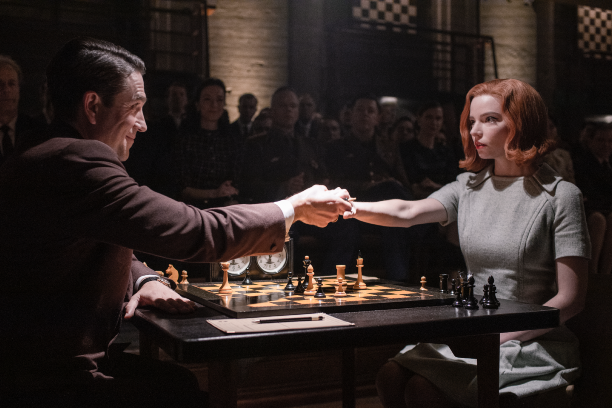
The Netflix series “The Queen’s Gambit” isn’t exactly an ethics film. However, it did trigger a memory from high school of an episode in my life that I cherish, when a group of callow teenage chess-players, led by me, repeatedly made the admirable choice, and left the scene as heroes, even though we lost.

It was my junior year, and approximately the same period in which the heroine of “The Queen’s Gambit” finds herself discriminated against for being a rare young woman in the male-dominated world of competitive chess. Arlington High School had a chess club, and I was president of the club and captain of the team. We had a girl on the team: my sister Edith, who was a freshman that year. She was undefeated in our league in ten competitions with other schools, first because she was very good, if ruthless, second because everyone she played under-estimated her, and third because I “stacked” her in our ten board line-up. Edith always played 9th or 10th board, which means she was facing inferior players, giving the AHS team a guaranteed win every time.

That year we decided to enter the Metropolitan Boston High School Team Championship tournament, a five player-team affair routinely won by Sharon (Mass.)High School’s team. It featured the highest ranking junior player in the state, and the state Junior Champion, as well as a third player of similar caliber. I brought Edith as our fifth board, and sure enough, she was the only girl in the tournament. She also did very well, though she lost one game early on: the competition was much stronger than what she was used to.

Continue reading