Stop Making Me Defend President Biden!

In his Christmas speech on December 23, President Biden said, referring to Christmas’s religious significance,

“How silently, how silently, the wondrous Gift is given. There is a certain stillness at the center of the Christmas story. A silent night when all the world goes quiet and all the glamour, all the noise, everything that divides us, everything that pits us against one another, everything — everything that seems so important but really isn’t, this all fades away in stillness of the winter’s evening. And we look to the sky, to a lone star, shining brighter than all the rest, guiding us to the birth of a child—a child Christians believe to be the son of God; miraculously now, here among us on Earth, bringing hope, love and peace and joy to the world.”

Many conservative blogs, pundits and celebrities “pounced,” attacking the President for not mentioning Jesus by name.

The headline at The Daily Wire was “Biden Delivers Christmas Address Without Mentioning Jesus By Name: ‘A Child Christians Believe To Be The Son Of God’” Father Gerald Murray of the Archdiocese of New York told Newsmax that it made “no sense” for Biden to omit the name of Jesus from his annual Christmas address to the country. “President Biden is always talking about his Catholicism and how it inspired him,” Murray said. “If you’re going to honor the birth of Jesus, you should mention his name. I was very sad to see that. That’s not anything that should be imitated in the future.” Doug Collins, a Georgia Republican and former member of the House,said, “Not saying the name of Jesus—look, there are other holidays to celebrate, but Christmas is the birth of Christ. When we celebrate the birth of Christ who came and gave us the gift of life. That’s what we celebrate and to take that out is just sad.” The Heritage Foundation’s Kara Frederick, complained, “America’s lost its sense of God, it’s Judeo-Christian values, and I think this is just a manifestation. This speech not mentioning Christ, talking about how divided this nation’s been for so long, it’s all part and parcel of the secularization of America and we need to return to our faith.”

The United States is not supposed to have a stated “sense of God,” and for the President of the United States to officially espouse the beliefs of any particular religion is, according the the line of judicial interpretations of the Establishment Clause and the First Amendment, a violation of the Constitution.

Continue reading

The Entitled Working Mother’s Christmas Lament

For some reason I’ve been getting accounts of a lot of overseas ethics controversies of late, like the German hospital patient who shut off her roommate’s oxygen machine because it was “too noisy.” The source of this ethics quiz is the UK, where a frustrated mother argues on a parenting site that it was selfish for a childless colleague to compete with her for a day off on Christmas, because she was a mother.

“Ok I feel terrible about this,” the indignant mom wrote in a thread on UK-based parenting site Mumsnet, as she explained that their manager told the two women to work out their conflict themselves, and let him know their solution. Continue reading

In Dedham, Massachusetts, A Library’s Christmas Tree Makes People “Uncomfortable”

So the board of library trustees and the library director responded to an undisclosed number of complaints by banning the tree, so nobody can enjoy it.

Ever since uber-athiest Madeleine Murray O’Hair’s lawsuit got the Supreme Court to rededicate itself to ensuring that national, state and local governments did not endorse a particular religion in defiance of the Constitution’s establishment cause, there has been a tug of war over how America should celebrate Christmas. Are office Christmas parties “insensitive”? Should elevators play “Joy to the World?” Is the greeting “Merry Christmas!” offensive to someone who isn’t a Christian?

Prior to Mrs. O’Hair’s attack, the balance between religious and secular elements at Christmas time was solid. Schools included traditional Christmas carols in their annual programs without anyone seriously regarding it as pro-Christian propaganda; Bing Crosby was as likely to sing “O Holy Night” as “White Christmas” on his TV Christmas specials. Then the lawsuits started flying over public crèche displays, and otherwise rational people began causing trouble. I remember a smart and generally sensible female executive at an association I worked for in the ’80s making a huge issue out of a “Christmas elves” staff gift exchange mandated by the executive director. She was Jewish, and felt “excluded” by “Christmas elves.” So the gimmick was renamed the “holiday pixies” program. What the heck are “holiday pixies?” Unless she was one, which I doubt, how did that make her feel more “included”? Her successful Christmas protest only managed to put a sour taste in everyone’s mouth and divide the staff, just as the current Christmas nonsense divides the country.

Continue reading

A Christmas Music Ethics Spectacular! [Third Stanza: The Good, The Bad, And The Creepy]

The New York Times has an article about the competition to create a new Christmas music standard, or at least a hit song for streaming.  The piece’s “Rules of the Game:

No. 1: The public prefers the old classics, and isn’t too interested in new songs.

No. 2: Singers shouldn’t wander too far from the melody.

No. 3: “You can’t be too corny at Christmas. You totally get a free pass.”

Corny is fine, but what about creepy?

D. Dark Christmas Songs

1. Traditional Carols

The problem with “The Carol of the Bells” isn’t the lyrics, it’s the music. The thing is affirmatively creepy; my mother hated it, and compared the tune to “The Hall of the Mountain King.” No other Christmas music has been so frequently used darkly. It came, then, as no surprise when the TV horror mini-series “Nos4A2,” based on a novel by Stephen King’s son, used the carol as its theme music. The show is the tale of a damned man who kidnaps children and takes them to “Christmasland” where they are kids forever, and also become little vampires. The music, which is by a Ukrainian composer, is unquestionably ominous. Why it has remained in the Christmas canon is a mystery to me.

Another carol in a minor key is “We Three Kings,” which contains this cheerful lyric in Verse 4, sung by Balthazar:

Myrrh is mine; its bitter perfume
Breathes a life of gathering gloom;—
Sorrowing, sighing,
Bleeding, dying,
Sealed in the stone-cold tomb

Merry Christmas!

And why would you give that stuff to a baby?

I’m going to call I Heard the Bells on Christmas Day” a traditional carol since its lyrics are more than a century old. It’s not creepy, but it is a sad song, and sadder still when one knows its origins. 

Henry Wadsworth Longfellow wrote a poem titled “Christmas Bells” on Christmas Day, December 25, 1863. He was in despair: his son had been wounded fighting for the Union the month before, and the poet feared he would die. The author of “Paul Revere’s Ride,” “Evangeline” and other famous poems also was still mourning his second wife, who had died horribly in a fire two years earlier. He was not in a good state of mind when he wrote,

Continue reading

Sunday Afternoon Ethics Reflections, 11/20/2022, Part 2: The Rest Of The Stories…

[Part I, consisting of the introduction to today’s random collection and a related selection from the EA archives, is here…]

1. This marks the official beginning of the yearly holiday runaway emotions train wreck for me, with which I have permanent love-hate relationship that grows more intense each year. I inherited from my mother an immediate nostalgia, regret and sense of loss with this season, typically kicking in with the first Christmas song, which Sirius was cruel enough to offer weeks ago. I think that’s why I gravitate to the Karen Carpenter version of “Home for the Holidays,” because her early loss was so tragic, and her unique voice was so emotionally expressive. This coming week is our 42nd anniversary, of which I am proud from a perseverance and integrity standpoint, since almost nobody among our contemporaries are still on their first marriage, Thanksgiving, which will have fewer people around the table than ever before, then the anniversary of my finding my father dead in his easy chair on my birthday, followed by the annual hell of getting 2000 lights on a live 8 foot tree, a task that falls entirely on me now, and then Christmas madness. What fun. And yet I love the memories, the lights, the music, the spirit and the values the season represents.

Rats. Here we go again…

Continue reading

Open Forum, Most Ethical Time Of The Year Edition…

Hit it, Andy!

It’s the most ethical time of the year!
With the generous giving
As people start living like everyone’s dear
It’s the most ethical time of the year!

It’s the Gold-Goldenest Rule time of all
When the ethical virtues call us to assert news

That Hope is on call!
It’s the Do Unto-est season of all…

There’s epiphanies coming
And carols for humming
Reminding us how to be kind
There’ll be joyful surprises
As Man realizes the good will a Christmas can find…

It’s the most ethical time of the year
With Emanuel Kanting
And wishes for granting
When loved ones are near
It’s the most ethical time of the year!

Ethics Alarms Encore: “Christmas Music Blues”

[The previous post reminded me of this one, from 2015. Here it is again, slightly updated and edited. It’s as accurate now as it was then, unfortunately.]

At the rate things are going, I am certain that before long no pop vocal interpretations of traditional Christmas music will be easily accessible on the radio. This is a cultural loss—it’s a large body of beautiful and evocative music—and someone should have, one would think, the obligation of preventing it. But I have no idea who.

I realized this when I felt myself getting nostalgic and sad as I listened to a series of “Christmas classics.” For one thing, they all reminded me of my parents, whose absence beginning in 2011 permanently kicked my enjoyment of the season in the groin. For another, all the artists were dead. Bing: dead. Frank: dead. Elvis: probably dead. Andy Williams, Nat King Cole, Dean Martin, Judy Garland, Burl Ives, Gene Autry, The Andrews Sisters, Perry Como, Elvis, Karen Carpenter, John Denver–dead. Long dead, in most cases. Christmas has become a serenade of dead artists. Except for the narrow range of country music stars for those who enjoy “O Holy Night” with a twang, living pop artists don’t sing these songs. OK, Mariah Carey, Josh Groban and Michael Bublé. Not many others. A few years ago, Sirius-XM was so desperate to find living artists that it was playing the Seth McFarland Christmas album. Seth can sing, but I’m sorry, but it’s hard to enjoy “Silent Night” while picturing “The Family Guy.”

Continue reading

Ethics Quiz: Christmas Spirit Meets Hanlon’s Razor

Bad Santa

Your Ethics Alarms ‘Welcome to Pre-Christmas Madness!’ Ethics Quiz:

Was this design malicious or just stupid?

Remember Hanlon’s Razor, so essential to keep firmly in mind during The Great Stupid: “Never attribute to malice that which is adequately explained by stupidity.”

Monday Morning Ethics Warm-Up 1: Rittenhouse-Free Zone Edition

JFK assassination

President Kennedy was assassinated on this date in 1963, easily my most vivid memory of any national event in my lifetime. I am not an admirer of Jack Kennedy as a President or a human being, but it is hard to imagine a more wrenching disruption of the nation’s course, spirit, fate and future than what occurred that day in Dallas.

We watched everything unfold for the rest of the week on our black and white TVs, from Walter Cronkite’s somber announcement that the President of the United States was dead, to the shooting of Lee Harvey Oswald, through to the D.C. funeral procession and John-John’s salute.

The day still represents traumafor me, and I am sure to many others of my generation: when Grace and I were planning our wedding in 1980 and November 22 was suggested as the most convenient date, I insisted on the 23rd instead. This is also the date that kicks off the dreaded holiday season, stuffed with milestones good and bad (I count seven between now and New Years), periods of anxiety, nostalgia and anticipation in between, and too much longing and memories of loss to bear.

I hate it.

1. Yes, it’s an unethical Christmas tree. In the town of Grimsby in North East Lincolnshire, the official Christmas tree has been taken down from the town center after a local uproar declaring the 10 foot, conical artificial tree a “national embarrassment.” It also cost a thousand pounds. The town’s explanation was, shall we say, confusing, with Councillor Callum Procter claiming,

There are great plans for celebrating the start of the Christmas period next week. Unfortunately, the Christmas Market tree was installed too early, and we understand that people were confused and thought this was our civic tree. The tree has been removed temporarily today and our contractors are reinstalling again, for free, ahead of the market next week. I’m looking forward to seeing people enjoying the illuminations, the market, and the revamped St James’ Square with the civic tree and the special lighting on the Minster as part of the Christmas experience.

Wait…the town is going to put the same tree back up, and everyone will like it because it won’t be “too early”? I am dubious. Here’s the tree:

bsd tree

Continue reading

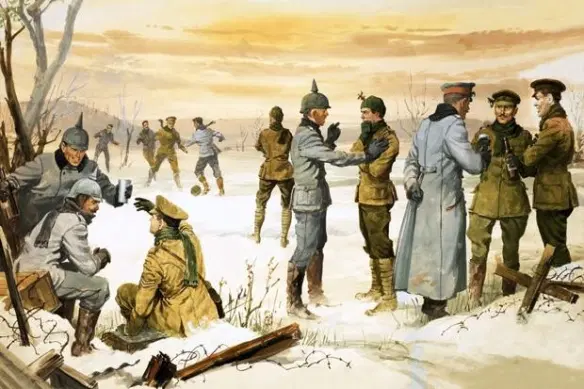
Remembering, Again, The 1914 Christmas Truce

Truce

I’ve posted on this a couple of times, and as it is one of the more unusual ethics events in history to occur on Christmas, here it is again. Of course, as an America, I am joyful about another, more consequential military event that happened on Christmas. Washington crossed the Delaware river on this date. His resulting victory over the Hessians at Trenton was, in the end, less than consequential militarily, but it was important nonetheless . It bolstered the rebelling colonies’ morale, at a point where there were serious doubts that the nascent democracy had any chance to prevail.

One of the weirdest events in world history took place on Christmas 1914, at the very beginning of the five year, pointless and stunningly destructive carnage of The Great War, what President Woodrow Wilson, right as usual, called “The War to End All Wars.”

World War I, as it was later called after the world war it caused succeeded it,  led to the deaths of more than 25 million people, and if anything was accomplished by them, I have yet to read about it.

The much sentimentalized event was a spontaneous Christmas truce, as soldiers on opposing sides on the Western Front, defying orders from superiors, pretended the war didn’t exist and left their trenches, put their weapons and animus aside, sang carols,  shared food, buried their dead, and perhaps, depending on which source you choose to believe, even played soccer against each other.

The brass on both sides—this was a British and German phenomenon only—took steps to ensure that  this would never happen again, and it never did.

It all began on Christmas Eve, when at 8:30 p.m. an officer of the Royal Irish Rifles reported to headquarters that “The Germans have illuminated their trenches, are singing songs and wishing us a Happy Xmas. Compliments are being exchanged but am nevertheless taking all military precautions.” The two sides progressed to serenading each other with Christmas carols, with the German combatants crooning  “Silent Night,” and the British adversaries responding with “The First Noel.“ The war diary of the Scots Guards reported that a private  “met a German Patrol and was given a glass of whisky and some cigars, and a message was sent back saying that if we didn’t fire at them, they would not fire at us.”

The same deal was struck spontaneously at other locales across the battlefield. Another British soldier reported that as Christmas Eve wound down into Christmas morning,  “all down our line of trenches there came to our ears a greeting unique in war: ‘English soldier, English soldier, a merry Christmas, a merry Christmas!’” He wrote in a letter home that he heard,

Continue reading