Comment Of The Day: “KABOOM! So It Has Come To This: The Book-Of-The-Month TV Commercial”

The recent post about Madison Avenue continuing its effort to coarsen the popular culture and society with gratuitously vulgar commercials, in this case Book-Of-The-Month Club believing that it is hilarious to fake out viewers into thinking they are watching a tampon commercial, was not one that I felt would ignite much controversy or varied comment. As is often the case, I was wrong. The essay generated several surprising threads, including a comment by prolix, controversial blog warrior Alizia, whose commentary here ranges all the way into another post, the article about a high school musical casting controversy and the school’s unethical response to it.

She also raises the question of whether Ethics Alarms should engage more frequently in meta-ethics and philosophy. One reason I selected her comment as a Comment of the Day is that I’m interested in other readers’ views on that topic, not that I’m interested in turning in that direction. My focus as an ethicist has always been practical ethics, and the posts here about grand ethics issues of the sort that have been debated to no productive end for centuries have been incidental and few. Frankly, those topics don’t interest me very much; certainly not enough to devote the blog to it. About a year ago an erudite young woman briefly submitted some provocative comments here but want to argue about competing philosophical theories. She was shocked, indignant and angered when I refused to engage, and after yelling at me for a while, left the forum.  For those seeking what she sought, I recommend going here.

Abstract and scholarly ethics have undermined the subject of ethics to the degree that it is not one  most people can tolerate or understand, effectively removing ethics from public education and general discourse, and thus undermined the goal of an ethical society as well. They are still relevant to the discussion; I just know from hard experience how philosophy tends to send normal people fleeing like the Tokyo crowds in a Godzilla movie.

Here is Alizia’s Comment of the Day on the post, KABOOM! So It Has Come To This: The Book-Of-The-Month TV Commercial:

One things I noticed and have mentioned a few times in respect to the Ethics Alarms blog and, naturally, the people who participate in it, is that it often clearly distinguishes a situation or event in which an ethical issue is brought out and then it successfully and interestingly provokes an examination of the problem or issue. Yet what I notice as well is that the issue is not brought out in a larger context. Or, the larger context is rarely explored. The reason why it is not explored is more interesting and it seems to me more important than what is allowed to be explored or what is acceptable. I can think of two instances and I will mention them.

In this present instance it is noticed that advertising is incorporating vulgarity. But it is really far more than that, at least as I see things. What is the real issue? The real issue is the pornographication of culture. It is, I think this is true, coming about because this is the sort of things you-plural have allowed to go on. It is certainly true (as I have scoldingly said) that ‘it is your generation that has allowed these levels of moral and ethical corruption to creep in’ and I think that this is a necessary stance to take. In my view, though it is not appreciated much here, ‘the pornographication of culture’ connects to sexual expression of many sorts and also extends to ‘the homosexualization of culture’.

There is an active agent, either in the business culture itself, or perhaps in academic culture, that has set in motion these pornographic processes. And just as media culture and Hollywood has gotten continuingly infected with this material (which I assume *you* find titillating and exciting and do not oppose), similarly one can now notice the insinuation of homosexuality into the culture-productions. It becomes visible, included, and influential thereby. Normalized. But behind these appearances, behind this increasing in-flux, stands something far more raw, far more brutal, far more elemental, far more powerful and influential, and that is ‘the pornographic’, a truly ugly and vile *world*. And what *you* do has world-scale ramifications. Continue reading

“The Indefensible ‘Nigger’ Double Standard,” The Sequel!

From Princeton comes exactly the same scenario that I wrote about in March of 2016.

This time, it was anthropology professor Lawrence Rosen who used “nigger” multiple times during a lecture this week in his Anthropology 212 course, “Cultural Freedoms: Hate Speech, Blasphemy and Pornography.” “What is worse, a white man punching a black man, or a white man calling a black man a nigger?” Rosen said, in the context of describing “what is acceptable as free speech and what is not.”

Several black students walked out of the class in protest, two registered a complaint, and now Princeton has vowed to sponsor “a dialogue” with students. This gives far  too much legitimacy to their objections.  The students enrolled in a course about hate speech, blasphemy and pornography, and protested when the professor said an offensive word?

The school’s response should be “Stop looking for ways to be offended and to put others on the defensive, learn the meanings of the concepts of ‘intent,’ education,’ and ‘context,’ and grow the hell up.

As the 2016 post about the identical nonsense at the University of Kansas concluded, “Context matters, and in the case of nigger, the only context that matters is what the word was intended to communicate. The “context” of the speaker’s skin color does not matter.”

I am happy to be able to post that clip from “The Life of Brian” again, in which an official condemning a man for uttering the taboo “Jehovah”is executed for saying the word in order to condemn him.

I wonder if those Princeton students would get the joke.

[A related post is here.]

________________________

Pointer: Other Bill

KABOOM! So It Has Come To This: The Book-Of-The-Month TV Commercial

We have discussed here the increasingly common phenomenon of companies building their TV ads on the juvenile gag of suggesting a vulgar, obscene or rude word, or a topic not discussed publicly in polite society but not really saying what is clearly implied.

Kraft Heinz Company advertised its products with a TV ad in which a boss caught  his employee becoming sexually aroused by his lunch, with the tagline: “Food You Want to Fork.” Get it? HAR! Heineken featured a gay-themed beer ad about “flipping another man’s meat”–“Huh? It’s just barbecue! You must have a dirty mind!.” Wonderful Pistachios uses “nuts” as sexual innuendo, Booking.com uses “booking” in phrases suggesting “fucking,” and K-Mart uses “ship” to suggest “shit.” Reese’s Peanut Butter Cups has run commercial featuring the tags Women want like to make it last…Men are done in seconds…Typical.”  Last year, Volkswagen had Dean Martin crooning about “The Birds and the Bees”  while we see a VW bouncing up and down as the couples within engage in vigorous sexual intercourse, unless they are tying to use pogo sticks.

This is corporate America accelerating the coarsening and vulgarizing society, endangering manners, and helping to make boors out of our children. Quoting Ethics Alarms quoting Ethics Alarms the last time I wrote about this: Continue reading

Question: Is There Any Justification For A State Censoring Vanity Plates? (And What’s Wrong With “KAIJUU”?)

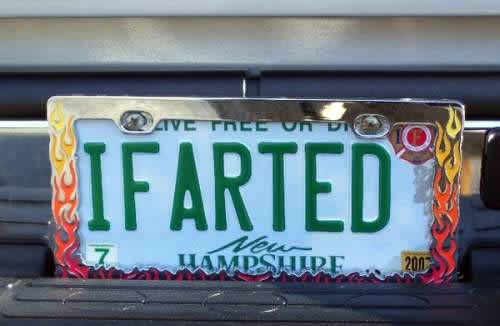
My answer to the first question? Absolutely not.(  My answer to the second is, “I have no idea.” ) If a driver can put a sign in his rear view mirror or a bumper sticker on her bumper without state sanctions, then a driver should be able to have whatever he or she chooses on a vanity plate.

Utah, for examples, bans vanity plates with profanity, “derogatory language,”  drug references,  sex talk, references to bodily functions, “hate speech,” targeting a particular group, or advocating violence advocates, as well as alcohol references and the number combo “69.” Ethics verdict: None of their business. These are words and numbers, and the state is declaring content and intent impermissible. When I see a car with an obnoxious vanity plate, I’m grateful. This is useful information. Racist or vulgar plates translate into “I am an asshole, and want you to know it!”

Thank you, sir! I appreciate the heads up.

Below are the plates banned by Utah over the past five years. Most of them fly right over my head. If you have to be a cryptographer to figure out why a plate is offensive, then it’s not offensive.

The less our governments interfere with freedom of expression, the safer we are.

Here’s the list (the  pointer marks indicate spaces): Continue reading

Comment Of The Day Weekend Continues! Comment Of The Day : “Morning Ethics Warm-Up, 12/30/2017: Is Robert Mueller Biased? …Is President Trump A Robot?

A single line in this morning’s  Warm-Up sparked this fascinating exposition by Ash. Here was the context:

Jay Malsky, an actor who has appeared in drag as Hillary Clinton. Melsky, while watching  the Hall of Presidents attraction at Disney World, began shouting at the audio-animatronic Donald Trump. (The Huffington Post said he “mercilessly” heckled the robot, showing  derangement of its own. Robots don’t need mercy, and you can’t “heckle” one either.)

Here is Ash’s Comment of the Day, primarily a quote but a perfectly chosen one, on the post, Morning Ethics Warm-Up, 12/30/2017: Is Robert Mueller Biased? Are The Patriots Cheating Again? Is Larry Tribe Deranged? Is President Trump A Robot?: 

“Robots don’t need mercy, and you can’t “heckle” one either.”

You should date this and file it, because I guarantee you, the way you treat Siri and Alexa and Cortana and Ok Google is *already* being described as problematic.

“Sexual harassment: there are no limits…According to Dr Sweeney, research indicates virtual assistants like Siri and Amazon’s virtual assistant Alexa find themselves fending off endless sexual solicitations and abuse from users. But because humans don’t (yet) attach agency or intelligence to their devices, they’re remarkably uninhibited about abusing them. Both academic research and anecdotal observation on man/machine interfaces suggest raised voices and vulgar comments are more common than not. It’s estimated that about 10% to 50% of interactions are abusive, according to Dr. Sheryl Brahnam in a TechEmergence interview late last year. Continue reading

Comment Of The Day: “Thanksgiving Ethics Quiz: The Girl Scouts Anti-Hug Campaign”

Now and then I see an issue and immediately think, “Now THIS should get the comments flowing.” So it was when I caught a mention of the Girl Scouts’ anti-hugging screed on CNN’s Headline News. Sure enough, the resulting ethics quiz not only sparked a lot of comments, but a lot of excellent ones. This, by Emily, was a standout.

Here is her Comment of the Day on the post, Thanksgiving Ethics Quiz: The Girl Scouts Anti-Hug Campaign.

Oh goodness, do I have thoughts on this. It isn’t new to me at all; my Facebook page is full of young moms who share this stuff (it’s been going around for years) and it drives me nuts.

First of all, we all show affection at different times when maybe we don’t totally want to. You give a friend or spouse or family member a hug because they’re feeling down, or they’re leaving for a six month trip to Japan, or you want to show you’re glad to see them, even if they need a shower or a breath mint or you don’t feel like getting out if your comfy chair. This is part of the give and take of personal relationships; you’d feel insulted if they didn’t offer your preferred form of affection or support when you need it.

Children need to be taught this, or we’re going to raise a generation who think their comfort is the only thing that matters, even in personal relationships and within their family. Continue reading

Thanksgiving Ethics Quiz: The Girl Scouts Anti-Hug Campaign

From the Girls Scouts website:

Holidays and family get-togethers are a time for yummy food, sweet traditions, funny stories, and lots and lots of love. But they could, without you even realizing it, also be a time when your daughter gets the wrong idea about consent and physical affection.

Have you ever insisted, “Uncle just got here—go give him a big hug!” or “Auntie gave you that nice toy, go give her a kiss,” when you were worried your child might not offer affection on her own? If yes, you might want to reconsider the urge to do that in the future.

Think of it this way, telling your child that she owes someone a hug either just because she hasn’t seen this person in a while or because they gave her a gift can set the stage for her questioning whether she “owes” another person any type of physical affection when they’ve bought her dinner or done something else seemingly nice for her later in life….

…Give your girl the space to decide when and how she wants to show affection. Of course, many children may naturally want to hug and kiss family members, friends, and neighbors, and that’s lovely—but if your daughter is reticent, don’t force her. Of course, this doesn’t give her license to be rude! There are many other ways to show appreciation, thankfulness, and love that don’t require physical contact. Saying how much she’s missed someone or thank you with a smile, a high-five, or even an air kiss are all ways she can express herself, and it’s important that she knows she gets to choose which feels most comfortable to her.

Your Ethics Alarms Thanksgiving Ethics Quiz:

Is this responsible advice, or does it go too far?

Continue reading

Ethics Quote Of The Week, And A Few Related Diversions

My son is named after this President, incidentally.

The quote itself is by Ron Chernow, the historian who authored the recent well-reviewed biography of out 18th President, “Grant,”  “Hamilton,” the biography that inspired, we are told, the mega-hit musical. and “Washington” (won’t somebody send a copy to the fools at Christ Church?) was given to an interviewer as his description of another book, the Philip Roth’s historical novel  “The Plot Against America”:

[A] democracy can be corrupted, not by big, blaring events, but by a slow, insidious, almost imperceptible process, like carbon monoxide seeping in under the door.

Some random thoughts on this statement, which I believe is exactly right, and a lot more interesting than the more frequently used analogy about boiling a frog slowly:

  • Grant, as Chernow’s book (among others of recent vintage) documents, was present at one of those points when democracy seemed to be in the process of being poisoned, and acted forcefully.

By 1868, when Grant was elected to succeed Andrew Johnson, who had done everything he could to allow the South to resist extending civil rights to the newly freed slaves, the KKK had evolved into a powerful terrorist organization that referred to itself as  “The Invisible Empire of the South.” Under the  Klan’s first  “Grand Wizard,” the brilliant former Confederate cavalry general  Nathan Bedford Forrest, whites from all classes of Southern society joined the Klan’s ranks. They attacked and punished newly freed blacks for crimes like  behaving in an “impudent manner” toward whites, brutalized the teachers of  schools for black children, and burned schoolhouses. It also terrorized and often murdered Republican party leaders those who voted for Reconstruction policies.  In Kansas over 2,000 murders were committed as the 1868 election approached; in Louisiana, a thousand blacks were killed in the same period.

Grant entered office knowing that the Civil War victory could come apart. He made some bad appointments–Grant was naive about politics and trusted too easily—but his choice as Attorney General, Amos T. Akerman, was masterful. With Grant’s support, and the with the help of the newly created Justice Department under Grant, he vigorously worked to enforce the Fifteenth Amendment, which gave the vote to black men in every state, and the First Reconstruction Act of 1867, which placed tough restrictions on the South and closely regulated the formation of their new state governments. Between 1870 and 1871, the Republican Congress passed and Grant signed into law the Enforcement Acts, which made it a crime to interfere with registration, voting, officeholding, or jury service by blacks. Congress also passed the Ku Klux Klan Act, which allowed the government to act against terrorist organizations.

  • When I was growing up and becoming interested in the Presidents, a life-long passion that led me to both law and ethics, Grant was routinely listed as one of the worst in the line. All one heard from historians was about the financial scandals that rocked his administration. Grant’s great success in subduing the Klan was literally never mentioned. The main Presidential historian then was Arthur Schlesinger Jr., a member of Jack Kennedy’s inner circle. His job as he saw it was to minimize the contributions of any Republican President, like Teddy Roosevelt (“near great” in his rankings), Eisenhower (“below average”) and Grant (“failure’). Meanwhile, Woodrow Wilson, who dragged the U.S, into the first World War, botched the Versailles Treaty and who actively revived the Klan, being a stone-cold racist, was “great.” Naturally, I believed all of his distortions, which were largely those of the historians at the time, then, as now, often partisans and propagandists. It took me a while to realize that this had been my first encounter with the Left attempting to alter present perception by controlling the past.

That is one of the major sources of Chernow’s carbon monoxide today, except that the disinformation now emanates from the schools, colleges, and the news media. Continue reading

Abashed Morning Ethics Warm-Up, 10/28/17 [Updated]

Good Morning!

1 Following a day in which various exigencies and responsibilities, plus fatigue and distraction, caused me to whiff on getting up at least three posts I thought were worthy of consideration, yesterday I failed to get any up at all. This makes me very unhappy, and I apologize. A fly-in, fly-out assignment in New York City had me up early and back late, whereupon I had my son’s birthday to acknowledge, the World Series to scrutinize and some aching feet to attend to. Priorities can’t be ignored, and being able to recognize when something you want to do and are devoted to doing just cannot be done well in the time allowed is a matter of life competence. Yet I hate failing loyal readers who care about ethics issues and rely on Ethics Alarms to explore them, and feel negligent when this occurs…fortunately, not very often.

Still too often, however.

2. The emergence of Hollywood director James Toback as a serial sexual harasser (at least) had me preparing a post about why theatrical directors are especially prone to this conduct. The gist of it was that in college, where participation in theater is often more social than aesthetic, directors forming romantic relationships with their cast members is neither taboo nor typically exploitative. Similarly, in community theater such relationships are not unusual or unethical, unless they interfere with a director’s artistic duties: casting an inferior performer because she’s your girl friend or because you want her to be is per se unethical. These are the cultures that produce many directors, and they enter professional theater, and later films, with bad habits that cannot be tolerated or continued in a professional context. Similarly, performers also come out of that culture. It may be difficult for some of them to comprehend that what is arguably acceptable in amateur settings is becomes unconscionable in a professional one.

However, this cannot explain Toback’s conduct. An astounding 200 plus women now say they were harassed or assaulted by him, and the list filled up in less than week. Compared to Toback, Harvey Weinstein and Bill Cosby seem restrained.

Actress Selma Blair, for example, says her agent arranged for her to meet Toback for a possible role in one of his films after her career had begun with promise. Blair says the meeting was scheduled at a hotel restaurant, but  when she arrived the hostess told her that Toback wanted to meet in his hotel room. There, Toback asked her to perform a monologue nude, directed her to have sex with him, and said he would not let her leave until he “had release.” Then the actress says, he simulated sexual intercourse on her leg. 

I begin my sexual harassment seminars by stating that the problem is one of ethics. If you have respect for human beings regardless of gender, if you are fair to people you interact with, if you are caring toward them and obey the Golden Rule, if you apply the three basic ethics alarms checks (“Does this seem right? Could I tell my mother about this? Would I want this on the front page of my local newspaper?”), then you won’t be a harasser. But I can’t begin to explain how someone reaches the point of depravity and utter contempt for women that he would behave the way Blair describes Toback behaving. This is, to understate it, uncivilized. Was he raised by wolves? I suspect even wolves would be horrified by his behavior. My father never had to sit me down at 13 and say, “Jack, it’s time for a talk. It’s never right to simulate sexual intercourse on a woman’s leg when she has come to interview for a job.” I didn’t need to be told this. Who needs to be told this who isn’t already a dangerous sociopath?

Somehow, the culture of Hollywood devolved to such a state that abuse of power and women became a social norm, and even conventionally acculturated adults had their values erased and replaced. That is the only way the Tobacks and Weinsteins could come to exist. That culture is now too sick and entrenched to be wiped clean by a few scandals. It is going to take a long time to change it, if indeed it can be changed. Continue reading

Ethical Quote Of The Month: David Brooks, Channeling Yale Law professor Stephen L. Carter

First, a bit of a disclaimer:

In his Monday column for the New York Times, David Brooks evoked Yale Law professor Stephen L. Carter‘s 1998 book “Civility” to recommend how reasonable people should engage with “fanatics.” I like the quote a lot, with this caveat: Brooks makes it clear, as almost all Times op-eds do now, that by “fanatic” he means all those strange, nasty, stupid, hateful people who don’t subscribe to the New York Times world view and progressive cant. As a result, I have to take Brooks’ words with several grains of sea salt, and indeed try to forget that they are coming from a pundit who has at other times implied that President Trump should be removed from office regardless of whether he actually does anything that would meet the standards required by the impeachment clause or the 25th Amendment.

That and other opinions he has put into print–always in the measured words of the intellectual he styles himself to be—marks him as a fanatic in my book, just one operating under the cover of gentility and intellectual rhetoric. Now, it would have been easy for Brooks to dispel my suspicions and also to have a larger audience for his wisdom had he chosen, as his example of a fanatic, a member of the antifa, or a college student who believes that conservatives should be censored, or any number of leftist nut cases who are as plentiful now as the autumn leaves. But no. Brooks knows that wouldn’t endear himself to his colleagues like Paul Krugman and Charles M. Blow, so his first example of a fanatic, and his only American one, was “a Trump supporter” who threatened him at a baseball game.

Thus Brooks’ column manages to be condescending and arrogant, as well as partisan, because of his failure to harness his biases. The substance of his quote, however, comes via Terry Teachout, the drama critic of The Wall Street Journal, the critic-at-large of Commentary and a thoughtful moderate for an arts guy, and through Amy Alkon, a moderate conservative feminist Trump-hating blogger and author, and Professor Carter, who seems like a reasonable and not especially political sort. This is enough, I think, to cleanse Brooks’ words of their inherent hypocrisy. Deciding that those who disagree with you must be the fanatic in the conversation is, after all, a poor starting point for a productive discussion.

With those reservations and qualifications, here is the quote: Continue reading