Cartoon Ethics: The New York Times “Eliminationist” Joke

The New York Times is taking fire from diverse commentators on the Right for publishing a political satire cartoon that includes this panel:
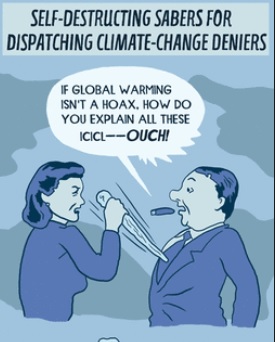
KillingPeopleWhoDisagreeIsFunny

It is part of a larger cartoon japing at the supposed aftermath of a harsh winter:
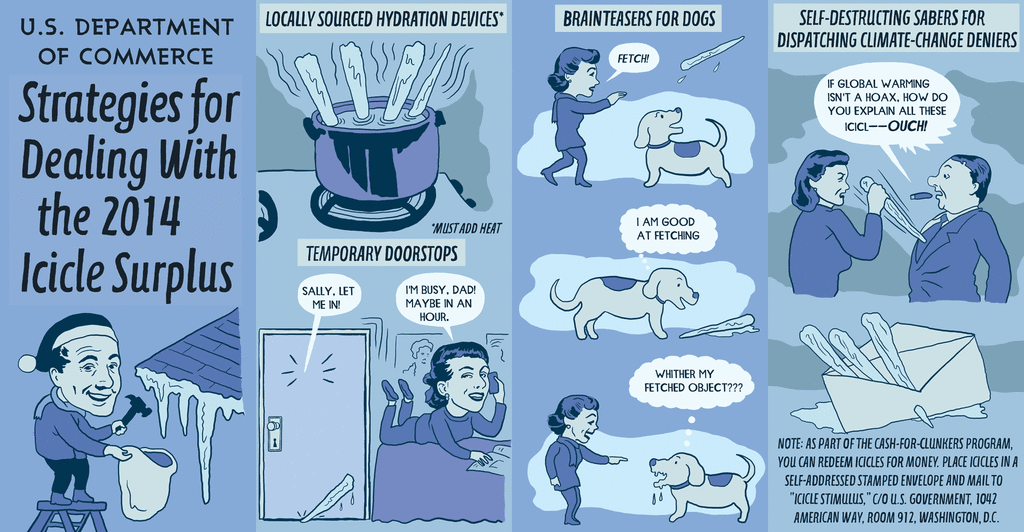
see-something-say-slide-F2R2-jumbo

Among the ethics complaints against the drawing:

  • “Aside from its patently offensive notion that those holding different political views don’t deserve to live, the panel in question also lacks a key element in political cartoons that aim to be tongue in cheek — it isn’t funny. Imagine the outrage at the Times if Sarah Palin, Rush Limbaugh, Ann Coulter, et al., suggested that liberals should die for not agreeing with them. Yes, things would get nasty in a hurry. Has it really been that long since the Tucson massacre and the left’s demand for more civility, at least from conservatives?”Newsbusters
  • “Global warming has made much of the country so cold that the Times is instructing its readers to use giant icicles to bludgeon the non-believers to death.”Ed Driscoll
  • “NY Times Suggests Killing “Climate Change Deniers”Weasel Zippers
  • “So, as WUWT readers well know, I have a different opinion about global warming.Do you think the New York Times  should endorse stabbing me (and others with similar opinions) through the heart like a vampire because I hold that opinion?”Anthony Watts Continue reading

Ethics Quote Of The Week: Charles Krauthammer

“I repeat: I’m not a global warming believer. I’m not a global warming denier. I’ve long believed that it cannot be good for humanity to be spewing tons of carbon dioxide into the atmosphere. I also believe that those scientists who pretend to know exactly what this will cause in 20, 30 or 50 years are white-coated propagandists. “The debate is settled,” asserted propagandist in chief Barack Obama in his latest State of the Union address. “Climate change is a fact.” Really? There is nothing more anti-scientific than the very idea that science is settled, static, impervious to challenge.”

—Conservative columnist Charles Krauthammer, in a column titled “The myth of ‘settled science’”

"90% of the 95% majority of climate scientists think it's pretty likely that their models will prove to be sort of correct. See? Certainty!"

“90% of the 95% majority of climate scientists think it’s pretty likely that their models will prove to be sort of correct. See? Certainty!”

With one unfortunate exception, Charles Krauthammer’s recent op-ed about the absurd and discrediting certainty about future global warming and its cause is so logical, fair and reasonable that one has to wonder why no non-conservative has had the integrity to write a similar piece. He was moved, I assume, by the recent flurry of obnoxious assertions from the Obama administration and its allies in the media, most notably Secretary of State John Kerry, who said,

“We should not allow a tiny minority of shoddy scientists and science and extreme ideologues to compete with scientific facts. Nor should we allow any room for those who think that the costs associated with doing the right thing outweigh the benefits. The science is unequivocal, and those who refuse to believe it are simply burying their heads in the sand. We don’t have time for a meeting anywhere of the Flat Earth Society.”

John Kerry’s powers of critical analysis have been demonstrably weak in his supposed areas of expertise, such as foreign relations (See: Syria), and I will accept bets as to whether he could make any sense out of a climate change projection model graph, or even be sure whether he was holding it upside down or not. John Kerry doesn’t understand climate change science, and hasn’t a clue whether it is “unequivocal,” proven by the fact that he would say such a nonsensical thing. The same can be said about President Obama. Krauthammer again:

“Obama ostentatiously visited drought-stricken California last Friday. Surprise! He blamed climate change. Here even the New York Times gagged, pointing out that far from being supported by the evidence, ‘the most recent computer projections suggest that as the world warms, California should get wetter, not drier, in the winter.”

But this is the pattern: science ignoramuses accuse anyone who doesn’t agree with their politically motivated “scientific” opinions of being a science ignoramus. Continue reading

Now THIS Is Irresponsible Broadcast Journalism

"Rarrit!" [Translation: ]

“Rarrit!” [Translation: “Potentially, it’s connected to that-“ ]

This jaw-droppingly stupid conversation actually took place on CBS This Morning, as hosts Charlie Rose and Norah O’Donnell mused about the extreme cold hitting the U.S., and attempted to connect it to that shared mission of the media, environmentalists, and anti-capitalists, global warming, though when you are using epic cold as your proof, “climate change” sounds a lot less silly:

CHARLIE ROSE: Is it stronger/weaker this year than it has been in the past?

BRYAN WALSH, TIME SENIOR EDITOR: …There is – some theories, actually, that some of the warming, actually, you’re seeing up in the Arctic might be changing the atmospheric circulation in that part of the world – actually causing those winds to weaken, and maybe, makes these cold spells a little more likely than they otherwise be….We had a few strong snowstorms – this despite the fact that we’re still seeing warming happening in the winter and the rest of the year. So, there is some theory that, maybe, this is changing the atmosphere, making it more likely.

NORAH O’DONNELL: …I mean, this is the first time I’ve heard the phrase ‘polar vortex’, and I don’t feel I’m out of it. I mean, were you familiar with it?

WALSH: I was not that familiar with it – no – but now, of course, it’s one of those terms that’s –  that’s everywhere….

ROSE: Is it definitely connected to global warming?

WALSH: Potentially, it’s connected to that-

ROSE: Potentially-

WALSH: These, these – been happening already. What’s new, perhaps, is the fact that the winds may actually [be] weakening. That could be due to warming in the Arctic; changing the atmospheric circulation; therefore, making it more likely for that cold, dense air to escape the vortex – spill down to us.

Now who can argue with that? Continue reading

Anti-Smoking Ethics—And A Subversive (But Ethical!) Suggestion

"Sorry, sir, but sort-of-looking-like-you're smoking's not allowed in here, and besides, a phony study will be finding it deadly any day now."

“Sorry, sir, but sort-of-looking-like-you’re smoking’s not allowed in here, and besides, a phony study will be finding it deadly any day now.”

Little noted in the news winds was the fact that a major study reported in the Journal of the National Cancer Institute found “no link between the disease and secondhand smoke.” Oh!  Well, never mind then. The supposed deadly effects of second hand smoke gave hoards of health-policing citizens leave to not only be obnoxious and confrontational–“You have no right to pollute my lungs!”—but also to ban a legal consumer product in public places as well as to stigmatize anyone using the products as selfish sociopaths perpetrating slow-motion serial murder.

The second-hand smoke theory always seemed too convenient to me. Many years ago, I permanently soured my relationship with the head of a large Washington association, a non-smoker (as am I, except that I don’t presume to tell others what legal products to entertain themselves with), by opposing his ban on smoking in meetings and offices (and, eventually, his employees’ own homes) because he thought it was dangerous.  He trumped me by producing a couple of fishy studies that, it appears, were in fact as fishy as I suspected at the time. I would like to see a call for accountability on this: how did data now shown to be completely without factual basis manage to surface, become accepted in the regulatory establishment, and be used to bully smokers for decades?

And if you think this reminds me of the over-hyped scientific “consensus” on global warming and climate change, you are exactly right. Continue reading

Unethical Quote of the Week: Rush Limbaugh

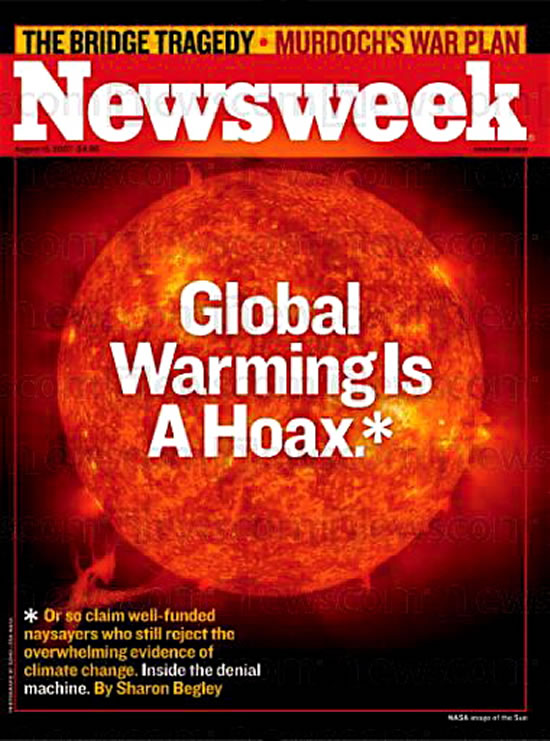
“Speaking of global warming…which has now been proven to be a hoax”…”

—-Rush Limbaugh, riffing today on his radio show regarding the evils of liberals from Obama to Bloomberg.

No, actually, Newsweek is now a hoax.

Actually, Newsweek was the hoax.

This an outright ethics foul, even if Rush believes it. If he doesn’t believe it, it’s a lie. If he does believe it, it is still a reckless, incompetent and irresponsible thing to say to millions of listeners who trust him to tell them the truth.

Global warming, or climate change, is not a hoax. Its exact extent may not be known, or as conclusively known as some scientists and commentators claim. It may be difficult to measure, and the historical data it is being measured against may be flawed. Its researchers may have biases, and have strayed too far over the line into advocacy. They may also have been too willing to stifle dissenting voices in the scientific community. How serious global warming will be, when its effects will be fully felt and how long it will last are all matters of projection and speculation, subject to error. Projections have been, and will continue to be, unreliable, and arguably, too unreliable to justify costly public policy measures. Remedies are speculative, and cost-benefit ratios are in doubt.

It is also true that many of the most vocal and visible supporters of the most dire projections by climate change researchers, as well as the most vociferous attacker of climate change skeptics, literally don’t know what they are talking about. Their fervor is driven by ideology and faith rather than actual expertise and scholarship, and anything they say on the subject should be given no weight whatsoever. This groups includes journalists, columnists, bloggers, celebrities, academics not in the sciences, public officials and leaders, including, depressingly, Barack Obama, whose State of the Union speech comments on climate change were outrageous and irresponsible: Continue reading

The Global Warming Debate Is The World Series of Confirmation Bias

Confirmation bias is the dastardly human thought tendency that makes objectivity virtually impossible, and fair analysis nearly so. It is the human instinct to view external facts and events in such a way that they confirm preexisting beliefs, or, if they challenge these beliefs, to find reasons to distrust the facts or explain them away.

A line in a Washington Post book review caused me to realize that nothing  exemplifies confirmation bias at work better than the global warming controversy. It was a review by Post business editor Alan Sipress of “Spillover,”  a new book about how pandemics spread. He wrote:

“This year, a mild winter and an unusually hot summer — which look suspiciously like results of man-made climate change — yielded a bumper crop of virus-carrying mosquitoes. The result is an unprecedented outbreak that has sickened people in almost every state.”

Wait a minute: why does the past year’s mild winter and unusually hot summer “look suspiciously like results of man-made climate change”? Were there never mild winters with scorching summers before scientists developed climate change models? And why do those two factors, when paired, “look suspiciously” like man-made climate change? What about the winter and summer of 2012 screamed “man-made”? Continue reading

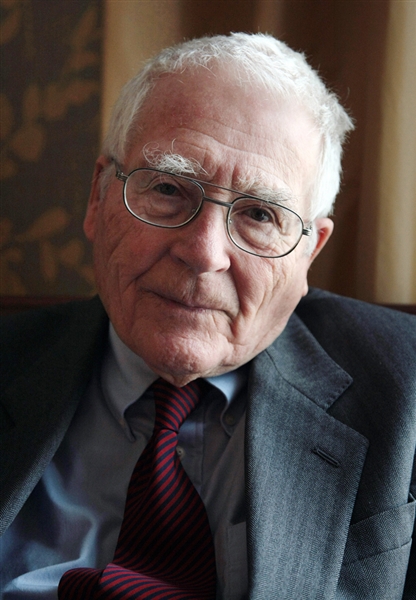
Ethics Hero: “Gaia” Scientist James Lovelock

James Lovelock

“The problem is we don’t know what the climate is doing. We thought we knew 20 years ago. That led to some alarmist books – mine included – because it looked clear-cut, but it hasn’t happened. The climate is doing its usual tricks. There’s nothing much really happening yet. We were supposed to be halfway toward a frying world now. The world has not warmed up very much since the millennium. Twelve years is a reasonable time… it (the temperature) has stayed almost constant, whereas it should have been rising — carbon dioxide is rising, no question about that.”

With that admirable statement of candor and humility, renowned earth scientist James Lovelock did what everyone in the climate change debate should be doing, and should have been doing all along. He admitted the uncertainty of climate science, the fallibility of models and projections, and the fact that the extent, speed, predictability and causes of climate change are still far from certain. If other scientists involved in this critical issue had Lovelock’s integrity,  perhaps ignorant pundits, journalists and politicians would not feel so justified in calling skeptics about climate change the equivalent of Holocaust deniers. Continue reading

Climate Wars Ethics: Gleick’s Lie, and the Death of Trust

You cannot fight for the truth with lies. Why is this so hard to learn?

This is a big ethics story, with general ethics lessons and serious public policy repercussions in an area already muddled with ethical misconduct on all sides. I’m going to restrict Ethics Alarms to the purely ethical analysis. and, at the end, point out some of the excellent articles that the incident has inspired regarding the policy implications of it all.

Last week, leaked documents prepared for a board meeting of the libertarian think tank, the Heartland Institute, were published on various blogs and websites. The Institute is a major player in the effort to disprove, debunk or discredit scientific studies showing man-made climate change, and block the adoption of anti-climate change policies while undermining public support for them.  One of the most provocative documents was a “Climate Strategy” memorandum laying out Heartland’s secret efforts in sinister terms. The source of the documents, and the one who made them available to global-warming promoting bloggers, was a mysterious individual calling himself “Heartland Insider.”

Now the source has revealed himself, and it is a prominent climatologist on the front lines of the climate change battle, scientist Peter Gleick of the Pacific Institute. Gleick explained what occurred in a column at the Huffington Post: Continue reading

Eight Glasses of Water and the Climate Change Bullies

Never mind.

A surprising new report announces that the well-established health standard that we should all drink at least eight glasses a day is a myth, with no data to support it.  Moreover, the report says, drinking so much water may actually be harmful.  Meanwhile, widespread acceptance of water and hydration as a health benefit has led directly to the explosion in the use of bottled water, wasting money and creating an environmental crisis with so many discarded plastic containers.

I would hope that such news, and we get these kind of sudden “never mind!” stories with fair regularity, might convince some of the more insulting critics of global warming skeptics to temper their contempt.
The ideologues and conspiracy theorists who refuse to accept that the world is warming—though nobody really knows how much or how long—and that the effect is likely caused by mankind—though nobody can say with certainty that mankind can reverse or stop it—are rightly derided, up to a point. But those who question the astonishing certainty with which some climate change scientists, Al Gore, and a passel of pundits, columnists and bloggers who barely passed high school chemistry claim to know what the effects of global warming will be, even though doing so requires extensive estimates, extrapolations and assumptions, are being no more than prudent, considering how frequently far simpler scientific conclusions have proven to be flawed, exaggerated, or as may be in the case of  the eight glasses of water, just plain wrong. Prudence is especially appropriate when speculative science transmuted into doctrine calls for huge expenditures of scarce resources and the re-ordering of national priorities, effecting nations, commerce, businesses and lives. Continue reading

As Winter Strikes, Inconvenient Truths…Again

In the midst of what is being called the coldest winter in Great Britain since records began being kept, some wags have been unkind enough to tweak the “you’re all idiots for not agreeing that only world government can save us” climate change zealots by circulating a 2000 article that ran in the Independent, the nation’s most enthusiastic pro-global warming newspaper. Some excerpts: Continue reading