Here’s why:
There is hope.

Support the man, not the drunk-driving killer, who also happened to BE the man. Right?
Eight days after he was locked up for manslaughter as a result of being drunk at the wheel in a car accident that took the life of a team mate, Dallas Cowboys player Josh Brent was allowed on the sidelines with his team during its game against the Philadelphia Eagles. Brent’s teammates had requested that he be present to show their support, and apparently this had the blessing of Jerry Brown’s mother, whose deceased son was the victim in the crash.
ESPN commentator Dan Graziano took to his keyboard to pronounce the Cowboys public embrace of a player charged with killing someone while driving drunk misguided and wrong: Continue reading

Okay, so you weren’t born on third base like this guy. It doesn’t mean you can’t score.
40 yr. old Gen-Xer delivers a worthy Comment of the Day, leveled at my criticism of the Angry Unemployed Law Grad blog, “Third Tier Reality.” I think it provides valid perspective, though I also think the post’s characterization of how this issue has been handled on Ethics Alarms is somewhat unfair. (You can read my response under the original article.)
Here is the Comment of the Day, on the post, “Unethical Website of the Month: Third Tier Reality”:
“My point is that the situation Nando is railing about is more complex than the scenario of a bunch of disgruntled youth, unwilling to “work hard”, whining for a hand-out. Nando may pour it on thick with name calling and scatological imagery; fair enough. However, to dismiss the underlying message is overly simplistic, dismissive of people’s good-faith effort and ignores the real economic hardship that many face. Continue reading
Eric Lomax was a hero of forgiveness.

Eric Lomax, his book, the Bridge on the River Kwai,, and his friend, the man who tortured him.
In 1942, Eric Lomax, was a 19 year old member of the British Royal Corps of Signals stationed in Singapore when he joined thousands of British soldiers in surrendering to the Japanese. It was 1942. He was one of those shipped to Thailand and became one of the slaves laboring to build the Burma Railway, also known as the Death Railway. The building of the railroad and the brutal treatment of the English prisoners by their Japanese captors formed the plot of the classic 1957 David Lean film, “The Bridge on the River Kwai,”
After Lomax was discovered to have built a radio receiver from spare parts, he was mercilessly tortured and interrogated by his captors. After his release, fantasies about murdering his main torturer, a man named Nagase Takashi, obsessed him. Lomax spent the early years of his retirement in the 1980s looking for Takashi, and eventually learned that he had become an interpreter for the Allies after the war. In 1992, he stumbled across an article profiling Nagase and noting that he was haunted by guilt over his mistreatment of one British soldier. That soldier, Lomax realized, had been him. He arranged to meet the man who tortured him, and whom he had spent the rest of his life dreaming of murdering.
Torturer and victim met in 1993, on the infamous bridge Lomax had been forced to help construct (and which was not blown up, the film ending notwithstanding). Continue reading
 The Penn State disease is not restricted to colleges. Now there comes a lawsuit showing how ugly it is when the contagion hits a high school.
The Southern Columbia Tigers are a real high school football power in Pennsylvania, and naturally the Southern Columbia Area School District and Southern Columbia Area High School Principal James A. Becker wouldn’t do anything to change that…like, for example, barring two rapists from playing on the team when they were so good at scoring the legal way, as well as…well, you know.
A law suit filed by “C.S.” in Federal Court alleges that the school district and high school principal protected two star student athletes after it had been proven in court that they had sexually assaulted the girl, a student at the school as well. From the complaint: Continue reading

Uh, wrong meeting, Barney…
A friend who is a member of Alcoholics Anonymous flagged an interesting ethical dilemma involving the huge, loosely-affiliated alcoholism recovery and support group.
Judges often order mandatory attendance at AA meetings as conditions for leniency in alcohol-related crimes, like DUI, spousal abuse, and others. The problem is that AA is system of commitment and trust, and someone who only comes to meetings under threat of jail time have neither. It is the AA attendee’s acceptance of the reality that they are helpless against alcohol and willingness to commit fully to the program with others like than that allows AA to be as successful as it is, and the assurance of anonymity the group provides makes its existence possible. “Court-ordered attendees slink in here, roll their eyes, do their time and leave,” he told me. “How do we know that they aren’t regaling their friends with hilarious tales about what does on at meetings? What right does a judge have to make AA host someone who doesn’t really meet the group’s criteria?”
Good question, and it’s the Ethics Quiz of the Day:
Is it ethical for judges to force a non-profit, non-government, voluntary organization to assist the justice system at the risk of their own integrity and their members’ confidentiality?
This time I’m going to let everyone weigh in before I show my cards.
Here is a link that discusses some of the related issues.
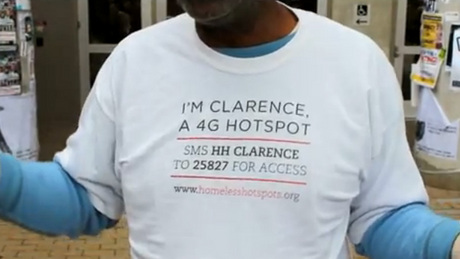 BBH Labs, the innovation unit of the international marketing agency BBH, hired members of the Austin, Texas homeless population to walk around carrying mobile Wi-Fi devices, offering high-speed Internet access in exchange for donations. Thirteen volunteers from a homeless shelter were hooked up to the devices, given business cards and put in shirts with messages that designated them as human connections. “I’m Rudolph, a 4G Hotspot” read the label on the homeless man on the New York Post’s front page with the lead, “HOT BUMS!”
The Walking Hotspots—now there’s a new horror series for AMC when they run out of zombies— were told to go to the most densely packed areas of the South by Southwest high-tech festival in Austin, Texas, where the technology trend-devouring conventioners often overwhelm the cellular networks with their smart phones. Attendees were told they could go up to a Homeless Hotspot and log on to his 4G network using the number on his T-shirt. A two-dollar contribution to the homeless man was the suggested payment for 15 minutes of service. BBH Labs paid the wired-up homeless $20 a day, and they were also able to keep whatever customers donated.
What BBH called its “charitable experiment” ended yesterday with the conference, and with all participants seemingly thrilled. The “Homeless Hotspot” gimmick got nationwide publicity, thirteen homeless men made some money, and conference participants got great connectivity…so why were so many people upset? Continue reading
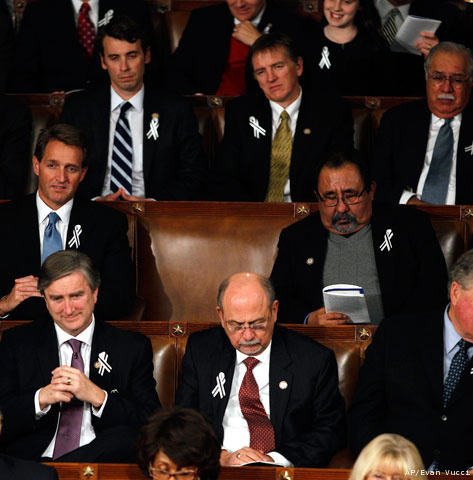
That's the Democratic Congresswoman from Arizona in the center.
Ethics Alarms first stated that Rep. Gabrielle Giffords was seriously disabled and needed to resign from the house on January 17, 2011. I wrote:
“Almost no medical experts foresee a woman with such massive head injuries being able to return to work within a year, if she can return at all. She only has a two-year term. Is it fair to the people of Arizona, not to mention the country, to have a member of Congress who is unable to work during the days ahead, which are critical to the nation on so many fronts?”
Although the answer to this question was obvious at the time, Rep. Giffords did not resign. I returned to the topic in March, June, September and November, but not only did the Giffords camp and Democrats continue to ignore the issue, the media largely did as well. Never mind that during a contentious and important year of critical legislative issues, one Congressional District in Arizona was essentially unrepresented.
Today, finally, Rep. Giffords announced that she had resigned, more than a year after being shot in the head. Her friend, Democratic National Committee Chair Debbie Wasserman Schultz, told the press that her friend’s recovery was likely to take years, not months. WOW! That’s a bulletin! Who had any idea that the Congresswoman was that seriously injured? Continue reading
One of the most respectful and compassionate acts a human being can perform is to rescue the memory and achievements of a great man or woman from obscurity. Not only does this confer deserved longevity on the legacy of someone who has contributed something good and lasting to civilization and culture; it also is a gift to the rest of us, enriching our knowledge and perhaps providing us with inspiration as well.
This is what Martin Scorsese does for the early French film pioneer Georges Méliès in his new movie, “Hugo.” The film is a fictionalized account of how Méliès, a producer, director, actor and special effects innovator, was rediscovered by film-lovers and his countrymen after years of discouragement and depression. In a nice piece of irony and symmetry, Scorsese’s film duplicates the phenomenon his movie describes. Forgotten after World War I, Méliès and his work were celebrated late in the 20’s, and he received long overdue acclaim and recognition, including France’s Legion of Honor. After his death in 1938, his contributions to the art and craft of cinema faded from public awareness a second time. Once again, thanks to “Hugo,” the public is learning Méliès’s name and being delighted and inspired by his creations. Continue reading

Be sure not to miss this very special episode of "Congress: A Study in Courage That Does The Country No Good Whatsoever"
ABC’s Diane Sawyer will soon air her interview with Rep. Gabrielle Giffords, the first since the Arizona Congresswoman was shot in the head during Jarod Loughner’s Tuscon rampage in January. Giffords looks alert and upbeat, if understandably frail, and answers Sawyer’s questions with short, often single word responses. She has clearly made remarkable progress in her rehabilitation. She also obviously has a long way to go, and her prospects of working at a high level again, much less working on the nation’s problems, are speculative at best. Why then is she still filling a seat in the U.S. House of Representatives?
She is doing so because, of course, she is courageous. Because her recovery is inspiring, and it would be heartless and cruel to take her job away because of a madman’s bullet. She is doing so because it would be unfair and mean to rush heroic Gaby, and because Americans care. None of which has any relevance to the tiny, apparently trivial issue of governing America. Continue reading
 Ethics Alarms