Unethical Quote of the Week: Penn State Football Coach Joe Paterno

Did you know that Jerry Sandusky's autobiography was titled, "Touched," Joe?

“The fact that someone we thought we knew might have harmed young people to this extent is deeply troubling. If this is true we were all fooled, along with scores of professionals trained in such things, and we grieve for the victims and their families. They are in our prayers…It was obvious that the witness was distraught over what he saw, but he at no time related to me the very specific actions contained in the grand jury report. Regardless, it was clear that the witness saw something inappropriate involving Mr. Sandusky. As coach Sandusky was retired from our coaching staff at that time, I referred the matter to university administrators…If true, the nature and amount of charges made are very shocking to me and all Penn Staters. While I did what I was supposed to with the one charge brought to my attention, like anyone else involved I can’t help but be deeply saddened these matters are alleged to have occurred.”

—–Penn State Football Coach Joe Paterno, commenting on the indictment on 40 charges of child sexual abuse brought against his long-time former defensive coordinator, Jerry Sandusky. It was Paterno who first brought allegations of Sandusky’s sexual molestation of young boys to the University’s attention, and two Penn State administrators have also been charged with covering up Sandusky’s alleged misconduct.

Paterno’s statement is ethically troubling on many levels, self-serving and disingenuous. Continue reading
Comment of the Day: “Penn State, the Child Molester and the Dark Side of Loyalty”

Newcomer Steven Ardler muses over a provocative question about the virtue loyalty in his Comment of the Day on“Penn State, the Child Molester and the Dark Side of Loyalty”:

“Out of curiosity: would you say that a better definition of Loyalty is needed? It seems to me that the dilemma can be partially resolved by claiming all Loyalty need be to “the good” rather than to a person/institution/nation (I put the term in quotations because I am conflicted as to its actual meaning).

“We choose people and institutions that we believe maximize the good and adhere to their policies and behaviors accordingly. When those people or institutions step away from the good, our “Loyalty” to them is revoked. In this case, nearly by definition, Loyalty will always be a virtue. Of course, a very simple counter to this idea will be the varying interpretations of “good.” Muslim suicide-bombers are, in their ethical consideration, maximizing good in the universe by doing Allah’s will (according to their interpretation of that will). A bishop in the Catholic church may *feel* as if he is maximizing good by not condemning his pederast brethren, as he serves what he thinks is the ultimate good – a god. A coach at Penn State may think that he is loyal to the good, by determining that the university accomplishes enough good to be worth preserving from scandal. All of these are very apparently flawed, but this type of reasoning would abound with a new definition of loyalty, nonetheless. I feel like a re-tuned definition of Loyalty *helps*, but certainly does not resolve the problem. Is there a way to define loyalty in which it is actually a virtue, and not just a description of a series of actions?”

Stupid Religion Tricks

Efforts by religious and anti-religious interest groups to push their beliefs and agendas are unavoidable, if often annoying. When their machinations threaten real harm, they ought to be condemned, opposed, and told to behave. In its response to two recent incidents, our government is batting .500.

The Memorial Power Play

The Obama administration announced its objection to a Republican-backed proposal to add President Franklin D. Roosevelt’s D-Day prayer to the World War II Memorial in Washington. This would block the intent of Congressman Bill Johnson’s bill, the “World War II Memorial Prayer Act of 2011.” Continue reading

Penn State, the Child Molester and the Dark Side of Loyalty

"Loyalty" by Joe Drache

The ethical issues in the unfolding Penn State scandal are not complex. Unless the grand jury got things completely confused, high officials of the school as well as legendary football coach Joe Paterno had credible information indicating that former Paterno assistant coach Jerry Sandusky sexually molested young boys on the Penn State campus, and did nothing about it. Now, after a three-year investigation, Sandusky has been charged with forty counts of child abuse by Pennsylvania authorities, and Penn State’s athletic director and a university vice-president have been charged with perjury and failing to report the crime. [UPDATE 11/7/20011: the University officials both resigned late yesterday.]

Paterno is apparently not going to be charged, because he alerted university administrators, technically complying with Pennsylvania law. Ethically, it doesn’t matter. Paterno, like University athletic director Tim Curley, Gary Schultz, Penn State’s senior vice president for finance and business, and apparently Penn State president Graham Spanier as well, did nothing for nine years after being alerted to Sandusky’s apparent proclivities, knowing that a probable child sexual predator was not only on the loose, but operated a foundation for at-risk kids that kept him supplied with ready victims. Continue reading

An Ethics Lesson Missed, a Life Lost

Jayna Murray, victim of a murderer and ignorance of the the Golden Rule.

The grisly Lululemon Athletica murder trial in Montgomery County, Maryland, concluded with Brittany Norwood being quickly found guilty of the March beating and stabbing death of co-worker Jayna Murray in the yoga-wear store where they both were employed. Among the key testimony at the trial was that of Jana Svrzo, the manager of the Apple store adjacent to the murder scene, who said she heard banging, screaming, grunts and other someone-is-getting-attacked sounds, along with a frantic woman screaming things like, “God help me! Please help me!” and “Talk to me! Don’t do this!” Svrzo said she called another Apple employee over to the wall to confirm her suspicions, and they heard the voice say,”Stop! Stop! Stop!” and then, “Oh, God! Stop!”

The two Apple employees did nothing. Continue reading

Five Questions and Answers About The Steven J. Braun Law Firm Halloween Party Outrage

Imagine: tasteless Halloween costumes!

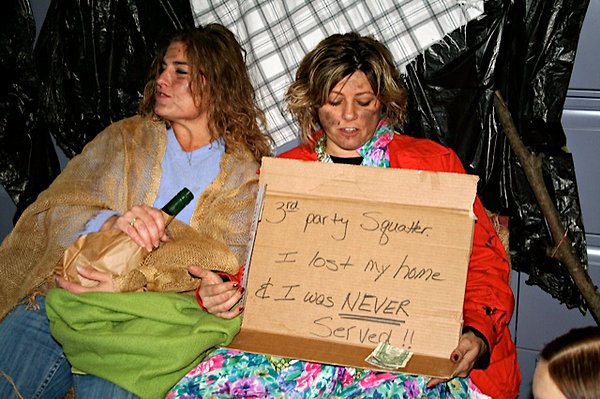
Background: New York Times Joe Nocera is stirring up public outrage because some employees of a law firm involved in questionable foreclosure practices attended the firms 2010 Halloween party dressed as homeless people. Photos taken at the Steven J. Baum law firm’s Halloween party last year were passed along to Nocera by a former firm employee.  In one that was posed on the Times site, two party-goers are dressed as  homeless people, with one holding a sign that reads, “I lost my home and I was never served.” Nocera wrote that the costumes show an “appalling lack of compassion.”

Here are ten questions and answers regarding ethics issues raised by the incident. Continue reading

Wolf’s Question and the Ethical Answer

"Upon reflection, perhaps failing to buy health insurance was a mistake..."

Wolf Blitzer’s question to Rep. Ron Paul at the CNN/Tea Party Express Republican debate in Tampa, Fla. has received most of its publicity because of the idiotic response it elicited from the audience, or some of it. That is good fodder for the Tea Party-slimers, but it was the query itself that raised the most interesting ethical issue.

What should happen, Wolf asked, when a healthy 30-year-old man who can afford insurance chooses not to buy it, and then goes into a coma and needs intensive care for six months? Ron Paul, true to his libertarian soul, muttered unhelpfully that we should all take responsibility for ourselves, which is true, but non-responsive. Blitzer followed up: “But, Congressman, are you saying the society should just let him die?” (This is where the barbarians at the gates added their bloodthirsty shouts of “Yeah!”)

Slate’s Jonah Goldberg has written about what he calls the three possible options available to American society to handle the comatose slacker: Continue reading

The Shannon Stone Tragedy Ethics Quiz, Part II

Don't try this if you're not a firefighter

 Many commenters were upset with me for characterizing the tragic death of Shannon Stone, who fell to his death while trying to catch a ball during a Texas Rangers game, as the result of his own bad judgment, suggesting that I was impugning the character of a dead man. (I wasn’t.) That reaction sparks the second Ethics Alarms quiz question relating to the incident.

NBC baseball blogger (and lawyer) Craig Calcaterra put up a post this morning headlined “Idiot nearly falls from the stands chasing a ball at the Home Run Derby”:

“Just days after Shannon Stone died from a fall while reaching for a baseball at a Texas Rangers game, a fan at last night’s Home Run Derby nearly fell out of the outfield stands while lunging for a home run ball hit by Prince Fielder.  He was spared serious injury or death only because his friends grabbed him by his feet, held him and then pulled him back as he dangled over the railing above a concrete deck 20 feet below…His name is Keith Carmickle, and common sense is not his forte. His fall came after he stepped up onto the narrow metal table which abutted the railing — the kind you stand in front of and set your drink on while watching the game — and then, while still standing on it, reached down low to catch the ball as it came in…He missed the ball, but his momentum carried him forward and he fell headfirst over the rail. If it wasn’t for his brother’s and his friends’ quick action, down he would have gone. Despite his idiocy, he (a) escaped this dangerous situation of his own making unscathed; and (b) was allowed to stay at the Derby by security. Both of these factors have been added to the “evidence that there is no God and/or that He is not just and fair” side of the big ledger I keep on my desk and in which I tally the wonder and folly of Humanity as I encounter it…”

Your questions to answer, if you dare: 1) Is it fair for Calcaterra to call Carmickle an idiot, and Stone just a random victim of circumstance? 2) Why or why not? Continue reading

Ethics Quiz: Should Shannon Stone’s Family Sue the Texas Rangers?

One Thursday, a 39-year-old firefighter named Shannon Stone leaned over a stadium railing at a Texas Rangers game to catch a ball flipped into the stands by Ranger outfielder Josh Hamilton.  Stone’s son, 6-year old Cooper, was a big Hamilton fan, and the devoted father made an extra effort, catching the ball but falling over the railing down to the concrete 20 feet below. He went into cardiac arrest on the way to the hospital, and died.

The railing where Stone fell is 33 inches, seven inches more that the legally required 26 inches. Why is it that short? So people sitting in the front row can see the game without having to look through the railing. Is it dangerous? Well, it was dangerous this time.

Everyone, naturally, is horrified by the tragedy. The Rangers held a moment of silence for the firefighter at the game last night. Hamilton, who like all major league players has been instructed to toss inning-ending balls and retrieved fouls into the stands for fans to catch as souvenirs, is understandably distraught.

Your Ethics Quiz: Should the Stone family sue the Rangers? Continue reading

Ethics, Porn, and the Creepy Professor

The Ronald Ayers saga raises the intriguing, Weiner-esque ethical issue of whether a college professor being creepy is sufficient reason to fire him.

The former economics professor was fired by the University of Texas for viewing pornography on an office computer, which the University’s policies forbade. The chain of facts has the ring of Kafka: 1) a student claims he hears “sexual noises” emanating from Ayers’ office, which 2) is considered sufficient provocation (the professor denied the accusation that he was not “master of his domain” at work) for the school to search his computer, which 3) uncovers evidence that he looked at some pornographic sites, and 4) also that he searched for the term “teen,” which 5) the university deems sufficient to indicate that he was searching for child pornography, so 6) they fired him, after three decades and tenure on the faculty.

University records say Ayers at first denied the allegations that he viewed pornography, but when confronted with a printout of his computer records, admitted that it may have happened “at the end of a long work day.” Ayers later told administrators seeing the porn was for “academic research.”

Uh-huh… Continue reading