Many Japanese soldiers during World War II went into battle carrying small “Rising sun” flags, the red sphere on the field of white, with the white field decorated by hundreds of classmates, family members and friends. The flags were for good luck, and to link soldiers to their loved ones while they fought for the Emperor. I had never heard of this practice until today; my father served in the European theater, so he would not have known that many American soldiers took these personal talismans from the bodies of fallen Japanese soldiers as war trophies.
U.S. Marine Marvin Strombo was such a soldier. A member of an elite sniper platoon during the bloody battle for the Pacific island of Saipan in 1944, he had taken a flag from a dead Japanese soldier lying on his left side—he remembered that the young man looked like he was asleep—after he noticed something white sticking out from his jacket.
The flag with all the inscriptions on it hung behind glass in Strombo’s gun cabinet in his home in Montana for decades until 2012, when the son of his former commanding officer contacted him for assistance with a book he was writing about the exploits of his father’s platoon. (ARGHHH!I just remembered that I haven’t gotten back to a member of my Dad’s unit who wrote me a couple of months ago!) Working with the author, Strombo learned about the Obon Society, a nonprofit organization in Oregon that works to locate and return the personal Japanese flags to the families of the fallen soldiers who carried them. Researchers determined that the dead soldier Marvin’s flag had belonged to was named Yasue Sadao. What Strumbo thought was calligraphy were really the signatures of 180 friends and neighbors, including 42 relatives, who saw Yasue off to war from Higashi Shirakawa, a small village of about 2,400 people in the mountains roughly 200 miles west of Tokyo. Continue reading →
This was a wonderful gesture of kindness and reconciliation. It won’t mean much to those who don’t follow baseball, and that is Reason #478,653,222 why it’s a mistake not to follow baseball.
I’ve written about the Steve Bartman fiasco several times. I am not in the “Steve Bartman was an innocent victim of circumstance” camp, though he was a victim of moral luck. He was an incompetent baseball fan, not paying sufficient attention to the game and interfering with it as a direct result. On the other hand, for members of the 2003 Cubs to use him as a scapegoat for their blowing a lead, the game, and the play-offs, and for Chicago fans to hound him out of town and into hiding, was far worse than his negligence, the most disproportionate and vindictive treatment of a fan in sports history.
Here was my summary of the saga to date before the Cubs finally won the World Series after more than a century of failure:
Bartman, for those of you who have lived in a bank vault since 2003, was the hapless young Chicago Cubs fan who unintentionally interfered with a foul ball that might have been catchable by Cubs outfielder Moises Alou in the decisive game of 2003 National League Championship Series. In a perfect display of the dangers of moral luck, Bartman’s mistake—it didn’t help that he was wearing earphones and watching the ball rather than the action on the field—began a chain of random events that constituted a complete collapse by Chicago in that very same half-inning, sending the Miami Marlins and not the Cubs, who had seemed comfortably ahead, to the Series. Bartman, who issued a sincere and pitiful apology, was widely vilified and literally run out of town. He then became part of Cubs and baseball lore, one more chapter in the sad saga has been called “the Billy Goat Curse,” the uncanny inability of this team to win it all.
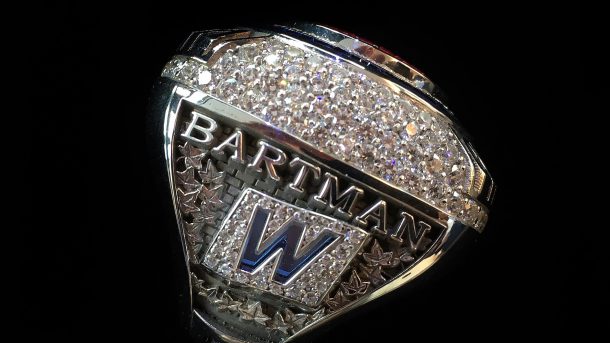
Yesterday the Cubs announced that the team had privately awarded Bartman an official Chicago Cubs 2016 World Series Championship ring as a special gift from the the Cubs organization. These things contain 214 diamonds at 5.5 karats, three karats of genuine red rubies and 2.5 karats of genuine sapphires, and are worth about $70,000. Even so, the symbolism is worth far more.
I find myself annoyed at the groundswell of good wishes for John McCain after his diagnosis of glioblastoma…McCain is a war criminal and, more to the point. someone who as a politician has championed horrifying actions and been lousy on state commitment to public health…But ultimately what troubles me is the urge to send such well wishes to an utter stranger as it reinforces the notion that some lives are more important than others. There are lots of people with glioblastoma and who have died from it (including my mother twenty years ago)….
—San Diego State University Political Science Professor Jonathan Graubart on Facebook, prompting some calls for him to be fired, and others on campus to second his opinion.
Is this an Ethics Quote or an Unethical Quote? I could call it an Ethics Quote because it raises many ethical issues, and mere statements of opinions, even stupid and vicious ones, are not usually unethical in themselves. This quote strongly suggests that the speaker is unethical in than one respect; it is also, at very least, irresponsible in its context, which is that he is a teacher, and represents the institution.
Jonathan Turley flagged this episode, as he reliably does any time a professor comes under fire for controversial speech. As always, he supports his fellow academic:
“Graubart’s comments are hurtful and hateful. It is a reflection of the incivility that has taken hold of our social and political dialogue. It is always sad to see a fellow academic rush to the bottom of our national discourse. However, we have free speech and academic freedom to protect unpopular, not popular, speech. Popular speech does not need protection. Graubart is expressing his deep political and social viewpoint on social media. He should be able to do that just as his critics have a right to denounce his views.”
San Diego State University is a government institution, and thus subject to the First Amendment, in addition to the principles of academic freedom. However, even a state institution has a right to protect itself from harm. This isn’t just political speech; it is bona fideasshole speech, signaling that the speaker is not a trustworthy teacher, and that any school that would have someone this intolerant, doctrinaire, vile and contemptuous of kindness and compassion educating, aka indoctrinating students isn’t trustworthy either. Universities, public or not, should be able to insist on a minimal level of professionalism from faculty in their public behavior and pronouncements so the institution isn’t permanently discredited, embarrassed, and harmed.
Bravo to Johnathan Turley for neatly summarizing what’s wrong with the Catholic Church’s recent affirmation of its long-standing requirement that the bread and wafers used during communion in Catholic churches around the world must have at least some gluten in them, or the Church will collapse and Satan will reign, or something. Meanwhile devout Catholics who must avoid eating gluten, including people who have Celiac disease, just have to plug along, get half a communion, or get sick. God wants it that way.
What a throbbing example of arrogant and compassion-free bureaucratic thinking. The Professor’s headline captured the idiocy and rigidity of it perfectly.
The Catholic News Agency shrugged the story off with a couple of rationalizations: “It’s always been this way” and “This is nothing new.” Neither are satisfactory excuses when making the communion dangerous to the increasing number of Catholics with Celiac disease. The issue is mirrored by the dilemma faced by alcoholics, who fear drinking wine; the Catholics, unlike the Methodists and other Protestant churches, insist on at least minimally fermented wine. Grape juice just won’t do. Why?
“Christ did not institute the Eucharist as rice and sake, or sweet potatoes and stout,” Chad Pecknold, a theology professor at Catholic University, told the Washington Post. “It may seem a small thing to people. But the Catholic Church has spent 2,000 years working out how to be faithful to Christ even in the smallest things. To be vitally and vigorously faithful … is something which is simply integral to what it means to be Catholic.”
[A long bitter section about how bureaucracies are habitually doctrinaire about small matters while ignoring pervasive corruption and destructive hypocrisy has been deleted here, in part because it is ugly, and also because anyone who can’t write their own version hasn’t been paying attention to the Catholic Church for the last 500 years…or even the last 17.]Continue reading →
Rockwall, Texas resident Andy Mitchell posted a photo on Facebook of himself and Justin Korva, a young stranger whom Mitchell had picked up and driven to his job after seeing him walking to work in his work uniform in 90 degree weather. He was stunned and impressed to learn that Korva walks three miles each way to his low-paying job at Taco Casa, a fast food restaurant,
“To all the people that say they want to work but can’t find a job or don’t have a vehicle all I can say is you don’t want it bad enough!” Mitchell wrote on the Facebook post. Mitchell then used his post as a springboard to raise money to buy a car for Korva, who is 20. It took less than 30 hours to raise $5,500.
Samee Dowlatshahi, the owner of a pizza restaurant who had set up a donation box for Korva’s transportation inside his establishment, contacted a friend at a local Toyota dealership. The friend told his boss about Korva, and persuaded the dealership to drop the price of a white 2004 Toyota Camry. This allowed Mitchell’s group to buy the car, pay Korva’s insurance for a year, and finance two years’ worth of oil changes along with a $500 gas card.
“Are you serious?” Korva said as Mitchell handed him the keys.
Dowlatshahi said,, “We just want you to know, seriously, this community, nothing we love better than to have someone who works hard. We take a lot of pride in that. It’s so hot out here, I can’t believe you walk even one mile in this heat.”
1. On the same New York Times front page (June 21) that announced the Georgia 6 result, surrounded by Times’ agenda-advancing stories with slanted headlines (climate change, North Korea, the Obamacare overhaul, the “divided GOP,” and Michael Flynn) was the kind of story that once made the Times’ reputation. It was headlined, “Haven for Recovery Becomes A Relapse Capitol,” Will this story be discussed today by the Sunday talking-head shows? Of course not. The implications of it are not friendly to progressive mythology.
The story explains how Delray Beach, Florida has become a Mecca for drug addicts and a bonanza for treatment centers and “sober houses,” group living facilities for addicts. Some quotes will provide a sense of the report, but you should read it all:
Unlike other places in the United States that have been clobbered by the opioid crisis, most of the young people who overdose in Delray Beach are not from here. They are visitors, mostly from the Northeast and Midwest, and they come for opioid addiction treatment and recovery help to a town that has long been hailed as a lifeline for substance abusers. But what many of these addicts find here today is a crippled and dangerous system, fueled in the past three years by insurance fraud, abuse, minimal oversight and lax laws. The result in Palm Beach County has been the rapid proliferation of troubled treatment centers, labs and group homes where unknowing addicts, exploited for insurance money, fall deeper into addiction.
…
Hundreds of sober homes — some reputable, many of them fraud mills and flop houses for drug users — sprawl across Delray Beach and several surrounding cities. No one knows exactly how many exist because they do not require certification, only city approval if they want to house more than three unrelated people. Hoping for a fresh start, thousands of young addicts from outside Florida wind up here in places that benefit from relapse rather than the recovery they advertise.
…
…the proliferation of fraudulent sober homes was in part also the result of two well-intentioned federal laws. First came a 2008 law that gave addicts more generous insurance benefits; then the Affordable Care Act, which permits adults under 26 to use their parents’ insurance, requires insurance companies to cover people with pre-existing conditions and allows for multiple drug relapses.
The result was a whole new category of young addicts with access to insurance benefits. This gave rise to a new class of abusive operator, as painstakingly chronicled in The Palm Beach Post: the corrupt sober house owner. Many drug treatment centers — which also treated inpatients — started paying sober-home owners “bonuses” from insurance money and fees for referring outpatients to their centers while they underwent therapy, according to law enforcement, a grand jury report and court records.
…
Sober homes, which are not covered by insurance, can get thousands of dollars a month for each recovering addict, in large part from treatment providers, law enforcement and city officials said. Much of it goes into the owners’ pockets. But it is also used to pay rent so patients can live free and to provide perks that lure patients from other sober houses: manicures, mopeds, gym memberships and, worst of all, drugs. Relapses are welcome because they restart the benefits clock.
To increase profits, many treatment centers and labs overbill insurance companies for unnecessary tests, including of urine, blood and DNA. Some have billed insurance companies thousands of dollars for a urine test screen. Patients often unnecessarily undergo multiple urine tests a week.
Ah, glorious compassion! So those of us who managed to not break laws and cripple ourselves while doing so get to pay for not only the self-inflicted problems of those who did, but also get to enrich the scam-artists who live off of their addictions, protected by compassionate, expensive insurance guarantees that require no personal responsibility or accountability. Meanwhile, “federal disability and housing anti-discrimination laws offer strong protections to recovering addicts who live in them.”
This is the better “treatment” alternative to the “war on drugs” that the compassionate people harangued us about for decades. Continue reading →
Like Title IX, like Obamacare, like so many well-intentioned laws and regulations designed to assist and protect vulnerable citizens or traditionally oppressed groups, the Americans with Disabilities Act (ADA) opened the door for abuse, absurd taxpayer costs, and unanticipated consequences. The ADA was rammed into law by activists compassion bullies who proclaimed that any attention to proportion and cost-benefit analysis was mean and heartless. Here is an example of what else came in that open door:
ADA lawsuits are now as common as sex-discrimination lawsuits, with more than 26,000 new claims filed against employers each year. The latest litigants have their sights on the most innovative segment of our domestic economy: e-commerce.In this trend, people sue businesses because their websites aren’t sufficiently accessible to the disabled — because the websites lack assistive technologies for the blind or hearing-impaired, say. It began in 2000, when Bank of America became the first entity to settle a web-accessibility lawsuit. Safeway and Charles Schwab soon followed suit. In 2008, Target paid $6 million to settle a class-action suit brought by the National Federation of the Blind, and nearly $4 million more to cover the plaintiffs’ attorney fees and other costs. More than 240 businesses across the country have been sued in federal court over website accessibility since the beginning of 2015. Similar litigation has been brought against universities on the grounds that the free online courses they offer aren’t captioned for deaf users, and against ride-sharing services because their smartphone apps lack text-to-speech capability for blind users.
…According to the demands of disabled users, in order for a website to be accessible, it must use fewer pictures, present text in a format that is compatible with text-reading software and employ design that allows for easy navigation. But the features that make a website more accessible for one disabled group are bound to be objectionable to another.
They may also conflict with other needs. Consider bank websites, which often employ timers that will shut down an online session for security reasons after a particular time period is exceeded. Such “timeouts” could present problems for some disabled users, but eliminating them in the interest of accessibility could impair security for all.
In the process of making a website accessible, questions invariably proliferate. Do certain color combinations violate the ADA because they confound the colorblind? Are certain layouts inaccessible if they’re confusing to users with a limited field of vision? Do the accessibility requirements apply only to the websites themselves, or do they also apply to Web content, such as advertising on a third party’s website? Will website hosts be responsible for the compliance of third-party sites? Must archived Web content be revised to comply? What about mobile apps? Do temporary technical bugs in an otherwise compliant website constitute a violation? What physical and mental conditions will require accommodation? So far, Web accessibility lawsuits have concerned the vision- and hearing-impaired, but future cases could be brought on behalf of plaintiffs diagnosed with dyslexia, ADD/ADHD, narcolepsy, cognitive impairments, paralysis and many other conditions.
The game is to sue deep pockets website owners and extort settlement pay-offs. That’s fine for the Bank of America, but not for, say, Ethics Alarms. This blog could be put out of business by such a lawsuit, and so could hundreds of thousands of others. Continue reading →
It is misleading to describe this story as a Democratic governor letting an convicted armed robber escape punishment so he can stay in the US, though that is how it is being reported.
The world has gone mad, but the pardon issued to convicted bank robber Rene Lima-Marinby by Governor John Hickenlooper isn’t necessarily proof of that, though Lima-Marinby’s weird story is.
He came to the U.S. as a toddler in the 1980 Mariel boat lift from Cuba, and had obtained legal residency. His 2000 criminal conviction for armed robbery when he was 19 caused that status to be revoked. Lima-Marin was sentenced to 98 years in prison for the robbery.
Let me pause. He was 19, and they sentenced him to 98 years in prison.
Then he was mistakenly paroled from Colorado state prison in 2008, 90 years early. I’ve written about these cases before. I hate them. Releasing a prisoner then coming back years later and saying, “Oopsie! Sorry! Our bad! Back you go!” turns a gaffe into cruel and unusual punishment. Unless a prisoner is a serial killer or a terrorist or breaks the law after he is released, the authorities should bear the burden of such incompetence, and any early release should stand.
Lima-Marin is a good example of why this should be the practice. he married, had a child and got a steady job installing glass. It took six years for the state authorities to discover their mistake, and in 2014 they sent him back to state prison for the remainder of his 98-year sentence.
I wouldn’t cross the street to watch over-the-top, beautiful but annoyingly nasal pop singer Nicki Minaj perform, but I’d walk miles to shake her hand.
Over the weekend, the mega-star answered Twitter questions about a lip syncing contest using her “Regret in Your Tears” music video. One audacious follower asked if the singer would pay for her college tuition. It never hurts to ask, right? Minaj not only agreed but offered to pay the tuition for other fans, tweeting,
Show me straight A’s that I can verify w/ur school and I’ll pay it. Who wants to join THAT contest?!?! Dead serious. Shld I set it up?
And she did set it up. Requests came in from all quarters, containing transcripts and student loan balances.
“U want to go to college but can’t? How much do u need to get u in school? Is that the only thing stopping u?” Minaj asked an immigrant fan who said she could not afford classes. Minaj sent the money. She also assisted a single mother who needed $500 for her remaining tuition, and sent $6,000 to cover the fall semester for another Twitter follower, including his room and board, courses and meal plan.
Yes, I am keeping my fingers crossed that Minaj’s spontaneous outburst of kindness and charity isn’t exploited by scammers. She’s certainly laying herself wide open to be misled. Yet one cannot be generous and compassionate and not be vulnerable to the worst in society. I’m sure Nicki knows that. To her credit, she is willing to court the risk to change some lives for the better.
She’s a deserving Ethics Hero, and boy, I needed one today.


 Dead serious. Shld I set it up?
 Ethics Alarms