The Lawyer Disability Conundrum

I frequently discuss lawyers continuing to practice under temporary disabilities, like bad colds, flues, serious pain (like migraines) or painful injuries. The lines are blurry indeed, but if a condition causes a lawyer to be sub-par in serving a client’s needs, the client should be informed, and the lawyer should be prepared to either delay the matter or find a replacement. Progressive disabilities, like age-related declines in stamina and cognitive ability, also have to be taken seriously by an ethical lawyer and dealt with responsibly in the best interests of clients.

Missouri has a rule that allows for a court to suspend a lawyer after an adjudication of disability or incapacity. This week the Missouri Supreme Court summarily suspended a lawyer after the lawyer had been found disabled by a Social Security judge. She has medical issues affecting her eyesight, back, and hands,and she also suffers from chronic migraines. Her lawyer insists that her judgment has not been affected, and that she is still capable of competent and zealous representation of her clients. The applicability of the Americans with Disabilities Act is obviously an issue.

The suspended lawyer cites the precedent of Paul Alexander, a recently deceased Dallas lawyer who specialized in ADA cases. He graduated from the University of Texas School of Law. Alexander had polio as a child, which rendered him a quadriplegic. He used an iron lung except when a case required him to leave his workplace in a wheelchair and practiced law for more than 40 years typing on his personal computer using a device he held in his mouth. Alexander also painted and wrote a book.

Presumably his clients were aware of his disability ans consented to his representation of them despite his disability. Presumably also, he would have been suspended in Missouri. Still, is the proper standard to be applied to all lawyers reasonably embodied by Paul Alexander, who was an outlier by anyone’s definition?
A Bit More DEI Among Trump’s Cabinet and Agency Picks Would Have Been Ethical

…as in prudent, responsible, respectful, and competent.

President-elect Trump’s best mouthpiece, Rep. Byron Donalds, essentially humina-humina-ed the question on CNN about whether Al Sharpton’s criticism of the nomination and appointments so far emanating from Mar-A Largo was valid. Certainly Sharpton’s rationale isn’t valid: that Trump “owes” black voters more African American cabinet members, but the presence of just a single black nominee among the many selections, that being former NFL player Scott Turner nominated last week be Secretary for the Department of Housing and Urban Development, is at very least unwise. Turner was part of Trump’s executive director of the White House Opportunity and Revitalization Council; now he steps into the job held last time by Dr. Ben Carson. No, I don’t think there is any chance Turner will be rejected by the Senate.

It certainly looks like Trump has designated HUD as the slot for tokens: Ben Carson, a neurosurgeon who revealed himself during the 2016 debates to be an idiot savant, had no qualifications for HUD other than his skin color. Turner is more qualified, but still: if Trump wanted to ensure that the “Trump is racist” trope continues unabated, he could hardly have pursued a course that would have supported it more vividly. There are certainly a lot of nominations and appointments “of color,” but in the United States, for obvious reasons, blacks are in a special category.

Continue reading

Ethics Hero: Karoline Leavitt

Res ipsa loquitur…

The link is here. (WordPress wouldn’t let me embed it.)

I had never heard Leavitt before; she was an assistant press secretary at the end of Trump’s term, ran unsuccessfully for Congress in 2022, and is now Trump’s 2024 National Press Secretary. Compare her to the pathetic Karine Jean-Pierre. Trump should use Leavitt as an example of the different standards of competence in Democratic and Republican administrations (not that Trump didn’t employ more than his share of incompetents as well, some of whom are now telling the news media that he likes Hitler).

In a sane and ethical world, a candidate staffer showing herself to be prepared, competent, articulate and devastatingly accurate when faced with mainstream media propaganda should not warrant Ethics Hero status. Unfortunately, displays like Leavitt’s almost never happen. She reduced the ABC Axis propagandist to nearly literal “huminahumina” babbling.

If only the candidate himself could communicate this well.

(Heck, if only I could communicate this well, I might have made my final appearance on NPR, when I was ambushed and mocked for correctly explaining how sexual harassment law can be abused to target public figures like Donald Trump, a more memorable last stand.)

Ethics Dunce: Wells Fargo

I received the notice above in my email inbox two days ago. Wow! That deal looks almost too good to be true!

It was. When I examined the terms, I discovered that the bank had made a teeny mistake. It didn’t take a deposit of just 25 dollars to earn the $525 bonus. It required a deposit of 25 THOUSAND dollars.

Details, details.

That’s a three decimal point error. It doesn’t exactly engender trust in the bank’s staff, its management, or it quality control procedures, does it?

Wells Fargo has a notable dossier on Ethics Alarms, notably here, but also here, here and most recently here. And the hits just keep on coming: this was an item from yesterday: Wells Fargo Accused of Draining Customers’ Accounts Without Notice or Authorization in ‘Blatant Disregard’ of Consumer Loan Protections: Class-Action Lawsuit.

Yeah yeah, anyone can make a typo (don’t I know it!) but a bank’s business is getting numbers right. I would think that especially after its terrible publicity over the past several years, Wells Fargo would check and triple check a mailing that goes out to all of its depositors to make absolutely certain no unnerving mistakes are in the copy.

I would think that, and apparently I would be wrong.

Being a helpful, responsible customer, I sent a screen shot of the botched email to my banker at the local branch. I got no reply; I also never received any error acknowledgment from the bank.

They probably are still sending that promotion out.

Ethics Quiz: National Anthem Ethics

You can’t really blame Frank Drebin for massacring “The Star Spangled Banner” in “The Naked Gun”—after all, he had to impersonate an opera singer so he could get on the field and protect Queen Elizabeth from being assassinated by Reggie Jackson. Rosanne Barr’s rendition, however…

…was something else again, an obnoxious, deliberate and unfunny insult by any ethical standards.

But what is your ethics verdict on this rendition of the National Anthem sprung as a surprise on the packed Busch Stadium in St. Louis, when the Cardinals’ veteran starting pitcher of 17 years, Adam Wainwright, now entering his final season, stepped to the microphone in uniform on Opening Day and sang…

…one of the most off-key, pitch-shaky versions of the song ever heard outside of a saloon, or “The Naked Gun”?

Your Ethics Alarms Ethics Quiz of the Day is…

Is it ethical to sing the National Anthem as a solo in public when you can’t do it well?

Continue reading

A Diversity Ethics Conundrum: Is It Plausible That Phil Washington Is Qualified To Head The FAA?

Phil Washington, President Biden’s nominee to head the Federal Aviation Administration, apparently knows absolutely nothing about aviation. He is black, however, and the Biden Administration has made it quite clear that that feature, virtually all by itself, can make an individual fully qualified for difficult and important government positions without any other indicia of special competence. [See: Karine Jean-Pierre, Kamala Harris et al.] In his testimony before Congress last week, Washington did not exactly dazzle with his answers to questions related to America’s civil aviation system. Senator Ted Budd (R-NC) received these responses to seven questions about basic aviation (in baseball terms, Washington was 0 for 7):

Budd: “What airspace requires an ADS-B transponder?”

Washington: “Not sure I can answer that question right now.”

Budd: “What are the six types of special use airspace that…appear on FAA charts?”

Washington: “Sorry, senator, I cannot answer that question.”

Budd: “What are the operational limitations of a pilot flying under BasicMed?”

Washington: “Senator, I’m…not a pilot.”

Budd: “But, obviously you’d oversee the Federal Aviation Administration, so any idea what those restrictions are under BasicMed?”

Washington: “Well, some of the restrictions I think would be high blood pressure some of them would be…”

Budd: “It’s more like how many passengers per airplane, how many pounds, and different categories, and what altitude you can fly under, and amount of knots — it’s under 250 knots — so, it’s not having anything to do with blood pressure.”

Budd: “Can you tell me what causes an aircraft to spin or to stall?”

Washington: “Again, senator, I’m not a pilot.”

Budd: “What are the three aircraft certifications the FAA requires as part of the manufacturing process?”

Washington: “Again, what I would say to that is that one of my first priorities would be to fully implement that Certification Act and report…”

Budd: “You know the three types?”

Washington: “No.”

Budd: “That’s type certificate, production certificate, and airworthiness certificate. Let’s just keep going and see if we can get lucky here. Can you tell me what the minimum separation distance is for landing and departing airliners during the daytime?”

Washington: “I don’t want to guess on that, senator.”

Budd: “Are you familiar with the difference between Part 107 and Part 44809 when it comes to unmanned aerial standards?”

Washington: “No, I cannot, uh, spell that out…”

Continue reading

Translation Ethics: Helluva Job, FEMA!

Nice, careful, professional work by the Federal Emergency Management Agency!

I’m kidding.

After a typhoon caused extensive damage to homes along Alaska’s western coast in September, FEMA’s job was to help residents repair property damage. Since most of the residents were native Alaskans, FEMA chose Accent on Languages, a Berkeley, California company, to translate its usual instructions on how to apply for aid.

They chose…poorly. The documents victims of the typhoon received would have been right at home in the Monty Python skit that featured translation book howlers like “My hovercraft is full of eels.” The Yup’ik and Inupiaq translations were nonsense. “Tomorrow he will go hunting very early, and will nothing,” read one mysterious passage. “Your husband is a polar bear, skinny,” another said. One document had bee translated into Inuktitut, an indigenous language that nobody uses in Alaska.

FEMA fired the translation company. It appears that the words in the “translated” documents were randomly lifted taken from Nikolai Vakhtin’s “Yupik Eskimo Texts from the 1940s.” “They clearly just grabbed the words from the document and then just put them in some random order and gave something that looked like Yup’ik but made no sense,” concluded an investigator.

The company’s CEO wrote, “We make no excuses for erroneous translations, and we deeply regret any inconvenience this has caused to the local community,” adding that FEMA would be getting a refund.

___________________________

Source: Associated Press

Tuesday Ethics Afterthoughts, 3/29/2022: A Cheat Sheet, Mask Mayhem, And More

(THERE IS NO GOOD GRAPHIC FOR “AFTERTHOUGHTS”)

The 29th is another of those ill-starred days in U.S. ethics, topped off in 1973 by the U.S. withdrawal from Vietnam, the half-way war that was an ethics train wreck for decades. Two years earlier, on the same date, Lt. William L. Calley was found guilty of premeditated murder by a U.S. Army court-martial at Fort Benning, Georgia. Calley, a platoon leader, had led his men in a massacre of Vietnamese civilians including women and children on March 16, 1968. Ten years before Calley’s conviction, Julius and Ethel Rosenberg were convicted of espionage for their role in passing atomic secrets to the Soviets during and after World War II. They were executed in 1953, a flashpoint in the schism between the American Left and Right that still is a sore point. (Ethel appears to have been a genuine villain.)

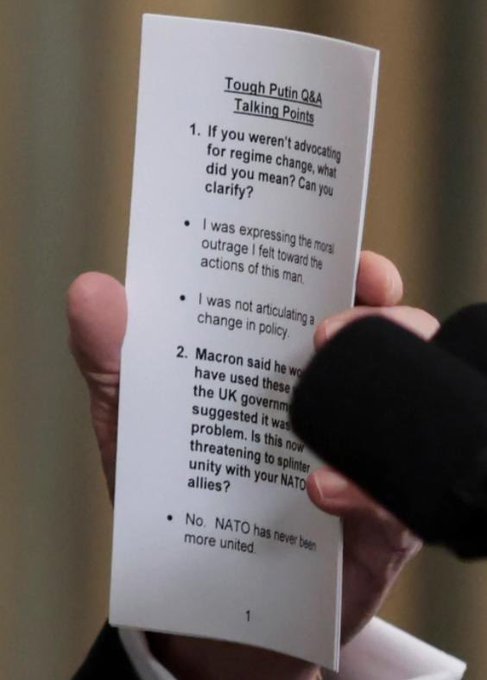
1. I thought this was a hoax. It’s not, unfortunately: someone got a photo of the cheat cheat for “talking points” that President Biden was holding when he massacred his explanation for his Russian regime change outburst in an exchange with Peter Doocy.

This does not fill me with confidence. You? The ethical value at issue is competence.

2. The propaganda and misinformation continues. Though some recently departed here could never grasp it, honest and trustworthy newspapers shouldn’t be publishing falsity and partisan propaganda in house opinion pieces. That’s when the opinion is offered using misleading or incomplete facts—deceit–and the New York Times does it almost every day. I can’t trust a group of editors who permit that. Examples:

It’s incredible how quickly we’ve normalized the fact that the last president tried to retain power despite losing the election and that a mob he incited stormed the Capitol. Many people took part in the effort to overturn the election — among them, we recently learned, the wife of a sitting Supreme Court justice, who hasn’t even recused himself in cases about the attempted coup.

The President in question wanted to challenge the results of an election he believed was the result of illegal manipulation, and as President, he had a duty to do that. I know Krugman isn’t a lawyer, but incitement is a term of art and a crime, and Trump did not “incite a mob” by addressing a crowd. Saying Justice Thomas “hasn’t even” recused himself because of the completely legal communications of his wife falsely implies that doing so is required or the justification for him to do so is undeniable. It isn’t. Editors should not allow such deliberately confusing and misleading opinion material Continue reading

When Factcheckers Go Bad…

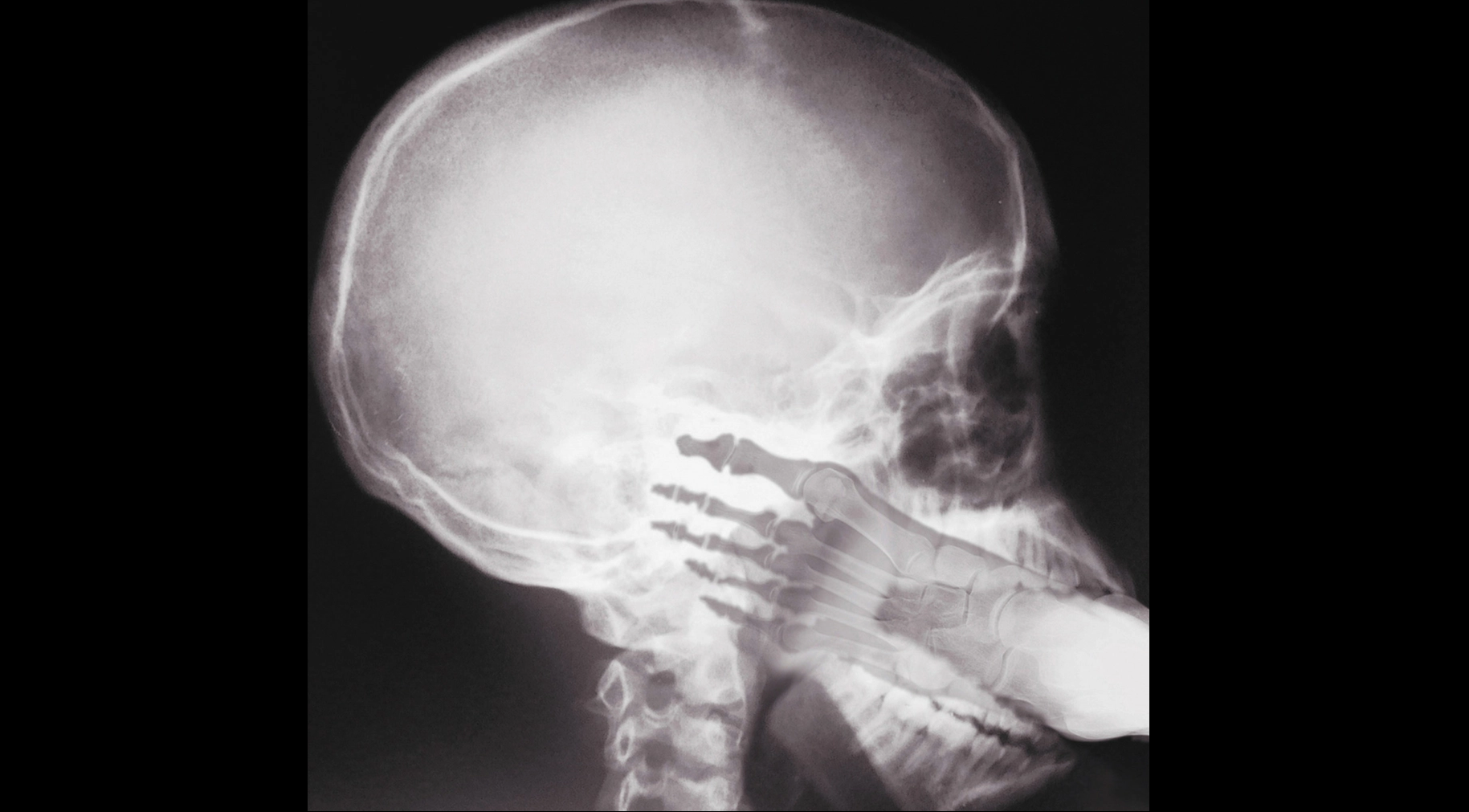
foot in mouth Xray

Here’s the First Law of Factcheckers: “Never make a public statement that shows you haven’t checked the facts.”

Glenn Kessler, the Washington Post’s longtime factchecker, broke that law today, and spectacularly.

After former President Trump chided Biden for not opening the schools by saying in his CPAC speech today,

“America’s children must get back in the classroom, and they must get back now. Joe Biden’s anti-science approach sold out America’s children to the teacher’s unions.”

Kessler, who is actually called “The Factchecker” by his paper, tweeted,

Kessler tweet

January 28? That would be Joe Biden, Ace.

The significance of this lazy, Twitter-driven botch is that Kessler is eager  and inclined to find fault with what Donald Trump says or does, and primed to protect Democrats, like Joe Biden. But we knew that, did we not?

Bias makes you stupid; Twitter makes you stupid. Bias and Twitter make you incredibly stupid.

Why should anyone trust Kessler’s objectivity and professionalism after this?

2020 Election Ethics Train Wreck Update: Well THIS Doesn’t Bode Well…

spelling problem

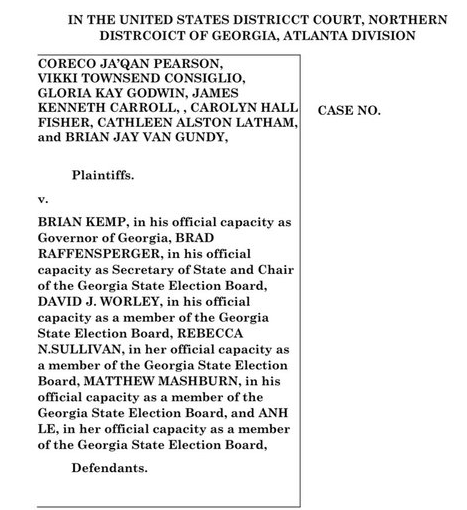
That’s the embarrassing first sheet of the more than 100 page lawsuit filed by lawyer Sidney Powell asking that 96,000 ballots (“at minimum”) in Georgia be disqualified. This is apparently the attack on the Georgia election that Powell referred to as releasing “the Kraken.”

Nobody seems to feel it’s necessary to explain that “Release the Kraken” is a reference to the semi-cheesy Ray Harryhousen stop-action film “Clash of the Titans,” which starred “LA Law’s” Harry Hamlin as Perseus, the Greek mythological hero. In the movie (though not in mythology), Perseus defeats the monstrous Kraken, which is released by the bad guys to kill him and Andromeda (it’s complicated). For some reason Perseus, in addition to carrying around Medusa’s head (which turns the Kraken to stone), rides the winged horse Pegasus. Pegasus was the transportation of a different Greek myth hero, Bellerophon. Neither Bellerophon nor Perseus had anything to do with the Kraken, which is not even a Greek myth monster. It’s Scandinavian, and is basically a giant squid.

Observations:

Continue reading