This quiz comes from the latest inquiry to “The Ethicist.” I disagree with much of Prof. Appiah’s answer, as I often have lately, but I do concede that the question is worthy of a serious ponder.
On their way out a restaurant, a family group was interrupted by a stranger who had also dined there. He said to the inquirer’s comely daughter-in-law, “With all due respect, you are very attractive.” The inquirer rebuked him saying, “That is wholly inappropriate, sir.” The inquiry continued,
“My cousin snapped at me that it was only a compliment. My sister got mad at me for upsetting my cousin. My daughter-in-law appreciated my reaction but said that she has had “way creepier men say way creepier things to her.” I responded to them all that a stranger has no business commenting on the looks of a person, good or bad, and that this man would never have said a word if any man had been standing with us. Who is right?”
Before I give you The Ethicist’s answer and mine,
Your Ethics Alarms Ethics Quiz of the Day is….
“Are spontaneous compliments on a stranger’s appearance per se unethical?”
The Economist surveyed five different countries, asking respondents what kind of conduct they viewed as sexual harassment.
Some examples (such as requesting a sexual favor) were obviously inappropriate, and were classified as such across all countries. Asked if a compliment on a woman’s appearance could be classified as sexual harassment, U.S. were a different matter. roughly a third of those under 30 in the U.S. answered, “Yes.”
Here’s the survey….
Thus we see how #MeToo propaganda has succeeded in convincing a large proportion of Americans that the simple act of engaging in the long-standing, traditional social balm of being nice should be avoided and even punished. For them, an innocent compliment must be regarded with suspicion. Since whether an arguable sexually inspired comment makes the recipient “uncomfortable” and is therefore “unwelcome” is the necessary predicate to a sexual harassment complaint and law suit. Continue reading →
Good Morning from sunny Daytona Beach, Florida, where I recently arrived to prepare for an ethics seminar I will be giving to a most ethical law firm. Ironically, the law firms that least require my guidance are the only ones that hire me. The law firms that desperately need ethics training don’t care.
1. Today in line (Group 6) to board my 6:45 AM American Airlines flight and wishing I were dead, my eyes were treated to the brilliant yellow jacket being worn by a young woman in front of me. In part because I wasn’t awake, I blurted out, “Thank-you for that jacket! The yellow is exactly the stimulation I need right now!” She smiled broadly and said, I think sincerely, “Thank you!” And suddenly I was reminded of the phony anti-Trump outrage of ten days ago, when the President allegedly embarrassed the nation and showed that he was a pig by daring to say to Mrs. Macron, “You’re in such good shape!”
By the reaction across the media, you would have thought he said, “What a great rack!” while drooling. There is nothing inherently inappropriate abut a spontaneous compliment on a woman’s appearance. It’s dangerous in the workplace, because there are women who are locked and loaded to cry harassment at such comments, no matter how mild or innocent, and if a women feels harassed, sayeth the law, you’re probably a harasser. However, actual human interaction involves reading people and situations, and every one is different.
Trump’s comment can easily be justified. I’m sure he’s used to women feeling like trolls when forced to stand next to his model wife, and a sincere sounding compliment is probably well-received. I was once passing through a receiving line that included a woman whom I had not seen for a year or so, and she had lost a great deal of weight. “You look great!” I said without thinking every hard about it. She appreciated the compliment; she had worked hard to lose the weight, and was glad I not only noticed, but that I said so.
Another encounter came when a young woman got on the elevator with me at a hotel a few months ago. She was wearing a sleeveless something or other, and her bulging biceps were hard to ignore. “Nice guns!” I said. She responded immediately with, “Thank you! I worked hard for them. Most guys think they’re gross.”
“Nah, they’re just insecure,” I said. “Being jerks. Don’t let them discourage you.”
“Thanks for that too!” she said, smiling, and got off on her floor.
Lots of factors go into whether a compliment is taken as a benign social gesture or a rude salacious intrusion. My actors in the ProEthics sexual harassment seminars do a skit in which “Good morning” is delivered in a way that could be sexual harassment, and “Wow, you look terrific this morning!” is said in a manner that raises no red flags at all. A chraming and skilled speaker can make comments that would have gotten me thrashed by that female bodybuilder sound like a sonnet. Continue reading →
And I don’t think her photo’s all that “stunning,” either. Happy now, Charlotte? And what are you smirking about?
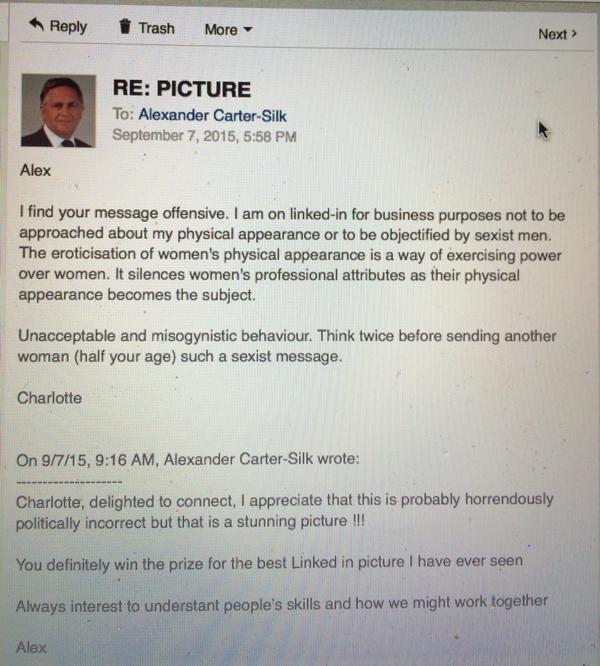
On the left is Alexander Carter-Silk, 57, the head of Brown Rudnick’s intellectual property group in Europe. He had received a LinkedIn request from human rights lawyer Charlotte Proudman, 27, on the right. He responded positively with the friendly comment that he was “delighted to connect,”,adding “I appreciate that this is probably horrendously politically incorrect but that is a stunning picture !!!” as well as “You definitely win the prize for the best Linked in picture I have ever seen.”
The Horror. For this arguably excessive degree of praise for her posted image, Proudman decided that Carter-Silk must be shamed world-wide. She responded with this A-Bomb rebuke, and shared it on Twitter:
Naturally, Carter-Silk was immediately torn to shreds by a feminist social media mob. Continue reading →
You're welcome. But now I'll never know what Eddie Murphy is really like!
I run into a lot of celebrities when I travel. I assume everybody does who travels very often; I know that I am better at recognizing them than the average person because my celebrity knowledge spans multiple generations, I have a good memory for faces, and I have always watched way, way too much television. And it happened again today: I was having my usual battles with an airport self-service check-in kiosk, this one in Atlanta, when I realized that the traveler enduring similar annoyances (“We have no record of your itinerary. Please enter the code that we call something other than what it is called on your ticket receipt before you get frustrated and have to wait in line to speak with an agent, because you know that’s what is going to happen.”) was the young actress-singer, Raven-Symone.
She was traveling alone, and it seemed clear that nobody around us had any idea who she was. Strange: doesn’t everyone watch “The Cheetah Girls,” “Dr. Doolittle 2” and re-runs of “That’s So Raven” on the Disney Channel? The encounter immediately sent me into Marshall Celebrity Recognition decision mode: what is the ethical way to treat the rich and famous if you are insignificant and lowly, and close enough to assassinate them? Continue reading →
The Republicans seldom look more silly—and politics seldom looks more cynical— than when the GOP complains that the media or liberal interest groups are ignoring conduct by a progressive politician that they would vociferously criticize if a conservative politician behaved similarly, even though the Republicans themselves see nothing wrong with the conduct, and would scream that the criticism was unfair if it was focused on a conservative. This is yet another of the funhouse mirror versions of the Golden Rule in action, being employed for a dubious “Gotcha!”: “Do Unto Others As You Would Do Unto Me, Even Though If You Did That Unto Me, I Would Condemn You For It.”
It is the game Republican women’s groups and conservative pundits are playing now, because the National Organization for Women hasn’t rapped the knuckles of President Obama for calling Rep. Debbie Wasserman-Schultz (D.-Fla.), the Democratic National Committee Chair, “cute.”
Wendy Wright, president of Concerned Women for America (a conservative women’s organization), called out NOW on its double standard, and said,“Of all people who ought to be offended at President Obama’s statement it should be an ardent feminist like Wasserman-Schultz. Isn’t objectifying women by their looks a mortal sin among feminists?” Charlotte Hayes, a senior fellow at the Independent Women’s Forum, the conservative twin of NOW, argued, “If a conservative had said this, [NOW] might have gone quite crazy. The Democrats might have gone quite crazy and tried to have his head on a platter. I guess Democrats could get really mad because you say a woman has a charming smile.”
But, she added, “I’m not one of those people who gets mad if you said I have a charming smile. I would be flattered.”
For its part, NOW has said that it has more pressing matters than criticizing a major ally’s politically incorrect gaffe, much as it couldn’t be bothered to criticize Bill Maher for calling Sarah Palin a “dumb twat” or MSNBC’s Ed Schultz for describing conservative pundit and single mother Laura Ingraham as a “right wing slut.” The President and the woman with the cute smile, meanwhile, are ignoring the whole thing.
Here is the irony, and the problem: they are all wrong.Continue reading →
In the thread following my post regarding Bill Maher calling Sarah Palin a “dumb twat,” I was asked about where “broad” and “babe” fall on the spectrum of misogynistic insults. I replied..
“Babe” and “broad,”: unlike “twat” are almost always intended as a compliment. I would never use either of the first two in direct address of a woman until I was certain that she would take it the right way. In fact, compliments are determined by reasonable intent—some women are insulted, or claim to be, if you say they look nice. In sexual harassment law, it is indeed the object/victim/ accuser who gets to define the dispute (if she likes “broad,” there’s no complaint…if she doesn’t, you better apologize quickly.) That’s the law—that doesn’t mean that a comment reasonably intended as a compliment suddenly becomes uncivil because of a hairtrigger offense.”
This prompted indignant replies from several, reaching a crescendo that indicated that I was hopelessly archaic, and that “broad’ was now officially an insult, an offensive insult, and nothing but an insult. I gave up to the onslaught, and agreed that “broad” was, in fact, now an insult. Continue reading →





 Ethics Alarms