“Zodiac” And Real Lawyer, Fictional Lie Ethics

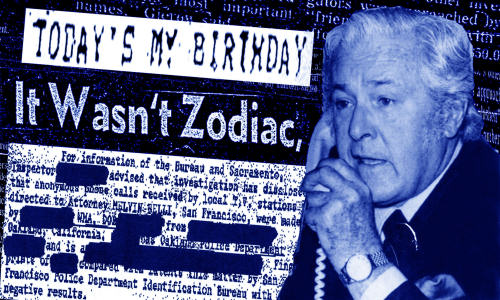
zodiac Belli

One of the problems with being an ethicist is that every movie seems like an ethics movie.

I watched “Zodiac” last night, struck by how much it resembled “Spotlight,” and not just because Mark Ruffalo had similar roles in the two films. It is a long, intense 2007 movie about the frustrating 1960s and early 1970s manhunt for the serial killer who called himself the “Zodiac” while killing seemingly random victims in the San Francisco Bay Area, and taunting police, Jack the Ripper-style, by sending them  letters, blood stained clothing, and in a special touch, ciphers mailed to local newspapers. The case remains unsolved.

What set off my ethics alarms, however, was a scene based on an actual incident in the case. From the website “Zodiac Killer Facts”:

On the night of October 11, 1969, the Zodiac murdered cabdriver Paul Stine and removed a portion of the victim’s shirt. Days later, the killer mailed an envelope to the offices of The San Francisco Chronicle. Inside, the Zodiac had included a blood-soaked piece of Stine’s shirt along with a letter that traumatized the Bay Area for decades. In his customary cavalier style, The Zodiac wrote, “School children make nice targets. I think I shall wipe out a school bus some morning just shoot out the frunt tire and pick off the kiddies as they come bouncing out.”

The Zodiac’s threat to assassinate school children terrified children and parents everywhere, and created a nightmare of security concerns for police and school officials. Armed men escorted children to and from schools while patrol cars and even aircraft followed along and monitored the surrounding area. As media coverage of Zodiac’s murderous plans increased and fears of a horrific ambush grew, a local television station was the setting for a chilling scene.

In the early morning hours of October 22, 1969, the Oakland police department received a phone call from a man claiming to be the Zodiac. The caller said he wanted famous Boston attorney F. Lee Bailey to appear on a local television talk show, but told the operator that he would settle for San Francisco lawyer Melvin Belli in the event Bailey was unable to appear.

Hours later, Belli was the guest on the show with host Jim Dunbar. A man called the KGO television station several times, and, in conversation with Belli, claimed he was the Zodiac and that his name was “Sam.”

Continue reading

Unethical Donald Trump Quote Of The Day: Whatever It Was That He Told The New York Times “Off The Record” That The Times Unethically And Unprofessionally Allowed Its Staff To Talk About, Putting Trump In An Impossible Bind That He Should Have Been Able To Rely On A Respected News Source Not To Put Him In…

new-york-times-nytimes-building-cc

Let me be clear: The New York Times has shown itself to be partisan, untrustworthy, and no longer fit to be regarded as the flagship of American journalism. The fact that they did this at the expense of Donald Trump, an existential danger to U.S. culture and governance, in no way mitigates the betrayal of journalistic ethics the Times’ conduct represents.

From Buzzfeed:

The New York Times is sitting on an audio recording that some of its staff believes could deal a serious blow to Donald Trump, who, in an off-the-record meeting with the newspaper, called into question whether he would stand by his own immigration views.

Trump visited the paper’s Manhattan headquarters on Tuesday, Jan. 5, as part of a round of editorial board meetings that — as is traditional — the Democratic candidates for president and some of the Republicans attended. The meetings, conducted partly on the record and partly off the record in a 13th-floor conference room, give candidates a chance to make their pitch for the paper’s endorsement.

After a dispute over Trump’s suggestion of tariffs on Chinese goods, the Times released a portion of the recording. But that was from the on-the-record part of the session.

On Saturday, columnist Gail Collins, one of the attendees at the meeting (which also included editor-in-chief Dean Baquet), floated a bit of speculation in her column:

The most optimistic analysis of Trump as a presidential candidate is that he just doesn’t believe in positions, except the ones you adopt for strategic purposes when you’re making a deal. So you obviously can’t explain how you’re going to deport 11 million undocumented immigrants, because it’s going to be the first bid in some future monster negotiation session.

Sources familiar with the recording and transcript — which have reached near-mythical status at the Times — tell me that the second sentence is a bit more than speculation. It reflects, instead, something Trump said about the flexibility of his hardline anti-immigration stance.

So what exactly did Trump say about immigration, about deportations, about the wall? Did he abandon a core promise of his campaign in a private conversation with liberal power brokers in New York?

Sure, I’d like to know. I’d love to know if the single issue that has made Trump the most unqualified and unfit Presidential nomination front-runner in U.S. history has been manipulated by him to gull his easily gullible, “poorly educated” supporters. Maybe the knowledge that he has no intention of deporting millions and building a wall would make them see him as the cynical con man he obviously is. That doesn’t matter, though. We shouldn’t know what Trump said off the record, and we shouldn’t  know that any off-the-record comments were made. That the New York Times’ staff is so undisciplined and unethical that it would gossip about such a session shows the paper’s commitment to principles of journalism ethics to be inadequate for a small town weekly rag. Continue reading

What Lawyers Can Teach Doctors About Ethics

So THAT'S why they wear masks!

So THAT’S why they wear masks!

Sandeep Jauhar is a cardiologist, the author of “Doctored: The Disillusionment of an American Physician” and “Intern: A Doctor’s Initiation.”and a contributing op-ed writer for the New York Times. He recently penned a column for the paper that raised concerns about threats to doctor-patient confidentiality, specifically from the case, in Washington state, of Volk v. DeMeerleer.

Howard Ashby, a psychiatrist, was sued after his patient, Jan DeMeerleer, shot and killed an ex-girlfriend and her 9-year-old son before shooting himself.  The estate of the victims, Rebecca and Phillip Schiering sued Dr. Ashby, alleging that he breached a duty to warn DeMeerleer’s victims even though the killer had made no specific threats toward the Schierings during his treatment.  Last year, however,  that judgment was reversed by an appeals court, which held that doctors could be required to warn “all foreseeable victims” of their potentially dangerous patients in their care.

It’s a terrible decision, and Jauhar does a good job explaining why. Unfortunately, he also writes this..

“I once took care of a business executive in the emergency room who had hired call girls during a weekend drug binge. When he saw a police officer outside his room, he quietly handed me an envelope containing a large amount of white powder. I wasn’t sure what to do with it, so I discarded it. For the next several hours the patient eyed me suspiciously, probably wondering whether I had ratted him out. But it never occurred to me to do so.”

Well, it should have. Confidentiality is one thing, assisting in a crime is another. The Hippocratic Oath says“What I may see or hear in the course of treatment, I will keep to myself.” That only means, however, that doctors who learn about criminal activity a patient may be involved in is bound not to report it (lawyers have the same obligation).  Jauhar did more than not report criminal activity; he participated in it. He crossed the line by disposing of contraband. Continue reading

“The Good Wife” Jumps The Ethics Shark

jumping the shark

I saw this coming several seasons ago- that the once ethically challenging CBS legal drama “The Good Wife” was on the way to strapping on Fonzie’s old water skis and jumping the old Ethics Shark. Sure enough, after being able to watch the show irregularly and being either confused or disappointed when I did, I finally got a chance to watch an entire episode last night. The Shark has been officially jumped and TGW is no longer bothering to check with its legal ethics consultants. This is known as “The David Kelley Syndrome,” as all of that producer’s legal dramas, “The Practice,” “Ally McBeal,” “Boston Legal,” etc, begin plausibly and end up in the Legal Ethics Twilight Zone as the writers run out of ideas.

In last night’s episode, “Cooked,” Good Wife Alicia’s defendant was charged with making GHB. He claims innocence because he wasn’t making authentic GHB, but a GHB-like substance,without the same chemical compound as GHB itself and thus less dangerous.  Alicia explains the law to him, which is that he would be better off if his intent was to make GHB but he  ended up with the pseudo GSB by mistake, instead of successfully making the possibly illegal GHB-like drug intentionally.  She says that he needs to be clear which he did, and tells him to tell the truth.

This is the common, much criticized defense lawyer tactic called “The Lecture” in the novel “Anatomy of A Murder.”  A lawyer is bound to explain the law to his or her client, and that sometimes means educating a client regarding how to “remember” what happened.

Then Alicia discovers that her defendant isn’t who he claims to be. He’s an FBI agent, and he’s part of an FBI sting to prove the judge in the case is taking bribes. She says she’s going to tell the judge about his false identity (and also that the charges were fake) so he tells her and that if she blows his cover, he’ll tell the judge that she suborned perjury by  giving “The Lecture.” She backs off, and agrees not to tell the judge.

Suspend her.

1. If she has a personal interest (Rule 1.7) that conflicts with her duty to protect client confidences (Rule 1.6), like her conflicting duty as an officer of the court to report a fraud on the court, a.k.a. THE WHOLE CASE, then the least she must do is withdraw under Rule 1.16. Continue reading

Why Ethics Rules Are Useless Without Common Sense

HIPAA

An ethicist’s pet peeve: People who misuse formal ethics rules to justify unethical or stupid behavior because they never thought about what why the rule exists.

This happens a lot. My favorite example was the famous athlete enmeshed in a scandal. Ay a press conference, he said that he couldn’t answer specific questions because of “atttorney-client privilege,” and not one of the reporters had the education to say, “Huh? You’re the client! The attorney-client privilege prevents your lawyer from revealing what you told him. It doesn’t stop you from revealing anything, you cretin.” In my seminars, when an attendee cites a professional ethics rule as the reason why he shouldn’t do something, I often ask, “And why is that a rule? What’s wrong with what it forbids?” Often, disturbingly often, the individual has no idea.

The New York Times today featured another example: medical providers and others not even subject to the law using HIPAA to avoid giving out information they could and should give out, in mots cases misinterpreting the law to do so. Among the examples in the Times story:

  • A retirement home refusing to tell friends of a resident that the resident had died (only health care providers, health insurers, clearinghouses that manage and store health data, and their business associates are covered by The Health Insurance Portability and Accountability Act of 1996. a.k.a. HIPAA)
  • A hospital that  refused to accept information about a patient’s allergies from the patient’s daughter (Wow: hospitals can receive medical information; HIPAA restricts the ways they can disclose it)
  • Another relative of a patient reprimanded by hospital staff for talking about her loved one’s medical problems in the cafeteria, because, she was told, it was a HIPAA violation.
  • A minister told a church staff not to announce the names of ailing church members because it was would violate HIPAA  (That’s right: he really thought it was against the law to tell congregation that someone was sick.)
  • Some providers cite HIPAA to block patients from seeing their own records.

This is why morality alone doesn’t make people ethical, especially if they aren’t very bright. Continue reading

Another TV Doctor, Another Breach: Dr. Sanjay Gupta’s Heroic And Self-serving Ethics Blindness

Are TV doctors entertainers, journalists or doctors? In a way the question doesn’t matter: if they are doctors, then they are obligated to follow medical ethics and the standards of their profession at all times, no matter what else they may be taking compensation for. This is why “Dr. Oz” is ducking the issue when he tries to avoid accountability for pushing quack remedies on his TV show (if it ducks like a quack…) by arguing that he isn’t practicing medicine, but engaging in entertainment. He’s still a doctor, every second of his life, once he takes that oath.

CNN’s Dr. Sanjay Gupta has largely steered clear of ethical issues in his tenure as the network’s medical expert. Not entirely, however; for example, in 2009, he was prominently mentioned as a possible Surgeon General, and was in discussions with the White House while continuing his reporting on the air, raising real and potential conflict of interest concerns. The most recent controversy is more serious. Continue reading

When Is It Ethical For Lawyers To Testify Against A Client? Here’s An Example…

Next time, stick to baseball hypotheticals, Darrell.

Next time, stick to baseball hypotheticals, Darrell.

From Panama City, Florida comes this rare legal ethics scenario. Darryl Mack, 22, accepted 20 years of prison in exchange for a no contest plea to a murder charge, after he learned that his original attorney in the case would be testifying for the prosecution. The revelation by an accused  criminal’s own lawyer of what most think are privileged statements would be devastating evidence, which is why lawyers are almost always prohibited by the ethics rules from doing this.  Mack had been trying to block the testimony on that basis. However, Circuit Court Judge James Fensom ruled those statements could be used against Mack at trial. Why? It is because of a useful and necessary exception to the ethics rules known as the crime-fraud exception.

If you are a “Breaking Bad” fan, this one of the reasons Saul is a crook, not a lawyer.

“The last thing a lawyer wants to do is testify against his client,” the prosecutor in the case explained. “But it is not reasonable to ask your lawyer to be your conspirator.” That means that a request for such advice is regarded by the profession as a request for assistance in breaking the law, and a lawyer cannot ethically give such advice. Such a request isn’t confidential, and isn’t privileged. A lawyer doesn’t have to reveal such information, but he also risks being charged as an accessory if the proposed crime is committed.

Timothy Hilley, Mack’s initial legal counsel, testified in a closed courtroom that Mack had posed a hypothetical to him at the end of a jailhouse interview, and Hilley viewed it as a veiled statement of  intent to commit murder. Mack allegedly asked his then defense counsel what would happen if a witness was unavailable for the trial, a question Hilley took to refer to a witness to the July shooting death of 24-year-old Tavish Greene, the victim in the murder Mack was charged with.

“Mack was on his way to leave, and he walked over to door and he said, ‘Could those statements be used if he was murdered,’” Hilley testified.
“I said, ‘No, it would be hearsay.’” Mack then asked, “How much time do I have?” Hilley said. “And I didn’t catch it at first, but then he asked again, ‘How long before trial?’ ” Mack left the room after Hilley told him the trial could begin as soon as June.  The lawyer reported the incident to the State Attorney’s Office, and withdrew as Mack’s attorney. Continue reading

A Failure To Understand Legal Ethics Kills

Sunshine-skyway-bridge

This week, John Jonchuck arrived at his lawyer Genevieve Torres’s office in Tampa, Florida dressed in his pajamas. He had his 5-year old daughter Phoebe with him.

Torres’s new client had a history of arrests for domestic battery, driving under the influence, and passing fraudulent checks.  Jonchuck told her he had cared for Phoebe for two years, and asked Torres to file papers that day so he could have full legal custody of his daughter.

There were clues, however, that indicated to Torres that something was amiss….the pajamas, for example. Then her client kept saying that she was God, the Creator. When he asked her to read a Bible in Swedish, and told the lawyer to come with him to St. Paul’s Catholic Church to baptize him, she was pretty much sure he was stark, raving mad, and that his daughter was in peril—especially when he left her office with the ominous statement,  “Don’t file the paperwork. It’s not going to matter anymore.”

Torres called 911, saying that she was his lawyer, and that she believed the little girl wasn’t safe. “He’s out of his mind, and he has a minor child with him driving to the church now,” Torres explained. Hillsborough County sheriff’s deputies found Jonchuck and Phoebe at  the church, where he was meeting with a priest .Jonchuck told them God had spoken to him in the past, according to a Sheriff’s Office report. Deputies determined that he was not a danger to himself or  Phoebe.

Thirteen hours later, Jonchuck dropped Phoebe off Tampa’s Sunshine Skyway bridge, and she drowned in the dark waters below. Continue reading

A Lawyer Argues “Do No Harm” Should Be Added To The Legal Ethics Rules, Thus Proving Herself To Be A Hopelessly Unethical Lawyer

This is Alexa. She'll let you know if your client is good or bad, and whether you should help him. Just ask.

This is Alexa. She’ll let you know if your client is good or bad, and whether you should help him. Just ask.

Lawyer Alexa Van Brunt contributed a jaw-dropping op-ed to the Washington Post over the holidays. It was titled “The ‘torture’ memos prove America’s lawyers don’t know how to be ethical,” and argued that the legal profession needs the equivalent of the medical profession’s “First do no harm” ethical standard.

It was irresponsible for the Post to print such a piece, because it made its readers, most of whom are thoroughly confused about legal ethics already, even more confused. So far, I have yet to find any lawyer who regards Van Brunt’s theory as anything other than laughable, tragic, shocking, or proof that ideology rots the brain. She cannot possibly understand legal ethics or even what the duties of the legal profession are and compose such an embarrassing piece.

Alexa Van Brunt is, we are told, an attorney at the Roderick and Solange MacArthur Justice Center, a Clinical Assistant Professor at Northwestern University Law School and Center, and a Public Voices Fellow with The OpEd Project. This explains a lot. She is a public interest lawyer on a mission, and thus represents only causes that she thinks are good, right and important. Apparently she missed the part of law school where you learn that one of a lawyer’s jobs is to assist non-lawyer clients as they try to accomplish their goals, which they believe are good, right, and important. These often involve engaging in controversies with others, and zero-sum results. Someone is going to suffer “harm.”

In medicine, what “do no harm” means is frequently clear: make the patient better, not worse. There are usually not competing patients, where a limited amount of health must be allotted among suffering human beings. Thus a doctor will not ethically take a healthy heart from a living patient to give to another. In law, however, “Do no harm” would render many disputes beyond legal assistance. Is a defense lawyer who refuses to let a guilty client be convicted by insufficient evidence, jury bias and wrongful interpretation of the law doing harm by freeing a criminal, or is it harm to allow prosecutions to violate due process? Is a real estate lawyer who assists as a company purchases virgin land for the building of a factory doing harm to the environment, or is the lawyer for the environmental group that tries to block it doing harm to the economy?

Van Brunt’s primary focus is the torture issue, but even there, what is “harm” is muddy. Those who supported the use of torture believed that precluding it would place the U.S. population at risk. Alexa defines “harm” as violating international law and the Constitution, but the Constitution, some scholars believe, does not prohibit torture as the CIA practiced it, and in war, doing harm is necessary to win. Who decides whether a litigant who wants to sue for police brutality is going to do harm to public safety, or whether defending a police officer accused of murder will encourage police executions of unarmed men? Who decides, when it comes to  finding that a lawyer violated this new, sensitive ethics rule, what constitutes “harm”?

Why Alexa, of course! She and all those other good people who know with absolute certainty what is right and just in every case—they know what harm is. Just ask them. Meanwhile, client confidentiality is out, because sometimes a lawyer keeping his client’s secrets may cause harm to others. Providing legal advice to banks, defense contractors, auto manufacturers, gun-makers, processed food manufacturers, McDonalds, pharmaceuticals, the Defense Department, the CIA, pro-life organizations (abortion providers don’t harm anyone, of course), the NRA, the Republican Party, this all causes harm…by Alexa’s standards, and she knows best. We don’t need judges or juries, just let the consciences of lawyer and their associations decide which clients are virtuous enough to be worthy of legal representation.

The op-ed is not just absurd, but ignorant and alarming. How can anyone this warped and lacking in understanding of the law and the ethical duties of the profession be teaching at a law school, where she can assist in the minting of new lawyers as ignorant, arrogant and unethical as she is?

Talk about doing harm.


Case Study In Cultural Ethics Rot: “Bin Laden Shooter” Robert O’Neill

Dead, but still helping to corrupt our culture...

Yes, dead, but still helping to corrupt our culture…

Do you remember all those World War II, Korean War and Vietnam veterans who published books and gave interviews taking personal credit for the successes of the United Armed Services? No, neither do I, because there weren’t very many. The ethical culture of military organizations has always been that the unit is what matters, not the individual. For a soldier to seek credit, accolades and celebrity through his own disclosures was regarded as disgraceful conduct, and a betrayal of military honor and tradition.

Those values, and the important larger cultural values that they reinforce, are crumbling rapidly. Former Navy SEAL Robert O’Neill, one of many U.S. special forces members to storm Osama bin Laden’s compound on May 2, 2011, confirmed to The Washington Post that he was the unnamed SEAL who fired the fatal bullet at the terrorist leader. His decision to make himself an instant celebrity and speaker circuit star comes nearly two years after another Seal in the mission, Matt Bissonnette, published his account of the raid, “No Easy Day.” The Post says that O’Neill has endured “an agonizing personal struggle, as he weighed concerns over privacy and safety against a desire to have a least some control over a story that appeared likely to break, with or without his consent.” There is no struggle if O’Neill accepted that fact that his ethical obligation is to shut up, and not dishonor his colleagues, his profession and his country by choosing celebrity over preserving a vital ethical standard.

Will future Seals jeopardize the success of their missions as each tries to deliver the “money shot” that will literally result in millions? Why wouldn’t they, now that soldiers are absorbing the American culture’s obsession with cashing in and becoming famous as the primary objective of human existence? Like all ethical standards, the tradition of soldiers neither seeking individual credit nor wanting it had strong practical reasons for its existence. A military unit is the ultimate team, and no team can function at maximum efficiency if the members regard themselves as competing for glory. Continue reading