I had to get this post up before the Morning Ethics Warm-Up, because it warmed ME up by almost exploding my head.
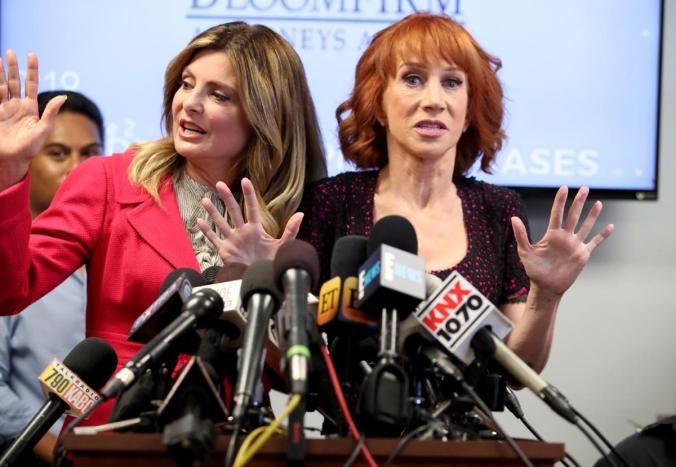
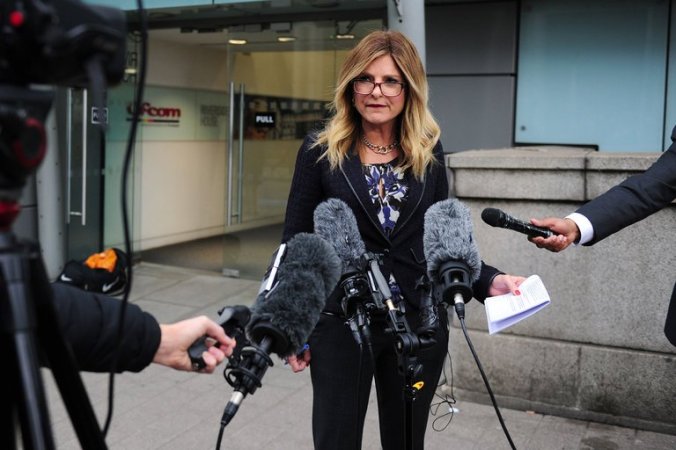
Lisa Bloom, the daughter of feminist muck-raking celebrity attorney Gloria Allred, has already shown the she has either no regard for legal ethics, or is spectacularly ignorant of them. She has publicly breached the duty of loyalty, attacking her former client, Harvey Weinstein; she took on Weinstein in the teeth of a blatant conflict of interest that she also publicized, as if it was something to be proud of. Yesterday, she showed that she is unfamiliar with, or perhaps just doesn’t give a damn about, the core legal ethics principle of confidentiality, perhaps the most important legal ethics duty of all.
Her latest ex-client to be the victim of Bloom’s unprofessional conduct and disloyalty is Kathy Griffin, she of the severed head. Griffin announced that she had fired Bloom, and wasn’t nice about it—but then when is Griffin ever nice?—saying, “Yes, I got Bloomed. Yes, I didn’t have a good experience with her. Yes, I feel that she and her husband exacerbated my personal situation.” Disaffected clients can say anything they choose about their lawyers. They can do it on Yelp, on the lawyer consumer site Avvo, to the Hollywood Reporter or hire a skywriter. What a client says, mean or not, untrue or not, still does not alter a lawyer’s continuing ethical obligations one whit. A lawyer cannot get into a public fight with a former client over what did or did not occur during the representation. Every lawyer knows this, or is supposed to.
Yet Bloom—I would say “incredibly” had we not seen other examples of her professional ethics cluelessness—released this statement on Twitter:
[My head told me in a statement that it would have exploded over this but determined that doing so over Kathy Griffin and Lisa Bloom was demeaning to head-explosions. I concur.]
The fact that Bloom had prepared Griffin’s remarks for the press conference, the fact that they worked on them together, the fact that Griffin discarded them, the fact the performer “ad-libbed” and “extemporized” are all client confidences. For all we knew, Griffin’s claim during the press conference that she was ignoring her notes was part of a pre-planned strategy. I assumed it was; Griffin is an actress. “It’s best if you show that you are talking from the heart, Kathy,” is advice I would expect Griffin’s lawyer to give. A lawyer cannot tell the public that a client ignored her advice. Only the lawyer and the client know that. Revealing it is to disclose information the lawyer learned during the course of the representation that will harm or embarrass the client, a serious ethics violation and betrayal of trust Continue reading →
Now, don’t sue me, Lisa! Remember what it says in the “About” section (above), this is all just my opinion. When I say you are a stunningly unethical lawyer, that’s just my analysis; it’s true I know something about legal ethics, teaching and consulting on it full time, but I can’t assert my opinion as fact. I can’t read your mind or slog through your soul. I don’t know what a bar disciplinary committee would decide, though I know this is a famously gray area in legal ethics, so unethical conduct is unlikely to be punished. And when I say you’re a hack, remember that “hack” isn’t a description subject to objective proof, any more than, say, “asshole.” Perhaps your definition of “hack’ is different from mine. In fact, I’m sure it is.
That said, your conduct is a professional disgrace. I think. Who knows? I may be wrong.
In an interview with BuzzFeed News published this weekend, Bloom, speaking of her recently terminated representation of Harvey Weinstein, said
“I can see that my just being associated with this was a mistake. All I can say is, from my perspective, I thought, ‘Here is my chance to get to the root of the problem from the inside. I am usually on the outside throwing stones. Here is my chance to be in the inside and to get a guy to handle this thing in a different way.’ I thought that would be a positive thing, but clearly it did not go over at all.”
Bloom added that she will no longer represent men accused of sexual misconduct, “even those who convincingly tell me they are innocent….I will just make the best choices I can out of every situation. I have clearly not been successful. I think anybody who does big bold things fails. And I definitely failed on this one.”
What Bloom has failed at is called “being a trustworthy and competent lawyer.”
The next day, during an appearance on Good Morning America, Bloom even more explicitly threw her former client under the metaphorical bus:
“It’s gross, yeah,” Bloom told GMA. “I’m working with a guy who has behaved badly over the years, who is genuinely remorseful, who says, you know, ‘I have caused a lot of pain.’”
Did Bloom actually graduate from law school, or did she just apprentice in her mother’s office (she is Gloria Allred’s daughter) and somehow get an honorary license? Did she never learn about the a lawyer’s duties of loyalty and confidentiality? She obviously didn’t know about conflicts of interest, since she represented Weinstein while agreeing to let him turn her book into a TV miniseries.
Ethics Alarms has previously criticized lawyers who have publicly undermined their former clients. The most recent example was last year, when a former Trump lawyer used his experiences while representing the future Presidential candidate decades earlier to write a scathing mid-campaign attack on his former client in the Huffington Post. I wrote,
There is strong disagreement in the profession about whether the answer to “Is this unethical?” should be an outright yes. The status of loyalty among the legal ethics values hierarchy is as hotly contested now as it ever has been. If a lawyer wants to attack a former client in a matter unrelated to the representation and no confidences are revealed in the process, is that a legal ethics breach? If it is, it would be a very tough one to prosecute. I think it’s a general ethics breach, as in wrong and unprofessional. It is disloyal, and clients should be able to trust their lawyers not to come back years later, after a client let the lawyer see all of his or her warts, and say, “This guy’s an asshole.” It undermines the strength of the public’s trust in the profession.
(My Dad was from Kentucky. He couldn’t stand Tom T. Hall…or Mitch McConnell)
1. I have been working on a legal ethics seminar for lawyers who represent seniors (I was told that the politically correct term among the groups was “older clients.” Older than what?) It is one of those areas of the law in which the usual ethics rules don’t work very well, or sometimes not at all. This anomaly requires a lawyer practicing in the field to be ready to embrace the Ethics Incompleteness Principle: to violate the letter of the professional ethics rules in the best interests of the client. For example, what does a lawyer do whose aging client lives with a son or daughter, and the lawyers sees signs of elder abuse? When the lawyer asks the client, he makes various excuses for his caretakers, and finally says that while he has been abused, it’s not serious and will only get worse if the lawyer says or does anything in response to it. Now what? The fact of the abuse, under the usual construction of the rules, is a confidence controlled by the client.
The emerging consensus is that the lawyer can ethically use the exception to confidentiality that allows an attorney to reveal a client confidence to prevent death or serious bodily injury to a “third party,” the client becoming “the third party” for his own protection.
2. A federal lawsuit was filed last week alleging that a Tennessee judge and sheriff violated inmates’ constitutional rights by instituting a program offering reduced jail time for criminals who agree to undergo vasectomies or get contraceptive implants. The suit claims the White County program amounted to “eugenics with a twist.” I don’t think it’s much of a twist; I’d say it’s eugenics, straight up. I’d assume CBS will love it: after all, eliminating criminal types is even better than eradicating Down Syndrome babies. Isn’t it?
3. Lots of people sent me this horrible story, about the cheerleader camp at a Denver area high school where young girls were being forced to do splits (it hurts me even thinking about doing splits) , with the camp’s instructor shown in a leaked video pushing down on the shoulders of a 13-year-old as she screamed for him to stop.
Boy, there is a lot of child abuse out there.
The Denver Board of Education said in a statement: “As the elected representatives for Denver Public Schools — and as the moms, dads and family members of D.P.S. students ourselves — we are deeply disturbed by the videos of cheer practices at East High School that came to our attention yesterday.”
Gee, it’s good to know that you are all disturbed that children are being tortured at schools that you are supposed to be overseeing.. This must mean you are competently doing your jobs. No, actually it doesn’t
“As the investigation continues,’’ it states, “our focus must be entirely on our students, families and educators.”
The school superintendent also said: “We have sent notification to our athletic directors emphasizing that D.P.S. does not allow the use of ‘forced splits’ or any other activity that puts a student’s physical or mental health at risk, or in which a student is forced to perform an exercise beyond the point at which they express their desire to stop.”
An Ethics Alarms note to that school system: Any athletic directors who have to be reminded that abusing children in their care, and continuing to make them perform painful acts after they have said that they don’t want to, is not something they should be doing shouldn’t be employed in the first place. Continue reading →
I have finally read the transcript, which you should do as well. By now I have also seen a lot of video clips. (James Comey really says, “Lordy!” Wow.)
First, some general observations, with more detailed comments to come in a subsequent post.
1. My earlier expressed opinion of James Comey when I defended him against conservative accusations that he was giving Hillary Clinton an undeserved break by not indicting her were revealed as too generous yesterday. I still believe he is honest and non-partisan. More than ever, I believe that he is untrustworthy. He was obviously in a difficult position—many, in fact—that he was not able to successfully manage, if anyone could have. However, his oft-repeated insistence that he (and his FBI) did not play politics was exposed as false, if not dishonest (a gracious interpretation of the sort that Comey denied the President in his bitter testimony.)
2. The fake Russia collusion narrative pushed by Hillary, Democrats and the news media to simultaneously excuse her loss and undermine the Trump Presidency was killed yesterday, but will wander around like a zombie for months if not years because Trump-haters will not have the integrity to admit they were wrong. Chris Matthews, a once astute and courageous liberal Democrat reporter who morphed into a partisan, knee-jerk progressive shill and anti-Republican scold as soon as he started getting paid by MSNBC, had a sudden flashback to his days of integrity when he pronounced yesterday,
“But the big story has always beenthe assumption of the critics of the president, of his pursuers, you might say, is that somewhere along the line in the last year, the president had something to do with colluding with the Russians. Something to do, a helping hand, encouraging them,feeding their desire, to affect the election in some way, some role they played, some conversation he had with Michael Flynn, or Paul Manafort, or somewhere. And yet what came apart this morning, was that theory, because in two regards the president said according to the written testimony of Mr. Comey, ‘go ahead and get anybody satellite to my operation and nail them, I’m with you on that,’ so that would mean Manafort, Carter Page, someone like that. And then he also came across today what was fascinating, Comey said that basically Flynn wasn’t central to the Russian investigation, that he was touching on it. That there was, of course, Flynn had an honest, we assume, wasn’t honest in his answer on the official forms that he had to fill out to become a national security head.”
But it only touched on that, it wasn’t really related to that. But he could be flipped for that, but in other words, they could flip him because they had him caught on something he dishonestly answered but he wasn’t central to the Russian thing, and I always assumed that Trump was afraid of was that he had said something to Flynn, and Flynn could be flipped on that. And Flynn would testify against the president that he had had some conversation with Flynn in terms of dealing with the Russians affirmatively. And if that’s the case, where’s the there there?”
There is no there there, and never has been. Thus the anti-Trump hysterics are left with what they have always believed was proof enough: Hillary lost, leaked hacks of e-mails that led the public to realize how sleazy the Democrats were should have never been seen by voters, Trump was the beneficiary of the leaks, he had said nice things about Putin, he’s an unethical creep, and a lot of his associates had business contacts with Russia, and besides, they just know Trump is guilty.
That’s not enough; in fact, it’s nothing at all. Matthews as both a lifetime Democrat and a romantic regarding the Presidency and democracy detests Trump to his Irish-American Boston liberal core, but he knows when to get off a bandwagon that will embarrass him if he stays on board, or make it impossible for Chris to look in the mirror.
3. For a lawyer, Comey’s loose use of the term “liar” and his stated belief that he assumed that Trump was a liar early on in their relationship shows a troubling inattentiveness to his own biases, as well as a classic misunderstanding of what it means to lie. Comey said Trump lied about why Comey was fired, for example. Comey has no way of knowing which of the many legitimate reasons for firing him played the biggest role in his firing. He does not know what Trump was thinking, so he cannot assert that Trump lied. He can say that he believes Trump lied, but that is only his opinion: it does not make Trump a liar, and it is not evidence. Last ditch bitter-enders among the Impeach Trump Lynch Mob will be arguing that Comey’s various opinions and reactions prove misconduct by Trump. But lying and obstruction of justice are not like sexual harassment, where a second party, by his or her reactions, determines whether misconduct has taken place. Comey stated that he took Trump’s words that he “hoped” that the FBI would drop the Flynn investigation as a “direction.” He also could have taken it as a marmoset, but that wouldn’t mean that the President meant it as one.
Any time a supervisor says “I hope you do this,” it is a statement of what will make that supervisor happy. (Did Obama ever say to his Treasury Secretary, “I hope the IRS is tough on those tea party groups: they are about as non-partisan as I am!”?) Nevertheless, it leaves the decision in the hands of the subordinate.
4. Comey came off like a classic disgruntled former employee, and I’ve interviewed many of them, angry that he was fired and determined to do as much damage to his former supervisor as possible on the way out the door.
Mark S. Zaid is a distinguished lawyer currently active in bolstering anti-President Trump efforts. He actively trolls on Twitter for clients looking to bring laws suits against the administration, and his clients include prominent “resistance” conspiracy theorist and blogger Louise Mensch, whose name I was blissfully unaware of until last week, and now she is turning up in my e-mail, in my story feeds, everywhere.
A couple of days ago, Mensch launched a new Trump rumor, using “anonymous sources” (which makes her just like the New York Times and Washington Post!) that the Daily Kos picked up. You can read it here: good luck. It is so muddled in its “facts” and suppositions that it makes other fake news look good. Naturally, the Daily Kos took the “breaking” scoop at face value, although it was so legally absurd it made my teeth hurt. The Palmer Report, the same wacko site that drove Larry Tribe around the bend, also was in the mix.
My favorite item in the “story” was that a court had handed down an indictment against President Trump, not for criminal purposes but to support his impeachment. When I read stuff like this, I stop reading further. Grand juries don’t work like that. Courts don’t work like that. Indictments don’t work like that. Impeachment doesn’t work like that. Nothing works like that, except to a mind where complete hatred and fear of Donald Trump and the joy of having so many mutually infected embarrassing themselves in high places has caused the brain to morph, hopefully only temporarily, into a gerbil wheel.
Zaid, who obviously has a high tolerance for this blather being a 24-7 Trump basher himself, apparently couldn’t take it any more, and wrote to his client Louise on Twitter and in the comments to The Daily Kos story,
Respectfully to my client, there is no info available to support this. We need more than just these anonymous source(s).
This is like putting client advice on a billboard. This is like leaving client advice on an answering machine (yes, I’ve encountered that!). This is like putting client advice on your Facebook wall, and it is exactly like posting client advice on a public website, because that’s essentially what Zaid did. Continue reading →
There were not one but three excellent, informative, detailed comments, one after the other, in response to the post about the GOP’s elimination of the recent Obama FCC regulations of Big Data gathering by broadband providers. Technology competence is, I believe, the greatest looming ethics issue for the professions, and it is important for the general public as well. All three of these Comments of the Day are educational. If only the news media and elected officials were as well-informed as Alex, John Billingsley, and Slick Willy.
First rule: anything online is vulnerable, no matter who secures it. It follows that any computer/device connected online is also vulnerable.
Second rule: Public WiFi is hack-able, and doing so is not that difficult. Someone just has to want to. Using it for playing games could make you vulnerable, and using it to access your financial information (banks, brokers, etc.) is stoopid
Third rule: Anything you do electronically is forever. Any tweet, snap chat, Facebook post, cell phone text or conversation, email, web post, browsing activity, and anything else may be saved by someone. Some of those are harder to get than others: browsing activity takes a snooper on the data line, or a court order to set a snooper up at your ISP. For instance, all cell phones activity is now all saved by the NSA, including where the phone was when. No, no one looks at it, not until they have a reason to research a person, perhaps years later. ‘Smart’ TVs can record you in your own home, without your knowledge, unless you take steps to stop it (electrical tape over cameras/microphones is a start, but still not enough)
Fourth rule: Any public activity can be recorded today. Besides CCD cameras everywhere and license plate readers on many roads, facial metrics can track you in most urban and many rural areas. Even going into the desert or mountains could be spotted via satellite, should the motivation be enough to look your way.
So don’t leave your computer connected to the Internet 24/7 (a power strip that stops electricity from reaching the computer helps cut connectivity when ‘off’), do nullify the ability of other devices to spy on you in your home, and never say anything electronically you do not want going public. Use complex passwords, and never the same for multiple sites. Password safes are better than written notes (and Apple Notes are silly to use for this.) How much you protect yourself depends on your level of paranoia.
Do you have something to hide? A secret you would rather not be made public? Do not document it electronically! Or use the method below.
Now, how to be safe with electronic information: Place it exclusively on an air-gapped (no network connection at all) computer. Place that computer in a heavy steel safe. Encase that safe in concrete, take it out to a deep ocean trench, and drop it overboard. Forget the coordinates where you dropped it.
The point is, nothing is fool-proof
You can take steps to lower the probability that your information gets out, but even using paper and quill pen was only so good as the physical security the document was placed under. Learn some simple steps and you will remove yourself from the radar of most predators. People are careless, apathetic, and just plain dumb, so anything you do helps keep you safer.
I keep such information in a secure, encrypted flash drive that is not stored in a computer USB slot. Could someone break the encryption, should they find the drive and wish to spend the effort? Sure. But if they want me that badly they will get me, one way or another. Why would they? I do not have any deep dark secrets or hidden crimes in my past. Even so, why should my business be available to anyone just to browse through?
Your mileage may vary, but doing nothing is unethical in my responsibilities to my family.
We can make short work of this one. The post, which is being circulated around social media with great glee, embodies an unethical impulse, breach of confidentiality, and vengeance. It is miles away from the other end of the disgruntled ex-employee spectrum, but on the spectrum nonetheless, along with taking a shotgun to one’s former office and firing away. Trying to harm an employer because you got yourself fired simply illustrates the kind of character deficits that resulted in the termination.
As with everything else in life,there is an ethical way to get fired. That would be to shake the hand of the one who handed you the pink slip, state your appreciation for the chance to work and sincere regret that it did not work out, then to say good-bye and good luck to fellow workers, then walking out with head held high. Leaving while darkly muttering “You’ll be sorry!” under your breath, or trying to harm the company’s reputation or business though retaliation later, is both unethical and stupid. Calvin better hope his ill-considered message doesn’t get into any potential employer’s hands. You’d have to be nuts to hire someone like him.
His is the not-so-secret recipe for distrust and failure.
If your head doesn’t blow over this one, it’s missing something.
Richard Keenan, 65, the former mayor of Hubbard, Ohio from 2010-2011 and a self-proclaimed devout Christian, confessed in a group therapy session to having sex with a little girl over three years beginning when she was four. He’s now facing life imprisonment for rape, if his statements are admissible.
Prof Jonathan Turley discusses the legal issues involved with using admissions made in a clinical setting, and you can read about them here. I am posting to commemorate the ex-mayor’s other defense position, which is why my head is on the ceiling and walls of my office. Are you ready?
Keenan says that the sex was consensual, because the four/five/ six /seven-year old was a“willing participant, ” and..
…she initiated it.
I think that’s all I want to write about this now, or ever.
I’ve also got to go get an armful of paper towels.
A couple of weeks ago, a real estate lawyer named Thomas M. Wells provoked a lively debate in the legal ethics community when he authored a Huffington Post piece titled “Donald Trump Hired Me As An Attorney. Please Don’t Support Him For President.” I’m proud to say that I flagged the issue for my colleagues first, in part because they unanimously detest Trump, even the tiny minority who aren’t full-blooded Democrats or progressives, and may have been blinded by that bias.
For me, the issue was crystallized by the headline. Wells’ headline (it doesn’t matter if it was really his or the site’s: as a lawyer, he is obligated to make sure that his article doesn’t breach legal ethics rules and principles, and the headline is part of his article) suggested that he had some special knowledge and authority regarding Trump because of what he had learned while representing him decades ago. The ethics rules prohibit lawyers from revealing client confidences, which are usually defined as what a lawyer learns about a client during the course of a representation that the client would not obviously want revealed to the world. Confidences can be revealed by actions, as well as words, and the headline comes very, very close to saying “I know things you don’t about Donald Trump because of what learned when I was his trusted lawyer.”What follows from that may be a reader’s conclusion that the post reflects secret information. Thus the headline made my legal ethics alarms sound.
Wells has the same right as you or I to register a public opinion about his former (or current, for that matter ) client, as long as the opinion doesn’t interfere with his representation. Lawyers do not give up free speech right by being lawyers. That’s where the “maybe” comes from. There is strong disagreement in the profession about whether the answer to “Is this unethical?” should be an outright yes. The status of loyalty among the legal ethics values hierarchy is as hotly contested now as it ever has been. If a lawyer wants to attack a former client in a matter unrelated to the representation and no confidences are revealed in the process, is that a legal ethics breach? If it is, it would be a very tough one to prosecute. I think it’s a general ethics breach, as in wrong and unprofessional. It is disloyal, and clients should be able to trust their lawyers not to come back years later, after a client let the lawyer see all of his or her warts, and say, “This guy’s an asshole.” It undermines the strength of the public’s trust in the profession. Continue reading →
In an article last year inspired by increased attention in the legal profession prompted by Hillary Clinton’s epic incompetence handling her e-mail, New York’s Legal Ethics Reporter last year published “Ethical Implications & Best Practices for Use of Email.” It began with a quiz:
Which of the following statements are true?
A. Email is a wonderful tool for the successful practice of law.
B. Email not only saves time and money, but also allows for prompt communication with clients, colleagues, and opposing counsel.
C. Email is overused, often results in incomplete or inaccurate responses to inquiries, and fills up your Inbox with useless information.
D. Careless use of email can subject the sending lawyer to embarrassment, unhappy clients, lost income, breach of the duty of confidentiality, discipline, or claims of malpractice.
E. All of the above.
The correct answer is E— All of the above.
One reason lawyers are, as a group, far less forgiving of Hillary’s nonsense (and lies) is that her conduct, if it involved a client, and not just a relatively minor institution like the U.S. State Department, would constitute a clear violation of the ethics rules covering competence and confidentiality. (Let’s ignore, for now, the rules requiring honesty and the avoidance of conflicts of interest.). Work- and case-related e-mail must be handled with care, or disasters occur. One of the lawyers for disgraced ex-NFL quarterback Johnny Manziel just provided a lesson in how that can happen, and it is going directly into my next seminar.
Defense attorney Bob Hinton, representing Manziel in a hit-and-run case, accidentally sent an Associated Press reporter an e-mail intended for the athlete’s legal team. The misdirection appears to be the result of an auto-address feature that assumed whom Hinton wanted to communicate with based on the first few letters he typed.
In the memo, Hinton expresses exasperation at the extent of Manziel’s dependence on illegal drugs, and reveals that he has a receipt that shows Manziel may have spent more than $1,000 at a drug paraphernalia store just 15 hours after he was involved in the crash. “Heaven help us if one of the conditions is to pee in a bottle,” the lawyer wrote. This is a problem, since Manziel is seeking a plea deal that almost certainly would require periodic drug tests. Continue reading →








There were not one but three excellent, informative, detailed comments, one after the other, in response to the post about the GOP’s elimination of the recent Obama FCC regulations of Big Data gathering by broadband providers. Technology competence is, I believe, the greatest looming ethics issue for the professions, and it is important for the general public as well. All three of these Comments of the Day are educational. If only the news media and elected officials were as well-informed as Alex, John Billingsley, and Slick Willy.
I am very proud of the level of the discourse on Ethics Alarms, and these three Comments of the Day on the post Ethics Quote Of The Month: Tech Dirt’s Mike Masnick On The Internet Privacy Bill are prime examples.
First, here’s slickwilly:
How to be safe with electronic data
Now John Billingley’s contribution:
Continue reading →