A Lawyer Argues “Do No Harm” Should Be Added To The Legal Ethics Rules, Thus Proving Herself To Be A Hopelessly Unethical Lawyer

This is Alexa. She'll let you know if your client is good or bad, and whether you should help him. Just ask.

This is Alexa. She’ll let you know if your client is good or bad, and whether you should help him. Just ask.

Lawyer Alexa Van Brunt contributed a jaw-dropping op-ed to the Washington Post over the holidays. It was titled “The ‘torture’ memos prove America’s lawyers don’t know how to be ethical,” and argued that the legal profession needs the equivalent of the medical profession’s “First do no harm” ethical standard.

It was irresponsible for the Post to print such a piece, because it made its readers, most of whom are thoroughly confused about legal ethics already, even more confused. So far, I have yet to find any lawyer who regards Van Brunt’s theory as anything other than laughable, tragic, shocking, or proof that ideology rots the brain. She cannot possibly understand legal ethics or even what the duties of the legal profession are and compose such an embarrassing piece.

Alexa Van Brunt is, we are told, an attorney at the Roderick and Solange MacArthur Justice Center, a Clinical Assistant Professor at Northwestern University Law School and Center, and a Public Voices Fellow with The OpEd Project. This explains a lot. She is a public interest lawyer on a mission, and thus represents only causes that she thinks are good, right and important. Apparently she missed the part of law school where you learn that one of a lawyer’s jobs is to assist non-lawyer clients as they try to accomplish their goals, which they believe are good, right, and important. These often involve engaging in controversies with others, and zero-sum results. Someone is going to suffer “harm.”

In medicine, what “do no harm” means is frequently clear: make the patient better, not worse. There are usually not competing patients, where a limited amount of health must be allotted among suffering human beings. Thus a doctor will not ethically take a healthy heart from a living patient to give to another. In law, however, “Do no harm” would render many disputes beyond legal assistance. Is a defense lawyer who refuses to let a guilty client be convicted by insufficient evidence, jury bias and wrongful interpretation of the law doing harm by freeing a criminal, or is it harm to allow prosecutions to violate due process? Is a real estate lawyer who assists as a company purchases virgin land for the building of a factory doing harm to the environment, or is the lawyer for the environmental group that tries to block it doing harm to the economy?

Van Brunt’s primary focus is the torture issue, but even there, what is “harm” is muddy. Those who supported the use of torture believed that precluding it would place the U.S. population at risk. Alexa defines “harm” as violating international law and the Constitution, but the Constitution, some scholars believe, does not prohibit torture as the CIA practiced it, and in war, doing harm is necessary to win. Who decides whether a litigant who wants to sue for police brutality is going to do harm to public safety, or whether defending a police officer accused of murder will encourage police executions of unarmed men? Who decides, when it comes to  finding that a lawyer violated this new, sensitive ethics rule, what constitutes “harm”?

Why Alexa, of course! She and all those other good people who know with absolute certainty what is right and just in every case—they know what harm is. Just ask them. Meanwhile, client confidentiality is out, because sometimes a lawyer keeping his client’s secrets may cause harm to others. Providing legal advice to banks, defense contractors, auto manufacturers, gun-makers, processed food manufacturers, McDonalds, pharmaceuticals, the Defense Department, the CIA, pro-life organizations (abortion providers don’t harm anyone, of course), the NRA, the Republican Party, this all causes harm…by Alexa’s standards, and she knows best. We don’t need judges or juries, just let the consciences of lawyer and their associations decide which clients are virtuous enough to be worthy of legal representation.

The op-ed is not just absurd, but ignorant and alarming. How can anyone this warped and lacking in understanding of the law and the ethical duties of the profession be teaching at a law school, where she can assist in the minting of new lawyers as ignorant, arrogant and unethical as she is?

Talk about doing harm.


Case Study In Cultural Ethics Rot: “Bin Laden Shooter” Robert O’Neill

Dead, but still helping to corrupt our culture...

Yes, dead, but still helping to corrupt our culture…

Do you remember all those World War II, Korean War and Vietnam veterans who published books and gave interviews taking personal credit for the successes of the United Armed Services? No, neither do I, because there weren’t very many. The ethical culture of military organizations has always been that the unit is what matters, not the individual. For a soldier to seek credit, accolades and celebrity through his own disclosures was regarded as disgraceful conduct, and a betrayal of military honor and tradition.

Those values, and the important larger cultural values that they reinforce, are crumbling rapidly. Former Navy SEAL Robert O’Neill, one of many U.S. special forces members to storm Osama bin Laden’s compound on May 2, 2011, confirmed to The Washington Post that he was the unnamed SEAL who fired the fatal bullet at the terrorist leader. His decision to make himself an instant celebrity and speaker circuit star comes nearly two years after another Seal in the mission, Matt Bissonnette, published his account of the raid, “No Easy Day.” The Post says that O’Neill has endured “an agonizing personal struggle, as he weighed concerns over privacy and safety against a desire to have a least some control over a story that appeared likely to break, with or without his consent.” There is no struggle if O’Neill accepted that fact that his ethical obligation is to shut up, and not dishonor his colleagues, his profession and his country by choosing celebrity over preserving a vital ethical standard.

Will future Seals jeopardize the success of their missions as each tries to deliver the “money shot” that will literally result in millions? Why wouldn’t they, now that soldiers are absorbing the American culture’s obsession with cashing in and becoming famous as the primary objective of human existence? Like all ethical standards, the tradition of soldiers neither seeking individual credit nor wanting it had strong practical reasons for its existence. A military unit is the ultimate team, and no team can function at maximum efficiency if the members regard themselves as competing for glory. Continue reading

Undermining Addiction Treatment For A Petty News Story: The Ethics Bankruptcy Of CBS and Dean Kendrick

"Here you go, Dean. Now: what did Robin Williams share at your AA meeting?"

“Here you go, Dean. Now: what did Robin Williams share at your AA meeting?”

 Alcoholism is a national scourge that destroys lives, families and businesses, and  often kills both sufferers and those they interact with. It it is incurable. One of the few effective methods of keeping alcoholism under control is the Twelve Step program developed by Bill Wilson in the 1930s, and taught by the organization he founded, Alcoholics Anonymous. Millions of Americans attend AA meetings every day, including many who are very close to me.

Dean Kendrick works for CBS affiliate KPIX-5 in San Francisco, and he’s apparently an Alcoholic Anonymous member. This means that 1) we shouldn’t know he’s a member, and 2) especially that he shouldn’t be revealing, especially on television, that anybody else is a member, and 3) he absolutely should not be revealing what someone said or how they acted at a meeting he attended, and 4) this even applies to Robin Williams, dead celebrity that he is. Continue reading

A Too Common Media Practice That Is Per Se Unethical: The Purchased “Opinion”

"But remember---we tell you what opinion to express. Deal?"

“But remember—we tell you what opinion to express. Deal?”

Lanny Davis, the attorney and Washington D.C. political consultant who became a tiresome, repetitive and shameless presence on national television during the Monica crisis, has just authored a review of sorts of Hillary Clinton’s book, “Hard Choices.” On “The Hill,” he pronounces it a genuine portrait of its author, and as accurate as it is complimentary. “No, Hillary Clinton hasn’t changed through all the years: the importance of family and friends, the “service gene” as active today as I witnessed some 45 years ago,” David writes, ” motivating her to “never quit — never stop working to make the world a better place.”

Maybe the book is wonderful, and maybe it isn’t; about that, I do not care. Davis begins with a lie: he says that the book’s sales “are strong,” when the buzz on the web, and not just among those rooting for Clinton to fall on her face, is how disappointing sales are. But Davis is paid by his clients to shade the truth; I’m not going to quibble about the deceit inherent in “strong.”

This, however, matters, and it is a long-held pet peeve of mine: Lanny Davis works for the Clintons. He has for years. If he is not currently on Hillary’s payroll, he will be, or is angling to be: pick a, b, or c. The conclusion is the same no matter which it is: he is biased; he will personally benefit from endorsing Hillary and her book, and thus his article, which purports to be an honest, objective, reliable assessment, is almost certainly nothing of the kind. Continue reading

Ethics Hero: Dick Masten—When Ethics Trumps Law

A heroic and ethical snack...

A heroic and ethical snack…

One way I can always start an argument on Ethics Alarms is to state my position that willfully breaking the law is per se unethical as a breach of citizenship. Like all rules, however, this one has exceptions. Dick Masten, the Director of Miami-Dade Crime Stoppers, recently demonstrated one of them.

The former police chief was ordered by Judge Victoria Brennan to reveal the name of a tipster in a cocaine possession case, State vs. Lissette Alvarez. Alvarez was arrested in 2013 and charged with cocaine possession. Brennan called for Masten to come into court and confer with her in chambers regarding the case. Miami-Dade Crime Stoppers sparked the eventual arrest after getting information from a tipster who was assured anonymity. Alvarez’s attorney insists that the tipster’s information is part of the evidence against his client, saying, “Ms. Alvarez, in this case, has every right to confront her accusers. But more particularly in this case, it’s not the accuser, but the evidence that the State will use against her.”

Ordered by the judge to reveal the name of the tipster, Masten, insisted that he couldn’t divulge information to be reviewed in closed court that might be discoverable as evidence. “There is a possibility that looking at certain documents, a defendant could work that case backwards and put the tipster at peril, and I’m not gonna let that happen,” he said. In a dramatic touch, Masten swallowed  a slip of paper that held the tipster’s name. “What is personal to me, is the promise,” Masten said before his ethical snack. “Some of these tipsters could end up dead. Not on my watch.” Continue reading

My JFK Ethics Tale

 Shredded Files

As regular readers here  know, I am not an admirer of the character of John Fitzgerald Kennedy, though he had some notable leadership skills that I respect. His reputation as a great man and President is vastly inflated and, in a strange way, I may share some of the responsibility for that.

Several years ago, I had just completed an ethics seminar for the DC Bar. One of the issues I discussed was the lawyer’s ethical duty to protect  attorney-client confidences in perpetuity, even after the death of the client. An elderly gentleman approached me, and said he had an important question to ask. He was retired, he said, and teased that I would want to hear his story. I don’t generally give out ethics advice on the fly like this, but I was intrigued.

“My late law partner, long before he began working with me, was Joseph P. Kennedy’s “‘fixer,'” he began, hooking me immediately. “Whenever Jack, Bobby or Teddy got in trouble, legal or otherwise, Joe would pay my partner to ‘take care of it,’ whatever that might entail. Well, my partner died last week, and when I saw him for the last time, he gave me the number of a storage facility, the contract, and the combination to the lock. He said that I should take possession of what was in there, and that I would know what to do. Continue reading

Ethics Quiz: Reddit Ethics And The Non-Privileged Confession

confessions

Reddit’s OffMyChest forum is promoted as a safe social media site to post confessions and to seek support or advice for very difficult, personal, potentially embarrassing problems. Of course, there is no such thing on the web, and such posts are only as confidential as the forum’s participants are trustworthy.

An 18-year-old poster calling himself Pilot94 unburdened himself about a statutory rape (or two) that he escaped punishment for thanks to some good luck. But the episode obviously still troubled him. He began…

“I’ve never been good at this sort of thing. Never in my life have I fully told the truth to anyone, except my best friend…But there are things I need to say that I’ve never been able to say before. I am purposefully not using a throw away account, I highly doubt anyone I know will find this but if they do, I’m glad you now know… “

He went on to describe his life to date, and how it had begun to spin out of control:

“I basically turned into a drug dealer with my best friend. He took the pills and I sold them. We started to get into trouble with the police. Patrick and I vandalized numerous parks and places around our town. We got caught for that had probation and fines, etc. That didn’t stop the Dynamic Dumbasses though. We picked up charges for shoplifting, under age consumption, speeding, drunk driving, etc. But nobody knew. We were such good liars that we were able to keep it all to ourselves. …We ran from cops all the time and partied, got drunk, got high, and raised hell. I kept dealing drugs and we kept taking them. Somehow we avoided getting charged for that, though we were close multiple times.”

Then came the incident that prompted the post:

“I knew some girls from school (I thought they were 15-16, they ended being 13-14) that I met at a party. One night they called us up and said they were drunk and wanted to have fun. We couldn’t say no. We drove out and picked all 3 of them up. We parked by the neighborhood pool, got in the back of the truck, and started going at it. Everyone had their clothes off, the girls were making out with each other and having sex…After about an hour, we headed back to their house. We were out front when a cop pulled up. Then shit hit the fan. The girls accused us of raping them, getting them drunk and supplying drugs. They revealed their true age to the police…One of the girls was so drunk she had to have her stomach pumped and spend the night in the hospital. [My friend} and I went home with our parents as the police impounded my truck and started a full criminal investigation into what had happened. Apparently all 3 were virgins prior to the night, and only did this because they were drunk. The one with alcohol poisoning also had vaginal tearing, and they performed a rape kit on her. The evidence against us was incredible. I don’t know why we weren’t arrested on the spot…But for some reason, both the lead detective on the case and the chief of police were fired shortly after. We were told we would hear from the new officer in charge of our case, but we never did. I don’t know how or why, but it just disappeared.”

The near disaster prompted a life turnaround, he wrote, that at least so far was a success:

“Needless to say this scared us beyond straight. Going from expecting 10+ years in prison to miraculously being free was incredible. Somehow I straightened my life up and actually graduated with honors from a Top 500 school….I received a full ride Army ROTC scholarship to a prestigious military school to study Russian and International Affairs and eventually receive a commission as an officer. [My friend and I]  both have no idea how or why we were given another chance, but we definitely aren’t going to fuck it up. I know there are stories on here about suicide and other heavy subjects, but this is the most honest I’ve ever been in my life, and it feels amazing. Sorry for making it so long!”

So trusting was the author that he later posted a photo of a scholarship he received from Army Reserve Officer Training Corps to Reddit’s military forum. It included his name, and some Reddit users connected the scholarship, the school, the name and the earlier confession.

And alerted the school.

Now he may be kicked out, and perhaps prosecuted. When he asked on the forum why anyone would do this to him, one Reddit member, perhaps the same one who revealed his secret, wrote…

“You ruined a couple of girls’ childhoods. You make it sound like your a good person now and that you have turned over a new leaf but you never once indicated that you felt any remorse for these people you destroyed. I think you far exaggerate to us and yourself how good of a person you are, and how deserving you are of forgiveness.”

Another wrote:

“He considers drugging and raping 3 14 year olds in the back of his pick up “minor”, he has no remorse for the lives he’s hurt, only that he was caught. He is deserving of no forgiveness until he can show that he actually feels remorse.”

Your Ethics Alarms Ethics Quiz Question is this...

Was reporting him to his school based on his post ethical, or unethical? Continue reading

Comment of the Day: “‘The Ethicist’ and the Doctor”

"Your secret is safe with me, but I have to ask...what that stolen Renoir doing up there?"

“Your secret is safe with me, but I have to ask…what that stolen Renoir doing up there?”

Jeff Long scores his first Comment of the Day with a welcome excursion into the thickets of medical confidentiality. As I expected, many readers were troubled by my support of strict patient-doctor confidentiality as dictates by AMA medical standards. Jeff does an excellent job elaborating on why I (and the professions like law, medicine and the clergy) take the position they do. In professional relationships, trust is essential, and you can trust professions that approve of breaching confidentiality when a damaging secret is involved.

Here is Jeff’s comment, on the post “The Ethicist and the Doctor.”

“First, with regard to Matthew’s example of the cheating spouse who contracts an STD, I think it would probably be difficult to come up with a better example of “the system working as intended.” In the world where doctors respect confidentiality, at least one person gets treated. In the world where the doctor blabs to the world (or at least, to the spouse), there’s a good chance that nobody does. In fact, if the cheater forgoes treatment out of fear of exposure, s/he is putting the spouse at even GREATER risk than in the former scenario, since the STD goes untreated and has a larger window in which to infect the spouse. Certainly, the ideal world is the one where the cheater gets treated AND confesses to the spouse, but the onus for that lies with the cheater. It’s not the doctor’s place. Continue reading

“The Ethicist” and the Doctor

It's all Greek to "The Ethicist"!

It’s all Greek to “The Ethicist”!

The third New York Times writer to take over the mantle of “The Ethicist” column, Chuck Klosterman, may be the most reliable yet, but he ended up wandering into the ethical weeds in his recent advice to an ethically-perplexed doctor, and engaging in advice column malpractice.

A physician asked him what was his ethical course when a patient divulged to him that his persistent headaches may have arisen from the stress of keeping a secret: he was responsible for a crime that had been pinned on an innocent man. Before the consultation, the doctor had promised his patient that “whatever he told me would not leave the room.”  Now the physician was having second doubts, and wondered if he was right to keep the confidence to his patient at the expense of an innocent man’s freedom and reputation.

Klosterman’s answer:

“I would advise the following: Call the patient back into your office. Urge him to confess what happened to the authorities and tell him you will assist him in any way possible (helping him find a lawyer before going to the police, etc.). If he balks, you will have to go a step further; you will have to tell him that you were wrong to promise him confidentiality and that your desire for social justice is greater than your personal integrity as a professional confidant.”

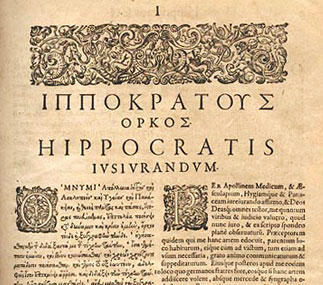
First of all, I don’t understand why a doctor is asking this question to a newspaper ethicist unless he doesn’t like what professional and medical ethicists are telling him. Klosterman, in reaching his reasonable-sounding but flat-out wrong reply, simply discards the concept of professionalism, beginning with the Hippocratic Oath…. Continue reading

Just What Every President Doesn’t Need…A Traitor

"My observations while serving in the President's trust are held in strictest confidence, and...HOW much? Sure, I'll write a book!"

“My observations while serving in the President’s trust are held in strictest confidence, and…HOW much? Damn! Sure, I’ll write a book!”

President Obama is hardly the first President to be blind-sided by a “tell-all” exposé authored by someone who had an obligation to keep his mouth shut and his keyboard quiet. The unethical practice of a President’s former advisors, cabinet members, secret security agents, servants and others who held his trust cashing in and publishing often bitter, agenda-driven books detailing juicy and uncomplimentary details of what went on behind closed doors began gaining steam during the Reagan years (something else to detest David Stockman for) and has accelerated in every administration since.

The latest sniper shot from a grassy knoll is the work of Vali Nasr, a professor and former senior State Department adviser who worked with Richard Holbrooke, previously Obama’s special envoy to Afghanistan and Pakistan. In his new book, which, of course, had to be published while Obama was still in office to have a chance of making the former advisor the money he craves, Nasr relates details of what he regards as the incompetent White House foreign policy decision-making apparatus, in which vital calls that should have been left to experts were run through Obama’s political team, whose judgment was based on polls and narrow, short-term political considerations. Continue reading