Morning Ethics Warm-Up, 9/16/17: Amazon Purges Reviews For Hillary, Equifax Must Die, Making Literature More Diverse, And The Red Sox Get Away With It…

GOOD MORNING!

1 “It would be wonderful, wouldn’t it?”

This is the response that the widow of writer Roald Dahl to a reporter’s suggestion that Charlie, the hero of Dahl’s “Charlie and the Chocolate Factory” (aka “Willy Wonka and the Chocolate Factory:) should be made black in a future “reworking” of the book. Recently Mrs. Dahl has claimed that Charlie was originally supposed to be black, but that her husband changed the character before the book was published. She blames his agent, who was, she says (none of this is more than hearsay) afraid that the book wouldn’t sell as well in American with a black hero. She blames “American sensibility.”

No, it wouldn’t be wonderful to start changing the races (and inevitably, genders and sexual orientations) in “reworkings” of literary classics. It would be unethical and irresponsible, as well as a defilement of the author’s visions and creations. Whatever the reason was, and we cannot know it regardless of what Mrs. Dahl now claims, Charlie was white in Dahl’s book. If he had wanted his book to be about a black child, or a little girl, or a Muslim transsexual, the author would have made it so. If someone obsessed with tribal identity politics wants to write a new adaptation under their own name so we can jeer and mock him or her, swell. But it isn’t any more “wonderful” to “rework” Dahl’s own story this way than it is to make Bob Cratchit black, or Captain Ahab black, or Bigger Thomas in “Native Son” Asian-American.

Of course, a stage or film adaptation of the book can cast it any way it chooses.

2 The major business ethics story this past week has been that data security breach by credit giant Equifax. An estimated 143 million Americans now face identity theft for the rest of their lives because the company wasn’t competent to be in the business it was in. It’s that simple. The ways in which Equifax blundered into allowing all this data to be hacked are legion, with more revelations almost daily. My personal favorite is that it neglected to install a patch that would have made its files more secure, delaying for months for no good reason.

Business analysts point out that despite this massive demonstration of ineptitude, the company is not likely to suffer more than the cost and inconvenience of a class action lawsuit or five. The companies that pay Equifax weren’t harmed by the breach, just the lives of the credit-seekers who they use Equifax to check. Nobody seems to think that even this massive misconduct will put Equifax out of business.

The company has dumped some executives, and will probably dump some more, reorganize, and padlock that barn door securely now that the horse has fled. TooLate. The company is untrustworthy, and more than that, companies like Equifax that gather personal information about innocent citizens need to be scared sick about what will happen to them if they can’t keep the information from falling into malign hands. Equifax needs to be put out of business. Its leaders and management need to be imprisoned, fined so severely that they are reduced to eating cat food, or blacklisted so their future employment is limited to bait shops and traveling carnivals. Continue reading

Unethical Quote Of The Month: Simon Radecki

“You probably haven’t seen the news. Can you confirm whether or not your daughter Bridget has been kidnapped?”

–Pennsylvanian Simon Radecki of Northampton County, asking Senator Pat Toomey a question at a public town hall relating to the President’s decision to suspend the DACA.

It’s seldom one sees a deliberate breach of question and answer ethics from a member of the public (journalists breach these all the time, but they also are held to higher standards).Radecki’s question to the Senator qualifies, and is about as odious as the breed gets.

To begin with, the question was framed as a lie, suggesting that there was any report to confirm. It was also vicious, an intentional infliction of emotional distress (a tort), a plausible threat, and a direct Golden Rule breach. Nobody would want to have someone falsely report that his daughter was the victim of a crime or in mortal danger, yet this is exactly what Radecki did to Toomey. To add to the question’s unethical pedigree, Radecki dragged Toomey’s innocent 16-year-old daughter ( Ivanka Trump-hate  notwithstanding, being the child of a Republican is not yet a crime)  into a political controversy, exploiting her and employing her as a tool of partisan attack.

Nice. Continue reading

How The Human Factor Foils Technology And Ethics: A Case Study (UPDATED)

Baseball finally installed a replay review system to address umpire calls that were shown by TV slow-mo to be clearly wrong. For all the complaining about the system, it was the only ethical choice. Mistaken calls were changing the results of games, and because of technology, this was now obvious to all. Only technology could solve the problem.

Unfortunately, however, human beings still control the technology. Bias, emotion and other impediments to ethics will still prevail more often than we like to think. Yesterday’s Red Sox Yankee game provided a classic example.

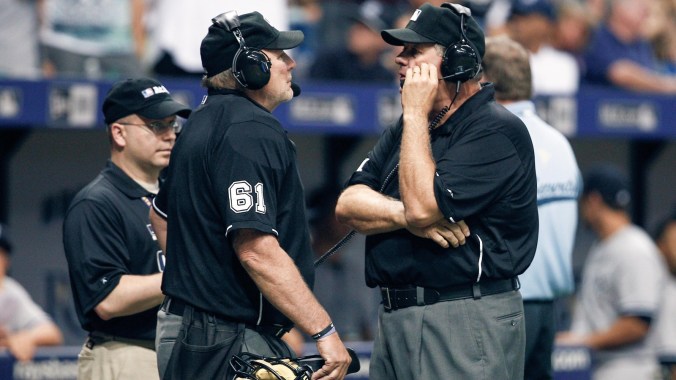
Yankees manager Joe Girardi challenged a safe call on the Sox’s Andrew Benintendi when he slid into second base for an apparent double. The video showed that the second base umpire had missed the play. Upon review—the umpires put on headsets to get the verdict from a New York studio where another set of umpires check the video from multiple angles—the call was reversed, and Benintendi was out.

In the same inning, Red Sox manager John Farrell challenged an inning-ending double play. The review showed Red Sox baserunner Mookie Betts safely reached second before the throw, allowing the Red Sox to score the game’s first run. For the second time in a single inning, Greg Gibson,  the second base umpire, had his call reversed. I have never seen this happen before. For an umpire, this is not just embarrassing, it is professionally humiliating.

Later, in the seventh inning, the same star-crossed (cross-eyed?) umpire  called Yankee Greg Bird  out as he was doubled off second base after a lineout. The video this time was more conclusive than the first challenge: the umpire blew it, again. Bird had beat the throw.

While the challenge was being reviewed, the Red Sox broadcasters, who had concluded that Bir should have been called safe at second, were talking about the rarity of the same umpire being reversed three times in a single game. Sox color man Dennis Eckersley wondered aloud if professional courtesy and loyalty might affect the review.  What he was really asking was whether the umpires in New York would allow a colleague to be exposed to the disgrace of being reversed three times in one game. This wouldn’t only  make him look bad, after all. It would make umpires look bad. Three strikes and you’re out, after all.

Sure enough, the decision from New York was that the call at second was correct. Bird was out, even though the video showed he was safe.

The umpires have plausible deniability here: this was hardly the first time that a replay review seemed at odds with a video. Nonetheless, it was a sobering display. By all appearances, the umpires distorted the game to protect one of their own who was having a terrible night. They were employing the Golden Rule in the kind of setting where the Golden Rule works against an ethical result, not for it.

Fortunately for the umpires, allowing the third blown call at second was allowed to stand had no effect on the game’s outcome, but that is just moral luck. The umpires made a very clear statement. They regard loyalty to colleagues as more important than their profession, the game, their fans, or public trust. They, or at least the umpires involved, cannot be trusted to put aside their biases and conflicts when their duties demand it. Technology may be unbiased, but the humans using it are not. Professionals are not always professional when a colleague’s fate is involved.

Humanity is the ultimate conflict.

Professor Volokh’s Ethics Dissent On The Vicious, Pazuzu-Blaming Professor’s Firing

‘Yes, I know he’s an idiot, but we should support idiots as highly paid teachers of our children, for the protection of the non-idiots…

Eugene Volokh is one of the best and most objective legal minds in the country. If he finds himself on the Supreme Court when Kennedy retires or Ginsberg shuffles off this mortal coil, we will not have suffered through the ugliness of the Trump years in vain. When he opines, I listen, as we all should, and he has now opined regarding the now fired idiot that I wrote about this morning, ex-University of Tampa visiting sociology professor Ken Storey.

Storey used Twitter, in the middle of the still-unfolding human disaster in Houston and soon New Orleans, to announce that flooding victims who were Trump supporters or Republicans deserved to die. He did this twice, so his later claim that his words did not intentionally convey what his words were obviously intended to convey was a desperate and obvious lie.

I wrote:

The university or college that fires an employee like Storey is protecting its reputation as a responsible institution, by stating in clear terms that people with terrible judgment and cruel and unethical instincts who are motivated by hate and intolerance are not qualified to teach….because they aren’t. That professors increasingly have no ethics alarms beeping when the prepare to publish sentiments like Storey’s (or worse) shows how thoroughly the leftist echo chambers of most campus faculties turn academics into Pat Robertson, which is to say, rigid, mean, and dumb. Once upon a time, liberals giggled themselves silly over the evangelical huckster’s periodic pronouncement about how a disaster was God’s way of punishing the U.S. for not abusing gays sufficiently, or similar bile, Now they do the same thing, and expect their colleagues and students to applaud.

Today, in the Washington Post, Professor Volokh advocates a different position:

Storey’s comments were nasty and mean-spirited; and I should note that the University of Tampa is a private university, in a state that doesn’t limit private employers’ ability to fire employees for their speech. The university’s actions thus seem legal (assuming they didn’t breach any contract). And Storey’s comments also weren’t academic or likely to be part of a serious political debate.

But the university’s action strikes me as further undermining the freedom of expression and debate at American universities, including the freedom to say things that are much more thoughtful. If you were an untenured faculty member at the University of Tampa, would you feel free to express your views on controversial subjects, when you saw how the university reacted to this tweet? Even if your views were very different politically, what do you think the University would do if people started pressuring for your dismissal, pointing to the Storey incident as precedent?

I’ve talked before about “censorship envy,” one mechanism through which these sorts of speech restrictions can grow: “If my neighbor — and especially my political adversary — gets to ban speech he reviles,” the thinking goes, “why shouldn’t I get to do the same?”

If a university has a strong policy of protecting speech, including offensive speech, administrators can point to that policy as a means of resisting calls for firing a controversial faculty member, and they can appeal to people’s desire to see speakers on their own side protected, and use that desire to help protect speakers on all sides. But once the university starts firing some people for speech “that do[es] not reflect [the university’s] community views or values,” that makes it much harder to resist calls for more suppression. Indeed, at that point tolerating speech starts implicitly conveying the message that the speech does reflect the university’s community views or values — and to avoid that implication, the university would have to fire any speaker who offended some sufficiently influential constituency.

I am very confident that in this rare case, Prof. Volokh is dead wrong. Continue reading

Comment Of The Day: “The Good Hoax”

Becoming the first Ethics Alarms comment to achieve a Comment Of The Day on consecutive days is Ryan Harkins. Ethics Alarms has a fair number of lawyers contributing regularly, as well as teachers, doctors, a theologian, business owners, managers, ex-military, scholars, and other professionals, plus practitioners of various trades and the arts. I have been hoping for more engineers to join the discussion, and Ryan brings that perspective along with his communications skills.

Here is Ryan Harkins’ Comment of the Day on the post, The Good Hoax:

While I was a graduate student at the University of Wyoming, one of my office mates was approached by a group who offered, for a couple of thousand dollars, to do all the research for his Master’s Degree and write up the results in a guaranteed-to-pass thesis. Supposedly my office mate tracked down some of the reviews of this group and found that some had indeed managed to attain a Master’s using services like this. As a disclaimer, I didn’t personally follow up on it, or investigate to see if people were later identified for their fraudulent activity.

A year or two later, my advisor was showing me a website that generated very scientific-sounding, but utterly meaningless journals, complete with references. The abstracts this random generator produced weren’t too far off from some of the jargon-laden examples quoted above. One of the claims to fame of this website was that it had actually managed to get a couple of these randomly-generated papers approved at conferences. I think this link to SciGen will take you to the site my advisor found.

My time in academia impressed on me that journal papers are far from the infallible entity we would like them to be. There were people in my field (theoretical computer science) that had a reputation of getting three papers out of each finding they’d made: the initial paper, the correction of the initial paper, and the correction of the correction. I was always worried that, if I ever actually made any findings worth publication, I would have missed some error in my logic that would render my results invalid, and yet people for decades hence would utilize my results in their research, leading to error cascading down for generations. Continue reading

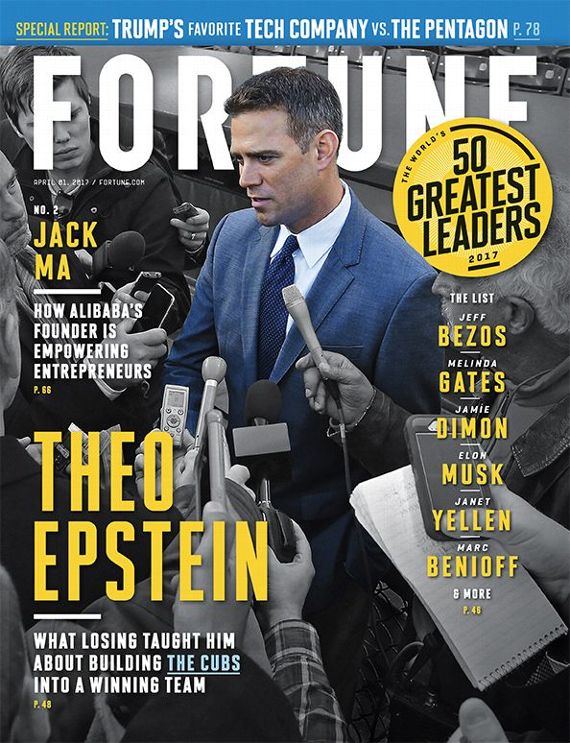
Ethics Quote Of The Month: Chicago Cubs President Theo Epstein

“That is ridiculous. The whole thing is patently ridiculous. It’s baseball–a pastime involving a lot of chance. If [Ben] Zobrist’s ball is three inches farther off the line, I’m on the hot seat for a failed five-year plan.”

—-Theo Epstein, president of the Major League Baseball’s 2016 World Champion Chicago Cubs, upon learning that Fortune Magazine had chosen him #1 among “The World’s Greatest Leaders” in a click-bait list released last week.

Thank-you, Theo, for explaining moral luck and the perils of consequentialism to the public. When it came down to the final innings of Game 7 in last year’s World Series, it looked for a while like Cubs manager Joe Maddon was about to blow the chance to win an elusive title after over a century of frustration by keeping his clearly gassed closer on the game. That his risky decision didn’t make Maddon a goat for the ages and Epstein one more name in the long list of Cubs saviors was pure moral luck—the element of chance that often distinguished heroes from villains. winners from losers and geniuses from fools in the public’s mind—and gross consequentialism, judging decisions by their uncontrollable results rather than their objectively judged wisdom and ethics at the time they were made.

If the Cleveland Indians had won that crucial game in extra-inning, no matter how, Epstein might have made Fortune’s list (I doubt it), but he would have been nowhere near the top. Continue reading

Case Study Of A Story News That Media And Web Bias Makes Impossible To Check: Susan Rice’s “Unmasking”

I am not going to write about the ethics issues in the latest Susan Rice controversy, but I am going to write about why I can’t get an objective enough assessment of what the story is to write about it competently.

Susan Rice, President Obama’s National Security Advisor,  sought to “unmask” the identities of members of President Trump’s campaign and transition team who were incidentally mentioned in foreign surveillance intelligence reports. This was first reported over the weekend by conservative conspiracy theorist Mike Cernovich, which meant that no commentators on the Left believed it, but then it was confirmed yesterday by Bloomberg’s Eli Lake.

Many conservatives treated this as confirmation of President Trump’s much-derided claim that the Obama administration “wiretapped” him. The Wall Street Journal’s editorial board issued an op-ed this morning, saying,

All this is highly unusual — and troubling. Unmasking does occur, but it is typically done by intelligence or law-enforcement officials engaged in anti-terror or espionage investigations. Ms. Rice would have had no obvious need to unmask Trump campaign officials other than political curiosity.

On Medium, Mike Doran wrote,

“In late December, the administration launched an information campaign designed to depict President-elect Trump as Moscow’s Manchurian candidate. Vladimir Putin had installed Trump in office by “hacking the election,” so the argument went; Hillary Clinton, therefore, was the rightful president.

The claim that Susan Rice was unmasking merely to arrive at the ground truth of Russian behavior would be easier to swallow if the information she gleaned from unmasking had not been used to perpetrate a fraud on the American public. The leak to Washington Post columnist David Ignatius about General Michael Flynn’s conversations with Russian ambassador Sergei Kislyak (which I discuss in this article) is the most egregious example of a senior administration official using material gathered from illicit unmasking in order to tell a very big and very pernicious lie.”

The New York Times, sadly predictable in its knee-jerk defense of Democrats rather than resolving to get at the truth,  immediately argued that there was nothing to the story at all: 

Former national security officials, who spoke on the condition of anonymity, described the requests as normal and said they were justified by the need for the president’s top security adviser to understand the context of reports sent to her by the nation’s intelligence agencies.

Mother Jones’s Kevin Drum mocked the story as pure conservative fantasy regarding a favorite villain:

But! Susan Rice is also a Republican bête noir, the villainess of Benghazi who LIED ON TV repeatedly and tried to get everyone to believe that the attacks were due to an INTERNET VIDEO when we knew all along they were really the work of RADICAL ISLAMIC TERRORISTS, a phrase that OBAMA WAS UNWILLING TO UTTER.Here’s what we can say about the Rice situation at this point.

Sarcasm is used by Drum here to hide the fact that Rice did lie about Benghazi, and was part of an Obama administration effort (that included Hillary Clinton) to blur the fact that it was a planned terrorist attack, not a spontaneous reaction to a video, which would have undermined Obama’s campaign assertions that he had “decimated” Al Qaeda. ( Mother Jones readers will not believe anything negative about Obama, Democrats, or progressives.)

The Federalist, meanwhile, called foul on CNN, which immediately moved to discredite the latest Rice story: Continue reading

Ethics Dunce: Treasury Secretary Steve Mnuchin


Treasury Secretary Steve Mnuchin has pledged “not participate personally and substantially in any matter that has a direct and predictable effect on the financial interests” of his financial holdings, without obtaining an official waiver for doing so. He also had advance notice of how a Trump administration figure could breach ethics rules when Kellyanne Conway, in the course of criticizing organized boycotts of First Daughter Ivanka Trump’s merchandise line, blurted out  “Go buy Ivanka’s stuff!” during an interview on “Fox & Friends.”  The Office of Government Ethics and members of   the House Oversight Committee urged disciplinary action for Conway’s clear, if probably inadvertent, ethics violation. (None occurred. It should have.)

Never mind. During a C-Span broadcast interview last week, Secretary Mnuchin was asked for a movie recommendation (this was a set-up, but an easy one to duck), and said,

“I’m not allowed to promote anything that I’m involved in. So I just want to have the legal disclosure, you’ve asked me the question, and I am not promoting any product. But you should send all your kids to ‘Lego Batman.’ “

HAHAHAHAHA!!! ‘I’m not supposed to do this because it’s unethical, but I’ll do it anyway, because ethics rules are silly, the President doesn’t care about them, and besides, Kellyanne got away with it, and so will I!’ Continue reading

Ethics Quote Of The Day: Charlotte Hogg, Ex-Bank of England COO

“However, I recognise that being sorry is not enough. We, as public servants, should not merely meet but exceed the standards we expect of others. Failure to do so risks undermining the public’s trust in us, something we cannot let happen. Furthermore, my integrity has, I believe, never been questioned throughout my career. I cannot allow that to change now. I am therefore resigning from my position. I will, of course, work with you through any transition.”

—-The Bank of England’s chief operating officer and incoming Deputy Governor for Markets and Banking, Charlotte Hogg, in her letter of resignation over criticism regarding a possible conflict of interest and her failure to report it.

Charlotte Hogg, a senior Bank of England official who had been named a deputy governor, resigned this week after a Parliament committee found that she had failed to disclose a potential conflict of interest: her brother held a senior position at Barclay’s during her time at the central bank. Hogg insisted that she never breached her duties or passed along any confidential information to her brother, but she had helped draft an industry ethics code of conduct policy required a disclosure of such conflicts. This creates doubts about her integrity, judgment competence, as well as the appearance of impropriety.

The Parliamentary committee recently issued a report finding that Ms. Hogg’s professional competence “short of the very high standards” required to be deputy governor, adding that her failure to disclose her brother’s role was a “serious error of judgment.”

This is one of my favorite kinds of conflicts, because it may be only appearances at stake. What if, as is often the case (sadly), Hogg and her brother are estranged? What if she doesn’t speak to him? What if they hate each other? Never mind: the public, not knowing this,  will suspect that she might use her position to favor him or his bank, so disclosure is crucial to maintaining public trust. Not disclosing, in contrast, raises suspicions. Why didn’t she let everyone know about her brother? What was she hiding? Continue reading

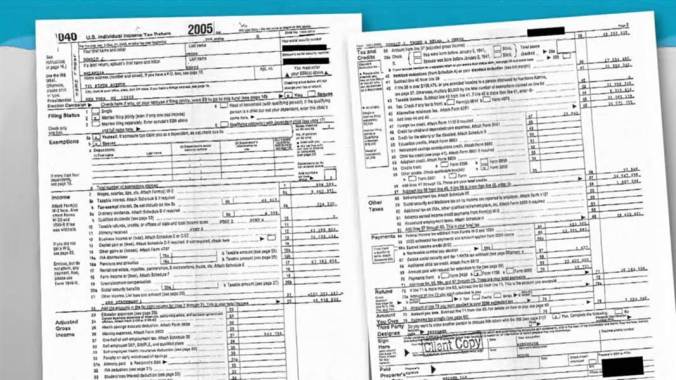
Ethics Observation On The Trump 2005 Tax Return

Yesterday, MSNBC host Rachel Maddow endlessly hyped the fact that  veteran investigative reporter David Cay Johnston had obtained President Trump’s 2005 federal tax return. When it was revealed, the scoop didn’t justify the hype. Trump  paid 38 million in taxes that year,  24% of his income—not the top rate, but not “nothing,” which was the rumor Democrats were selling during the campaign.

Ethics points:

1. Whoever leaked the return broke the law, and doing so was unethical.  No, it’s not illegal for the news media to take material stolen by others and sanctify it via their First Amendment protections.  It should be though. When they do this, they aide and abet a crime, and Freedom of the Press wasn’t supposed to allow THAT. At very least, journalists should be required to reveal the names of the criminals who steal and release our proprietary documents. The publication of these makes such thefts worse, not better.

2. I don’t see why the President’s tax returns from 12 years ago has any genuine relevance to anything now. The returns were relevant to the decision of whether or not people wanted to vote for him. Now, the tax documents have no purpose, except for the insatiable Trump-bashers to have something new to bash him with. Anything will do.

3. David Cay Johnston was dishing about his “scoop” with GMA’s George Stephanopoulos, and decided to start a new rumor. He speculated that Trump leaked the return himself.  No evidence, not a drop, and yet that’s what this veteran reporter felt was justifiable to say on national TV. Gee, can we call THAT fake news?

4. Then, as he did with Maddow, the reporter went on about all the conflicts of interest that Trump’s financial dealings have created. Again, this is re-litigating the election. At this point, there is no practical way to eliminate Trump’s conflicts and the appearance of impropriety that they create, and he’s not going to bother trying. Johnston, and others, including me, never made a clear case to the public why the President’s unprecedented financial entanglements should have been disqualifying; nor did Hillary, in part because her own financial entanglements were disqualifying. Well, the train left the station, y’all. You had your chance, and botched it. Johnston, like so many of the other bitter-enders who want to turn back time, ultimately get back to, “But…but…but…we never should have elected this guy! Surely there is something we can do to undo it!”

No, there isn’t. Cut it out. Continue reading