Now THIS Is Unprofessional Conduct: The Lesson of the Jilted Dentist

No! It's NOT safe! It's not safe at ALL!

The hallmark of professionals is trust. We should be able to trust professionals to do their duty on our behalf despite their personal feelings. Lawyers often dislike or even fear their clients, for example: a defendant charged with murder who has stabbed his previous three attorneys with pencils is now back in court with a fourth, though certain precautions have been taken. When a professional finds that his or her personal feelings are so intense that they jeopardize the professional’s ability to fulfill their duties objectively, fairly and well, then that’s a conflict of interest, and it must be dealt with, usually by stepping aside.

A professional who doesn’t step aside despite an evident conflict has determined that he or she has the detachment and self-control to overcome it. A recent news story from Poland, however, suggests that it is not a good idea to risk too much trust on a professional’s determination that she can remain objective. Continue reading
Comment of the Day: “Ethics Chess Lesson: The Tale of the Kidney and the Ungrateful Boss”

New commenter Christine has a valuable personal experience to relate, as an individual who donated a kidney to a stranger herself.  The main thrust of her post covers a topic that I have written on before but did not mention in this case, though I should have. Someone who performs a kind and generous act counting on rewards, copious thanks and gratitude, is  doing it for the wrong reasons. The act itself is all that matters. Certainly, gratitude is the right way to respond to generosity, but an act done in anticipation of personal benefits isn’t really altruistic. It is opportunistic. This is a cliché to be sure, but true nonetheless: the generous act must be its own reward.

Here is Christine’s Comment of the Day on the post, Ethics Chess Lesson: The Tale of the Kidney and the Ungrateful Boss.

I want to also commend Christine for following the comment policies, which many of the new visitors here who commented on this post did not do. I prefer full named on posts, but I only require that I am informed of  every commenter’s real name and have a valid e-mail address within a reasonable time of their first submitted comment. One way or the other virtually all of the regular commenters here have managed to do this, and it makes a difference, even in my responses. I regard such commenters as collaborators , not just marauders, and most of the time, I treat them accordingly:  tgt, Steven, Lianne, Margy, Glenn, Tim, both Michaels, Karl, Neil, Karla, Rick, blameblakeart, Barry, gregory, Eric, Curmudgeon, Eeyore, Julian, King Kool, Joshua, Jay, Tom, Bill, Danielle, Elizabeth, Patrice, Ed, Bob, The Ethics Sage and Jeff…I know there are others.   Thanks to all of you for letting me know who you are.

Now, Christine: Continue reading

Ethics Chess Lesson: The Tale of the Kidney and the Ungrateful Boss

Ethics chess is complicated, but ignore it at your peril!

Ethics chess is the process by which one considers the likely chain of events that follow from an act, and tries to predict the ethical dilemmas that may result before they occur. Debbie Stevens and Jackie Brucia didn’t play ethics chess. This is what happened to them.

When  Stevens was exploring the possibility of returning to the Atlantic Automotive Group, where she had worked previously, she met with Brucia, her former and potential boss, and somehow got on the topic of Brucia’s health problems. She needed a kidney transplant, and had found a donor, though it was not yet certain that the kidney would be hers. Stevens said that she might be willing to contribute her own kidney if that donor didn’t work out.

Later, Stevens was hired by Brucia,and two months later, in January of 2011,  Brucia called Stevens into her office and told her that she had lost her organ donor. “Were you serious when you said you would be willing to give me one of yours?’ Brucia asked.  “Sure, yeah,” Stevens says now. “She was my boss, I respected her. It’s just who I am. I didn’t want her to die.’’ It wasn’t exactly a direct donation, but Stevens donated her kidney to a stranger who matched up well with it so Brucia could be advanced on the list and get a better matched kidney from another source. Nonetheless, Brucia got a healthy kidney because Steven’s gave up one of her own. Continue reading

Unethical Website of the Month: The Ethical Psychic Project

Here’s all you need to know about “The Ethical Psychic Project” and the website that supposedly advances it. One of the ethical topics covered in the ethical forum section is “Animal Communication”:

“Our animal friends need help, too! Ask one of our Psychic Animal Communicators to connect with your pet, either on the Earthly plane or crossed over!”

Sounds ethical to me! I was surprised not to see other topics of similar ethical weight and credibility,  like “Want to win in at the slot machines?” and “Ever wonder what Joe Biden will say next?”

There appears to be nothing whatsoever ethical about the The Ethical Psychic Project, except that a bunch of people who decided they couldn’t make enough money selling phony deeds to imaginary uranium mines thought that the word “ethical” might suck in some marks. Oh, there’s an ethics code on the site, all right. This psychics code is considerably worse than the last one I wrote about, and that won no prizes. This one is funnier, though, because with a little tweaking, it could just as well serve an ethics code for Superman or Green Lantern, or the Good Witch of the North. It contains such self-validating blather as: Continue reading

“Blue Bloods” Ethics: The Good Lie?

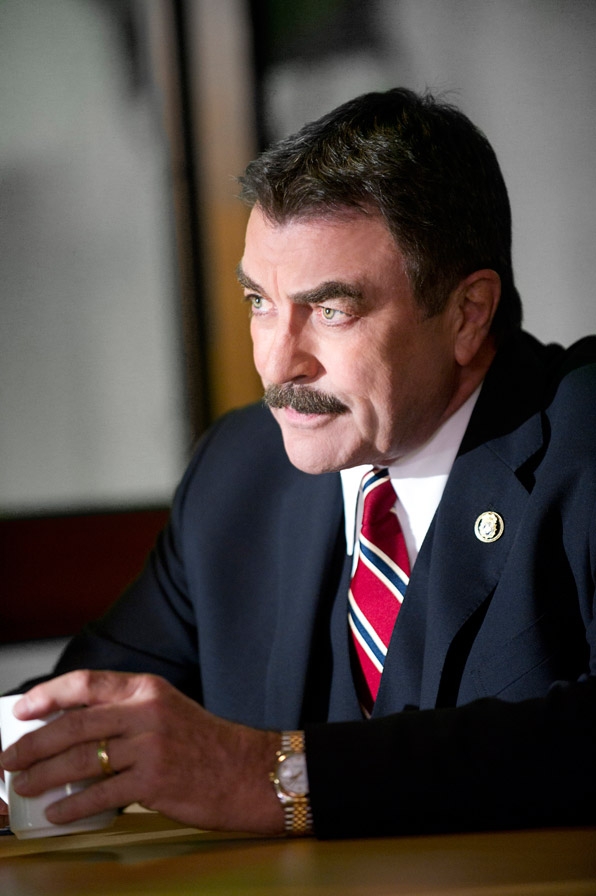
Tom Selleck as NYC Chief of Police Frank Reagan

Tom Selleck’s CBS drama “Blue Bloods,” chronicling the exploits of  the Reagans, an improbable fictional New York City family that dominates NYC’s law enforcement, featured an excellent example of a necessary lie last night, in which utilitarian principles would hold that the lie,  a rather serious and extensive one—many interlocking lies, really—was the most ethical option available.

The situation arose because the Chief of Police (Frank Reagan, played by Selleck) learned that his police officer son, Jamie Reagan, had rescued a child from an explosion, and the press and city were clamoring to know who the hero was. (Nobody saw the rescue, which is a contrived detail, but necessary to set up the ethical dilemma.) But Jamie was also working undercover in a serious and dangerous operation, having infiltrated an organized crime family. (Why was a uniformed cop allowed to stay on the street while leading a double life? Seems reckless to me, but Father Chief knows best.) To protect the undercover operation and his son, Frank Reagan decides on an elaborate deception, persuading his son’s partner, who was on the scene of the rescue, to take the credit and even accept a commendation in a public ceremony.

Lying to the public and the press to such an extent is almost always inexcusable, but protecting an anti-crime effort in the public interest, as well as the imperiled officer involved in it,  is a rare case in which the balance tips away from the truth. The “Blue Bloods” solution was the best one available given the situation and the law enforcement priorities.  But… Continue reading

Economists Start Getting Serious About Ethics

Charles Fergusen’s documentary about the 2008 financial collapse, “Inside Job”, chronicled the maze of deceit, conflicts of interest, greed, recklessness and self-serving maneuvers across multiple professions and sectors of the economy that led to the meltdown. Among the professions that were implicated in the account was that of economists, who in many cases advised Congress and others regarding economic policies without disclosing their own ties to special interests and various players in the drama. The debacle was a severe blow to the credibility of economists as a group and economics as a discipline. Many have since called for the profession to put in place conflicts of interest rules to guide practitioners and to build public trust.

For my part, I was surprised to learn that there was not such a code already in place. As a lawyer, I am  spoiled—the legal profession, as with judges, doctors, researchers, psychiatrists, accountants, legislators and government workers, has recognized the need for formal ethics guidelines for a very long time. The number of fields without ethics codes continues to amaze me, although one of those professions is…ethics.

Economics, however, is making strides. At its annual meeting in Chicago last week, the American Economic Association  issued  principles for disclosure of potential conflicts of interest and conflicts related to published academic papers. Here they are: Continue reading

The Third Annual Ethics Alarms Awards: The Worst of Ethics 2011 (Part 1)

Yes, it was Joe Paterno's year, all right.

Welcome to the Third  Annual Ethics Alarms Awards, recognizing the Best and Worst of ethics in 2011!

This is the first installment of the Worst; Part 2 is here. And the Best is here. 

2011 prompted more than 1000 posts, and even then I barely scratched the surface of all the ethical dilemmas and unethical conduct swirling around us. If you have other choices for the various distinctions here and in the subsequent Awards posts, please make them known.

Here are my selections:

Unethical Community of the Year:  Huachuca City, Arizona. Leading the way among American communities that believe, in their hysteria, that former sex offenders who have served their sentences are nonetheless fair game for persecution and the denial of basic rights as citizens and human beings, Huachuca County passed an ordinance that bans registered sex offenders from the use of all public facilities, including parks, school and libraries.  Runner-up: Obion County, Tennessee. Last year, Ethics Alarms gave the county runner-up status as “Unethical Community of the Year” for sending its volunteer fire department to watch a man’s house burn down because he had failed to pay a $75.00 fee. In 2011, it did it again. I swear: if Obion County hasn’t come up with a better system and this happens again in 2012, Obion County will get the title no matter what some other unethical community does.

Most Warped Ethical Values: The Penn State students who protested the firing of football coach Joe Paterno, because, you know, he was such a great football coach that a little thing like allowing a predatory child molester to run amuck on campus shouldn’t be blown all out of proportion. Runner-up: Ron Paul supporters.

Unethical Website of the Year: Lovely-Faces, the anti-Facebook stunt pulled by Paolo Cirio, a media artist, and Alessandro Ludovico, media critic and editor-in- chief of Neural magazine, to show how inadequate Facebook’s privacy controls were. To do it, they stole 250,000 Facebook member profiles and organized them into a new dating site—without the members’ permission. The site embodied “the worst of ethical thinking: taking the identities of others for their own purposes (a Golden Rule breach), using other human beings to advance their own agenda (a Kantian no-no) and asserting that their ends justify abusing 250,000 Facebook users, which is irresponsible utilitarianism.” Continue reading

Thank you, Donald Trump

I can't bear to post another picture of Donald Trump, so I'm using this cute Jack Russell puppy's photo instead. I would also vote for the puppy for President before I would vote for Donald Trump.

I had been having misgivings about annointing Donald Trump the Ethics Alarms Jerk of the Year last spring, since so many strong contenders emerged as the year went on—Rev. Terry Jones, Alec Baldwin, Newt, Leroy Fick, of course, and others. Trump, however, took matters in hand, and locked up his award with a flourish by announcing yesterday that he had forsaken the Republican Party and was seriously considering a third party run  for the presidency. For reaffirming my original assessment, thank-you, Donald Trump.  For everything else, curses are more appropriate.

The man is totally without shame. Two weeks ago, he was fully prepared to be the moderator of a GOP candidates debate…a blatant and outrageous conflict of interest for anyone who had the faintest glimmer of a presidential bid still in what passes for his mind. When all but the equally shameless Newt Gingrich and the desperate Rick Santorum declined to be Trump’s props, he withdrew as moderator, and now this. Is he running for President out of spite? I suppose that would be more admirable than his earlier fake pass at a run, which was evidently designed to pump up ratings for his reality show. This public buffoon is willing to distort the democratic process and throw a monkey wrench into an extraordinarily important national election on a whim, a lark, or a hissy fit. Continue reading

Love Your Lawyer? Bad Idea. Love Your Client? Even Worse.

This is all your fault, Arnie!

A Connecticut lawyer under fire for commencing a lawyer-client relationship with a woman with whom he was romantically involved made the novel argument that it is good to be in love with your client.  This indicates a profound misunderstanding of human nature and the nature of a lawyer’s duties.

Almost ten years ago, the American Bar Association recommended that state bars include a direct prohibition against lawyers having sexual relations with their clients, and the majority of the states did so. As I have mentioned before, it’s a dumb rule, too broad and too narrow simultaneously, a classic example of how some kinds of unethical conduct do not lend themselves to precise rule-making.  The main problem with the no-sex rules is that they are unnecessary. The legal ethics rules are replete with exhortations to maintain objectivity, independent judgment and to avoid conflicts of interest. Common sense suggests that it is irresponsible to confuse one relationship by adding another; professional standards dictate that combining a professional relationship of independence and with romantic relationships is wrong.  As the D.C. Bar’s Rules of Professional Conduct point out in its comments to Rule 1.7, Conflicts of Interest: Continue reading

George Will Is Conflicted, and Telling Us That He Is Doesn’t Cure It

Is George Will's wife making him pull his punches?

Conservative columnist George Will has a conflict of interest problem not of his making. A regular, and superior, commentator on politics and current affairs in op-ed pages and on television, Will’s objectivity and independent judgment is apparently compromised by the fact that his wife is an advisor to the presidential campaign of Texas governor Rick Perry

Initially, Will took the position that his wife’s business and his were independent, and that his integrity should be presumed based on his long and distinguished record as a columnist. But the Washington Post ombudsman, among others, declared that Will’s readers needed to be able to make their own judgment about his objectivity, and lately Will has been issuing formal disclaimers whenever he wades into Republican presidential politics. Most recently he did this while slamming New Gingrich—accurately and with precision—for taking a cheap shot at Mitt Romney regarding Romney’s work at Bain Capital.  Will wrote: Continue reading