In Connecticut, A Surrogate Mother Triggers An Epic Ethics Train Wreck

Crystal Kelley and...somebody's baby

Crystal Kelley and…somebody’s baby

There is no field of ethics more murky or subject to conflicting interpretations than bioethics, and few issues in bioethics are as confusing as those involving surrogate mothers who decide that they should have some say regarding the fate of the child that grows in their bodies. CNN has reported on the most perplexing such scenario I’ve every encountered, so perplexing that I can’t unravel the ethical rights and wrongs of it.  I wonder if anyone can with confidence. I’ll just summarize the main features and some of the issues raised; you will need to read the whole, stunning story to fully appreciate this train wreck’s sweep and carnage.

I. Crystal Kelley, a single mother who had endured two miscarriages, wanted to help another couple conceive, but mostly wanted the $22,000 fee since she was out of a job. She contracted with a couple seeking their fourth child, and was implanted with two previously frozen embryos. One survived. Ethics issue: Did Kelley tell the parents about her miscarriages?

2. Five months into her pregnancy, tests showed the baby Kelley was carrying had serious medical problems, though the child had a chance at survival. The couple said that they wanted Kelley’s pregnancy terminated because they didn’t want the baby to suffer. Ethics issues: Is that a valid reason to take an unborn child’s life? Was it the real reason? Was the real reason that they were unwilling to pay for and endure all the necessary medical treatmenst, or that they wanted nothing less than a “perfect” baby? Does it matter what the real reason was? Continue reading

Artistic License, History, and Lincoln’s Green Socks

Of course, some historical fabrications are harmless.

Of course, some historical fabrications are harmless.

Several well-placed critics are taking “Lincoln” screenwriter Tony Kushner to task for what they believe are unethical misrepresentations of fact in the much-praised, and supposedly scrupulously accurate film. He, on the other hand, is annoyed. Kushner counters that unlike in history books where a historian gives a well-researched “a blow-by-blow account,” it is reasonable and ethical for a screenwriter to “manipulate a small detail in the service of a greater historical truth. History doesn’t always organize itself according to the rules of drama. It’s ridiculous. It’s like saying that Lincoln didn’t have green socks, he had blue socks.”

I’m going to spare Kushner lawyerly word-parsing and not hold him to “a greater historical truth,” though I suspect that in his hands (he is a skilled political propagandist as well as writer), we would not be pleased with what that license would bring. A politically sympatico film director named Oliver Stone, for example, thought it served a greater historical truth to present completely fictional evidence that Lyndon Johnson was complicit in John F. Kennedy’s assassination, even though Stone’s vehicle, “JFK,” was marketed as a veritable documentary on the “truth” of the Kennedy assassination. Let’s just say that Kushner feels that in a work of entertainment and drama, strictly accurate representation of all historical facts is impossible and unreasonable to expect or require.

I agree. But there is a big, big difference between the ethics of showing Lincoln wearing the wrong color socks, and representing a highly dubious story as fact to denigrate the reputation of a probable hero, as James Cameron did in “Titanic” when he showed First Officer William Murdoch taking a bribe to let a passenger on a lifeboat ( fantasy), shooting a passenger (pure speculation), and committing suicide (denied by a fellow officer under oath at the inquest). Continue reading

No, Mark Mattioli is Not An Ethics Hero

Dexter, for example, is a very civil serial killer.

Dexter, for example, is a very civil serial killer.

I’ve been getting emails from people nominating Mark Mattioli as an Ethics Hero for his comments before a subcommittee of the Connecticut Legislature considering gun control measures following the Newtown, Connecticut school attack. It’s easy to see why they think that is appropriate, since his emotional remarks—he lost his son in the tragedy—sounded ethical themes throughout.  Insisting that more laws were not the solution, Mattioli decried violence on television, and poor parenting. “We need civility across our nation,” he said, and for “common decency to prevail.” He called for accountability, and personal responsibility.  All nice sentiments; he got a standing ovation from the legislators.

Ethics, however, is not some kind of magic wand that fixes all problems, and how Mattioli thinks it will eliminate crazy teens with semi-automatic weapons is beyond me. We heard the “incivility kills” argument once before, you will recall, when the Left and the media went on a “blame Rush Limbaugh and Sarah Palin for Jared Loughner”  rampage of their own.  Mattioli’s lament had all the practical relevance to addressing gun violence as Rodney King’s “Can’t we all get along?” and John Lennon’s “Give peace a chance”…which is to say, none. Continue reading

Ethics Dunces: The Videogame Burners of Southington, Conn.

book burning

On January 12, they are burning “violent videogames” in Southington, a Connecticut town not far from Newtown, scene of the Sandy Hook massacre.

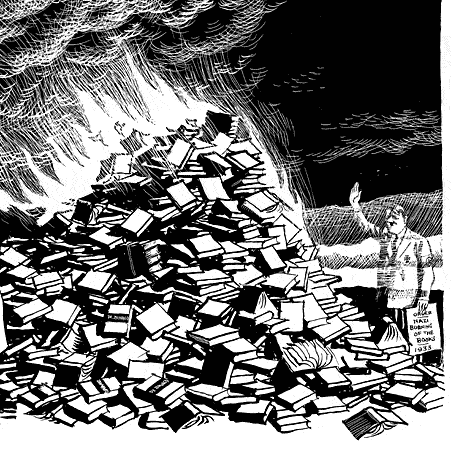
Is there a more irresponsible, historically ignorant, un-American, First Amendment-offending, foolish, ignorant and ugly act than burning speech and art because you object to their content? They burned rock and roll records  in the Bible Belt during the 1950s—that was stupid, disgusting and frightening. Hitler, you may recall, burned books; the USSR too. In 2013, consigning electronic media like videogames to the flames is indistinguishable from burning books. I would expect American citizens of normal intelligence to immediately realize that.

I guess I would be wrong.

The local group organizing the bonfire has put out some rationalization for it. I could not care less what sad reasoning and warped values motivate their book-burning. It is a symbolic insult to freedom of thought.

No question: book burnings are legal and protected speech. It is also conduct redolant of mob rule, ignorance, intolerance, fear, hate, and Ray Bradbury novels. Some activities have earned permanent revulsion, legal or not, in American culture because they are the traditional tools not of democracies, but of totalitarian governments,  the enemies of democracy and free thought. Book burning is one of them.

And burning videogames is exactly the same thing.

Update: The news accounts eventually make it clear that the group will collect the various forms of violent entertainment in a dumpster, which will also include movies and recordings, and that the actual incineration will be performed by city workers, as part of their rubbish disposal duties. Is this better? Worse, because now the town government is participating? I don’t think it is useful or enlightening to play parsing games. I see this event as indistinguishable from a book-burning, and while The Guardian’s description of it as such could be called misleading (or inflammatory?), I salute them for correctly diagnosing what this is in its essence.

Unethical Quote of the Month: The Washington Post

“When will America choose to protect children instead of guns?”

—- The headline writer for the Washington Post, introducing columnist Petula Dvorak’s column this morning on the Newtown, Connecticut elementary school shooting, which took the lives of 26, including 20 children.

Newtown shooting

Presumably the Post’s headline writer was inspired to come up with that headline by the similar statement from Marian Wright Edelman, president of the Children’s Defense Fund, who was quoted in Dvorak’s essay. Edelman said,

“This latest terrible tragedy at Sandy Hook Elementary School is no fluke. It is a result of the senseless, immoral neglect of all of us as a nation to fail to protect children instead of guns and to speak out against the pervasive culture of violence. It is up to us to stop these preventable tragedies.”

This is not quite as irresponsible and dangerous as the Post’s headline, but it is close. The suggestion that greater safety and security compels and justifies abandoning the core rights that make the United States unique and free is the ticket to tyranny, benevolent or otherwise. Continue reading

“Baghdad Bob” Dionne’s Orwellian Flackery

Baghdad Bob

There was a time long ago when columnist E.J. Dionne Jr. was legitimately regarded as the liberal twin of uber-consvervative Charles Krauthammer, a persuasive, analytical, fair, ideologically consistent political commentator. Somewhere along the line Dionne decided to recast his role as a full-time flack for the Democratic Party. His cheerleading became shrill and increasingly dishonest, often to the point of ridiculousness: James Taranto of the Wall Street Journal now regularly refers to Dionne as “Baghdad Bob,” after Saddam Hussein’s ridiculous Information Minister during the Iraq invasion, who issued straight-faced  on-air declarations that the Americans were being thrashed even as world viewers could see convincing contrary evidence in news reports, and Iraqi citizens could see the truth out their windows.

I now ignore Dionne, because he has no credibility at all. His readers must consist almost entirely of close-minded partisans on the left seeking comfort food, close-minded partisans of the right seeking an injection of adrenaline, and unsuspecting, trusting readers who don’t realizethat they are being misled. Having just finished posting here about Connecticut lawmakers passing a ban on the death penalty that is as cowardly as it is incoherent, my early morning head nearly exploded to see the headline on Dionnes’ column this morning about the same law. The headline?

“Connecticut’s Courage” Continue reading

Ethics Dunces: Connecticut Lawmakers

Hayes and Komisarjevky, the Cheshire, Conn. killers

Good thinking, Connecticut!

  • With home invaders/multiple murderers/ rapists/sadists Stephen Hayes and Joshua Komisarjevsky duly convicted and sentenced to death by lethal injection, the state legislature passed, and the Governor signed, a law making Connecticut the latest state to ban the death penalty.
  • Since a majority of the public, the legislators and virtually everyone aware of the horrendous facts of the infamous home invasion murders that Hayes and Komisarjevsky unquestionably committed think these two creatures deserve to die, the legislators made the law prospective only, meaning that it only would apply to those convicted of future crimes.
  • Despite the legislative intent, the obvious Equal Protection challenge to a law that treats two sets of citizens—current convicted murderers and future ones—differently may save the lives of Hayes and  Komisarjevsky,  the other 9 residents of the state’s death row, and such likely future residents as Richard S. Roszkowski, convicted of murder for gunning down a man, woman and 9-year-old girl on Sept. 7, 2006, but still facing a second death penalty phase trial, after his first one was overturned on a technicality.

It would have shown integrity for Connecticut lawmakers to have the courage of its supposed convictions, and to abolish the death penalty while having in its custody as perfect candidates for capital punishment as have ever been captured, Stephen Hayes and Joshua Komisarjevsky. In case you have forgotten the details of their June 23, 2007 invasion of the Cheshire, Conn. home of the Petit family, or were lucky enough to miss that horror story until now, here are is a mercifully brief summary. Continue reading

“King Lear” in Connecticutt

"Happy 98th birthday, Mom! Now get the hell out of my house."

Perhaps it is not fair to compare 71-year-old Peter Kantorowski to King Lear’s heartless  daughters Regan and Gonoril. After all, Peter says that his 98-year-old mom, Mary, is welcome to stay with him and his wife at their home, but she refuses. Still, Kanterowski, like the Lear girls, is trying to evict an aged parent from her residence after she had signed the property over to him. And even Regan and Goneril didn’t serve their father the King with an eviction notice on his birthday…but that’s what Peter’s gift was to his mother last December.

According to Probate Court records, in 1996 Mary Kantorowski and her husband, John transferred their small, yellow Cape Cod-style house to a trust administered by eldest son Peter on the condition that Mary could live there until her death, and that upon her death the house would go to Peter and his younger brother, Jack. In July of 2005, Peter quitclaimed the house from that trust to another he and his wife set up, giving him ownership, he says, without the prior conditions. A retired taxidermist, Kantorowski swears he is trying to evict his mother from the home she has lived in since 1953 for her own good. “She would be better off living with people her own age,” he told the Connecticut Post.

Well at least he doesn’t want to stuff her. Continue reading

The Great Norwalk Kindergarten Heist

The Tanya McDonald controversy

A homeless woman is facing 20 years in prison if she is convicted of stealing over $15,000 of Norwalk, Conn. taxpayer funds. The details of her crime are controversial: she lied about her residence to get her child into what she believed was a better school system, but one that, as non-resident, she was not entitled to use. The details also create a tangled mess of law, justice, ethics, fairness, compassion, public policy, finances, class and education.

Let’s try to unravel it, shall we? Continue reading

The Kardashian Kard Saga: Proof That We Are Doomed?

In “Terminator II,” there is  a scene in which young John Connor–desperately trying, along with his mother and the android killing machine sent from the future to protect the boy, to prevent the apocalyptic future that waits for him—sees young children gleefully pretending to murder each other with toy guns.  “We’re not going to make it, are we?” he asks the Terminator. “People, I mean.” The fact that a bank has chosen the Trashy Kardashian Sisters to promote a credit card aimed at teenagers prompts approximately the same sense of futility. At a time of crisis in which our culture that desperately needs to encourage responsible fiscal conduct led by financial institutions we can trust, this is what we get.

We’re doomed. Continue reading