Ethics Alarms Generally Ignores Michael Moore But a Quote This Unethical and Cretinous Warrants an Exception…

“Who’s really being removed by ICE tonight? The child who would’ve discovered the cure for cancer in 2046? The 9th grade nerd who would’ve stopped that asteroid that’s gonna hit us in 2032? Do we care?”

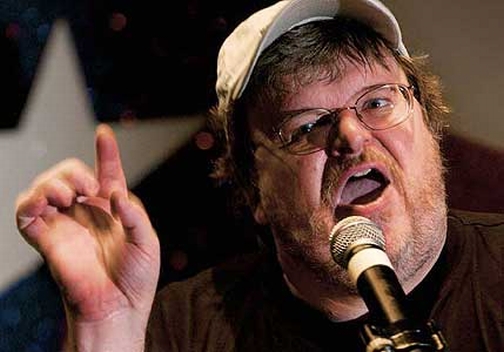
Yes, activist communist and has-been documentary-maker Michael Moore really and truly made that head-explodingly stupid argument, my candidate for the most ridiculous rationalization for allowing illegal immigrants into the U.S. yet, even topping the “But that poem on the Statue of Liberty!” excuse.

It is so stupid that the theory would be a valuable diagnostic tool on IQ tests. If someone checks the “Sounds good to me!” box, that test-taker’s cognitive ability should automatically be judged as “dangerously impaired.”

As we have explained here many times, consequentialism is the ethical theory for dolts, the concept that a decision or action is right or wrong depending on what happens as a result of it. Moore is saying that an action is unethical or wrong if anything good might have happen if a different choice had be made. I hesitate to give this walking, talking ethics corrupter credit, but he just has to be smarter than to believe that. As usual, Moore is trying to con the dimmer members of the public, a large contingent among Americans who still pay attention to him.

One wag on social media responded to Moore’s insulting question with “Now do abortion.”

Bingo.

Paging Moral Luck! Paging Moral Luck!

Judge S. Kato Crews, a progressive appointee by President Biden to the U.S. District Court in Colorado, refused to allow an injunction against the San Jose State women’s volleyball team from including a biologically male “transwoman” (above) to compete with the team in a women’s volleyball conference tournament this week. He ruled that appellate and Supreme Court precedents clearly establish that the protections of Title IX and the 14th Amendment apply to transgender individuals.

A key factor in the decision seems to be that the plaintiffs, which are the other colleges in San Jose State’s conference, a current co-captain of the San Jose team, other former players and the recently-suspended assistant coach, should have filed the suit earlier. The conference’s transgender participation policy has been in effect since 2022 and four conference opponents and one non-conference opponent forfeited games against San Jose State beginning in September.

“The rush to litigate these complex issues now over a mandatory injunction,” Crews ruled, “places too a heavy burden on the defendants”—the Mountain West Conference and its commissioner, two administrators at San Jose State, the school’s head volleyball coach and the board of trustees of the California State University System. That’s a reasonable judicial call under most circumstances, but the judge and the entire pro-trans movement in the U.S. is now at the mercy of moral luck. That is the annoying life reality that random occurrences out of the control of decision-makers have a way of retroactively defining a decision as either prudent and wise or reckless and wrong. Crews’ decision neatly tees up the perfect conditions for moral luck to settle the trans athletes in women’s sports controversy

Continue reading

A Nelson For the “Get Trump!” Mob and a Lesson in Consequentialism

I was teaching another legal ethics course today and had occasion to muse about what a foolish ethical system consequentialism is, as I have periodically discussed on EA. The short version is that deciding whether an action was right or wrong, ethical or unethical depending on what the eventual results flowing from it are is both foolish and illogical: an action can only be judged based on what is known at the time the action is taken. What occurs as a result of the action is vulnerable to chaos: once those metaphorical billions of billiard balls start rolling around on the theoretical infinite pool table, anything can happen and frequently does. People habitually say that a decision was “a mistake” or “wrong” when it was neither, just because the results of the decision were the opposite of what was intended.

Think of “The Simpsons'” master of mockery Nelson Muntz above as the spokesperson of the cosmos, and as Donald Trump as his unwitting agent. The previous, pre-Musk proprietors of Twitter, full allies that they were in the coordinated (and unethical) effort by the Axis of Unethical Conduct to bring Donald Trump to ruin for all time, kicked him off the ubiquitous social media platform for insisting that the 2020 election had been stolen, a plausible but unprovable thesis. (I quit Twitter in protest, as the move was totalitarian, reflecting the totalitarian drift of the entire political left—which has continued.) The Trump Haters and Trump Deranged cheered. Trump, given no outlet for his annoying but often effective outbursts, juvenile jibes, rants and trolling orgies, responded by setting up his own pseudo-Twitter platform, Truth Social. It was and is cheesy, but it did its main job, which was to provide the ex-President with a web platform from which he could not be censored or silenced.

Continue reading

Eventually, We May Have To Call It “The Great Stupid Day”

It’s Columbus Day, and The New York Times’ way of celebrating it is to publish an op-ed  by a Hispanic anti-Columbus freelance audio journalist who complains about there being a gigantic statue to the explorer in Puerto Rico. After all, she reasons, the island is in “the part of the world that suffered Columbus’s brutality firsthand.”

Columbus’s “brutality,” of course, is not what’s being celebrated or honored by Columbus Day.   In 2019, before the Dawn of The Great Stupid, I re-posted both essays I have authored on Ethics Alarms about Columbus, the first, from 2011, explaining why it was an ethical holiday; the second, from two years later, taking the ethical position that Columbus is a problematical figure to honor. The comments the dual post inspired were diverse and excellent, and none of them endorsed contrarian post #2. 

2019 seems decades away now, with the annus horribilis of 2020 yawning between then and now like, well, the Atlantic Ocean. One bit of the Times op-ed perfectly crystalized why I cannot embrace the anti-Columbus Day movement—-even Massachusetts is considering making it “Indigenous Peoples Day,” meaning the Mayflower is next on the airbrushing list—and it was a CBS story linked to it about all the other Columbus statues that have been toppled lately (while the one on Puerto Rico, where Columbus is mentioned in the national anthem, still stands) “explains”:

After George Floyd, a 46-year-old Black man, was killed in police custody in Minneapolis on May 25, protests flooded the country and forced America to reckon with its past. Many protesters across the country flocked to local statues, demanding their removal and in some cases taking them down themselves. Almost 60 Confederate monuments have been removed, relocated and renamed since Floyd’s death, according to the Southern Poverty Law Center.

Yeah, THAT makes a lot of sense. A non-racial incident in Minnesota involving an over-dosing habitual criminal trying to resist arrest and ending up dying in the midst of negligent restraint by a bad cop makes people want to cancel an iconic 15th Century explorer. Brilliant. Yet it is also fitting, somehow: the same episode was permitted to launch the Great Stupid and its prevailing ethos that only the negative consequences created by something matter, the somethings including free speech, rules, laws, law enforcement, men, romance, white people, the Founders, literature, “Gone With The Wind,” gestating babies, industry, civilization, and the United States of America, among others. The one really bad line of my anti-Columbus (but not anti-Columbus Day) piece was this: “And who is to say that the world would be better today had pre-Columbian civilizations persisted without European interference?”

Ugh. NOBODY can say the world would be better today if those primitive cultures had not been overwhelmed by a superior one. Well, the can say it, but it would be incredibly stupid. A satirical article linked to a comment in 2019 made the point nicely with its facetious list of ways to “not be a bigot on Indigenous Peoples’ Day.” The list (with explanations; read the piece):

  1. Perform human sacrifice
  2. Massacre neighboring indigenous peoples
  3. Collect scalps of your enemies
  4. Enslave other humans
  5. Eat people
  6. Steal everything
  7. Torture your enemies
  8. Complain about Europeans doing the same thing you did

The article concludes, “If you don’t do these—at least one of them—you’re a bigot.”

Well played.

Here are the two Columbus articles again. I no longer endorse the second, but it’s worth including for the counterpoint. It’s also worth including this Comment of That Day, though it wasn’t recognized at the time (mea culpa), by Steve-O-in NJ:

I hate to break the news to you, but this isn’t about Christopher Columbus and what he did or didn’t do. This isn’t about the Indians and how they should or shouldn’t have been treated. This is about two things leading to a third thing. First this is about dividing society, not just between the Italian-Americans and the Indians, but between those who choose to celebrate, or even who choose to leave it alone, and those who oppose to appear “woke” or “forward-thinking” or just not to appear racist. Second, it’s about an attack on the West, its history, and its traditions by those who hate it and all it stands for, and can’t wait to try to make this place into the illusory utopia people like Bernie Sanders promise. It’s from both those things that a few folks hope to score political points and generate political capital.

It’s rich to call those who choose to celebrate Italian-American culture and contributions racist. We were treated pretty badly upon arrival, and not really even considered white initially. The biggest lynching ever in the US was of 11 Italian-Americans in New Orleans. It was also a year before we were allowed to join the fight in WW2 because we “passed the test” according to FDR. We might not boast a heavily decorated UNIT from that conflict like the 442nd, but we do boast several highly decorated INDIVIDUALS, like John Basilone, Vito Bertoldo, and Ralph Cheli.

It’s also rich to call the third most influential person (after Christ and Mohammed tied for first and Guttenberg second) in history a villain for making everything that is America possible. Don’t give me that Leif Erickson was first nonsense, he established no lasting link. But while we’re on the topic, if Leif truly was first, doesn’t the guilt transfer to him? Don’t bother answering, the question was rhetorical. And please don’t throw out that pseudohistory about the Welsh Indians and Chinese villages on the West Coast before Columbus. Here’s one you can answer, though: Do you really think that, once it was known there was a whole untouched hemisphere, the rulers of Europe would have written some kind of treaty banning any European from sailing west out of sight of the Pillars of Hercules? Do you think such a treaty would have lasted more than a generation? Do you really think that the world would be a better place had the United States never come to be? Yes or no, please, no equivocating. If the answer is no, then why the fuss? If the answer is yes, why are you still here?

Viva Italia! Viva America! Viva Colombo!

The two posts….

I. Celebrate Columbus Day, Honor Columbus

Continue reading

Ethics Quiz: Axis Sally

Mediocre movies can still raise important ethics questions, and so it is with a 2021 bomb called “American Traitor: The Trial of Axis Sally.” The film dramatizes the bizarre tale of Mildred Gillars, a Maine-born American woman of modest looks and talents who rode her aspirations for a Hollywood career into an infamous gig as an infamous Nazi German radio propagandist during World War II. My father told me about her broadcasts from Berlin, and how she used sexy tones to tell American servicemen that they were doomed, that the Jews, not Germany, were their real enemy, and that their wives and girlfriends were cheating on them while they were in Europe fighting Hitler’s “invincible army.”

Her last broadcast was just a few days before Germany surrendered; Gillars was arrested and charged with being a traitor. In 1948, “Axis Sally” faced a very real threat of being hanged as she went on trial for eight counts of treason. Thanks in great part to a vigorous (if reluctant) defense by famed criminal defense attorney James Laughlin, played by Al Pacino in the film, the jury found her guilty of only one, and what could have been a 30 year jail term turned into ten.

Dad said that American GIs thought “she”Axis Sally” was hilarious, that no soldiers took her seriously, and that her singing was terrible. Her broadcasts were popular in the U.S., as she often relayed news of American prisoners of war to show how well they were being treated by their German captors.

Although I suspect that Pacino’s ringing closing argument in her defense was punched up considerably from the original by Laughlin and maybe even contained some arguments Laughlin did not make, the points he raises in the movie are fascinating:

Continue reading

Bias Also Makes Philosophers Stupid

Kate Manne, an associate professor of philosophy at Cornell University, is tired of dieting, so she tied herself up into rhetorical knots and rationalizations to argue that dieting is “immoral.” She also allowed herself to be published doing so.

How embarrassing. This is one reason why philosophy is a dying field, albeit slowly: how can anyone trust someone who masks pure self-interest in philosophical theory?

Manne writes,

I recognize that even if you are a fat person who would be healthier if you lost weight, you don’t owe it to anyone to do so; you don’t owe it to anyone to be healthy in general. And I know how much my internalized fatphobia owes to oppressive patriarchal forces — the forces that tell girls and women in particular to be small, meek, slight, slim and quiet.

Continue reading

The Big Lies Of The “Resistance”: #9 “Trump’s Mishandling Of The Pandemic Killed People”


Instapundit has a running “Jaws”-evoking gag, jointly favored by contributors Stephen Green and Ed Driscoll,  when they are introducing posts that highlight certain outrages. For example, the link to an article titled “Five Times Obama Abused His Power and Democrats Didn’t Care”  was introduced with their catch phrase,“You’re gonna need a bigger blog.” That would be an appropriate introduction for the latest addition to the Ethics Alarms list of the Big Lies launched in the ongoing effort to undermine Donald Trump.

[The Big Lies Of The “Resistance”: A Directory has been updated, and can be found here.]

This one, the ninth (it replaces the previous #9, which is now subsumed in this one), is made up of hundreds, maybe thousands of smaller lies, fake news and deliberate misinformation, along with the now familiar sneering innuendos in virtually every report on the Administration’s efforts to respond to an ongoing health crisis.

The Democratic Party/”resistance”/mainstream media collective got overambitious with this one. It is simultaneously attempting to blame Trump for the Wuhan virus and the economic collapse that was the direct result of measures they claim he undertook too late. Meanwhile, they are advocating continuing damage to the economy in response to the virus now, while fearmongering about its risks. The internal hypocrisy and contradictions inherent in this is too obvious even for dimmer citizens to miss.

Big Lie #9 can stand as one of the most flagrant examples of unrestrained hindsight bias in world history. Leaders often have to act without perfect or even adequate information ; this was–is— especially the case with the pandemic. Even now, not enough is known about the virus, which may also have multiple strains and mutations. Whether any measures put in place by decision-makers are “good” decisions can only be judged by what is known at the time they are made;  to do otherwise is consequentialism, which is unfortunatley how most people think, but which is, upon reflection, moronic. Stupid decisions that work, they reason, are smart; well-considered decisions that don’t are incompetent. President Trump’s enemies are counting on this non-logic to carry the Democrats  to victory in November. It is a cynical and dangerous strategy, because it relies on undermining trust in the nation’s leadership.

The fact is that there may have been nothing President Trump could have done to make the effects of the virus any less devastating than they have been. Health organizations have been wrong; his experts have been wrong, China engaged in a deadly cover-up. One particularly hypocritical theme, which has also been employed as criticism in the wake of the George Floyd riots, is that President Trump has failed the test of leadership, that unlike President Roosevelt in his eloquent messages about the Depression and after Pearl Harbor, this President was unable to rally the nation through a crisis.

This criticism makes me particularly angry. Trump is no FDR, but the entire effort by the “resistance” and the news media since the President’s election has been to destroy his ability to be a bipartisan leader. They have withheld the respect for the office that all Presidents need to function effectively, and that all elected Presidents before this one were accorded as a matter of institutional tradition. They removed that crucial tool in their relentless efforts to destroy him, and now they denigrate him for not using it. The hypocrisy is loathsome.

One mistake Trump made, a typical one for him, was to say, early on, that he was not “responsible” for the outbreak. This is yet another example of how the President’s clumsiness in his rhetoric undermines his effectiveness and hands his foes metaphorical clubs to beat him with. He apparently thinks responsibility is synonymous with blame. It is not. Leaders are responsible for what occurs while they are in power. They are not, however, necessarily at fault. Continue reading

Sunday Ethics Catch-Up, 5/17/2020: Consequentialism, Graft, Firing the IGs And More Proof Of NFL Rot, As If You Needed Any

Good day!

Lots of ethics flotsam and jetsam hanging around, mostly on my office floor…

1. Speaking of the NFL, the most unethical sports organization extant…Four NFL players were taken into police custody in a span of less than 24 hours from yesterday morning to yesterday evening. First Washington Redskins wide receiver Cody Latimer, was arrested after an incident that started with shots being fired. He was booked on charges of assault in the second degree, menacing, illegal discharge of a firearm, prohibited use of a weapon and reckless endangerment. Later Saturday, Seahawks cornerback Quinton Dunbar and Giants cornerback Deandre Baker  turned themselves in after arrest warrants were issued for the two players. Baker was accused of using a semi-automatic firearm last week to rob multiple people, with Dunbar’s help, of more than $11,000 in cash plus watches and other valuables worth more than $60,000. Then, last night, Bills defensive lineman Ed Oliver was arrested on charges of DWI and unlawful possession of a weapon.

Even for the NFL, which has more players arrested and charged with felonies in any single season as Major League Baseball has had in the last 40 years, this was impressive.  The sport recruits its stars from among fake college students who receive little education while being pampered and idolized, with the predictable result.

2. Firing the IGs. President Trump’s latest controversy involves firing the State Department’s Inspector General Steve Linick. This is the latest of several such firings: before this, we saw the dumping of then-Inspector General for the Intelligence Community Michael Atkinson for his role in the whistleblower complaint that prompted the Ukraine probe, and the firing of Glenn Fine, the inspector general overseeing pandemic relief. Continue reading

Exactly How Much Are We “All In This Together”? The Golden Rule Vs. “Look Out For #1”

Well it’s 4:30 am again, and once more an issue encountered right before bedtime has pushed me into insomnia.

I wish I could blame Philip Galanes, as it was a question in his advice column Social Q’s that got my ethics alarms ringing, but I should have been thinking about this one as soon as the pandemic response entered the social isolation phase. It’s not only a difficult ethics issue but an important and a classic one.

In “The Diary of Anne Frank,” we learned that the four member Frank family hid from the Nazis in a two floor secret annex in  Otto Frank’s office building. Soon after going into hiding, the group almost doubled with the addition of three members of the van Pels family, and still later, a dentist, Fritz Pfeffer, called Albert Dussel in the diary, was admitted to the group. Pfeffer was a stranger to the Franks, but the family dentist of Otto Frank’s employee Miep Gies (the heroic caretaker of the Franks and their secret ally)  and the van Pels. Adding Pfeffer strained the food supply and the living arrangements as well as increasing the risk to all, but nonetheless, the group accepted him.

An inquirer asked Galanes,

A couple of weeks ago, before Covid-19 exploded in New York, a close friend asked if she and her husband could leave Manhattan and stay with us at our home in Bergen County, N.J. It was a tough question to have asked of me, but I decided it was the right thing to do. I told my friend they could come. For other reasons, they didn’t. Now, she’s asked again. They’re really scared! I’m not sure what to do. My husband has asthma, they would have to share a bathroom with my cranky 19-year-old son, and I am helping my elderly mother who lives nearby (contact-free). Any advice?

His advice was to keep her out, and to expect the friends to be hurt by the decision.

There are missing details here, like the size of the house, which could make a huge difference in assessing risk. Some might ask other questions, like “Exactly how good a friend is this?” That would lead inexorably to other questions: “Would the answer be the same if it was a relative? An ex- lover? How about someone to whom the questioner owed a debt of gratitude? What if she offered to pay a lot of money? Would the same answer be as justified if the couple want to send  only their child? Two children? Continue reading

Pandemic Ethics Observations, Part 2: Reality

(Part I is here.)

I’m going to try to keep this chapter as free of politics as possible for as long as possible.

It won’t be easy.

In general, the unprecedented society-wide obsession with the Wuhan virus pandemic in the U.S. is a product of mass media and social media as much as the virus itself. One could almost call it a parallel epidemic here, one of distorted behavior and social norms rather than illness. The question is whether that behavior and those norms are ethical in nature or if they are propelled by non-ethical considerations—fear, for example; not just fear for one’s own welfare being threatened, but fear of being made a pariah. It also matters if they work. Ethical requirements that are certain to be futile in practice because of well-known aspects of human nature are not ethical. They are delusional and harmful.

For the short term, one could give everyone the benefit of the doubt and call this mass Golden Rule behavior: each of us would like to have everyone else behave so as to minimize the likelihood that we would be infected, right? However, like so often is the case with the Golden Rule, this calculation only works in an imaginary vacuum that ignores the complex systems that are society, culture and civilization.

Do we really want “everyone” to behave in this extreme risk-averse manner if it crashes the economy? If it puts friends, neighbors and loved ones out of work? If it makes day to day life impossible? This is why Absolutism and Reciprocity fail so often as ethical systems, and why Utilitarianism is required in some measure to temper their effects and distortions.

However, in the outrageous scaremongering we are witnessing, some of it simple hysteria, some ignorance, and much of it motivated by that which I am going to try not to talk about until Part III, the real trade-offs are being obscured or missed. This is, to name  a single ethical breach, incompetence. I actually read several pieces yesterday that argued that to understand how the pandemic spreads, one should consider “World War Z,” the graphic novel-turned Brad Pitt horror movie. I understand the narrow point being made, but it’s still an irresponsible and stupid thing to say or write. “World War Z,” is dystopian future film in which a rampaging virus turns most of the world’s population into mad, speedy, flesh-craving zombies. It is the likely end of the world, with everyone doomed to a horrible death.  That is not what faces the United States, or anyone, with this virus. Shut up! Continue reading