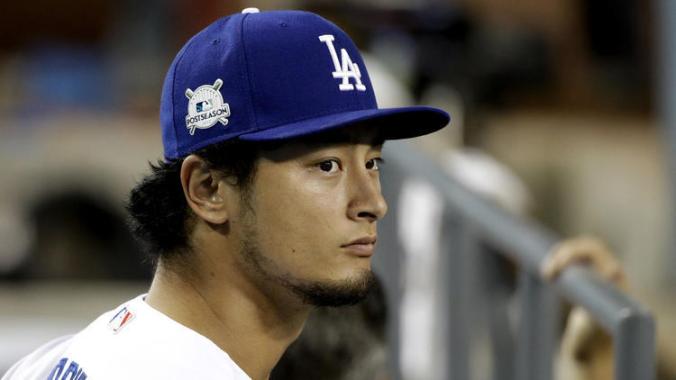
TMZ reported that Yu Darvish, the highly-regarded Dodger starting pitcher who may have delivered the worst World Series performance for a hurler ever, apologized to Dodger fans following his early exit from Game 7. Darvish didn’t make it out of the second inning in either of his two starts.
To begin with, I don’t think he apologized. Darvish said, “Dodger fans … they expect we won the World Series. I couldn’t do it. I still feel sorry,but I did my 100%, so…” Of course he’s sorry that he stunk during the Series, lost two games, and was a major reason his team was defeated by the Houston Astros. He regrets tat he didn’t play better. That, however, is not the same as apologizing, which is how TMZ and—yecch–Breitbart headlined the story. It is a social balm to say that you are sorry that your best efforts weren’t good enough, but one should not apologize for bad results unless your conduct was wrongful in some way. An athlete not being at his best on a given day is not wrongdoing. It’s moral luck. If he performed badly because he was drunk, or tried to lose, or didn’t prepare properly, then he owes his stakeholders an apology for breaching their trust and his duty of competence. If, as Yu says he did, the athlete gave “100%,’ then there is nothing to apologize for.
Acting as if there is something to apologize for helps confuse the easily confused public on an important aspect of accountability. We are accountable for bad events when our actions lead to those events, but we can only be blamed for those bad events if some negligence misconduct or other variation from competent and responsible standards causes the undesirable results, when such results could have been anticipated. Continue reading →
One unethical act often opens the floodgates to many, in in unexpected, and unexpectable ways. An ethics alarm failure triggers another, then another. But who would expect that an extramarital affair would cause a passenger plane to have to make an emergency landing, for example?
All the moe reason to keep those alarms in working order.
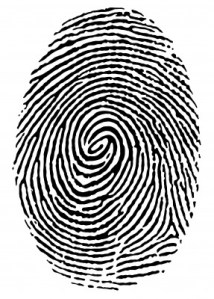
The distaff side of a couple on the way to a vacation in Bali on a Qatar Airways flight apparently had reason to be suspicious of her husband, so when he fell asleep, she oh-so-carefully manipulated his snoozing thumb to unlock his smartphone with its print, and did some snooping.
Ah HA! The bastard had been cheating on her!
So calmly, maturely, she began screaming and beating on her dastardly spouse so violently that the pilot had to divert the flight and land.
Cascade re-cap:
Triggering unethical act: Marital infidelity.
1 to 10Betrayal of Trust Scale score, with 1 being a forgivable lie and 10 being treason, I rate this an 8.
Secondary unethical act: Appropriating the body of another while he is incapacitated, and doing so to invade his privacy. (No credit for discovering above triggering unethical act.. That’s consequentialism: the result of an act cannot retroactively justify the act.)
Betrayal of Trust Scale score: 6
Culminating unethical act: Physical violence on a plane endangering innocent passengers, forcing the plane to land, inconveniencing many.
Grandstanding as always, Nancy Pelosi proclaimed that all of the Confederates honored in the Capital Gallery should come down. How odd that this never occurred to her when she was Speaker of the House and the Democrats held the Senate and the White House.
The Gallery is exactly the kind of enclosed public space for display that the statue-topplers argue should house the controversial statuary, places where their context can be considered outside of the public square. They don’t mean it, though. They want the statues hidden away, so nobody will see then without searching for them like Indiana Jones.
It was nice of Duke to show just how calculated and hypocritical this sudden eruption of horror at long-standing monuments is. While the school is capitulating to students by removing another statue of Lee from its chapel, there seem to be no plans to tear down the statue of George Washington Duke a Confederate soldier and a slave owner. Duke’s son, Buck, gave a large endowment to what was then called Trinity College, and in appreciation, the school changed its name to Duke University. And this happened in the twenties, which proves that the real objective was to salute Jim Crow—or so we are being told now.
Duke was named after a confederate soldier and a slave owner, meaning that by the Left’s logic the entire school is a memorial to white supremacy and slavery. But the students who happily agreed to have his name appended to their life forever are traumatized by a campus statue of General Lee. Continue reading →
The Charlottesville fiasco combined several ethics train wrecks, as I mentioned before, creating The Perfect Ethics Train Wreck. We have the airbushing away historical figures now out of favor ETW, the progressive anti-free speech ETW, the long-running 2017 Post Election ETW, which involves the news media’s determination to blow up any word or deed by the President, large, small, ambiguous or insignificant, into a justification to remove him. We have the burgeoning “pro-violence as long as it is against the far right caboose,” and the “Let’s figure out what the motives were behind specific statues, regardless of whether they were legitimate heroes or admired historical figures in the times in which the lived” cattle car. And, of course, the intensifying assault on free expression locomotive, bolstered by the guilt by association diesel engine.
What a mess. It is made worse by the fact that many of these rooted in fascinating and nuanced ethics problems, but being discussed on line and elsewhere by single-minded, narrow-view, partisan, doctrinaire, hypocrites and fools.
I’m going to root through some of the wreckage now…
Former African American NBA star and freelance social commentator Charles Barkley weighed in on the controversy by saying, “Who the hell cares about Confederate statues?” Of course, the vast majority of Americans don’t: it’s like the Washington Redskins. The controversy is driven by small, intense minorities forcing people to take sides over issues that they never thought about before. Adds conservative blogger Allahpundit:
“Remember, 62 percent told Marist that statues honoring leaders of the Confederacy should remain in place as historical symbols. That includes a plurality of blacks (44/40). If you nudge people to state an opinion on whether CSA monuments should stay or go, you’ll get a divide but one that leans strongly towards leaving them in place. If you include a “there are more important things to worry about” or “eh” option, the numbers that are effectively in favor of the status quo can only rise. Most people, I suspect, just don’t care much either way. In the end, to Barkley and to many, many others, we’re arguing about scenery.”
But apathy and ignorance don’t mean that important principles are not at stake, or that we are not facing a dangerous slippery slope. The blogger continues,
There’s peril in that, though, if you believe firmly in leaving the statues in place. The number of people who feel passionately about smashing monuments may be small but they’re motivated and have a defensible argument that these are tributes to white supremacy more than to the Confederacy or “gallantry” or whatever. If they succeed in pressuring local governments to remove them, the “eh” contingent (which includes Barkley) will flip the other way: “Now that they’re gone, there’s no sense obsessing over them anymore. What’s done is done.” The politics of “what done is done” are slippery here, easily mutating potentially from justifying the pro-statue position to the anti-statue one. Which, I guess, is why we’re destined for a big public argument over it despite wide apathy towards the subject across the population. Dedicated believers in leaving the statues alone know that if they don’t push back diligently, the tear-’em-down contingent will prevail through sheer agitative will.
Cultures can take tragic and destructive turns when a radical minority steers the ship after the majority shrugs and says, “Oh, let them have their way.” Freedom of thought, expression and communication often die by millimeters. Continue reading →
1. The Pope gave an interview saying, in Italian of course, that the United States of America, which he offensively grouped with Russia, China, North Korea and Syria, have “a distorted vision of the world.”
The Pope, who has spent the bulk of his adult life seeing the world through the narrowly focused lense of the Catholic Church, and who hails from a South American leftist state, thinks that the United States has a distorted view of the world. Wow. Besides the stunning hubris of this pronouncement, the Pope is engaging in an abuse of position and influence, and a remarkably short-sighted one. If he wants to exercise any influence at all over citizens of the world who have not been indoctrinate since childhood to regard him as a godly sage by virtue of a secret political vote by a bunch of superannuated Cardinals, he has to earn credibility by the evident quality of the statements he makes. Later on, in the same interview, the Pope made it clear that his undistorted vision of the world involves endorsing open borders.
I think the Pope has a distorted view of the trustworthiness of celibate men who have access to young boys, so I really couldn’t care less what he thinks about U.S. policies when he can’t objectively and responsibly process the terrible realities in his own organization.
2. I’ve been reading and listening to sportswriters since I was ten, and I have to say that I have little respect for the critical thinking skills of most of them. I was gobsmacked by an example of why this morning, as Steve Buckley, a long-time baseball reporter for the Hub’s #2 paper The Boston Herald, opined in a virtue-signaling mess of a column that “War heroes, not David Ortiz, deserve streets named after them.” David Ortiz, in case you live in a fallout shelter, is the recently retired iconic slugger of the Boston Red Sox. The team recently retired his number, and in a related honor, the city of Boston re-named a small street near the park after him. It had earlier named one of the many bridges in the city after him.
“We should reserve the streets, the corners, the squares, the playgrounds, to remember the men and women who died serving our country.” Buckley writes. Why? He never really gives a reason, he just tells us that this is the way it should be. Why are the veterans who die in military service more honor-worthy than those who risked their lives but survived? Since when are society’s only real heroes military heroes? Is he a time-traveler from Ancient Sparta? Do contributions to society during peacetime or on the home front matter less to a community than what happens on a foreign battlefield?
What about fallen police officers and fire fighters? Not worth a street name? Philanthropists, inventors and innovators who made life better for all, launched businesses, created jobs, helped families and neighborhood thrive—these don’t warrant a little bit of local immortality? David Ortiz made millions of people happy. In a racially divided city, Ortiz, a black man, became the face of Boston sports, at least for those who were nauseated by Tom Brady’s smug countenance. That was as important as his clutch home runs. Trivializing Ortiz’s contributions to Boston (the relationship of Bostonians to their infuriating baseball team is too complex to explain quickly to anyone who hasn’t been part of it) is trivializing the importance of entertainment and popular culture, which is nothing short of ignorant, especially in the United States. In the District of Columbia, a school is named after Duke Ellington. Good. In Los Angeles, for decades until California leftists finally removed it, a major airport was named after John Wayne. Excellent. And in Boston, the largest tunnel is named after Ted Williams, but maybe Buckley thinks that’s OK because Williams was a combat flier in two wars. (Pssst! Ted’s tunnel isn’t bearing his name because he crash-landed that jet, Steve!)
As a society and a species, we have a duty to remember those who have contributed to the culture we enjoy. There aren’t enough streets, schools, bridges and parks to honor them all, but they all deserve to be honored. Continue reading →
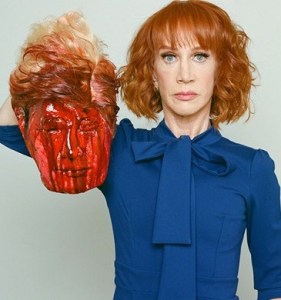
Comedian and actress Kathy Griffin has reportedly been interviewed by the U.S. Secret Service for more than an hour. The investigation is connected to a recent photograph which showed her holding the bloody head of Donald Trump.
Griffin’s attorney contends that the actress was just exercising her constitutional rights.
“She basically exercised her First Amendment rights to tell a joke,” Dmitry Gorin, a criminal defense attorney representing Griffin said. “When you look at everything in the media, all the times entertainers make videos or express themselves in other ways, you’ve never seen an entertainer, let alone a comedian, be subject to a criminal investigation.”
Ugh.
Griffin’s attorney doesn’t have to “contend” that she was “exercising her constitutional right” of free speech, she was exercising that right—-irresponsibly, recklessly, unethically, stupidly, hatefully, but she was still exercising it. There is no question that her disgusting photo was inappropriate and pure hate posing as humor, but never mind: people choosing to be hateful and irresponsible in their public speech should expect consequences, but not from the feds. Of course it chills freedom of expression for Griffin to be subjected to this kind of secret police-style grilling. It is a matter of public record that she is a comedian. It is a matter of public record that she is a professional jerk. Thus it is a matter of public record that she is a no threat to the President….just to a civil culture and good taste. Continue reading →
Last month, on March 14, 11-year old Tysen Benz read text messages saying that his 13-year-old girl friend had committed suicide. In apparent grief, the 11-year-old boy from Michigan’s Upper Peninsula hanged himself. In reality, the girl had sent the fake news as a joke. Or as a cruel trick. Or because she was 13.
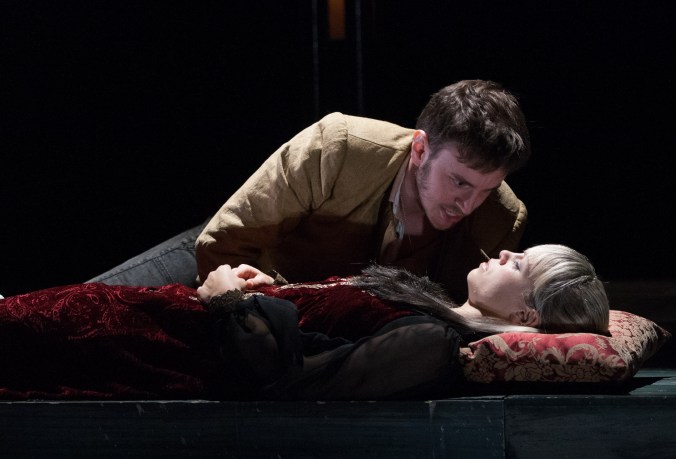
In the Shakespeare play, to fake her death Juliet took a sleeping potion that made her seem dead. (They didn’t have text messaging then.)
Now, if this was really “Romeo and Juliet,” Juliet would have killed herself too after learning that her boyfriend was dead. Instead, she is facing criminal charges. Marquette County Prosecuting Attorney Matt Wiese says that she is responsible for Tysen’s death, so he is charging her with malicious use of telecommunication service, punishable by up to six months in juvenile detention. He is also charging “Juliet” with using a computer to commit a crime, which carries a sentence of up to a year.
Why are these students smiling sweetly? Because they sent the message to their teachers to be wary; after all, there’s a lot of dirt on the internet…
Ugh.
Seemingly every one is cheering the Pittsburg High School (Kansas) students on the school paper who investigated their newly hired principal, found her credentials to be dubious, and forced her to resigned from her $93,000-a-year job. You can read the story here and here.
For the purposes of Ethics Alarms, I’m not interested in the principal at all. What matters here is that journalists, teachers, TV talking heads and everyone else commenting on the story are proving themselves ignorant of basic ethical principles, like the fact that conduct that happens to result in something desirable doesn’t make the conduct appropriate if it wasn’t ethical at the outset, aka “consequentialism leads to bad lessons and bad ethics,” and “the ends justifies the means.”
“Pittsburg journalism adviser Emily Smith said she is “very proud” of her students. “They were not out to get anyone to resign or to get anyone fired. They worked very hard to uncover the truth.”
Emily Smith is too incompetent and ethically confused to advise aspiring student journalists or any other students. The students “wanted be assured that she was qualified and had the proper credentials,” according to the student editor of the paper. That’s not their job, their duty, or their business. They aren’t journalists; they are students learning about journalism. Determining if the new principal was qualified was entirely the responsibility of the the Pittsburg Board of Education, which botched its job and approved hiring the principal at its meeting March 6. That the students did the due diligence the Board failed to do is being used as cover by the Board: Everything worked out because of these great students, who we have educated so well!
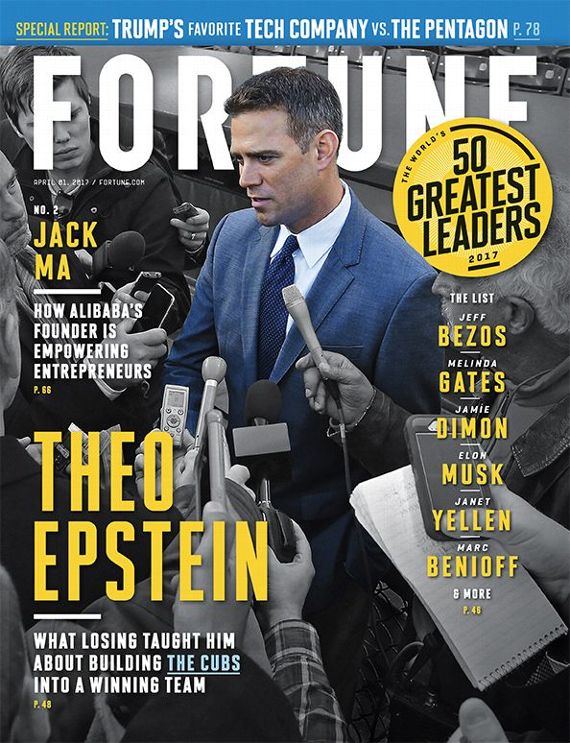
“That is ridiculous. The whole thing is patently ridiculous. It’s baseball–a pastime involving a lot of chance. If [Ben] Zobrist’s ball is three inches farther off the line, I’m on the hot seat for a failed five-year plan.”
—-Theo Epstein, president of the Major League Baseball’s 2016 World Champion Chicago Cubs, upon learning that Fortune Magazine had chosen him #1 among “The World’s Greatest Leaders” in a click-bait list released last week.
Thank-you, Theo, for explaining moral luck and the perils of consequentialism to the public. When it came down to the final innings of Game 7 in last year’s World Series, it looked for a while like Cubs manager Joe Maddon was about to blow the chance to win an elusive title after over a century of frustration by keeping his clearly gassed closer on the game. That his risky decision didn’t make Maddon a goat for the ages and Epstein one more name in the long list of Cubs saviors was pure moral luck—the element of chance that often distinguished heroes from villains. winners from losers and geniuses from fools in the public’s mind—and gross consequentialism, judging decisions by their uncontrollable results rather than their objectively judged wisdom and ethics at the time they were made.
If the Cleveland Indians had won that crucial game in extra-inning, no matter how, Epstein might have made Fortune’s list (I doubt it), but he would have been nowhere near the top. Continue reading →
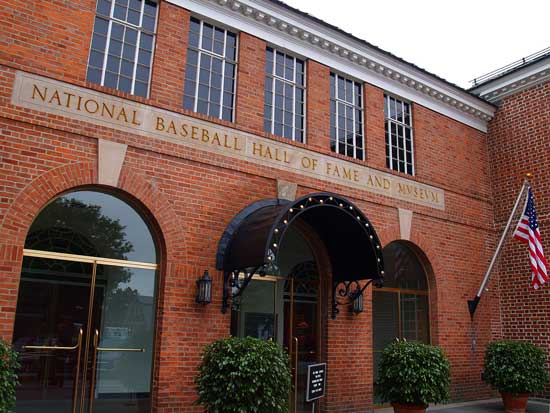
Baseball’s Hall of Fame votes were announced yesterday, and is often the case, the ethical issues raised were as interesting as the choices. The Baseball Writers Association Of America chooses who is to be enshrined; successful candidates must be on 75% of all ballots submitted, and have ten years of edibility after the initial 5 year waiting period expires.
Here were the vote totals of the players receiving significant support; the years each player has been on the ballot is the last number.
Jeff Bagwell 381 (86.2%) (7)
Tim Raines 380 (86.0%) (10)
Ivan Rodriguez 336 (76.0%) (1)
Trevor Hoffman 327 (74.0%) (2)
Vladimir Guerrero 317 (71.7%) (1)
Edgar Martinez 259 (58.6%) (8)
Roger Clemens 239 (54.1%) (5)
Barry Bonds 238 (53.8%) (5)
Mike Mussina 229 (51.8%) (4)
Curt Schilling 199 (45.0%) (5)
Manny Ramirez 105 (23.8%) (1)
Bagwell, Raines and Rodriguez were elected. Hoffman, the all-time leader in relief pitcher saves, just missed, and will almost certainly get into the Hall next year.
Ethics Observations:
1. More than anything, it is discouraging to see Barry Bonds crossing the 50% threshold. Bonds cheated, took the integrity out of some of baseball’s most important records, has lied about it to this day, and corrupted the game. Of course he is disqualified by the character requirements for entrance to the Hall. Bond’s vote total rise is attributed to several factors, including the old, unethical rationalizations we have been reading in defense of Bonds since he was playing. The latest excuses include the influx of younger voters who never saw Bonds nor witnessed the grotesquely inflated mutant he turned himself into, more voters throwing up their hands in frustration over the problem of sifting through so many players whose PED use is rumored, likely, or insufficiently proven, and voters who find the Hall’s recent election of former commissioner Bud Selig hypocritical, since he contrived ignorance to allow Bonds and others break the rules as long as possible. None of those excuses and rationalizations justify a single vote for Bonds.
2. Ivan Rodriquez‘s election also probably helped Bonds. He was one of the greatest catchers of all time, quite possibly the greatest defensive catcher, but in Jose Canseco’s first baseball and steroid tell-all book, “Juiced,” the steroidal slugger wrote of personally injecting I-Rod with the stuff while they were Texas Rangers. The catcher never tested positive in a drug test, but Canseco’s accusation was credible, especially after Rodriquez magically gained about 25 pound of muscle and started hitting home runs. Unlike Bonds, however, the evidence against him was slim. Jose, for example, is one of the great slime-balls in sports history. He may not be a liar, but since he admittedly wrote hisbook out of spite, he might be.
3. Ivan, in turn, was helped by the election of Jeff Bagwell. No player ever pinned steroid use on him, but Bagwell was judged a steroid-user by many because he became so muscular after starting out as a normally-built third baseman. Bagwell lifted weighs like a fiend, and clearly had a Hall of Fame level career, so keeping him out purely on suspicion seemed unfair, and was. His election slipped down the slope to boost Rodriquez, though, which in turn allowed some writers to rationalize voting for Bonds (and Roger Clemens, not as clearly guilty as Bonds, more seriously implicated than Rodriguez). Continue reading →


 Ethics Alarms