I’m Dreaming Of A Zombie Christmas

Zombie Nativity

I didn’t say it was a pleasant dream.

Hmmm, how should I describe this? I would say that a law is being used to violate the First Amendment rights of an unethical jerk who is intent on abusing them.

Or, in the alternative, Jasen Dixon may just be an idiot.

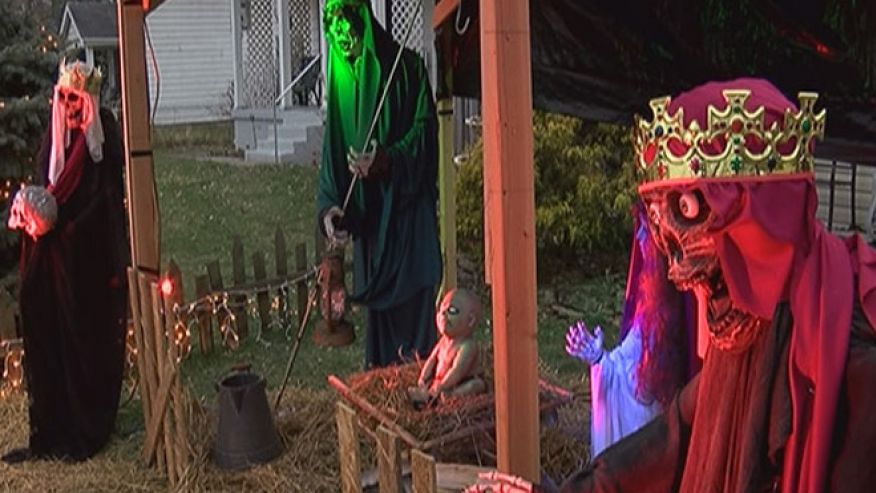
Sycamore Township, which is just outside Cincinnati, has responded to complaints by neighbors by applying various ordinances against Dixon’s unusual Nativity scene that he constructed in his front yard. It features life-size figures portraying Joseph and Mary as the walking dead, and a zombie baby Jesus, who has pale skin and pure white eyes. Here, here’s a close-up of Zombie Baby Jesus:

Zombie-nativity-scene

Awwwww!

Dixon suspects that the township laws, which prohibit structures in the front or the side yard of a residence that occupy more than 35 percent of its total area, and require that the primary structure must be 3 feet from the street and 6 feet from the dwelling, are really being selectively enforced against him because his holiday display offends some people….well, almost everyone. I suspect this as well.

Poor Jason says he doesn’t mean any harm: he’s just doing the best he can to celebrate the birth of baby Jesus. “I wanted a Nativity and I worked with what I had,”  says Dixon, who manages a nearby haunted house called “The 13 Rooms of Doom.” He says his First Amendment rights are being infringed.

“I’ve lived here for 15 years and I’ve never had a violation of any kind,” Dixon said. “It’s a holiday decoration. I know if it was a real pretty Nativity scene they wouldn’t be saying anything.”

I’ll agree with that too. Continue reading
Ethics Tools: “A Theory of Jerks”

Actually, no. The OTHER kind...

Actually, no. The OTHER kind…

In Aeon Magazine last month, philosophy professor Eric Schwitzgebel provided a serious essay on the nature of “jerkitude.” It is also an excellent essay, and useful. “Jerk” is a designation that I have occasion to use frequently on Ethics Alarms, and for the most part, Schwitzgebel convinced me that I have been using it properly. Some excerpts… Continue reading

More Airport Ethics: The TSA, the Bedonkadonk and the Slobs

Badonk

I’m not sure what to make of this scene, which I witnessed at Washington’s Reagan National airport as I waited to be scanned prior to my flight to Miami. I have some thoughts, though.

The young, zaftig, fascinatingly-shaped African American woman in front of me was wearing one of tightest, most revealing, shape-hugging, leaving-nothing-to-the-imagination knit dresses I or anyone has ever seen, especially in an airport. The garb was obviously chosen to highlight, as in broadcast world-wide, her most prominent and unusual asset: an awe-inspiring derriere, which appeared to be fit, toned, and suitable for showing a drive-in movie. She was attracting side-glances and open-mouths from all around her, male, female, and probably the machinery too, and obviously reveled in the attention.

When she stepped into the imager and was told to raise her hands over her head, she giggled and did a spontaneous bump and grind move, threatening the integrity of the structure. That did it. The young African-American male TSA agent was launched into smiles, winks, and a stream of comments on the women’s super-structure, along the lines of, “Damn, girl! Don’t go distracting me like that! How am I supposed to do my job? And man, I am distracted! Why, some big old terrorist could walk right by me while I’m taking you in, and then where would we be?” Laughs all around from the other agents, giggles and more gyrations from the woman, more banter from her admirer. Continue reading

Of The Great Noodle Ordeal, Sweeney Todd, Stressors, and The Importance Of Ethics In Stopping Mass Killings

I have a theory about mass killings, and it is neither original nor exclusive: in fact, it has been proposed in various forms for at least a  century But I think it is worth considering.

I think that the smart, creative, intense, ambitious, restless and entrepreneurial people in this country keep designing an environment, and forcing it on us whether we like or need it or not,  that is increasingly, and ultimately unbearably, hostile to those who are not smart, creative, intense, ambitious, restless and entrepreneurial. I think that as life becomes increasingly stressful and confusing for average people—remember, about half of the public is below average intelligence, and even average intelligence is nothing to jump up and down over—they are more likely to reach what the serial killer profilers on “Criminal Minds” call “stressors”—the final straw, the moment when they see red, and deadly fury takes over. On the TV show, of course, the stressor is the death of a child, or a firing, or the onset of an illness, or financial setbacks. But I can see it simply being the realization that life is hopeless…that it is always going to be a miserable, frustrating struggle, and that powerful, rich, meddling people are at work always finding ways to make sure it gets harder and harder, and ultimately futile, for normal human beings to get through the day.

I entertain delusions that I am smarter than the average bear, and I can barely stand it myself. Yesterday, stuck at La Guardia, I wanted to get some food in the a terminal’s food court. The place I chose had just added computerized self-ordering on iPads. I’m not intimidated by iPads; I use one. The woman in front of me, however, stared at the device—there were no readily available employees to guide her through it—as if it were a space alien. She pushed some buttons, sighed, and gave up. Continue reading

Ethics Quiz: The SpongeBob Headstones

SpongeBob Gravestone Removed

You can’t make stuff like this up.

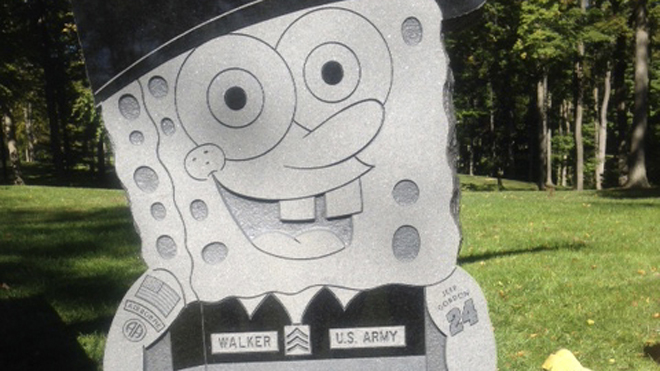
Apparently I was last one in the nation to learn about the surreal dispute between the parents of the late Kimberly Walker, a 28-year-old Iraq War vet who was  found murdered in a Colorado hotel room eight months ago, and the owners of Cincinnati’s historic  Spring Grove Cemetery, concerning the headstones erected over her grave on October 10.

The cemetery reversed its official approval of the twin monuments, apparently bestowed by someone who had momentarily been possessed by the spirit of Chuck Jones, saying that it would be inappropriate for a traditional and historic 19th Century pastoral cemetery that serves as the final resting place of Supreme Court Chief Justice Salmon P. Chase, several Civil War generals including “Fighting Joe” Hooker, who lost the Battle of Chancellorsville, the Hall of Fame manager of the 1927 Yankees, Miller Huggins, and many others, to sport not one but two hideous 6-foot-high, 4-foot-wide, 7,000 pound slabs of granite lovingly carved to depict SpongeBob Squarepants in military gear, one of which displays Kimberly’s name on his uniform. (For those of you who are hopelessly estranged from popular culture, SpongeBob is a fictional deep sea yellow sponge who stars in a popular Nickelodeon cable TV children’s cartoon show. Kimberly, we are told, loved the show. SpongeBob is an idiot, by the way.)

The family is outraged, and feels abused. “I feel like, and we all feel like, SpongeBob should stay there. We bought the plots, all six of them. We put the monuments there, we did what we had to do and they said they could provide that service to us,’ said Walker’s twin sister Kara, who was looking forward to eventually being buried under the second headstone. “I thought it was the greatest thing in the cemetery. I even told the people there that I think this is the best monument I’ve ever seen. It’s the best headstone in the cemetery and they all agreed. It came out really nice.”

Yyyyyyyeah.

Still, putting considerations of taste aside—-and what American these days doesn’t do that daily?—the Walkers duly purchased the plots (they have four more…and just think of what might end up on them) and properly cleared the monuments.

Your Ethics Alarms Ethics Quiz for this lovely Fall day is this:

Does fairness dictate that the Walkers be allowed to erect whatever monuments they choose, including giant, garish sculptures of a cartoon character, to honor the memory of their daughter? Continue reading

NYU Law Karaoke E-Shaming Ethics Verdict: Approved

Horrible music

Above the Law has posted an e-mail sent to the NYU law school community to reprimand and shame a law student’s dorm neighbors who kept the student awake into the wee hours on a week night, singing karaoke. Most e-shaming is excessive, vindictive and unfair, but I think this is an example of the best of the breed:

Date: Fri, Aug 30, 2013 at 4:20 AM
    Subject: An Open Letter to the Occupants of Mercer #[redacted]
    To: Law School Exchange Continue reading

Travel Ethics: Of Restroom Horror, Furious Apes and Dying Canaries

horrified_look

Perhaps with the sole exception of running into Larry Craig, my biggest fear in airport restrooms is encountering a bathroom stall that appears to have been last used by one of the baboons of the Kalahari. Why, in the name of humanity, would there ever be a reason for someone to leave a toilet seat dripping in urine, or the floor in front of the toilet covered and piled high with soaked and soiled toilet paper, or the toilet bowl filled with something that looks like it was deposited by an incontinent yak? Who among my civilized-appearing fellow travelers is secretly engaging in the manners of an Australopithecus? What ‘s the matter with these people? Continue reading

Ethics Quiz: The Case Of The Creepy Student

Muse and Artist, Victim and Harasser, or Censor and Victim?

Muse and Artist, Victim and Harasser, or Censor and Victim?

Joseph Corlett’s essay, though I have not found the full text of it,  is undoubtedly creepy.

In fall 2011, the 56-year-old countertop refinisher was taking a writing course at the Oakland University in Rochester, Michigan. His teacher, Pamela Mitzelfeld, gave the class an open writing assignment for their journals, and, Corlett says, assured them that any topic was acceptable, with no-holds barred.  She said, Corlett’s lawsuit now asserts, that she wanted “the raw stuff.”

That’s just what she got. Corlett wrote an essay called “Hot for Teacher,’ inspired by a Van Halen song by the same name, describing how his sexual attraction to Mitzelfield was irresistible. “Tall, blonde, stacked, smart and articulate…” he described her in his daybook. “Are you kidding me? I should drop right now. There is no way I’ll concentrate in class especially with that sexy little mole on her upper lip beckoning with every accented word. And that smile.”

Mitzelfield alerted university officials, saying that Corlett’s essay frightened and upset her, and that she refused to teach him any further. Moreover, she insisted that either he be ejected from the campus, or she would quit herself. He was escorted out of Mitzelfeld’s class a few days later by the Oakland University Police. A sexual harassment charge was dropped, but a hearing by university officials found Corlett guilty of intimidation and he was expelled for the rest of the semester. University officials allegedly told him that he would be arrested if he returned to the campus. His suspension lasts for  three semesters, and he must go through sensitivity counseling before he can reapply.

Aided by The Fire, Corlett is now suing for over two million dollars in damages, maintaining that his First Amendment rights have been infringed. “The university has essentially issued a straightjacket to every writing student to protect the delicate sensibilities of faculty and staff,” says Greg Lukianoff, FIRE advocate. The legal issues look pretty clear: Oakland University has a terrible case. “Write anything” means write anything, and certainly cannot mean “write anything except something the instructor will freak out over, in which case we’ll fix you good.” If it is true, as Corlett alleges in his lawsuit, that Mitzelfield made no objection to other sexually themed compositions by him that referred to her, his treatment by the school is indefensible. That’s not the ethical question, however. That question is your Ethics Alarms Quiz for the day, and goes like this: Conceding that Oakland University mishandled the episode…

Was Corlett’s essay ethical and blameless?  Continue reading

Comment of the Day: “And The Solution To This Phenomenon Is Simply Ethics. Why Is That So Hard?”

Sir Galahad

Sir Galahad

Reader Aaron Paschall was on a roll today, and his two-part comment on the thread regarding a woman’s lament about the sexual harassment she faces every day constitutes one of the best and most eloquent Comments of the Day Ethics Alarms has ever recognized with the honor. Here is Aaron’s perspective on the post “And The Solution To This Phenomenon Is Simply Ethics: Why Is That So Hard?”:

“Certainly it’s a sad state of affairs when a woman (or man) has to keep to the well-lit areas in order to avoid the dangers lurking in the dark. If Emily’s post is a lamentation that it would be wonderful if people needn’t fear the darkness, then I agree wholeheartedly. If Emily’s post is intended as a screed about how unfair it is that she can’t go walking down dark alleys as she would like because of all the nasty, brutish men lurking in the shadows, I can only laugh and say that I can’t walk down those alleys, either. Nor would I wish to, because I’m wiser than that. Continue reading

And The Solution To This Phenomenon Is Simply Ethics. Why Is That So Hard?

construction_workers_at_voi_bigWith her “Letter to the Guy Who Harassed Me Outside the Bar” , Emily Heist Moss makes me briefly wonder, not for the first time, why all men haven’t been murdered in their beds by an organized feminist vigilante posse. The conduct she describes is disgusting and infuriating just to read about, and I don’t even have to experience it.

The amazing thing is that this kind of ritual harassment would vanish with some slight behavioral additions to our culture, many of which once were the norm, habits of good conduct like etiquette,  manners, consideration, civility, fairness, kindness, respect, and the Golden Rule. They could become cultural norms again, and rather easily, I would think, with an increase in responsible parenting, a responsible popular culture, and the development of role models with integrity. Not featuring serial and unapologetic sexual harassers as stars of sitcoms (Charlie Sheen) and political conventions (William Jefferson Clinton) would help; so would a serious effort by Hollywood not to trivialize workplace harassment as cute or amusing, as in the long-running “Cheers,” or in current TV  dramas like “Criminal Minds” and “NCIS.”

Moss writes, Continue reading