The Center for Public Integrity got what it wanted yesterday, which was headlines about its extensive new study of public ethics laws in the U.S. In order to get its cherished publicity, the Center added to the public’s confusion about what corruption is, what ethics is, and how one discourages one while iencouraging the other in our various governments. They released results that graded the 50 states according to “corruptibility”, and found that New Jersey was the least corruptible of all. I hope the Center’s officials and scholars are happy with their PR, but if they have a shred of integrity and common sense, they should be ashamed of themselves. Continue reading
corruption
Climate Wars Ethics: Gleick’s Lie, and the Death of Trust
This is a big ethics story, with general ethics lessons and serious public policy repercussions in an area already muddled with ethical misconduct on all sides. I’m going to restrict Ethics Alarms to the purely ethical analysis. and, at the end, point out some of the excellent articles that the incident has inspired regarding the policy implications of it all.
Last week, leaked documents prepared for a board meeting of the libertarian think tank, the Heartland Institute, were published on various blogs and websites. The Institute is a major player in the effort to disprove, debunk or discredit scientific studies showing man-made climate change, and block the adoption of anti-climate change policies while undermining public support for them. One of the most provocative documents was a “Climate Strategy” memorandum laying out Heartland’s secret efforts in sinister terms. The source of the documents, and the one who made them available to global-warming promoting bloggers, was a mysterious individual calling himself “Heartland Insider.”
Now the source has revealed himself, and it is a prominent climatologist on the front lines of the climate change battle, scientist Peter Gleick of the Pacific Institute. Gleick explained what occurred in a column at the Huffington Post: Continue reading
Old Testament Treatment For The Miramonte Elementary School Culture
Following the discovery that two Miramonte Elementary School teachers, Mark Berndt and Martin Springer, allegedly engaged in lewd activity with students, Los Angeles Unified School District made the brave decision to replace all teachers and staff, with everyone being re-assigned. Predictably, there have been protests and criticism. The basic argument: it is excessive and unfair. The good teachers, whoever they were, weren’t at fault.
Yes, they were; at least, they were responsible, and share accountability for a culture they were part of. The school district’s decision correctly assumes that when two members of a relatively small teaching staff abuse young children over a long period, something is rotten at the school beyond those teachers. Oversight is lax, administrators are looking the other way, teachers are protecting colleagues or refusing to acknowledge the implications of what they see or hear. There is a substantial chance that the Miramonte Elementary School didn’t just have some proverbial bad apples, but that it had created a culture that encouraged apples to go bad. There can be no certainty that Berndt and Springer were the only abusers on the staff, and the safety of children is at stake. Clear out the school, and wipe out the culture; have new personnel from top to bottom. It is easier to start over with a rotten culture than to try to fix it: this was God’s attitude in the Old Testament, and He had a point. The difference is that He killed off corrupt cultures with floods and fire, or just made them wander in the desert for generations. Luckily, this isn’t Congress, Wall Street, Hollywood, or Rupert Murdoch’s empire. You can start all over with a school. Continue reading
The Corruption Problem
“Maybe, just maybe, the legislative and judicial systems have been corrupted, by, dare I say it, corporations?”
—Ethics Alarms commenter and OWS warrior Jeff Field, in his comment regarding the weekend post, The Marianne Gingrich Ethics Train Wreck

I don’t know how Jeff reaches the conclusion that the judicial system has been corrupted by corporations. Judges, unlike legislators, do not grow rich as a result of their inside knowledge and corporate connections. Judges, unlike revolving-door Congressional staffers and lawyers, do not generally come from corporate backgrounds. The fact that a judicial decision benefits the interests of some corporations, and many do not, does not mean that the decision was not just or was influenced by more than persuasive legal arguments. Those who believe that begin with the biased and untenable position that any decision that benefits a corporation must be, by definition, wrong.
So let me put that dubious assertion aside as the result of excessive reformer’s zeal and crusader’s license, and deal with the general proposition that corporations corrupt the legislative system, and society generally. Well, sure they do, but the statement is misleading, and, I would argue, meaningless because it places disproportional importance on the corrupting influence of this one, admittedly important, societal force.
Yes, corporations can be corrupting influences. So can government, and the lure of public office. The news media is a corrupting influence on the legislature, and upon society generally. Religion corrupts; as does popular culture, with its celebration of empty celebrity, glamor and wealth. Non-profits and charities are corrupted by their tunnel vision of specific worthy objectives to the neglect of others; the civil rights movement corrupts, as does feminism and all other advocacy efforts, which often, if not usually, succumb to an “ends justify the means” ethic, which is unethical. Indeed, freedom corrupts, as does dependence. Cynicism corrupts, and corrupts with a vengeance. Ignorance corrupts; so does the belief, however well-supported, that one knows it all. Ideological certitude and inflexibility corrupts.
Education, and the cost of it, corrupts. Sports, both professional and collegiate, corrupt people, students, and institutions. Science corrupts; technology corrupts. Heaven knows, the internet corrupts. Leisure and success; triumph and defeat; wealth and poverty, love and hate, desperation, patriotism; kindness, loyalty, sex, lust; intellectual superiority, beauty, physical prowess, passion. Talent corrupts. Kindness and sympathy too.
Self-righteousness. Fear. Worry. Envy. Stupidity. Zealotry.
And, as we all know, power and the love of money.
All of these and more corrupt human beings and the institutions, organizations and governments that they make up. If individuals are corruptible, something will corrupt them, as sure as the sun rises and the quinces ripen. To focus upon any one of the limitless and abundant sources of corruption and to say, “This, above all, is the cause of our problems” is naive and unfair. By all means, we must seek ways to limit the opportunities for corruption and the damage it can do, but we must also recognize that the ability to corrupt does not mean that something or someone does not or cannot contribute much good to society as well. Heroes can corrupt, as we saw in the tragedy of Joe Paterno, but we need heroes. Leaders can corrupt, and often do, but we still need leaders.
Ultimately, the best way to stop people and things from corrupting us is to understand what corruption is and how easy it is to be corrupted. Our inoculation is ethics, understanding right and wrong and how to recognize both, and learning to recognize when we are biased, conflicted, or being guided by non-ethical or unethical motivations. Shifting the blame for corruption away from ourselves is comforting, but intimately counter-productive. We have the power to resist corruption, just as it is within out power to select public servants who are not likely to be corrupted. It is our responsibility to do so.
Philidelphia’s Conflicted, Shameless, Greedy—But Law-Abiding!— City Council

In the City of Brotherly Love, why shouldn't the City Council show a little love to itself--and its members' bank accounts?
Philadelphia, a city that like all cities these days is reeling under budget deficits, contemplating harsh cuts in city services and programs and raising taxes, is receiving a cruel lesson in the limits of public-mindedness by elected officials when the price is right.
Philadelphia City Councilwoman Marian Tasco retired yesterday, collected $478,057 in pension payments, and then plans to return to work after she is sworn-in on Monday to serve her seventh term. Register of Wills Ronald Donatucci retired Dec. 23 and will also return to work on Monday. He collected $366,797.
Why are they doing this? Because they can. Because it’s a lot of money. Because nobody can stop them. In Tasco’s case, because her irresponsible, disengaged, foolish constituency voted her into office despite ample warning that this is what she had planned. Continue reading
The Hard-Working Mr. McLaughlin
Michael E. McLaughlin resigned as Chelsea, Massachusetts housing director last month, after it was revealed that he had manipulated his way into a $360,000 salary. Now it is being discovered, thanks to some investigative reporting by the Boston Globe, that McLaughlin wasn’t merely overpaid as perhaps the highest compensated state housing official in the nation. He apparently worked only 15 full days in Chelsea for the entire year, in an epic example of official deception and sloth at taxpayer expense.
The Globe’s smoking gun evidence consists of interviews and phone records, which clearly show that McLaughlin went to extraordinary lengths to avoid performing much work related to his job managing low-income housing in Chelsea. He didn’t appear in Chelsea for half the working days in 2011, choosing to spend 47 weekdays in Maine and Florida with his top assistant and “close personal friend” (ahem!), Linda Thibodeau. Then there were another 21 work days spent at conferences in warm cities like Phoenix to Miami, also usually with the comely Thibodeau to keep him company. Continue reading
Punishing Corrupt Companies Without Punishing the People Who Make Them Corrupt
From The National Law Journal, December 8:
“The Justice Department has announced that Wachovia Bank N.A., now known as Wells Fargo Bank N.A., will pay $148 million to federal and state agencies after admitting to anti-competitive activity in the municipal bond investments market.”
I understand why the Justice Department, the SEC and other federal agencies fine companies huge amounts for what is essentially criminal conduct, choosing negotiated settlements rather than engaging in time-consuming trials that would cost taxpayers money and risk failing for reasons ranging from investigator error to skillful defense strategy. Nevertheless, the policy encourages rather than discourages unethical conduct by corporate decision-makers. It does nothing to improve a culture that tends to define a bad business practice as a gamble that doesn’t work, or a scheme that gets discovered. Continue reading
“It’s A Wonderful Life” Ethics, Part 3
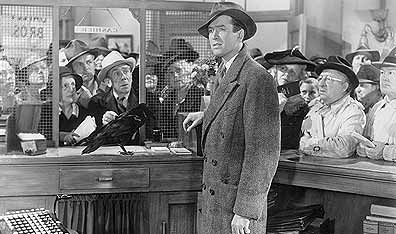
Here is the final installment of the Ethics Alarms overview of the ethical issues raised in Frank Capra’s classic. Some of the comments on Parts 1 and 2 have suggested that my analysis is unduly critical. Nothing could be further from the truth. I love the movie, and have already said that I find it ethically inspiring. Noting that characters act unethically in a movie about ethics is no more criticism than pointing out that people in horror movies never just leave when things start getting weird (as I would). I know that their actions drive the plot and are necessary. This is, however, how an ethicist watches a movie with as many ethical choices as “It’s A Wonderful Life.” I can’t help it.
Now back to George, Mary, and Bedford Falls:
11. Uncle Billy screws up as we knew he would
11. Christmas Eve arrives in Bedford Falls, and Uncle Billy manages to forget that he left the week’s deposits in the newspaper he gave to Mr. Potter. Thus more than $8,000 is missing on the same day that the bank examiner is in town. Why is Uncle Billy still working for the Savings and Loan? He’s working there because George, like his father, is putting family loyalty over fiduciary responsibility. Potter, of course, is a thief; by keeping the lost money to trap George, he’s committing a felony, and an unnecessary one. As a board member on the Savings and Loan, Billy’s carelessness and George’s negligence in entrusting him with the bank’s funds would support charges of misfeasance. Mr. Potter, had he played fair, might have triumphed over George legitimately, and no Christmas miracle or guardian angel could have saved him. But this is the inherent weakness and fatal flaw of the habitually unethical: since they don’t shrink from using unethical devices, they often ignore ethical ways to achieve the same objectives that would be more effective.
12. George folds under pressure Continue reading
“It’s A Wonderful Life” Ethics, Part 2 (of 3)
When we last saw George Bailey, he was defending his father’s dubious loan practices. In this, Part 2 of the three installments of “It’s A Wonderful Life” Ethics, we take the saga up the fateful Christmas Eve when George Bailey meets his guardian angel.
6. George’s Fork in the Road
George Bailey’s decision to give up his plans to go to college to save the Savings and Loan is clearly not motivated by his personal dedication to the institution; he doesn’t like the place. He says so over and over again. He admires his father’s motivations for starting it. Had Potter not sparked his resentment with his nasty comments about George’s late father, George would have been out the door. But his passionate speech in rebuttal of Potter’s words put him on the spot: after those sentiments, turning down the Board’s appointment of him to be the new operating manager of the S&L would have made George a hypocrite in his own eyes, and rendered his passion laughable. If George had integrity, then he had to accept the appointment.
It is one of the most interesting ethical moments in the film, because it represents a realistically complex ethical decision. George does what he does for selfish reasons as well as altruistic ones, and irrational reasons as well as considered ones. He wants to respect himself; he fears what might happen to his family and the community if Potter becomes the only financial power in town, and knows he will feel guilty if the consequences are bad. He feels like not staying will be taking Potter’s side over his father’s—completely irrational, since his father had given his blessing to George’s college plans, and wasn’t alive to be harmed by whatever he chose to do anyway. A large proportion of George’s decision seems to be motivated by non-ethical considerations, for he doesn’t like Potter—even hates him, perhaps—and wants to stick it to the old tycoon by foiling his victory. There are few ethical decisions in real life that are made purely on the basis of ethics, and Capra makes George’s decision wonderfully impure. Continue reading
Bad Jack’s New Gig
My NPR segment was live, and predictably shorter than the star of the day, disgraced lobbyist Jack Abramoff, who was there, also predictably, to talk about ethics. Isn’t it interesting that when businessmen, lawyers, investment gurus and politicians get caught and go to jail, they always manage to have very profitable epiphanies that make them ethics experts just in time to give them a book or speaking tour deal, since their original lines of work are no longer an option?
Do I believe these changes of heart and values are real? Not for a second. Continue reading