It was incredible: the only qualified candidate for the Pulitzer Prize just happened to be the spouse of a Pulitzer board member! What are the odds?
[Note:an incompletely edited and proofed version of this post was mistakenly published. I apologize. Thanks to Tim LeVier for flagging the problem.]
All awards and prize organizations are subject to fair suspicion about their integrity, and collectively, they undermine each other. The Academy Awards get criticized by prominent blacks, and suddenly the number of black nominees explodes. The Nobel Prize committee, once the epitome of a well-respected and trusted awards program, exposes its political bias by giving a Peace Prize to Barack Obama for no good reason whatsoever.
Then, beginning in late 2017, in an expose published late last year by a Swedish newspaper, the Swedish institution was rocked by accusations from18 women who said they were sexually harassed or assaulted by French arts promoter Jean-Claude Arnault, who is married to poet Katarina Frostenson and is friends with Horace Engdahl, both members of the Academy that awards the Nobel Prize in literature. Arnault was sentenced to two years in prison after being found guilty of raping a woman in 2011. This ugly publicity cast unwelcome light on more unethical conduct: a club called Forum that Arnault and Frostenson owned received a subsidy from the Academy. Yes, the members were voting finnacial benefits to themselves. There were also credible reports of Frostenson giving names of winners to Arnault before they were announced,, allowing him place wagers and win money with insider information. As the scandal expanded, Frostenson and Engdahl refused to resign. Three other members of the Academy left in protest.
1. If anyone cared, this would do in Rachel Maddow. The fact that so many of my otherwise intelligent and reasonable liberal friends insist that Rachel Maddow is God’d gift to journalism was a mystery to me when she first brought her perpetual smirk to MSNBC. It perplexed me greatly as she so obviously hyped and twisted her commentary, and once she became the #1 Russia-Trump conspiracy theorist on TV, I admit that I have lost the edge of respect for anyone who still watches her. Rachel Maddow bottomed out, I’d say, yesterday, when she was saying this last week:
“It’s hard to believe that they’d leave the newly appointed Attorney General William Barr to himself to personally pick through the [Mueller] report to try to figure out which mentions in this 400-page report might pertain to an open case”They wouldn’t leave that to Barr to do that. Mueller would have done that!
Mueller’s team would have done that as part of producing anything that they handed over outside their own offices. They’ve done that with every other document they have produced in the course of this investigation. You’d assume they’d be able to do that for this document too. But William Barr says, [exaggerated sigh] it’s taking him a really long time because he’s having to do all that himself.”
While was saying that it was suspicious that Barr wouldn’t seek Mueller’s assistance with the redactions, the chyron underneath her read,
“Barr: Special Counsel Is Assisting with Redactions”
Unlike the much-mocked Fox News gaffe, in which the talking heads were correctly reciting the story while the chyron said that Trump was pulling aid from “three Mexican countries“, this time the chyron was right, and the talking head was wrong. It might just be me, but I’d rather the actual reporters to be telling the truth, and graphics be messed up. Continue reading →
I’ve been thinking a lot about my Dad for some reason, and that was his favorite hymn. It’s an Easter hymn, but our church always had the choir sing it on the special spring service. My unusually musically talented friends knocked it out of the park at my father’s funeral service at Arlington National Cemetery. It also has the advantage of being composed by Arthur Sullivan, just like “Onward Christian Soldiers!” and “Tit Willow.”
1. Fill out your brackets, and enable corruption. It’s the NCAA tournament again, and again, helping the schools and the NCAA and the networks make money off of the destructive and corrupt culture of big time college basketball is ethically indefensible. The New York Times wouldn’t go so far as to say that, but it did recently write about the dissonance, beginning,
Every March, millions of Americans fill out brackets (more than 40 million people, by one count), cheer the underdogs and tune in on television. Others buy tickets to the games, wear jerseys of their favorite teams and let wins and losses dictate their mood. Yet fans who follow college basketball closely know about the game’s intractable relationship to corruption. Even many who come just for March Madness must know that the real madness is not always on the court.
A wide-ranging and fear-inducing F.B.I. investigation into college basketball recruiting continues to ensnare big-name colleges and little-known crooks. It is why Louisiana State, for example, is playing without its head coach, Will Wade, and why Auburn recently had an assistant coach suspended and a former assistant plead guilty of conspiracy for accepting bribes.
This week, the lawyer Michael Avenatti was charged with trying to extort up to $25 million from Nike in exchange for concealing information he had about illicit payments to recruits. He has since revealedsome allegations on Twitter….
The Times doesn’t bother to go into the related problem of how basketball distorts academic goals, sucks away resources that should be used for education, and usually leaves its athletes no better educated than they were when they arrived. As you might expect, the Times’ writer is too ethically incompetent to provide and enlightenment. For example, he quotes one ethicist as saying, “…Someone thinks, ‘Gosh, this is unethical, but I love it so much, and my friends and I have such a good time rooting and cheering that I’m going to participate anyway.’” That description could also be used to justify gang rape. Can we have a little nuanced clarification? Then the Times writer, John Branch, offers these ill-devised analogies:
“Such internal debates permeate our culture. Is it O.K. to dance to a Michael Jackson song, to laugh to a Louis C.K. joke, to watch a movie produced by Harvey Weinstein? To cheer for football knowing what it may be doing to players’ brains?”
Let’s see: wrong, wrong,wrong, and…right. 1 for 4.
A Michael Jackson song isn’t corrupt, or unethical: it’s art. He’s dead: dancing to the song does not enable the misconduct. A joke is a joke regardless of who tells it, and again, laughing at a C.K. joke doesn’t make it more or less likely that he’s going to masturbate in front of a female colleague. Workplace misconduct doesn’t taint the work product, and nobody has claimed that movies themselves are culturally corrupting, or that Weinstein’s films harmed the actors in them. Cheering for football is a legitimate comparison, because the sport itself is the problem, just like college basketball itself is the problem.
This is a bit of a departure, a showcase for one of Ethics Alarms most active commenters (especially appreciated as the blog experiences boycotts, embargos, and Facebook blocking and other indignities), Michael R. The topic is the recent College Admission scandal, which has been covered here and here.
Michael, an educator, is well informed on this topic, and he shows it in three excellent Comments of the Day. And I forgive him for never, ever, making a typo.
I.
The college scandal has many, many facets. What has caused standards to slip so low? Well, athletics obviously has a corrosive effect, with students admitted based on athletic ability instead of academic ability. The grade inflation has also greatly degraded college standards. The almost lack of education occurring in our high schools is another factor.
An overlooked factor, however, is the public higher ed systems’ oversupply of colleges. Public college policy has mainly been about votes and prestige, not actual societal need. This has resulted in a lot more colleges than the country actually needs. A typical example would be Local Community College. Well, the President of Local Community College would rather not be the laughingstock of the College President’s Club, so he petitions the state legislature to authorize his school to offer 4-year degrees. He states that his community deserves a 4-year school like (insert rival town here). This proposal is mainly decided on its political merits, not the needs of the state as a whole. It goes through, along with new funding for new facilities, new faculty, and more students for the Local State College. With all the Community Colleges becoming State Colleges, the presidents of the Regional State Colleges petition to become Regional State Universities. They point out the prestige and grant money they could get if they had graduate programs. This too, is granted based on political merit. The National Science Foundation is then pressured to remove funding from the traditional research schools and transfer it to the new State Universities amid allegations of elitism for favoring longstanding research schools with top-notch researchers over the new State Universities with no significant research results and they cave. Now, with no community colleges left, a new round of community colleges is constructed. This increases the number of seats for college students by 30% or so, but there are not more high school students graduating. This is repeated all over the country, so out-of-state students are not an option. The only reasonable option is to lower admissions standards. Once the admission standards are lowered, retention suffers and the faculty are ordered to improve retention and graduation rates. The only reasonable way to do this is to make the classes easier and the race to the bottom is on.Continue reading →
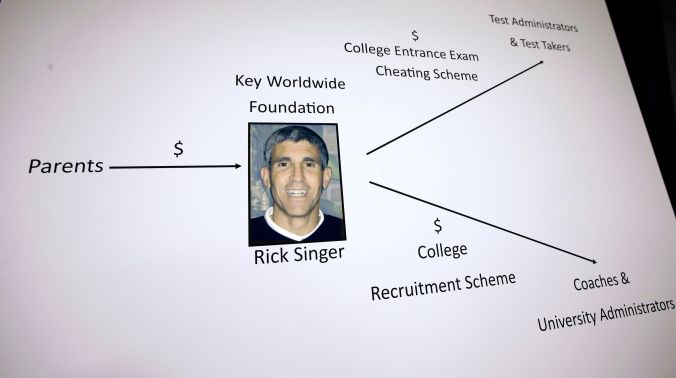
It is rare that an ethics story is the front page feature of the day, but the scandal that broke last nigh is certainly that. From the AP, on the results of the investigation code-named “Operation Varsity Blues”…
Fifty people, including Hollywood stars Felicity Huffman and Lori Loughlin, were charged Tuesday in a scheme in which wealthy parents allegedly bribed college coaches and other insiders to get their children into some of the nation’s most elite schools. Federal authorities called it the biggest college admissions scam ever prosecuted by the U.S. Justice Department, with the parents accused of paying an estimated $25 million in bribes.
More…
At least nine athletic coaches and 33 parents, many of them prominent in law, finance or business, were among those charged. Dozens, including Huffman, were arrested by midday.
Huffman, best known for “Desperate Housewives,” is married to celebrated actor William Macy (“Fargo”). Presumably he is going to be arrested too.
The coaches worked at such schools as Yale, Stanford, Georgetown, Wake Forest, the University of Texas, the University of Southern California and the University of California, Los Angeles. A former Yale soccer coach pleaded guilty and helped build the case against others.
I have to get my reply brief to that %$#@!#&%! Ethics Alarms defamation suit in today, and I just KNOW the online filing system isn’t going to work..
1. College basketball ethics. See? Baseball isn’t the only sport I follow! Zion Williamson, one of college basketball’s biggest stars and a potential NBA star as well, injured his knee after one of his Nike shoes split less than a minute into Duke’s game against North Carolina last week. Not only does Nike have a likely product liability lawsuit on its hands, while Williamson’s bright career is suddenly in limbo, the freak accident raised—AGAIN–issues of the propriety of the way universities like Duke handle big money sports. The New York Times asked:
“Here were all the issues of big-time college sports laid bare: Should amateurism be curbed in college sports, allowing athletes a cut of the money they help produce? Should a prodigious talent like Williamson, who is good enough to play professionally right now, have to risk his future competing for free because of an N.B.A. rule prohibiting him from leaping to the league from high school? Do the sneaker companies, which were at the heart of a federal fraud trial near the start of the season, do more harm than good in college sports?”
Answers: No, No, and Yes. Big time sports are a source of corruption in all colleges that feature them. Nobody should be admitted to college to play basketball or football. If they don’t want to learn, then there should be no place for athletes in college. Allowing universities to be participants in the business of sports to the extent that universities like Duke are is a travesty of education, and guarantees misconduct.
2. The shadow of Harvey Weinstein and Hollywood’s hypocrisy hung over the 2019 Oscars, but few noted it.
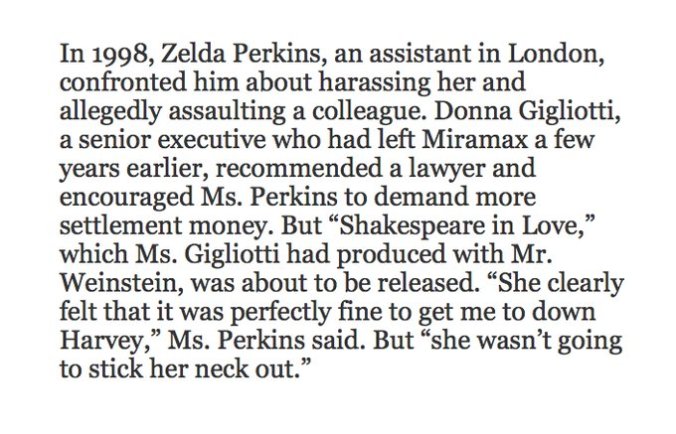
Donna Gigliotti produced the Oscars telecast. There has been no accountability for the many, many stars and Hollywood figures of both genders who enabled Weinstein’s crimes for years, then became #MeToo activists as soon as he no longer had the power to enrich them. [Pointer: Victory Girls]
3. Hasn’t this been obvious all along? Bloggress Ann Althouse does a terrific job deconstructing a New York Times article, a “Trump is Epic,” a conversation between columnists Gail Collins and alleged conservative (who wants to repeal the second Amendment) Bret Stephens, that could have been a parody of mainstream media bias and “resistance” false reasoning, but wasn’t. I didn’t have the heart or the stomach to fisk it, the thing is such self-evident crap: Thanks, Ann! She writes in part… Continue reading →
1. First candidate for “Incompetent Elected Official Of 2019”! The Troy New York City Council president got drunk and then went behind the wheel to chased another motorist at high speeds for nearly 30 miles last week . State police arrested Carmella R. Mantello, 53, after troopers received a call from a terrified driver who told dispatchers that some crazy person was tailgating him and driving erratically. When troopers pulled Mantello over, she denied following the man and claimed he was following her—interesting, since troopers stopped her when she was behind the complaining motorist. She also refused to take a breathalizer test.
Later, Mantello issued this statement:
“I understand the severity of my actions and take full responsibility. I apologize to my family, friends and constituents and am deeply sorry that I let you down,” she said. “I expect more from myself. Finally, I would like to personally thank the New York State Troopers for their professionalism in this matter and the service they render every day to keep our communities safe.”
The best way for her to honor professionalism and keep communities safe is to resign immediately.
Oh—I assumed that Mantello was a Democrat, since the news story didn’t mention her party affiliation. Nope! She’s a Republican.
2. You ain’t seen nothin’ yet!—get a load of THIS! Also, KABOOM! My head just exploded. Some ethics stories don’t need any analysis; they are res ipsa loquitur. I generally don’t devote pots stories when the despicable conduct is so obvious, but this one needs to be widely disseminated. From the New York Post:Continue reading →
Once again I am posting the Ethics Alarms Ethics Guide to Frank Capra’s 1946 masterpiece “It’s A Wonderful Life,” perhaps the greatest ethics movies of all time, as this blog’s official welcome to the holiday season. The film is commonly thought of as a Christmas movie, but it really is a Thanksgiving story. Unfortunately, the movie is so well known, so much imitated, so familiar in its tropes and cliches that we really don’t think about it very hard. We should.
The movie is exactly the kind of important shared cultural touch-point that I am advocating when I emphasize the importance of cultural literacy to our nation’s connective tissue. The film teaches about values, family, sacrifice and human failings unlike any other: its power and uniqueness disproves the assertion, made in one online debate here this year, that new cultural creations inevitably and effectively supersede older ones. No, they really don’t, and like copies of copies, eventually the cultural values conveyed get fainter and less influential. “It’s A Wonderful Life” would be an excellent basis for a middle school ethics course. I haven’t seen a better, richer film for that purpose come along since, and I’ve been looking.
I am also constantly amazed at how many people haven’t seen the movie. My son’s girlfriend admitted that she hadn’t at dinner today. A few months ago I gave a DVD to a pharmacist at our local CVS after I made a reference to the film and he had no idea what I was talking about. He said he would wait until the holidays to watch it with his family. I hope he does: he left the job soon after. There are some classic movies that parents have an obligation to make sure their children see. This is one. Despite the many ethics complexities and nuances that the film glosses over or distorts, its basic, core message is crucial to all human beings, and needs to be hammered into our skulls at regular intervals, far more often than once a year.
What I wrote about this message in an earlier posting of this opus still seems right to me:
Everyone’s life does touch many others, and everyone has played a part in the chaotic ordering of random occurrences for good. Think about the children who have been born because you somehow were involved in the chain of events that linked their parents. And if you can’t think of something in your life that has a positive impact on someone–although there has to have been one, and probably many—then do something now. It doesn’t take much; sometimes a smile and a kind word is enough. Remembering the lessons of “It’s a Wonderful Life” really can make life more wonderful, and not just for you.
I wondered about posting the guide again this year, as this feels like a year in which Ethics Alarms lost old readers rather than gained new ones. Then I read it again, and it reminded me of some important things I had forgotten, and I wrote it. I also, as is my yearly habit, edited and added to the commentary a bit. I’m smarter this year than I was last year, and I bet you are too…especially if you’ve been reading Ethics Alarms, just from figuring out how I’m wrong.
I hope you all had a terrific Thanksgiving, and that the holiday season is joyous for all.
And here we go:
1. “If It’s About Ethics, God Must Be Involved”
The movie begins in heaven, represented by twinkling stars. There is no way around this, as divine intervention is at the core of the fantasy. Heaven and angels were big in Hollywood in the Forties. The framing of the tale seems to advance the anti-ethical idea, central to many religions, that good behavior on earth will be rewarded in the hereafter, bolstering the theory that without God and eternal rewards, doing good is pointless.
Yet in the end, it is an ethics movie, not a religious one. George lives a (mostly) ethical life, not out of any religious conviction, but because step by step, crisis after crisis, he chooses to place the welfare of others, especially his community and family, above his own needs and desires. No reward is promised to him, and he momentarily forgets why we act ethically, until he is reminded. Living ethically is its own reward.
We are introduced to George Bailey, who, we are told, is in trouble and has prayed for help. One has to wonder about people like George, who resort to prayer as a last resort, but they don’t seem to hold it against him in Heaven. The heavenly authorities assign an Angel 2nd Class, Clarence Oddbody, to handle the case..He is, we learn later, something of a second rate angel as well as a 2nd Class one, so it is interesting that whether or not George is in fact saved will be entrusted to less than Heaven’s best. Some lack of commitment, there— perhaps because George has not been “a praying man.” This will teach him—sub-par service! Good luck, George!
2. Extra Credit for Moral Luck
George’s first ethical act is saving his brother, Harry, from drowning, an early exhibition of courage, caring and sacrifice. The sacrifice part is that the childhood episode costs George the hearing in one ear. He doesn’t really deserve extra credit for this, as it was not a conscious trade of his hearing for Harry’s young life, but he gets it anyway, just as soldiers who are wounded in battle receive more admiration and accolades than those who are not. Yet this is only moral luck. A wounded hero is no more heroic than a unwounded one, and may be less competent as well as less lucky. (This is not an observation that one should make in public, as President Trump learned when he made a lifetime enemy of John McCain.)
3. The Confusing Drug Store Incident.
George Bailey’s next ethical act is when he saves the life of another child by not delivering a bottle of pills that had been inadvertently poisoned by his boss, the druggist, Mr. Gower, who is addled by grief and drink after learning about the death of his own son. George’s act is nothing to get too excited over, really—if George had knowingly delivered poisoned pills, he would have been more guilty than the druggist, who was only careless. What do we call someone who intentionally delivers poison that he knows will be mistaken for medication? A murderer, that’s what. We’re supposed to admire George for not committing murder.
Mr. Gower, at worst, would be guilty of negligent homicide. George saves him from that fate when he saves the child, but if he really wanted to show exemplary ethics, heshould have reported the incident to authorities. Mr. Gower is not a trustworthy pharmacist—he was also the beneficiary of moral luck. He poisoned a child’s pills through inattentiveness. If his customers knew that, would they keep getting their drugs from him? Should they? A professional whose errors are potentially deadly must not dare the fates by working when his or her faculties are impaired by illness, sleeplessness or, in Gower’s case, grief and alcohol.
One could take the position that Mr. Gower “just made one mistake.” But trustworthy professionals don’t get to make such mistakes, not and still be trusted the next time. Trust is easily destroyed, and should be.
Mr. Gower also slaps George on the head several times. Today hitting a child like that is regarded as child abuse by a parent; when another adult hits a child, it’s grounds for arrest. This is one of many examples of evolving societal ethics in “It’s A Wonderful Life.” When the film was made, Mr. Gower’s conduct in beating a child employee was considered forgivable. If the local pharmacist slapped my son, I’d swear out a criminal complaint, and he still might end up shambling bum like Mr. Gower in the film’s alternate reality section.
4. The Uncle Billy Problem.
As George grows up, we see that he is loyal and respectful to his father. That’s admirable. What is not admirable is that George’s father, who has fiduciary duties as the head of a Building and Loan, has placed his brother Billy in a position of responsibility. As we soon learn, Billy is a souse, a fool and an incompetent. This is a breach of fiscal and business ethics by the elder Bailey as well a classic conflict of interest, both of which George engages in as well, to his eventual sorrow.
1. A conspiracy theory about a conspiracy theory about conspiracy theorists...Last night, a CBS procedural that I am finally sick of, “Criminal Minds,” appeared to be taking sides in the Trump vs. the FBI wars, with a side-swipe at Alex Jones, not that there’s anything wrong with that. The episode set up a conflict between the Good FBI agents who are the stars of the show, and the crazy, paranoid, anti-government “Truthers” who see government law enforcement as sinister and manipulative. (There was special focus on the ridiculous Sandy Hook conspiracy theory, with one of the tough serial killer hunter breaking down in tears remembering the massacre.) The most vocal anti-FBI character in the episode, who sneered out her every line about the series heroes (bad direction, in my view), was revealed at the end as the “unsub,” the psychopathic killer.
For some reason this was the first time it occurred to me how much prime time network TV serves as a PR service for the FBI, with the virtue, bravery and unquestioned rectitude of the agency and its employees being central to multiple dramas. The propaganda is escalating too: Dick Wolf of “Law and Order” fame is launching a new CBS series called, creatively, “FBI.” You would think, would you not, that this would be an odd time to produce such a series, with the reputation and credibility of J.Edgar’s baby at an all-time, and most deserved, low. However, Hollywood and the entertainment industry now sees its role differently than seeking mere ratings.
There is nothing wrong with TV writers and producers bring their political agendas into our living rooms, and there’s not a thing we can do about it anyway, other than change channels. Rod Serling used to get awfully preachy sometimes on “The Twilight Zone.” This was mighty ham-handed pro-Peter Strzok advocacy, though by CBS, or at least it seemed that way to me.
2. Marital Ethics. This is weird. Ethics Alarms has discussed the unethical conduct of Kellyanne Conway’s husband George, who has become a popular “resistance” and #NeverTrump figure by tweeting virulent criticism of the President, who employs his wife. Now Kellyanne has escalated the problem with an interview criticizing her husband, telling a reporter that his sniping ” is disrespectful, it’s a violation of basic decency, certainly, if not marital vows.” Then, according to an AOL report, she asked that her comments be attributed to “a person familiar with their relationship.” The reporter, correctly, refused.
It is a breach of loyalty and respect for one spouse to criticize the other in the news media. It is cowardly and a breach of honesty to criticize one’s spouse and to try to remain unaccountable for it by pretending the critique came from someone else.
What a fun couple! What a strange couple. What an unethical couple… Continue reading →
1. “That Dog” Ethics. I can think of more accurate and meaner names for Omarosa than “that dog,” but then my vocabulary is larger and more versatile than the President’s…but then, whose isn’t? I have never heard of “dog” being identified as a racist term—because it isn’t one—though it is a sexist term, often used to denote an unattractive female. Nonetheless, this is presidential language, indeed gutter, low-life language that demeans a President, his office, and the nation he leads when it issues from the White House.
Among the rationalizations that suggest themselves are 1A. “We can’t stop it” (apparently not, and neither can John Kelly), 2. A. “She had it coming” (nobody short of a traitor or a criminal deserves to be attacked by the President of the United States using such language), 7. “She started it” (which is excusable if you are in kindergarten), 8A.“This can’t make things any worse” (oh, sure it can), 22. “He’s said worse” (true) and many others: I don’t have the energy to go through the whole list.
Of all the dumb, incompetent, self-inflicted impediments to doing the job he was elected to do, the Omarosa fiasco might be the worst and most unforgivable. I’m not sure: I’d have to go through that list, and not only do I not have the energy, I think I’d rather rip my eyelids off.
2. I’m sure glad the new Pope fixed all of this. This story would normally fall into the category of being so obviously unethical that it isn’t worth writing about. Moreover, Ethics Alarms had referenced the Catholic sexual predator scandals in many ways, on many occasions. What distinguishes the latest chapter in this ongoing horror is that the latest revelations are coming after all of the lawsuits, damages, mea culpas and promises of reform, and they did not come from the Church. This means that the cover-up was and is ongoing. It means that even with the thousands of children who were raped and abused that we know about, there were many more. It also means, in all likelihood, that the abuse is continuing. Continue reading →





 Ethics Alarms