Judging McQueary: Child Rape Bystander Ethics

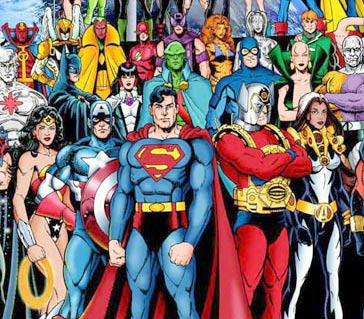
You have no excuses, Kal-El. But the rest...

“It was cowardly for a 6′4″ graduate assistant to witness the rape of a child by an older man and not only take no action to stop it but also not even call the police,” writes David French in the National Review.

He is, of course, referring to Mike McQueary, then a 28-year-old graduate student assistant coach for Joe Paterno at Penn State. Others have declared that it was an “absolute moral imperative” that McQueary physically intervene to stop the sexual assault.

It is interesting that the absolute moral imperative is nonetheless linked to qualifiers. French references McQueary’s size and the fact that the alleged assailant, Jerry Sandusky, is older. Some critics have focused on his gender. Still others, making the argument that McQueary failed to intervene because he didn’t take a child rape seriously enough, have suggested that he would have acted differently had Sandusky been beating, rather than raping the child. Of all the ethical debates surrounding the Penn State scandal, the question of how much scorn should be heaped on McQueary for not acting immediately to stop the rape in progress has been the most fascinating, and to my mind, the most disingenuous. It appears that every commentator, male or female, young or old, fat or fit, is convinced that would have charged in and battled the 57-year-old former wide-receiver, pummeling him into wet submission while the child escaped. Maybe. Studies and anecdotal evidence indicate that in fact, most people wouldn’t physically intervene. Perhaps sportswriters and op-ed writers are made of sterner stuff that the rest of the public.

Yes, that must be it.

None of this is to suggest that physically stopping a child rape in progress isn’t the right thing to do; it is. For his part, McQueary reputedly didn’t take any action to stop the assault,* which in order of effectiveness would be… Continue reading
Comment of the Day: “Mike McQueary and Me”

Some recent Ethics Alarms commenters

Joseph Edward bought me some time with this superb Comment of the Day, because I am writing a post on the same topic. Mike McQueary’s conduct in the locker room, when he allegedly witnesses Jerry Sandusky raping a boy,  has generated some of the most self-righteous and, I may say, annoying comments I’ve encountered on Ethics Alarms, characterizing my commentary (in “Mike McQueary and Me”) on why McQueary might have acted as he did with excusing his conduct. Most of these, I’m relatively certain, are motivated by those who want to shift responsibility for the Penn State debacle away from Joe Paterno.

One particularly persistent and vociferous commenter has decreed that it was an “absolute moral obligation” for McQueary to physically intervene to stop the assault he witnessed. Joseph touches on that dubious contention; I’ll have more to say about it soon. Meanwhile, here is his Comment of the Day, on “Mike McQueary and Me”: Continue reading

The Ethical Duty To Correct Stupidity

The Martin Luther King Memorial was unveiled without the commission responsible for it bothering to fix what has been almost unanimously condemned as an embarrassing mistake, a rephrased, out-of-context quote on the sculpture base (“I was a drum major for justice, peace, and righteousness”) that misrepresents Dr. King’s career and was also something he never said. This is inexcusable, but at least the boob who unilaterally made the decision spelled “righteousness” correctly. The sign above is emblematic of a different ethical problem, the widespread abdication of the shared obligation to speak up when one sees someone else making a really stupid mistake. Continue reading

Stacy Crim, Ethics Hero…and the Hardest Choice

Last week in Oklahoma, Ray Phillips fulfilled a promise to his sister Stacy, taking home from the hospital 5-pound Dottie Phillips, born prematurely in September, to become the newest member of his family.  Stacy died last month of brain cancer, just three days after holding her infant daughter for the first and only time. Dottie was able to come into the world only because Stacy, 41, had made the choice to reject chemotherapy for her rapidly spreading cancer that was diagnosed after she learned that she was pregnant.

When life places one of us in a “Sophie’s Choice” dilemma like Stacy’s, no one has standing to question or challenge whether the ultimate choice is “right.” There is no right choice. Stacy was faced with deciding whether to sacrifice the unborn child she had never met, a child whom many in America choose to regard as a neither a life or a being with any individual rights, but rather only as an ephemeral potentiality made of cells, similar to a pay-off at the races or a stock dividend. Even those who take the opposite view, that Dottie was a human life even at the earliest stages of her development in the womb, would never assert that a mother would be wrong to choose life-saving cancer treatments for herself at the risk of the unborn child. In such a case the right to choose is nearly unanimously accepted, and it is the hardest choice of all. Continue reading

Celebrate Columbus Day, Honor Columbus

Today is Columbus Day, not that one would know it to read the typical paper or to watch most newscasts. The Italian explorer’s reputation and legacy have been relentlessly eroded over the years by temporal chauvinists who apply spurious social and historical hindsight to justify unfair criticism of civilization’s heroes. Christopher Columbus deserves the honor this holiday bestowed on him.  He was a visionary and an explorer who, like all transformative figures, possessed the courage and imagination to challenge conventional wisdom and seek new horizons of achievement.

Holding Columbus responsible for the predation of the Spanish and the devastation of native populations that were among the unanticipated consequences of his achievement is the equivalent of blaming Steve Jobs for technology’s elimination of occupations and the fact that our children are fat and have the attention span of mayflies. And of course, anyone who believes that the Stone Age populations of the Americas would have continued to prosper in Avatar bliss without Columbus’s intrusion is ignorant of both human nature and world history. Continue reading

Ethics Hero: David Letterman

No Free Speech weenie he. Yale, take note.

I stopped watching David Letterman years ago, when I learned that he was an unapologetic serial sexual harasser.  I don’t like to patronize the work of professionals, however talented, who should have been fired and would have, if their employers had any integrity. As a result, I missed Letterman’s ascent into ethics hero territory. It pains me to admit this, since I neither like nor generally respect him, but that is where David Letterman belongs.

On the June 5, 2011 edition of “The Late Show with David Letterman,” the host smilingly pulled his finger across his throat to note the U.S. military’s reported killing of Ilyas Kashmiri, an Islamist terrorist who was one of the organizers of a deadly attack in India that killed and wounded hundreds of innocent civilians. On a roll, Letterman made a joke about Osama bin Laden’s death as well.A group of radical Islamists took offense, and in a posting on the Islamist web forum Shumukh al-Islam, called for Letterman’s murder, urging the eventual assassin to cut out Letterman’s tongue.

Continue reading

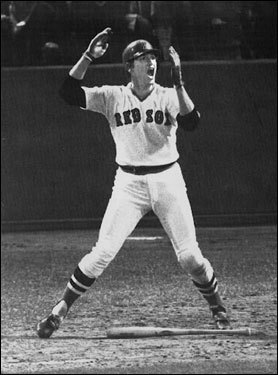
A Fan’s Obligation: 12 Life Lessons From Being a Red Sox Fan

Thanks Carlton. I won't forget.

This is not going to be a fun day.

The Boston Red Sox, the baseball team to which I have devoted a remarkable amount of my time, passion and energy over a half-century, are threatening to complete late season collapse of embarrassing and historic proportions. A spectacularly bad month of September has the team holding on to its once assured post-season play-off slot by its fingernails, and the squad appears to be dispirited and unhinged. Today the Red Sox play a double-header with the New York Yankees, the team’s blood-foe, and its prospects don’t look good. I, of course, must watch both games.

Following a losing baseball team is emotionally hard—I listened to or watched every game the Red Sox played in a six year period in which they never had a winning season— but following a collapsing winning team is much, much worse. It feels like a betrayal, yet at the same time the fan feels guilty for being angry with the players, who undoubtedly are suffering more than you are. This is, after all, their career. Still, you have had your hopes raised over many months; you have, if you are a serious fan, attached your self-esteem to your team’s fortunes. Watching it tank is like watching a presidential candidate you have argued for, and gone to rallies for and contributed to make an ass of himself in a debate. (And no, I’m not a supporter of Rick Perry.) Continue reading

The Cowardly GOP Presidential Field

Cowards. All of them.

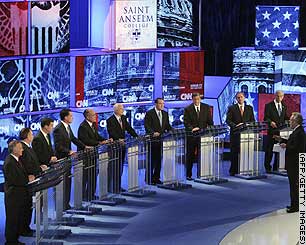
In three consecutive Republican presidential debates, members of the partisan audience have displayed obnoxious and callous attitudes in response to questions directed to the candidates. In the first, a portion of the assembled conservatives cheered an accounting of the convicted murderers put to death by the Texas penal system. During the second, vocal members of the audience shouted “Yeah!” to Wolf Blitzer’s questioning whether uninsured Americans should just be allowed to die without medical care. Then, in this week’s debate, the crowd jeered a videotaped soldier who declared himself as gay before asking if the candidates would support the recent elimination of “Don’t Ask Don’t Tell” as military policy.

Pundit efforts to characterize these outburst as typical of the Republican, conservative or Tea Party constituencies are blatant stereotyping, cynical and unfair. Anyone who has any experience speaking or performing to an audience knows that a few people can dominate audience reaction without being representative of it. No, it is not the Republican constituency that was exposed by these incidents, but the contenders for that party’s and the nation’s leadership. The failure of any one of the assembled candidates, nine in the first two debates, ten this week, to clearly and emphatically condemn the offensive reactions and the “thinking” underlying them suggests that none of the candidates possess the integrity, courage, confidence and values required to be a trustworthy leader of the United States. Continue reading

Solyndra, the White House, and the Most Dangerous Conflict of Interest of All

It isn’t a Republican or a Democratic Party problem, and it isn’t unique to the Obama Administration. It is a structural problem in American government, a conflict of interest that pits the best interests of the American people against the political interests of the party in power. The only solution to the problem, since it is here to stay, is leaders who acknowledge the conflict, are dedicated to doing the right thing anyway, and have the courage to demand that their staffs do likewise.

The Soyndra scandal shows that Barack Obama is not such a leader. That does not make him unique, but it is a serious ethical flaw nonetheless. Continue reading

Comment of the Day: Ethics Hero Alan Ehrlich Responds

"citation..for..making...the...police...look...bad.."

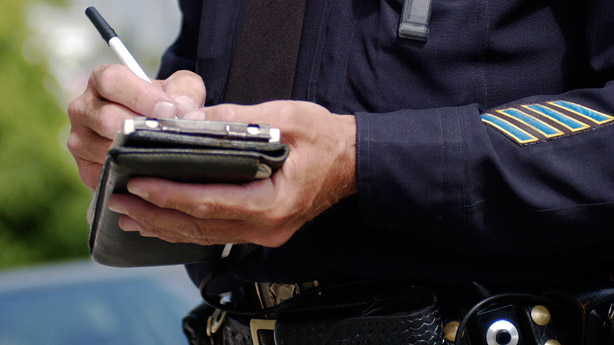
Ethics Hero Alan Ehrlich, the South Pasadena citizen ticketed for directing traffic at a busy intersection when the lights failed and no police responded, has provided some valuable insight and additional details in his comments to my post about his conduct and subsequent treatment, “When Ethics Hero Meets Ethics Dunce: Alan Ehrlich and the Spirit of Citizenship vs. South Pasadena Police Chief Joe Payne and Official Arrogance.” It is collected and posted below. Thanks, Alan. Continue reading