When The Anti-Liberty Mobs Attack, Courage And Character Are Paramount, Part I: The “Rub & Tug” Fiasco

As I explained in the initial post about the “Rug and Tug” controversy, the protests against Scarlett Johansson being cast as a biological female who led her life as a transsexual male  (that’s “Tex” on the left) made no sense. The arguments put forth by the transgender cyber-mob and others  undermined the movement for non-traditional casting that would provide minorities, like trans actors, more opportunities in their chosen field.  Their position was a double standard and  internally inconsistent, asserting that biological males who had transitioned to female were a more logical choice to play a real life character who was born female, than a female actress who would be playing a female identifying as a male…when as a female actress, that’s what she would be doing in reality. The controversy was unfair to Johansson (again) and was contrary to the whole concept of acting. Never mind! Transsexuals are currently the darling victim group of the Left, and don’t have to make sense, be consistent, or even advocate causes that avoid undermining other progressive causes and constituencies. What they say is just right, because they say so, that’s all, and anyone who disagrees is a bigot, and that’s that. They want what they want, and because they have been discriminated against in the past, they don’t have to be logical or consistent.

Thus, in episodes like this they can become monsters, using bullying and  social media to demand their desires regardless of whether it is an ethical position or not. Make no mistake: in this case, their position was not an ethical one. What is desperately needed when groups misbehave this way and abuse their influence and power is for their target to say no. Unfortunately, doing so requires unusual levels of principal, character, responsibility, intelligence and courage.

Johansson is a talented actress and a major star, but she does not, we now know, have what it takes. Noticing that no significant voices in Hollywood rallied to her defense, the actress quit the project and resigned from the role, issuing standard Hollywood political correctness blather:

“In light of recent ethical questions raised surrounding my casting as Dante Tex Gill, I have decided to respectfully withdraw my participation in the project. Our cultural understanding of transgender people continues to advance, and I’ve learned a lot from the community since making my first statement about my casting and realize it was insensitive. I have great admiration and love for the trans community and am grateful that the conversation regarding inclusivity in Hollywood continues. According to GLAAD, LGBTQ+ characters dropped 40% in 2017 from the previous year, with no representation of trans characters in any major studio release. While I would have loved the opportunity to bring Dante’s story and transition to life, I understand why many feel he should be portrayed by a transgender person, and I am thankful that this casting debate, albeit controversial, has sparked a larger conversation about diversity and representation in film. I believe that all artists should be considered equally and fairly. My production company, These Pictures, actively pursues projects that both entertain and push boundaries. We look forward to working with every community to bring these most poignant and important stories to audiences worldwide.”

This is Authentic Frontier Gibberish, self-contradictory and easily translated as “Hey, whatever the anointed  in-group says is right is right with me! I’m certainly not going to buck conventional wisdom if it means losing fans, roles, and money! You tell me what to think, and I’ll think it. Tell me to jump, and I’ll say “How high?” I welcome my Political Correctness Masters, and will do their bidding.” Continue reading

Where Have You Gone, Ernest Hemingway? Of Baseball, Tanking, Winning, Trying, And Life…

This essay is only incidentally about baseball, but like so many things that sieve through my brain, it was sparked by a conversation about baseball. On the satellite radio MLB channel, one of the interchangeable hosts—I really have trouble telling them apart: some are ex-general managers who nobody will hire, some are ex-players, and a few are sportswriters, but they all seem to say the same things, though one says them with a bilateral lisp—was interviewing a New York sportswriter. That alone would normally prompt me to switch to the Beatles Channel (or the weather), but as I reached for the dial I caught one of the writer’s comments. He was talking about the fact that the New York Yankees’ opponent at the time, the Tampa Bay Rays, were almost a .500 team, and were competing despite a tiny payroll, unlike many other teams this year, which have adopted the controversial strategy of fielding cheap and crummy teams (called “tanking’) in the hopes of getting high draft choices as a reward for  miserable won-lost records.

“I guess you have to admire the Rays,” he said, “though in this day and age, it makes no sense to try to be a .500 team.”

What a nauseating, unethical position, and how characteristic of the downward trend in American values and spirituality!  It makes no sense to try be a .500 team? This sentiment warps so much in American life today. It translates into the envy, resentment and anger that typical, normal, healthy Americans lug around on their souls all day because they aren’t rich like the people they see on TV, or the neighbor down the street who had wealthy parents and left him a bundle.

It makes sense for the Rays to try to be a .500 team because it means the team is doing the best it can, despite limitations beyond its control, to give its fans something to cheer and care about. It makes sense to try to be a .500 team for the same reason it makes sense to aspire to be the kind of steady, honest, hard-working middle class American who raises happy and well-adjusted children in a stable home but will never win any major awards or be the subject of features in their local newspapers. It makes sense to try to be a .500 team for the same reason it is right to work hard and well no matter what your salary, or whether you are being paid at all.

Ambition is a great motivator, as long as one understands that achieving one’s goals is often as dependent on chance and chaos as it is on industry and talent, and if you prepare yourself to be bitter about that, bitter is how you are likely to wind up.

I learned to love baseball passionately following a .500 baseball team–indeed a sub-.500 baseball team— that seemed like it would never be anything but. This was in an era where the New York Yankees literally won the pennant every year, with a rare exception now and then. The system was rigged to favor them, and had been for decades. The Boston Red Sox began every season knowing that getting to the World Series was a pipe dream, and their fans knew it too. Nevertheless, they tried. As an almost good team, they had a chance to win every game—not a great chance, when they were playing the Yankees, but a chance. Often the Sox made a good fight of it while going down: our hopes were raised, and there was that wonderful-horrible moment that is the beating heart of baseball where anything can happen from a miracle to a tragedy as the ball is hurtling toward the plate and fate’s resolution. Life is like that, and the sooner you realize and accept it, the better off you are.

The best hitters make outs 60% of the time, and the best teams still lose at least 35% of their games. The typical players and teams do worse than that, just like the typical American, indeed human being, loses a lot more often than he or she wins. The important thing, the thing that undergirds ethics, and integrity, and responsibility, and honor, is that you do the best you can, and pick yourself up when you fail, and try again. It’s not a bromide. It’s the only way to live without going crazy, becoming a serial killer, or surrendering to despair. Continue reading

July Fourth 2018 Post Red Sox Victory Over The Nationals Ethics Warm-Up: Patriotic Births And Deaths, Siri, Affirmative Action, And A GOP Rep. Wants To Forget The Past…

Happy

Fourth of July!

Sorry for the late Warm-Up: I had to root the Red Sox to victory in an 11 AM game, and will soon celebrate Independence Day by seeing “Jurassic World II”…

1. Ethics Dunce: Siri.  A speech by British Defense Secretary Gavin Williamson  in the House of Commons  yesterday was interrupted when Apple’s smartphone digital assistant, which heard her master mention terrorists in Syria, blurted out,  “I found something on the web for Syria!”

2. Good. Let it never be said that the Trump administration didn’t accomplish anything positive. Yesterday the Administration withdrew several Obama Administration policy documents designed to push universities toward admissions policies that involved preferences based on race. Affirmative action, which is government sanctioned race discrimination (because the ends justify the means) has always defied the Constitution, and the Supreme Court has consistently warned that the leash was short, and the breach would not be tolerated forever.  With higher education flagship Harvard University being exposed as grossly discrimination against deserving Asian-American applicants in the interest of “diversity,” and an affirmative action-tender majority on the Supreme Court looking like a thing of the past with Justice Kennedy’s retirement, this relic of the Seventies, a policy that exacerbated racial divisions as much as any factor in U.S. society, needs to be rejected completely and finally, and the announcement from the Education Department is an excellent start. In a related statement, as in the earlier withdrawal of the “Dear Colleague letter” that extorted universities into dispensing with due process and a presumption of innocence in student sexual assault cases, Attorney General Jeff Sessions pointedly rejected this method of abusing power that the Obama Administration fine tuned to an art, saying,

The American people deserve to have their voices heard and a government that is accountable to them. When issuing regulations, federal agencies must abide by constitutional principles and follow the rules set forth by Congress and the President. In previous administrations, however, agencies often tried to impose new rules on the American people without any public notice or comment period, simply by sending a letter or posting a guidance document on a website. That’s wrong, and it’s not good government.”

Exactly. Continue reading

Ethics Hero: Philadelphia Phillies Pitcher Vince Velasquez

I am now officially a Vince Velasquez fan.

Pitching in the second inning last night against my Washington Nationals (they will briefly cease being my team when they face the Red Sox in an inter-league series this week), Velasquez was nailed in his pitching shoulder by 97-mph line drive from the Nats’ Adam Eaton.  Rather than fall to the ground screaming—the ball easily could have broken the pitcher’s arm—Velasquez continued doing his job. He went after the deflected ball, throwing off his glove as he ran, picked it up with his left (non-pitching) hand, and threw hard and accurately to first base for the out.

THEN he fell to the ground in agony from the pain in his injured pitching arm. Velasquez was placed on the disabled list after the game, which he left immediately.

From a purely athletic standpoint, the play was remarkable. Velasquez is obviously ambidextrous, and I assume he has thrown a baseball left-handed before. Nonetheless, doing so in a game situation so accurately is astounding. Ethically, which is more important (here anyway), his play demonstrated exemplary character. His first thought was not of himself, though nobody would have thought less of him if the pitcher had fallen to his knees in pain immediately and taken himself out of the play. Velasquez’s immediate focus was on his job, and hid duty to his team. He not only completed the play, but reacted to the circumstances coolly and efficiently, exhibiting courage, diligence, sacrifice, responsibility, and competence.

Vince Velasquez is the baseball equivalent of the hero in a war movie who tosses the decisive hand-grenade into the nest of enemy soldiers after he has sustained a crippling wound.

Unethical Quote Of The Week: Texas Governor Greg Abbott

“Not only did he want to commit the shooting, but he wanted to commit suicide after the shooting. He didn’t have the courage to commit suicide.”

—-Texas Governor Abbott (R) to reporters today, speaking of 17-year-old Dimitrios Pagourtzis, the Santa Fe shooter.

The only question is whether this statement proves that Abbott is an idiot, or if he was just idiotically irresponsible on this occasion.

Kudos to Ann Althouse for the catch. She writes, “Whatever outrage you feel fired up or politically motivated to express, do not put that idea out there for young people to consume: Suicide is an act of courage.”

Exactly.

Choosing life, as well as choosing to accept the consequences of your actions, is usually the courageous choice. Does Abbott not know this, or was he just reaching for a cheap insult to use against a killer, and inadvertently stuck his foot in his mouth?

Someone should have asked him about the horrible suicide in New York City yesterday, when former Playboy Playmate Stephanie Adams jumped to her death from the top floor of the Gotham Hotel with her 7-year-old son in her arms. 

Governor Abbott must have really admired that.

Ethics Observations On The Homeless Hero

Perhaps you have seen this video:

Apparently both the Brooklyn attacker and the man who took him down were homeless.

Observations:

  • I thought the “knock-out game” was 1) over with and 2) an urban myth. This sure looks like the “game” to me.

I can’t find a single report that notes that, however.

  • I also can’t find the name of the man who tackled the assailant and held him until police arrived.

Why hasn’t such a good citizen been recognized?

  • Many of the headlines on this story are like CBS’s, which reads, “Homeless Good Samaritan Saves 2 Elderly Women Attacked By Homeless Man.” That’s fake news. Can’t these hacks get any story right? Watch the video. Yes, the man attacks the the attacker of the two women, but the bad homeless man was trying to leave. The damage to the women he punched was done. By no interpretation of that video can it be said that the “good Samaritan” saved  the victims. Indeed, he didn’t interact with them at all.

The video accompanies the headline, and yet the headline is still false!

Tell me again, ye Defenders of the News Media, why we are supposed to trust these irresponsible, undependable, incompetent hacks, much less respect them.

  • Would you do what the Good Samaritan did here? If not, why not?

Morning Ethics Warm-Up, 4/23/2018: An Overdue Pardon, A Questionable No-Hitter, A Stupid Tweet, A Modest Hero…

Yes, I’m still here…

For one of the very few times since 2009, there were no posts yesterday. I’m sorry. I was pressed on a client’s urgent deadline from 7 am to 11 pm, with errands and sanity breaks in between, and never could get my schedule or brain cleared sufficiently to work on Ethics Alarms.

1 This is the news media. This morning, HLN  has spent 5-10 minutes every hour covering the birth of Queen Elizabeth’s latest grandchild. He’s a boy, in case you were on pins and needles. This isn’t fake news, it’s non-news. Why is this important? What possible use does detailed information regarding the latest addition to the succession train (he’s fifth in line) of an increasingly anachronistic monarchy have to the U.S. public? I’m looking at the morning New York Times, and literally 98% of its contents are more newsworthy.

Among the events broadcast in connection to this non-event was an elaborately dressed “town cryer” in London, ringing a bell and reading from a scroll to announce the royal birth. After CNN’s remote cameras recorded this memorable moment, it was revealed by a London correspondent that the elderly man dressed like a Tower Beefeater is a wacko, with no official significance whatsoever. Then a half hour later, HLN showed the wacko’s act again, sans any wacko label, but text that said, “Moments ago.” Thirty minutes is “moments”? Then we got new post-birth news, the London odds-makers take on what the likely name of this completely unimportant future prince will be. The odds on “Jack” were 9-1. Said Robin Meade’s sidekick Jennifer Westhoven: “Jack? Wouldn’t that be ‘James’?”

No, you ignorant moron. A., Jack is a real name. I can prove it, and B. It is a nickname for John, not James.

Yeah, we should trust these people.

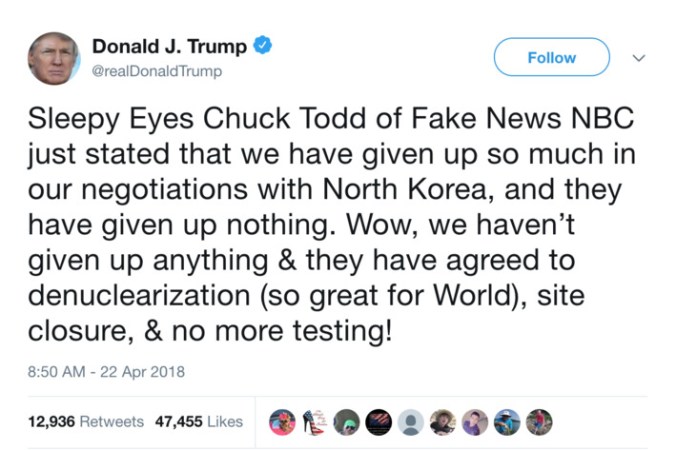
2. Trump Tweets. Okay, what is this? President Trump, flush with success over questionable reports that North Korea has decided to halt nuclear testing (you know, like Iran, and equally trustworthy), tweeted,

Now, it is easily determined that the North Koreans have not agreed to “denuclearization.” Meetings haven’t even taken place. The tweet is fantasy. This is the kind of thing the mouth-foaming Trump haters point to as an example of the President’s “lying.” A statement that can’t possibly deceive anyone else, coming from someone who habitually makes such statements, is a falsehood, but whether it is a lie is questionable. Does Trump believe this tweet, at least when he wrote it? I suspect so. He communicates–indeed, he thinks— in cloudy generalizations and concept clouds. Is this tweet and its ilk spectacularly irresponsible and self-destructive to his ability to be respected and believed? Oh, definitely. Stupid and embarrassing too. But a lie? I’m not sure. “Trumpism” might be a better term.

Calling out NBC with “fake news” in front of a tweet with fake news is certainly audacious stupidity, however.

3. Now the Good Trump (maybe): Reportedly, spurred by the suggestion of Sylvester Stallone, the President is considering a pardon for Jack Johnson, the first black heavyweight champion (1908-1915) who was hounded by the government and personally destroyed, mostly because of his proclivity to have relationships with white women. Johnson’s primary crime was being a successful, defiant, black man at the height of Jim Crow. The play (and movie) “The Great White Hope” tells his story, which is an American tragedy; Ken Burns also made a superb documentary about Johnson.

Johnson was convicted of violating the Mann Act, for transporting women across state lines for immoral purposes, in his case, miscegenation. Eventually he served time in a federal penitentiary. There have been calls to grant Johnson a posthumous pardon for at least a decade. A 2008 bill requesting President George W. Bush to pardon Johnson in 2008 passed the House, but failed to pass in the Senate. Senator McCain,  Representative Peter King, Burns and Johnson’s great-niece requested a presidential pardon for Johnson from President Obama in 2009, and again in  2016, in honor of the 70th anniversary of Johnson’s death in a car accident. A vote by the United States Commission on Civil Rights also called on Obama to “right this century-old wrong.” There was also a Change.org petition. Obama never acted, causing a firestorm of protest from the Congressional Black Caucus.

No, I’m kidding: it was hardly mentioned in the news media or by black activist groups. And Jack Johnson’s life, despite the fact that hardly anyone under the age of  50 could tell you anything about him, mattered. If President Trump finally does the right thing and clears Jack Johnson’s name, I wonder how progressives and the news media will attack him for it?

4. Wait, why wasn’t he texting, “I’m so terrified!”? James Shaw Jr., 29, rushed a shooter armed with an AR-15 (and not wearing pants) who had opened fire yesterday in a Waffle House in Antioch, Tennessee.  Four people had been shot dead and many other were injured before Shaw grabbed the gun’s barrel, pulled it away and threw it over the Waffle House counter. He suffered a gunshot wound and burns from grabbing the gun’s barrel.  Although his actions are credited with saving many lives,  Shaw Jr. denies that he’s hero. “I was just trying to get myself out. I saw the opportunity and pretty much took it,” he says.

Real heroes seldom regard themselves as heroes. The fact is that he took action, placed himself at risk in doing so, and had the right instincts, exactly the ones this culture is supposed to nurture but increasingly does not: take control of your own fate, and do what needs to be done.

Trust me on this, James (can I call you Jack?): You’re a hero. Continue reading

Morning Ethics Warm-Up, 3/31/2018: The Baseball-Trained Rifleman, The Hockey Hero Accountant, And Some Other Stuff That’s Just Annoying…

http://www.youtube.com/watch?v=xbAfEfBUuyw

Good morning!

1. “The Rifleman” and “Fix the problem.” I recently was interviewed by a graduate student in organizational leadership and ethics. One thing we discussed was how popular culture in America once dedicated itself to teaching ethical values and ethics problem-solving, especially in shows aimed at young audiences. This is not so true any more; indeed, popular culture models unethical conduct at least as often today.

I told my interviewer about recently watching an episode of “The Rifleman,” the early ’60s TV Western about a single father raising his young son while being called upon to use his skill with a rifle to fight for civilization in the harsh frontier.  In the episode, hero Lucas McCain (played by the under-rated Chuck Connors) had to deal with an old friend, now an infamous outlaw, who had come to town. (The ethical conflict between personal loyalty and an individual’s  duty to society was a frequent theme in Westerns.) Lucas was a part-time deputy, and at the climax of the episode, his friend-gone-bad is prepared to ride out of town to escape arrest for his latest crime. Lucas tells him not to leave, and that if he tries to escape, Lucas will have to let his custom-made rifle settle the matter, as usual. (Peace-loving Lucas somehow managed to kill over a hundred men during the run of the series.)  Smirking, his friend (Richard Anderson, later known as the genius behind “The Six Million Dollar Man”), says that he knows his old friend is bluffing. For Lucas owes him a lifetime debt: he once saved “The Rifleman’s” life.  You’re a good man and a fair man, the villain says. “You won’t shoot me. I know you.” Then he mounts his horse , and with a smiling glance back at “The Rifleman,” who is seemingly paralyzed by the ethical conflict, starts to depart. Now his back is all Lucas has to shoot at, doubling the dilemma.  You never shoot a man in the back, an ethical principle that the two officers who killed Stephon Clark somehow missed. We see McCain look at his deadly rifle, then again at the receding horseman. Then, suddenly, he hurls his rifle, knocking his friend off his horse. The stunned man is arrested by the sheriff, and says, lamely, as he’s led away. “I knew you wouldn’t shoot me.”

I love this episode. It teaches that we have to seek the best solution available when we face ethics conflicts, and that this often requires rejecting the binary option presented to us, and finding a way to fix the problem.

Of course, it helped that Chuck Connors used to play for the Dodgers, and could hurl that rifle with the accuracy of Sandy Koufax.

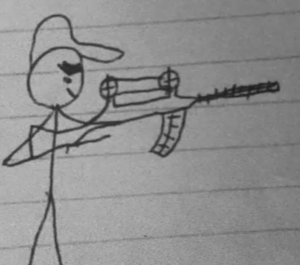
2. Here we go again! Now that anti-gun hysteria is again “in,” thanks to the cynical use of some Parkland students to carry the anti-Second Amendment message without having to accept the accountability adults do when they make ignorant, dishonest, and illogical arguments in public, teachers and school administrators are back to chilling free speech and expression by abusing their students with absurd “no-tolerance” enforcement. At North Carolina’s Roseboro-Salemburg Middle School, for example, a 13-year-old boy in the seventh grade was suspended for two days for drawing  a stick figure holding a gun.

I drew pictures like this—well, I was little better at it—well into my teens. It’s a picture. It isn’t a threat. It isn’t anything sinister, except to hysterics and fanatics without a sense of perspective or proportion—you know, the kind of people who shouldn’t be trusted to mold young minds. “Due to everything happening in the nation, we’re just being extra vigilant about all issues of safety,” said Sampson County Schools’ Superintendent Eric Bracy, an idiot. How does punishing a boy for a drawing make anyone safer? It makes all of us less safe, by pushing  us one step closer to government censorship of speech and thought.

Then we have Zach Cassidento, a high school senior at Amity High Regional School in Connecticut who was suspended and arrestedarrested!—for posting a picture of his birthday gift, an Airsoft gun, on Snapchat. He was not charged, but was suspended for a day from school….for posting, outside of school, on his personal account, the picture of an entirely legal toy gun (It shoots plastic pellets: my son has several of them).

The people who do this kind of thing to children in violation of their rights as Americans are the same people who cheer on David Hogg while signing factually and legally ridiculous petitions. They should not be permitted to teach, and this kind of conduct ought to be punished.

Where is the ACLU? For the organization not to attack these abuses is an abdication of the organization’s mission. Continue reading

Morning Ethics Warm-Up, 3/14/2018: The “Blotto From A Sleepless Night Fuming About Nobody Stopping That Puppy From Being Stuffed In The United Overhead Luggage Bin” Edition

Good Morning, United!

Where’s that whimpering sound coming from?

Grrrrrrr.

1 Don’t make America stupid, ABC. The new ABC legal drama “For The People” premiered last night, and lost me forever. I can’t trust the writers. In the final moments of the episode, a veteran female defense lawyer was consoling a young lawyer who was upset after losing a case. The older lawyer evoked the memory of a 1951 rookie for the New York Giants, who went hitless in his first Major League games and was devastated. But his manager put him in the line-up again, and he hit a home run in his first at bat, and never stopped hitting.

“Ah,” said the young lawyer, “Willie Mays. The greatest player who ever lived.” The older lawyer nodded sagely.

By no measure was Willie Mays the greatest baseball player. Is this racial politics by series creator Shonda Rhimes? I assume so: there is no other plausible explanation. The odds of two randomly selected baseball fans asserting that Mays was the greatest baseball player would only be more than miniscule if anyone who knows baseball believed that. Willie was the greatest centerfielder of all time, the greatest African-American player of all time, quite possibly the most charismatic and entertaining player to watch of all time, and very possibly the second most gifted baseball player of all time. But he wasn’t the greatest. The best player by every measure, statistical, modern analytics, WAR, JAWS, OPS, contemporary reports and common sense was, of course, Babe Ruth. He was the greatest hitter who ever lived, a great pitcher before that, and no athlete in any sport ever dominated it like Babe did in the Twenties.

Now, any individual can hold an eccentric opinion that Willie was better. But that was not how the assertion was presented. It was presented as an accepted fact that two random baseball fans agreed upon. This is irresponsible misrepresentation. I was trying to think of an equivalent: I think it’s like a TV show having someone quote the Declaration of Independence, and a listener then  say, “Thomas Jefferson. Our greatest President!” as the other individual nods sagely.

2. Four Regans, or, if you prefer, Linda Blair Heads.This is the new Ethics Alarms graphic for unethical media spin. The number of Regans can range from one to four, with four Regans signifying “spinning so furiously her head might fall off.” (If you don’t get the reference, you are seriously deficient in cultural literacy.) The four Regans go to the polar news media spinning yesterday’s special election in Pittsburgh, Pennsylvania, where Democrat Conor Lamb appears to have narrowly won a seat in a Republican stronghold, though the race is still too close to call. Continue reading

Morning Ethics Warm-Up, 3/6/ 2018: “Remember the Alamo” Edition

1 Remember the Alamo! On this date in 1836, before dawn, the Alamo fell. From the official Alamo website:

While the Alamo was under siege, the provisional Texas government organized at Washington-on-the-Brazos. On March 2, the convention declared independence and the Republic of Texas was born, at least on paper. The Alamo’s garrison showed its support for independence from Mexico by sending its own delegates to the convention.While they were unaware that Texas had declared independence, the roughly 200 Alamo defenders stayed at their post waiting on help from the settlements. Among them were lawyers, doctors, farmers and a former congressman and famous frontiersman from Tennessee named David Crockett. While the youngest was 16 and the oldest defender was Gordon C. Jennings, age 56, most defenders were in their twenties. Most were Anglo, but there were a handful of native Tejano defenders as well. Legendary knife fighter and land speculator James Bowie was in command before falling ill and sharing duties with Travis. Several women and children were inside the Alamo, including 15-month-old Angelina Dickinson. Just before the final battle, Travis placed his ring around her neck, knowing she would likely be spared. One of the last messages from the Alamo was a note from Travis asking friends to take care of his young son Charles.

The final attack came before dawn on March 6, 1836. As Mexican troops charged toward the Alamo in the pre-dawn darkness, defenders rushed to the walls and fired into the darkness. Travis raced to the north wall but was soon killed. Bowie was most likely killed in his bed, while reports differ as to Crockett’s death. Many believe Crockett survived the initial attack but was put to death by Mexican soldiers soon afterward.

Mexican soldiers breached the north wall and flooded into the compound. The fierce battle centered on the old church, where defenders made a last stand.

The battle lasted about 90 minutes.

From the San Antonio Express News:

BEXAR, Texas, March 6, 1836 — Alas, alas! Forever more, the name of the Alamo shall stand alongside that of Thermopylae in the annals of history as a tale of unmatched bravery to be handed down from generation to generation.

The bastion of Texas Liberty has fallen, and to a man, Lt. Col. William Travis and his fellow defenders — like the immortal 300 Spartans — have been martyred.

After withstanding an unrelenting siege of twelve days’ duration by one of the mightiest armies ever assembled on this continent, the walls of the old mission that had housed Travis (a man as brave as the fabled King Leonidas), Col. James Bowie, the Hon. David Crockett and some 200 other defenders were breached before the sun rose to-day.

Savagery was unleashed therein as a juggernaut orchestrated by the modern-day Xerxes, Mexican Gen. Antonio López de Santa Anna, swept over the Alamo….

Since I was a small boy, this episode in American history moved me more than any other. It still does.  I first learned about the Alamo when I watched Fess Parker as Davy Crocket, swinging his rifle like a baseball bat at Mexiacn skulls, the last man standing as behind him we could see more of Santa Anna’s soldiers pouring over the wall. We never saw Davy fall—my dad explained that this was appropriate, since nobody is sure how or when he died, unlike Travis and Bowie, and the last verse of the Ballad of Davy Crocket played…

His land is biggest an’ his land is best
from grassy plains to the mountain crest
He’s ahead of us all meetin’ the test
followin’ his legend into the West
Davy, Davy Crockett, king of the wild frontier!

The politics and complexities of the Texas war of independence don’t alter the essential facts: a group of men of different backgrounds, under the command of three prototypical American figures—the pioneer (Crocket), the settler (Bowie), and the law-maker (Travis), all of whom were trying to recover from dark periods in their lives—chose to make the ultimate sacrifice for a cause they believed in fervently enough to die for, in the company of others who felt the same. It was, after all, the perfect ethical dilemma, the choice between an ethical act for the benefit of  society and a non-ethical consideration, the most basic one of all: staying alive. They all had the same choice, and rejected life for a principle.

That’s what I remember about the Alamo.

2. There is hope. Once again, I gave a 90 minute presentation to a Boy Scout troop and parents last night, and challenged them this time with several hypotheticals that Ethics Alarms readers would recognize, such as this one, the plight of Ryan Seacrest and those who snubbed him on the red carpet,  the “Mrs. Miniver” flower show, and this one, from personal experience, which set off the most lively debate of all:

The Option

Your professional theater company has limited funds, so it offers its actors an option. They may choose a flat fee for their roles, or get a percentage of the show’s profits, if there are any, on top of a much smaller base fee.

The company just completed an extremely profitable production, the biggest hit your theater has ever had. Nine of the show’s ten cast members chose the percentage of profits option, a gamble, because most of the shows lose money. One, the star, who you know could not afford to gamble, took the flat fee for the role. After the accounting for the production is complete, you realize that every member of the cast will make $1000 more than the star, because of the show’s profits.

Question 1: What do you do?

  1. Give him the extra $1000. It’s only fair.
  2. Pay him the flat fee. A deal’s a deal.

You can weigh in:

Question 2: You remount the production, and the exact same thing happens. The actor chooses the flat fee, the show is again a huge money-maker,,and the rest of the cast will make much more than him because they chose the percentage. Do you give him the extra amount again?

  1. No. Now he’s taking advantage of me.
  2. Yes. Nothing has changed.

As before, the approximately 50 11- and 12-year old boys were astute, serious, thoughtful, and gutsy, and their ethical instincts were superb. Continue reading