How Paul Anka Proved Harry Truman Right…

I am not a big fan of Paul Anka or his work, so I considered the new documentary on his career a default choice this morning since ice is on my satellite dish and the channel selection on Direct TV was severely limited. But it’s true: you learn something new and useful almost every day, and often in the least expected places.

I did not know, for example, that Anka wrote “Johnny’s Theme,” the now iconic music that Johnny Carson walked onto the stage to at the start of his version of “The Tonight Show.” But it’s how it ended up as Carson’s entrance music that hammers home an ethics lesson.

When Johnny Carson was preparing to take over from Jack Paar as the host of “The Tonight Show” in October 1962, he ran into Anka, whom he had worked with in a TV special. Carson mentioned to Anka that they needed a new theme, so the pop star composer of “Put Your Head on My Shoulder,” “Puppy Love” and the theme to “The Longest Day” repurposed the instrumental arrangement for “It’s Really Love,” a song recorded by his one-time girlfriend Annette Funicello (not one of Annette’s hits) and sent a demo to Carson.

Johnny phoned Paul and thanked him for the offer (and said he and Ed McMahon loved the tune) but said that “Tonight Show” bandleader Skitch Henderson had “his nose out of joint” (does any one use that phrase any more?) because Carson wanted to use a melody written by a “20-year-old kid.”

So Anka suggested that Johnny Carson write new lyrics to his song and that they call it “Johnny’s theme,” which would then be the composition of the “20-year-old kid” and Henderson’s boss. Brilliant! Henderson had to consent to the song’s use every night, and it was Johnny’s walk on music for 30 years until Carson handed over the show to Jay Leno.

Carson’s name on the song meant that he got half the royalties, which averaged $400,000 per year: Carson’s cut was $200,000 a year for lyrics that were never heard or sung. “Johnny’s Theme” had been played more than 1,400,000 times by the end of the Carson’s show’s run. Anka says that Carson admitted he was embarrassed to make all that money for nothing, but the singer shrugs and smiles about it. Johnny got a great theme, and they both made money.

My favorite Harry Truman quote, perhaps my favorite ethics quote by any President and right up there with Winston Churchill’s immortal, “Success consists of going from failure to failure without loss of enthusiasm,” is:

“It is amazing what you can accomplish if you do not care who gets the credit.”

I don’t know if Paul Anka was familiar with the quote or even if he knows about it yet, but his solution to the “Tonight Show” dilemma is as good an example of Harry’s wisdom in practice as we are likely to see.

[Still waiting for WordPress, or someone, to tell me how to get page breaks in posts under their new %$^&#@ block system…]

Sackler, Tufts, Cancel Culture And The 100th Rationalization: The Reverse Ruddigore

I have been waiting to find the ideal 100th Rationalization, officially #70 (there are 30 sub-rationalizations on the EA Rationalizations list. It’s “The Reverse Ruddigore,” the equally valid opposite of Rationalization #21. Ethics Accounting, or “I’ve earned this”/ “I made up for that”:

 You cannot earn the right to act unethically by depositing a lot of ethical deeds in the imaginary ethics bank, nor can unethical conduct be erased by doing good for someone else. The illusion that one can balance the ethics books this way is referred to on the Ethics Alarms blog as “the Ruddigore Fallacy.”  Nobody earns the right to be unethical, not even once, no matter how exemplary their conduct. An unethical act is just as unethical, whether it is performed by a saint, a hero, or a villain.

“Ruddigore,” for those of you sadly unaware of the joys of Gilbert and Sullivan, is the unjustly under-rated work by the Victorian geniuses that involved an ancient curse on a family that required a Baronet of Ruddigore to perform a crime a day or die in agony, courtesy of his re-animated ancestors, who otherwise hang around, literally, as portraits in a haunted gallery. One member of the family who has inherited the curse, Sir Despard, believes that he has found a loophole:

“I get my crime over the first thing in the morning, and then, ha! ha! for the rest of the day I do good – I do good – I do good! Two days since, I stole a child and built an orphan asylum. Yesterday I robbed a bank and endowed a bishopric. To-day I carry off Rose Maybud and atone with a cathedral! This is what it is to be the sport and toy of a Picture Gallery!”

Looking back on past posts, I laid the groundwork for #70 when I condemned the decision of Walt Disney World to remove Bill Cosby’s bust from the its Academy of Television Arts and Sciences Hall of Fame of Fame:

[L]ast I heard Bill Cosby was still recognized as a major trailblazer in stand-up, TV comedy, and television integration (remember “I Spy”?), an important positive cultural force for race relations and black community self esteem, and a spectacularly talented comedian with a unique voice and presence. None of that has changed. Those were the achievements that prompted Cosby’s bust’s inclusion in Disney’s Academy of Television Arts and Sciences Hall of Fame Plaza, along with celebrities such as Lucille Ball and Oprah Winfrey who, like the Cos, have been inducted into the Television Academy Hall of Fame. O.J. Simpson is still honored in the College Football Hall of Fame, because he was one of the greatest college stars ever. His post-career hobby as a murderer, like Bill’s extra-curricular activities as a serial rapist, have nothing to do with the honor, just as Cosby earned and still deserves, his honor for what he achieved on stage and screen.

Subsequent bad acts no more cancel out past good ones than Sir Despard’s cathedral would make up for kidnapping sweet Rose Maybud. The current “Cancel Culture,” however, holds otherwise. In the latest episode, Tufts University announced today that it will strip the Sackler name from the buildings and programs on its medical campus, after a report censured the school for its relationship with the family whose drug company made OxyContin, the opioid blamed for hundreds of thousands of deaths nationwide. Continue reading

Comment Of The Day: The Betrayal And Ultimate Triumph Of Dorothy Seymour Wills”

The smartest –and most ethical—thing John and Paul ever did: agreeing to share credit for every song, no matter who wrote it.

On the topic of authors being reluctant or resistant to sharing authorship credits,I wrote in a replay in a comment to the post,

I have shared the authorship credits of several stage shows where I was the initiator and the creator of 75-95% or more. There are two shows, a drama and a musical, that have made substantial money without my sharing in any of it—one because I added co-authors out of respect for their non-authorship contributions, the other for which I got no credit at all despite making the alterations that made the difference between the show being a hit and a flop. My wife thinks I’m a sap and a patsy. No, I think sharing credit liberally is the right thing to do, and that generosity should be the rule, not the exception. And I will continue to do unto others what they should have done unto me, even if the others usually don’t.

Here is a different personal perspective on the issue, in mermaidmary99’s Comment of the Day on the post, “The Betrayal And Ultimate Triumph Of Dorothy Seymour Wills”:

I was a record producer in the early 1980’s. (Still am.)

In ones early 20’s it was unheard of to be a producer unless one was in the group. To be a woman in their early 20’s was shocking to most every man who would arrive to the studio to see me in charge. They often assumed my boss was coming.

The men were always respectful and helpful as I cut my teeth in those early days.

How did I get a job like that?

The label owner, who was a studio musician and had played with The Righteous Brothers and other acts, had heard 3 songs I wrote on an album (my boss chose them and was the producer) and loved them. He asked my boss who wrote them, and he said I had. (And that I assisted on production on those too) so the owner said. “have her write and produced the next record, this stuff is amazing!”

So along with my then boyfriend, I did.

Yes, later I was a mom and asked to produce for another label. (Women producers were still unheard of) and I accepted. I asked my husband to help.

I’ll never forget his reply.

He kindly declined saying. If he did, I’d not get the credit, They’d think, “Oh, she helped her husband and probably nagged for credit.”

I was hurt because I wanted him to share in it. He explained nicely again how it wouldn’t support my Dream. And he LOVED producing too .

I’ve often felt lucky he was so supportive, and reading this I realize how very fortunate I am to have had him by my side.

I’m glad this story is being told. This woman deserves credit and I can see why men would both want her to, and not. Continue reading

The Betrayal And Ultimate Triumph Of Dorothy Seymour Wills

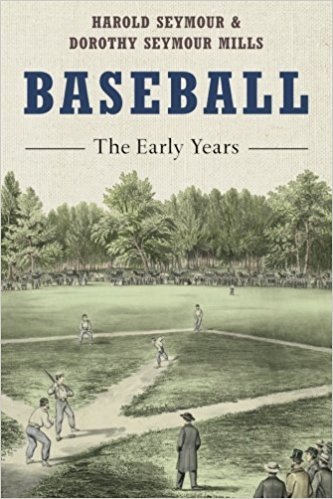
There was an upsetting ethics story in the obituaries last week. It told the tale of the rank injustice perpetrated by a famous and much-honored researcher, historian and author on his collaborator, from whom he withheld  credit and recognition—because she was his wife.

Dorothy Seymour Mills collaborated for more than 30 years on a landmark three-volume history of baseball with her first husband, Harold Seymour. Their work, originally attributed only to him,  is regarded as the first significant scholarly account of baseball’s past.  (“No one may call himself a student of baseball history without having read these indispensable works.” John Thorn in 2010, then Major League Baseball’s official historian.)

“Baseball: The Early Years” (1960), “Baseball: The Golden Age” (1971) and “Baseball: The People’s Game” (1990) all were completed with substantial and indispensable contributions by Dorothy, who, unlike her husband, was not a baseball fan. (“You write a lot more objectively about a subject you’re not in love with,” she once observed.) She was the primary researcher, organized the projects, typed the manuscripts, prepared the indexes (ugh) and edited each book before it went to the publisher. Because of her husband’s failing health, she wrote a substantial portion of “Baseball: The People’s Game.” Yet her husband adamantly refused to give her an author’s credit. Each book bore only Harold Seymour’s name, and hers was relegated to the acknowledgments.  The first book in the trilogy, “Baseball: The Early Years,” received rave reviews.  Sports Illustrated compared Seymour to Edward Gibbon, the iconic historian who wrote “The History of the Decline and Fall of the Roman Empire.” Dorothy was invisible, and her husband wanted it that way. Continue reading

Saturday Morning Ethics Warm-Up, 7/6/2019: Of Nike, MAGA Hats, Plays, Principals And All Manner Of Idiocy

Good morning.

Commemorating one week without our Rugby, who shrugged off his canine coil Saturday last. It has been a weird and lachrymose seven days, full of reflex attempts to call him, look for him, start to out out food, and more. Worsts of all have been the chance encounters with our neighbors and his admirers, which have ended in everyone involved getting choked up. This is all exhausting, and not conducive at all to adequate focus on other matters.

1. The rest of the story...Marshae Jones, the woman who got her unborn child killed by starting a fistfight with a co-worker, will not be charged for the death of the fetus in the Alabama case I wrote about here.  I thought that would be the result. In the Ethics Alarms reader poll, over 50% felt that she should be charged:

2. Grandstanding idiot alert! Arizona Governor Doug Ducey received applause among those who do not appreciate gratuitous America-bashing and wokeness-groveling  when  he reacted to  Nike’s decision to pull its “Betsy Ross flag” sneakers (because Colin Kaepernick objected) by announcing that he would no longer support state incentives for the company to build  a plant in the Grand Canyon State. Two days later, Ducey arrived  at a 4th of July party wearing Nikes.

I wonder how he managed to forget to wear his Colin Kaepernick tee shirt?

3. Harry Truman’s best quote comes to mind. That would be, “It is amazing what you can accomplish if you do not care who gets the credit.”

Two British playwrights, Allen-Martin and Sarah Henley, have accused actor Idris Elba of misappropriating their work on  “Tree,” a play they worked on with Elba for several years. “Tree” will have its world premiere at the Manchester International Festival this month, but the aggrieved playwrights will not be at the premiere,

They complain that their role in the play’s development has been erased, and that their work is not being properly acknowledged. Elba and and the play’s director say Allen-Martin and  Henley withdrew from the project, and that the show that has evolved no longer reflects their work.

“This whole process has been terribly upsetting, and we’ve felt terrified about speaking out…People need to be better, especially people who inspire others,” the pair wrote  on Medium. Continue reading

Sunday Ethics Revelations, 8/26/18: The B List [Updated]

Hi!

The death of John McCain is  one of many important ethics stories that came on the radar screen today, and several of them warrant solo posts. At the risk of not having time to get them up today at all—this is a work day at ProEthics, for ethics never sleeps—I’m going to keep the warm-up to the lesser stories, and keep my fingers crossed.

1. Miracle Whip, Florida. The town of Mayo, in Florida’s Panhandle, secretly made a deal with the Kraft-Heinz mayonnaise  alternative  Miracle Whip to change the hamlet’s name so videographers could capture the residents’ shock when they hear that the name of their town is now a corporate brand. The plan was for ad-makers to film faux efforts to get residents to remove mayonnaise from their homes. Street signs and the name on the water tower had been changed and the mayor lied in an interview with the Associated Press, insisting it would be a good idea to make the name change permanent, before residents were let in on the joke.

Mayo will get between $15,000 and $25,000 to con its own citizens. The money will be used for city beautification measures, so I guess that makes it OK.

The town should impeach the mayor and everyone involved with the scheme, which was almost certainly illegal, and clearly unethical.

But funny!

2. First Ma’amophobia, and nowThe Atlantic explores the controversy over using “guys” as a generic term for a group of mixed gender members, as in “hey, guys!” It’s an artificial controversy, and women who take offense when a boss says “you guys” when addressing the group knowing very well that no adverse intent was behind the wording should not be indulged, tolerated or “heard.” The problem is that overly sensitive superiors and others have given undo weight to similar contrived complaints through the years, with innocent and innocuous uses of  a whole dictionary of collective nouns and pronouns being declared near equivalents of racial or gender slurs.The confounding factor is that there are terms that need to be retired. The use of “girls” to describe adult women was part of societal marginalization, just as the use of “boy” for adult African American men was demeaning.  Eliminating the descriptive  distinction between “actors” and “actresses,” on the other hand, is based on a contrived offense.

What is objectionable is that any argument for declaring a term offensive is supposed to be per se decisive, without debate or analysis, if it’s offered by a so-called oppressed group. No group should have the privilege of not having to make its case. I will, for one, eat my foot before I submit to the rhetorical abortion that is “person of color.”

There is nothing necessarily wrong with calling a mixed group by the jocular “guys.” The alternatives all stink, in different ways. I will not use “y’all” and sound like a refugee from “Hee Haw.” “People” is imperious, and actually annoys me (though I would never complain about it). “Folks” is more informal (good) but rings phony (bad). “Friends” is presumptuous, speaking of John McCain, whose habit of addressing every group as “my friends” probably lost him a million votes in the 2008 election.

Communication shouldn’t be that hard, and definitely should not be dangerous. A little Golden Rule would go a long way toward eliminating this problem, guys. Continue reading

Giving Credit When Credit Is Overdue: The Great Paul Frees And The Untold Secret of “Some Like It Hot”

I’m going to reveal a secret.

Paul Frees certainly isn’t a secret, or shouldn’t be. You know Frees, even if you don’t know his name. He was a brilliant vocal talent who, like his better-known contemporary Mel Blanc (the voice of Bugs Bunny, et al.) was called “The Man of A Thousand Voices.” Frees was more versatile than Blanc, however, and more ubiquitous as well. He was the voice of Boris Badenov in the “Rocky and Bullwinkle” cartoons, as well as the voice of Santa Claus, Jack Frost and dozens of other characters in the Rankin-Bass animated specials that are still shown every Christmas.

Frees did a killer Orson Welles impression that was used is several films, and by Stan Freberg as the narration for his immortal comedy album, “Stan Freberg Presents The United States of America (Part I). He was the voice of both John and George in the Beatles’ animated TV show, and  Ludwig Von Drake for Disney. He recorded the “Ghost Host” of Disney’s Haunted Mansion ride; indeed, his voice turns up in many rides in the theme parks, including “Pirates of the Caribbean.” In commercials, he was Poppin’ Fresh, the Pillsbury Dough Boy;  Toucan Sam, the Fruit Loops mascot who sounded like Ronald Coleman for some reason; and Boo Berry, who was a spoof of Peter Lorre. His Peter Lorre imitation had been honed as a member of Spike Jones’ troop of musical maniacs, and his Lorre-rendition of “My Old Flame” is a highlight of “The Best of Spike Jones” album, which I play often to maintain my sense of humor in dark days…

None of that is the secret, however. Continue reading

Thanks, Lenddo, For A Brave, New…Crummy…World

I hate you, Jeff, and I hate your friends.

I hate you, Jeff, and I hate your friends.

Some ideas that brilliant young people have in the technology field should have remained unthought, and if thought, promptly rejected on the grounds that however clever and profitable, they will make the world a crummier place. This is one of those ideas:

From CNN Money we learn that Lenddo, a new financial lending companies (apparently none of the brilliant young people work in the marketing department—Lenddo???)  has figured out that one’s Facebook friends, and how friendly you are with them,  are a revealing indicator of your credit worthiness. If one of those FB friends is late paying back a loan to Lenddo, their data indicates that it means you are more of a credit risk than if that friend was right on time. Not only that, if the delinquent friend is someone you frequently interact with on the social network, it means you are even more likely to be a deadbeat.

“It turns out humans are really good at knowing who is trustworthy and reliable in their community,” happily crows Jeff Stewart, a co-founder and CEO of Lenddo. “What’s new is that we’re now able to measure through massive computing power.”  Fascinating, Jeff!

You suck. Continue reading

Of Hero Ethics, Credit, Fame, And Angel Cordero

Angel Cordero, unsung hero. And in good company.

Angel Cordero, unsung hero. And in good company.

Apparently a Cleveland man named Angel Cordero is every bit as deserving of accolades in the rescue of the three kidnapping victims of Ariel Castro [of alleged kidnapper and rapist Ariel Castro, that is. Reflect on this case the next time someone puffs themselves up to reprimand you for a missing “alleged” and lectures you about how the accused are “innocent until proven guilty.” Yes, we know—and that means we can’t lock them up and throw away the key until they have had a fair trial and been officially proven guilty beyond a reasonable doubt in the judgment of a jury. It does not mean,  in a situation where there is literally no possible interpretation of the facts that would not end with the conclusion that the man who owns the house where three women have been kept prisoner for ten years and who have told interviewers that he beat them, starved them and raped them, that to state the obvious is some kind of human rights violation. By the way, O.J. is guilty too.] as the more colorful, more publicized–and more ridiculed—Charles Ramsey.

I want Cordero to receive the credit and admiration he deserves. I don’t want him to feel bitter and unappreciated. If the media, public and popular culture is inclined to bestow its goodies on the heroes of this horrible story, I hope he gets his fair share. Still, I also hope that he would be sufficiently large of soul and solid of values to adopt the attitude that what is important is that the women were rescued, and not who gets credit for it, now or in the future. Continue reading

Concept Stealing Or Creative Evolution? “The Trip To Bountiful” Controversy And The Ownership Of Conceptual Innovation

"Pay up! Timothy Wilson owns that color!"

“Pay up! Timothy Wilson owns that color!”

The late playwright Horton Foote’s gentle drama (all of his dramas are gentle, come to think of it) “The Trip To Bountiful” is being revived on Broadway, and is stirring up the kind of nasty controversy he would have detested. (You probably know Foote better as the screenwriter who brilliantly adapted “To Kill A Mockingbird” into the classic movie it became.) The production has an all-black cast starring Cicely Tyson, and some are arguing that director Michael Wilson stole the idea of presenting Foote’s tale as the story of an African American family.They also claim that he owes Timothy Douglas, the professional director who first staged the play this way (in Cleveland, in 2011) public acknowledgment, and possibly compensation. Alisa Solomon lays out the theatrical ethics controversy here, and explores many related issues, including the murky distinction between colorblind casting and non-traditional casting.

As an ethicist and a professional stage director, I have a simple and direct answer for what Solomon seems to believe is a complex question: Baloney. Continue reading