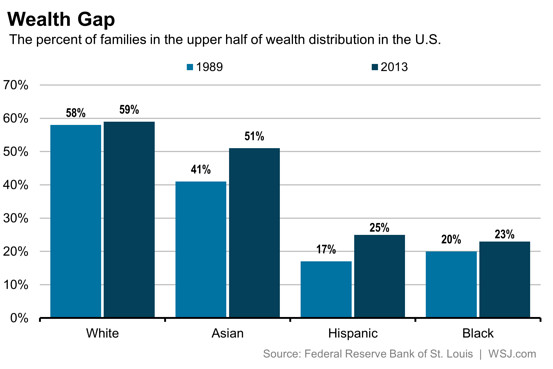
“Racial Wealth Gap Persists Despite Degree, Study Says”…Now What?

The story ran as the front page lead in the New York Times more than a week ago, and was promptly ignored as the more pressing matter of criticism Donald Trump’s erudition in condemning the violence in Charlottesville obsessed the media:

“The long-term trend is shockingly clear,” said William R. Emmons, an economist at the Federal Reserve Bank of St. Louis and one of the authors of the report. “White and Asian college grads do much better than their counterparts without college, while college-grad Hispanics and blacks do much worse proportionately.”

A college degree has long been recognized as a great equalizer, a path for minorities to help bridge the economic chasm that separates them from whites. But the report, scheduled to be released on Monday, raises troubling questions about the ability of a college education to narrow the racial and ethnic wealth gap.

“Higher education alone cannot level the playing field,” the report concludes.

Great. What will level the playing field, and if the only solutions are ethically flawed, can the nation ethically accept that the playing field cannot be leveled? Is it necessary that all races achieve identical levels of success? Does the fact that a race, or an ethnic group, either exceeds or falls short of statistical parity signal that draconian measures must be undertaken by the government? Are we really committed to results based policies, or opportunity-based policies?

In the Times print version, there was a chart that labelled, among other things, Asian families as “over-represented” among wealthyl households headed by a college grad. “Over-represented” is a provocative word, suggesting that something is wrong with Asian American achieving beyond what pure statistical analysis would predict. Is it so unimaginable that the group itself may have something to do with its success—that its culture and values may allow it to be “over-represented”?

No, it isn’t unimaginable, but it is inconvenient and politically explosive. If culture and values can explain over-achievement, it will be difficult to avoid the conclusion that culture and values also play a part in under-achievement as well. The Times report (I haven’t read the whole study)  doesn’t hint at such a conclusion, while citing many other potential causes:

Researchers have repeatedly found discrimination in the job market. When two nearly identical résumés are sent out, for example, it has been documented that the candidate with a white-sounding name receives more callbacks than the applicant with a black-sounding name.

Discrimination like this and other factors contribute to the persistent and substantial pay gap between whites and minorities. Blacks, for instance, hold a disproportionate share of government jobs — a sector that has shrunk in recent years and provides fewer opportunities for big wage gains. Blacks have fewer advanced degrees, and the ones who do are more often in lower-paying fields or graduates of colleges with lesser reputations.

“Blacks and Latinos at all education levels, including college and advanced degrees, earn less than their white counterparts, which means lower lifetime earnings” and less ability to save, said John Schmitt, research director at the Washington Center for Equitable Growth, who reviewed an advance copy of the report.

Blacks and Hispanics are also less likely than whites to inherit money or receive help from their parents to cover a tuition bill or a down payment on a house.

William A. Darity Jr., a professor of public policy at the Samuel DuBois Cook Center on Social Equity at Duke University, points out that a family headed by a black college graduate has less wealth on average than a family headed by a white high school dropout.

That last fact is especially discouraging.

The relative disinterest of the news media in the implications of the report is troubling, or perhaps I should say its disinterest in pursuing an open and honest discussion of what the implications are, and what new policies should be considered. The status quo, with historically oppressed and disadvantaged groups perpetually lagging behind and perpetually blaming white society for their persistent plight, is a recipe for chaos, generating shrill and divisive prescriptions like this one, from Chanelle Helm,  a Black Lives Matters leader in Louisville:

Some things I’m thinking about that should change (in that Southern, black grandmama voice):

1. White people, if you don’t have any descendants, will your property to a black or brown family. Preferably one that lives in generational poverty.

2. White people, if you’re inheriting property you intend to sell upon acceptance, give it to a black or brown family. You’re bound to make that money in some other white privileged way.

3. If you are a developer or realty owner of multi-family housing, build a sustainable complex in a black or brown blighted neighborhood and let black and brown people live in it for free.

4. White people, if you can afford to downsize, give up the home you own to a black or brown family. Preferably a family from generational poverty.

5. White people, if any of the people you intend to leave your property to are racists assholes, change the will, and will your property to a black or brown family. Preferably a family from generational poverty.

6. White people, re-budget your monthly so you can donate to black funds for land purchasing.

7. White people, especially white women (because this is yaw specialty — Nosey Jenny and Meddling Kathy), get a racist fired. Yaw know what the fuck they be saying. You are complicit when you ignore them. Get your boss fired cause they racist too.

8. Backing up No. 7, this should be easy but all those sheetless Klan, Nazi’s and Other lil’ dick-white men will all be returning to work. Get they ass fired. Call the police even: they look suspicious.

9. OK, backing up No. 8, if any white person at your work, or as you enter in spaces and you overhear a white person praising the actions from yesterday, first, get a pic. Get their name and more info. Hell, find out where they work — Get Them Fired. But certainly address them, and, if you need to, you got hands: use them.

10. Commit to two things: Fighting white supremacy where and how you can (this doesn’t mean taking up knitting, unless you’re making scarves for black and brown kids in need), and funding black and brown people and their work.

I read this, and find myself wondering if one of the reasons for that discouraging study’s results is the increasing influence of voices like Chanelle Helm’s.


Ten Further Thoughts On The “The Taunting Girls Softball Team”

Well! I returned from my seminar to find an excellent discussion underway regarding this Morning’s Ethics Warm-up, wholly devoted to the Virginia girls softball team that was hammered mercilessly for the raised middle fingers of six teammates to send off their vanquished foes in the semi-finals. Here are some further thoughts after reading the comments:

1. There is no question that the conduct of the girls concerned the game, the sport, and the League. They were in uniform. The message directed the “up yours” gesture to the other team. This is not a case where personal expression via social media was punished by an outside authority. Ethics Alarms has been profuse in its rejections of efforts by schools to punish students for their language, ideas or other expression on platforms like Facebook and Snapchat. Those are clearly, in my view, abuses of power, parental authority and free expression. This is not like such cases in any way. If a cheerleader squad, wearing the uniforms, colors and emblems of a school, behaved like these girls, punishment by the school would be appropriate, right up to the “death sentence” of dissolving the squad.

2. Would the reaction to the photo be different if it were a boy’s team? I just don’t think so.

3. The comparison has been made to the earlier post about Matt Joyce, a major league player, being suspended by the league for a comment made to one fan during a game in a heated exchange. For the life of me, I cannot figure out what anyone would think is similar about the two episodes, the primary difference being the fact that in one case, an adult was disciplined for professional misconduct on the field of play, and in the other, children were disciplined for breaching conduct their sport and organization exists in part to teach, reinforce and convey. The punishment of the player was $60,000 in lost income for a single word, not broadcast via social media. The team was not punished except to have to play without his services for two games, but then it was not colorably a team offense by any stretch of the imagination. I don’t even want to think about what an MLB team would do to six players who, in uniform, made the same gesture the girls did to “our fans.” They might all get released. Continue reading

Ethics Quiz: “13 Reasons Why”

“13 Reasons Why” is a Netflix  television series based on the 2007 novel “Thirteen Reasons Why” by Jay Asher. A high school student receives a box containing 13 cassette tapes recorded by his friend Hannah Baker, before she committed  suicide. The show has been a critical and popular success (although the Times didn’t like it much) , and a second season is planned.

But Researcher John Ayers of San Diego State University has studied the results of the show on the culture by monitoring discussions of suicide on the internet following the debut of “13 Reasons Why.” The phrases “how to commit suicide” and “commit suicide”  have experienced a 26% and 18% increase in searches. Ayers sees no other explanation for this other than the show.  Searches for the phrase “suicide hotline number” also jumped, by 21%

Ayers now says, “Our worst fears were confirmed That is, thousands of people, thousands more, are searching online about ways to kill themselves.”

Ayers wants the first season to be re-edited to discourage suicidal behavior, and argues that the second season should be postponed. “Psychiatrists have expressed grave concerns because the show ignores the World Health Organization’s validated media guidelines for preventing suicide. The show’s staff instead continue to prefer their gut instincts,” Ayers says.

Your Ethics Alarms Ethics Quiz of the Day is this head-scratcher…

Is it ethical for Netflix to continue running the series in light of Ayers’ research and recommendations?

Continue reading

Morning Ethics Warm-Up: 8/4/17

Good Morning!

1. An update to the Michelle Carter fiasco from Taunton, Mass., where the judge in the case discussed here sentenced the young woman to 15 months in jail for her supposedly deadly words, which “made” her boyfriend commit suicide. This classic example of the axiom “hard cases make bad law” provides the censorious camel’s nose access to the tent for advocates of  the criminalization of “hate speech,” opposition to climate change propaganda, and the gradual castration of freedom of speech. Carter should have never been charged or tried; doing so was an abuse of process, prosecutorial ethics and judicial ethics. I strongly suspect that the judge knows the case will be reversed on appeal as unconstitutional, hence his decision to stay the sentence, allowing Carter to remain free while her case winds its way to the Supreme Court. Meanwhile, her life will be stalled, and completely absorbed by the consequences of her texts urging teen Conrad Roy III to act on his expressed desire to kill himself, which he did. This is her real punishment, because the sentence will not and must not stand.

It is unethical to use the legal system this way. When the government takes it upon itself to punish citizens despite the absence of applicable laws, it is treading over the line dividing democracy from totalitarianism.

2. What is to be done about California? States have always maintained their own unique cultures, and that is a national strength. When a state’s culture becomes wholly estranged from and hostile to the values and principles of the nation it belongs to, however, it becomes a danger to that nation and perhaps to its citizens. What, if anything, is the responsibility of the federal government when this happens? What is the duty of the state’s elected officials?

Tucker Carlson’s creepy interview on Fox with a leader of the California secession movement,Shankar Singam, raised these questions and more. Among Singam’s jaw-dropping positions was that the documented exodus of middle class Californians and small businesses from the state was a good thing. “If everyone in the middle class is leaving, that’s actually a good thing. We need these spots opened up for the new wave of immigrants to come up. It’s what we do,” Singam told Carlson. He also told Carlson that “This is California. We’re not the United States.”

At least that settles the question of whether Hillary Clinton won the popular vote.

An ethical, responsible, loyal American governor would recognize the danger inherent in allowing his state to see itself as separate from the rest of the country, and actively work to reverse that dangerous trend and attitude. That governor is not Jerry Brown. Continue reading

Al Luplow And The Duty To Remember


A culture is defined by what it chooses to remember and what it chooses to forget. Ideally, a culture would remember everything, because knowing the past, as Santayana famously observed, was insurance against repeating its mistakes.  But time is a huge eraser, as Shelley told us:

I met a traveller from an antique land,
Who said—“Two vast and trunkless legs of stone
Stand in the desert. . . . Near them, on the sand,
Half sunk a shattered visage lies, whose frown,
And wrinkled lip, and sneer of cold command,
Tell that its sculptor well those passions read
Which yet survive, stamped on these lifeless things,
The hand that mocked them, and the heart that fed;
And on the pedestal, these words appear:
My name is Ozymandias, King of Kings;
Look on my Works, ye Mighty, and despair!
Nothing beside remains. Round the decay
Of that colossal Wreck, boundless and bare
The lone and level sands stretch far away.”
This is why historians have such a crucial role to play in preserving our culture, by preserving stories, lives and memories along with the inspiration and wisdom they can provide.Sometimes a lost memory is rescued from neglect. Today we remember Colonel Joshua Chamberlain as one of the central heroes of the Battle of Gettysburg for his desperate stand with the 20th Maine Volunteer Infantry Regiment at Little Round Top, culminating in his using his knowledge of military history (he was a college professor) to improvise the bayonet charge that held his position and turned defeat into victory. That was not the case for almost a century, however, until the historical novel “The Killer Angels” retold the story so vividly that Chamberlain’s entire career became the object of new scholarship and admiration. This was truth emerging, but it was also justice. Chamberlain deserved to be remembered.

Unfortunately, Chamberlain is an exception. Once a life, a deed, a remarkable moment is forgotten, it is usually gone. That is a tragedy for the culture. The duty to remember, which I have discussed here before, is the duty to protect the culture and its riches. It is also based on the Golden Rule. We all would like our lives to be remembered as long as possible, especially when we accomplished something that future generations could and would appreciate or benefit from recalling.

This brings us to Al Luplow.

Two nights ago, in an outrageously antic and entertaining game between the Cleveland Indians and the Boston Red Sox, Indians outfielder Austin Jackson robbed Hanley Ramirez of a home run by leaping in the air at the right centerfield bullpen fence reaching over it mid-air to catch the ball, and tumbling over it. He still held on to the ball—he could have easily broken his neck—and the home run became an out.

Although outfielders have fallen over that fence from time to time, notably in the 2013 play-offs…

Continue reading

A White House Of Assholes?* This Post Has Everything: An Ethics Dunce, An Unethical Quote Of The Month, An Incompetent Elected Official And, Of Course, KABOOM!

I wouldn’t have thought that a Trump Administration employee’s unethical conduct could make my head explode. I thought I was safe. After all, my hopes may be too high, but my expectations are so low. But there are my brains, dripping off the ceiling.

President Trump has a ludicrous burning crisis of chaotic management, undisciplined leadership, incompetent subordinates and mass competition for the National Foot-Shooting Championship. I suggested that months ago that this could only be addressed by the President appointing an experienced political professional with proven management skills and leadership ability to whip the White House into shape. President Trump had a better solution to the burning crisis: throw the human gasoline named Anthony Scaramucci  on it!

Brilliant!

What an idiot.

Yes, the Incompetent Elected Official of this post is President Donald J. Trump.

But the rest is all Scaramucci, the new White House Communications Director with no experience or acumen in the field of communications and public relations. This was immediately evident from his first substantial communication with the news media,  a vulgar, unprofessioal, undignified, embrrassing and vicious phone interview with the New Yorker’s Ryan Lizza unlike any interview by any White House figure ever.

Highlights, or rather points of signature significance, each showing that a) the man is an arrogant asshole and 2) President Trump possesses no judgment in his choices of staff whatsoever. Negative judgment.

1. He said, “I’m not [Trump advisor] Steve Bannon, I’m not trying to suck my own cock … I’m not trying to build my own brand off the fucking strength of the President. I’m here to serve the country.”

2. After Lizza asked Scaramucci about a private dinner that he had with President Trump,  Scaramucci boasted: “I fired one guy the other day. I have three to four people I’ll fire tomorrow. I’ll get to the person who leaked that to you. Reince Priebus—if you want to leak something—he’ll be asked to resign very shortly.” Continue reading

Comment Of The Day: “Comment Of The Day: ‘Ethics Observations On The Florida Teens And The Drowning Man'”

Responding to Pennagain’s comment, now a Comment of the Day, on his own Comment of the Day, Mark wrote in appreciation,

“Pennagain – I am a musician, mostly classical, and I tend to think in musical terms. I love it when I encounter something non-musical that is “symphonic” in its scope. Your response to my post is positively Mahlerian and, like a Gustav Mahler symphony, it must be listened to many times with each hearing offering up new ideas, connections to old ideas, or even bringing to life something completely new.”

This is, I think, Ethics Alarms’ all-time best ever comment by a commenter on another commenter’s comment on his Comment of the Day.

This July has an unfortunate record as the first month in the blog’s history to fall so far short of the previous year’s traffic in the same month. (Last year’s July did have the political conventions pumping up interest.) However, it also has seen the most Comments of the Day for a single month ever, with many more of equal distinction.  I’ll take quality over quantity every time.

Here’s is Pennagain’s Comment of the Day on the post, Comment Of The Day: “Ethics Observations On The Florida Teens And The Drowning Man”

I’m not sure the disconnect began with the hand-held devices, Mark. That was Phase III. I think the first part began with the invention of teenagers (as a group) in the early 50s, still “post-war” time — and “post-war” was barely “post-Depression” time, so it had been at least two decades and a full generation gone since the the good times rolled. The early 50s coincided with the installation of “labor-saving” devices which took over a lot of household chores for youngsters, not just for the housewives the companies advertised to. All of a sudden, I could keep what I earned on my paper route (though I did have to replace my own bicycle once, used, of course, after I carelessly left it in a neighbor’s driveway), mowing lawns, delivering groceries, raking (and burning) leaves, shoveling snow, sitting for the rowdy 7-year-old twins down the block. All of a sudden, we had a refrigerator in place of the ice-box, so I didn’t need to help chop ice; meat came ground so I didn’t have to cut the chunks and push them slooowly through the grinder; . . . I keep forgetting some things and remembering others, like ruining the dessert one night we had guests because I got some rock salt in the motor of the ice cream maker . . . having a clothes washing machine which got rid of most of the water so I didn’t have to help hold up the soaking wet sheets to be pinned on the lines above my head. All of a sudden, I had both privacy (my own telephone), my own music, and “free” time, however much my parents tried to fill it with after school lessons-this and lessons-that. Money and time. Time and money. It was time for friends to bump together with other pairs and bond like atoms in a molecule, becoming a “gang,” having our own things and our own things to do. Choosing our own movies, having sleep-overs, cook-outs, camp-outs, or just standin’ on the corner (“Most Happy Fella’) watchin’ all the girls/boys go by …. choices my mother had as a flapper for a very short time but in her young adulthood, not a teenager, already making the transition from one family to another.

Until I was in my 20s and living outside the US, I didn’t realize that growing away from my family (not spending most of my days with them) had not been a natural shift, and not a gradual one either. Nor was it particularly safe – a lot of new habits were acquired (smoking was mandatory, drinking less available, less so; under-exercised/over-eating — unrecognized for another generation!), and a lot of lessons were never learned properly, like working through emotion-based arguments, and almost everything about sex). By the time I left for college I was, though without realizing it, estranged from my parents — my peers and some self-appointed guides knew better than they did! — and stupid enough socially to be a total jerk. There was a missing link. So what? I let go of the past and caught up with the future. Continue reading

Comment Of The Day: “Ethics Observations On The Florida Teens And The Drowning Man”

My old friend Mark drops in to comment just a few times a year, but always delivers his trademark optimism, fairness, and perception. When he talks, I learned early on in our relationship, attention should be paid.. His was one of several excellent comments on the horrific episode in Cocoa Beach, where five teens stood by watching a handicapped man drown, and seemed to enjoy the sight mightily as they recorded his death on their cell phones. In response to another commenter’s query, “Are “kids” that are so disconnected that they’d do something of that magnitude rehabilitatable?”, Mark leaped k took the discussion to a related topic that I had found myself thinking about a lot while I was trapped in a lobby and two airports yesterday with nothing to do but wait and silently curse. What are electronic devices and social media obsession doing to our social skills and ability to relate to the world? At what point to we start sounding the ethics alarms…or the societal survival alarms? [ I’m going to include the last part of Mark’s earlier comment on the story, because it is a helpful introduction to the rest.]

Here is Mark’s Comment of the Day on the post, Ethics Observations On The Florida Teens And The Drowning Man:

…The natural human reaction to observe has been enhanced by our ability to record, and it now seems to be the first response in almost every situation – the more harrowing the better. I’m sure there is some personal thrill involved in being able to post the result, garnering comments and ego-gratifying oohs and aahs.

The situation in Florida is only the most horrible of them, right up there with the guy who posted pictures of himself with the corpse of his step-father, whom he had just murdered. Like everything else, this is a tiny part of a much bigger picture of who we are becoming as a culture. The 21st century ability to remain safely behind a screen while still feeling a full participant in life (Internet commenting a prime example) frees us of the necessary empathy (or simply humanity) to come from behind that screen to behave in ways that might be heroic or even civil. I have little difficulty seeing that behavior manifesting in children raised viewing life through a cell phone.

The much larger question – at least for me – remains “Am I my brother’s keeper?” It’s a nagging question, versions of which swirl in and around almost all the major political issues of our day and, now, into our personal dealings with one another. It is always there, but we come up with more and novel ways to avoid actually answering or acting on it. Clearly, it never occurred to these boys. Cain didn’t want to answer the question. And, I suspect, neither do we.

***

 I carry two cell phones, absolute wonders of technology, which remain in my briefcase most of the time although I’ll take one of them with me to a picture-taking occasion. My friends grit their teeth at receiving responses to texts that are weeks old. My relationship with my cellphone(s) was cemented when I had the opportunity to whale watch off of Maui. I realized that I was so concerned about my precious iThing getting wet or falling into the water that I wasn’t watching the whales. I put the phone away and decided that watching the real world with both eyes was more interesting and that’s what I try to do. I hope sincerely that that attitude would ensure that I offer whatever aid I can in a dire situation rather than wondering what it will look like on Facebook later on. Continue reading

Soccer, Civility, And Mexican Fan Ethics

During Mexico’s matches at the Gold Cup, the regional championship soccer tournament being played across the United States this month,  Mexican fans have been chanting the word “puto,” typically a slur used in Mexico to mock  gay men. The chant has become routine at Mexican national team soccer matches, and officials and many fans are embarrassed by the vulgarity and homophobic innuendo. Soccer officials of the Fédération Internationale de Football Association (FIFA) have warned and fined Mexico eight times already, but the chant survives. Gold Cup Tournament organizers asked players to read a pledge urging fans to set a civil a example for children. Security officials were authorized to eject fans who shouted it. They even installed a technical device to block the chant from being audible in TV broadcasts.

Never mind. Fans are still bellowing the anti-gay slur at opposing teams and players, maybe more enthusiastically than ever. What’s a soccer federation to so?

For the Confederations Cup in Russia last month, the FIFA tried to get tough and announced a three-step program to discourage the chant. The first response to “Puuuuut000o!” was  a public address announcement at the stadium, warning fans to stop or else.  If the chant continues, which it will and did,  the referees can stop the match until the chants subside. That won’t work either. I know fans. They will think that letting the game start and then having to be halted again because of what someone yells is hilarious. Finally, if all else failed, the referee can go nuclear and stop the match completely, sending everyone home. Continue reading

From The “Trump-Hate Disabling News Media Ethics Alarms” Files: The Washington Post “Kids Chorus”

For those inexplicably loyal fans of the news media who said to themselves, “Well, CNN is an exception. The other respected news organizations will never let the President push them to completely alienate the public’s trust,” here is the hard, cruel truth: you are dead wrong. Open your eyes.

Witness the Washington Post, which somehow thought that it would enhance its reputation as a fair, independent, responsible and objective news source by recruiting a group of children to mock President Trump by singing his tweets. This was a Washington Post promotion, now. The Post believes that its readers want to get their news from a newspaper that gratuitously ridicules the President of the United States.  Maybe they are right. Such readers, however, are not looking for facts, or objective analysis. Those readers are looking to feed their confirmation bias.

At “The Hill,” reporter Jonathan Easley tweeted: “WaPo getting kids to mockingly sing Trump’s tweets seems needlessly antagonistic and a dumb move right now.” 

Gee, ya think?

I’m trying to imagine the long list of broken ethics alarms that had to malfunction for the Post to let this get all the way through conception, to production, to publication. Nobody in the chain of command said, “Yeah, that’s hilarious, but let’s leave this kind of thing to Jimmy Kimmel, okay? We’re a newspaper.” Nobody. Nobody thought that this would simply confirm what media critics have been saying about toxic anti-Trump bias. Nobody thought about how a graphic demonstration of this mindset at the paper would undercut any claim that the Post is capable of fair reporting on an elected leader it would show such disrespect to just to make a promotional pitch. Nobody. Continue reading