culture
Comment Of The Day: “Christmas Music Blues”

In addition to honoring his Comment of the Day, I also have to thank texagg04 for his timely comment to last year’s lament here, “Christmas Blues,” about the state of Christmas music as presented by the media. Christmas and holiday music is a useful, if depressing, window into the state of U.S. culture, and if he hasn’t written this commentary, I would have had to. Unfortunately, the tex’s list is res ipsa loquitur, and what it speaks of isn’t good. Christmas, the most ethical of holidays, has been substantially stripped of its ethical foundations by pop culture.
Here is texaggo4’s Comment of the Day on the post “Christmas Music Blues.” For added perspective, you may also want to revue last year’s post, On the Importance Of Christmas To The Culture And Our Nation : An Ethics Alarms Guide.
As of noon today (Monday, 28 Nov), I ran a quick survey of songs played on our local “Christmas” station since the start of last Monday.
95 songs played (though 161 if you separate them by Artist and Version of the song) for a total of 1,893 times.
Here’s the list and how many times they were played (Down on the list are some weird outliers involving the Magnum P.I. and Miami Vice soundtrack. I have no clue how those landed on the station’s playlist archive…but they were there, so I’ve included them): Continue reading
The Complete “It’s A Wonderful Life” Ethics Guide [UPDATED AGAIN! ]
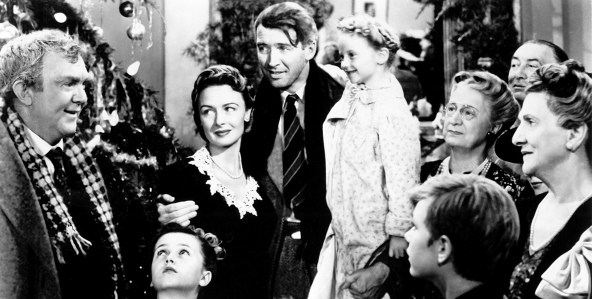
Once again, Ethics Alarms re-posts its ethics guide to Frank Capra’s 1946 masterpiece “It’s A Wonderful Life,”one of the great ethics movies of all time. It was written in 2011, and revised regularly since, including for this year’s version. I suspect we need it more in 2016 than usual.
It is fashionable now, and was even when the film was released, to mock its sentiment and optimism. On one crucial point Capra was correct, however, and it is worth watching the film regularly to recall it. Everyone’s life does touch many others, and everyone has played a part in the chaotic ordering of random occurrences for good. Think about the children who have been born because you somehow were involved in the chain of events that linked their parents. And if you can’t think of something in your life that has a positive impact on someone–although there has to have been one, and probably many—then do something now. It doesn’t take much; sometimes a smile and a kind word is enough. Remembering the lessons of “It’s a Wonderful Life” really can make life more wonderful, and not just for you.
Here we go:
1. “If It’s About Ethics, God Must Be Involved”
The movie begins in heaven, represented by twinkling stars. There is no way around this, as divine intervention is at the core of the fantasy. Heaven and angels were big in Hollywood in the Forties. Nevertheless, the framing of the tale advances the anti-ethical idea, central to many religions, that good behavior on earth will be rewarded in the hereafter, bolstering the theory that without God and eternal rewards, doing good is pointless.
We are introduced to George Bailey, who, we are told, is in trouble and has prayed for help. He’s going to get it, too, or at least the heavenly authorities will make the effort. They are assigning an Angel 2nd Class, Clarence Oddbody, to the job. He is, we learn later, something of a second rate angel as well as a 2nd Class one, so it is interesting that whether or not George is in fact saved will be entrusted to less than Heaven’s best. Some lack of commitment, there—then again, George says he’s “not a praying man.” This will teach him—sub-par service!
2. Extra Credit for Moral Luck
George’s first ethical act is saving his brother, Harry, from drowning, an early exhibition of courage, caring and sacrifice. The sacrifice part is that the childhood episode costs George the hearing in one ear. He doesn’t really deserve extra credit for this, as it was not a conscious trade of his hearing for Harry’s young life, but he gets it anyway, just as soldiers who are wounded in battle receive more admiration and accolades than those who are not. Yet this is only moral luck. A wounded hero is no more heroic than a unwounded one, and may be less competent as well as less lucky.
3. The Confusing Drug Store Incident
George Bailey’s next ethical act is when he saves the life of another child by not delivering a bottle of pills that had been inadvertently poisoned by his boss, the druggist, Mr. Gower. This is nothing to get too excited over, really—if George had knowingly delivered poisoned pills, he would have been more guilty than the druggist, who was only careless. What do we call someone who intentionally delivers poison that he knows will be mistaken for medication? A murderer, that’s what. We’re supposed to admire George for not committing murder.
Mr. Gower, at worst, would be guilty of negligent homicide. George saves him from that fate when he saves the child, but if he really wanted to show exemplary ethics, he should have reported the incident to authorities. Mr. Gower is not a trustworthy pharmacist—he was also the beneficiary of moral luck. He poisoned a child’s pills through inattentiveness. If his customers knew that, would they keep getting their drugs from him? Should they? A professional whose errors are potentially deadly must not dare the fates by working when his or her faculties are impaired by illness, sleeplessness or, in Gower’s case, grief and alcohol.
4. The Uncle Billy Problem
As George grows up, we see that he is loyal and respectful to his father. That’s admirable. What is not admirable is that George’s father, who has fiduciary duties as the head of a Building and Loan, has placed his brother Billy in a position of responsibility. As we soon learn, Billy is a souse, a fool and an incompetent. This is a breach of fiscal and business ethics by the elder Bailey, and one that George engages in as well, to his eventual sorrow. Continue reading
For Once, To “Move On” Concerning Clinton Scandals Is The Right Thing To Do
No.
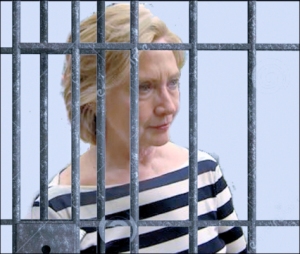
Ethics Alarms didn’t want to make heads explode all over American by designating the President Elect an Ethics Hero, for that would go too far. Still, his statement to the New York Times that he won’t recommend prosecution of Hillary Clinton, adding that she has already “suffered greatly,” is a welcome one as well as the ethical course to take.
The news, shocking to some of Trump’s more vindictive followers and also to those who, for some reason, believed that anything Trump has said, promised, pledged or mused about isn’t subject to reversal at any time, was revealed in tweets from New York Times reporters Mike Grynbaum and Maggie Haberman, who attended a meeting between the President-elect and reporters and editors at the paper. The reporters tweets were confirmed by Trump’s campaign manager, Kellyanne Conway.
One of the Clintons’ prime strategies when they are caught in misconduct is to deny, deny, deny while delaying and stalling, throwing up smoke, confusing the issues, boring most of the public stiff and making their accusers seem like Inspector Javert from “Les Miserables.” Then, before there is any resolution and the investigations seem as stale as last year’s Halloween candy, the Clinton Corrupted, on cue, begin saying that it’s time to “move on, ” which translates into, “Let the Clinton (one, the other, or both) get away with it.” The perpetually juvenile far-left activist group Move-On.Org was launched by that mantra during Bill Clinton’s impeachment travails.
It is an infuriating tactic since it has worked so often, but for once, the argument dovetails with ethics. The United States political process, much as hyper-partisans would enjoy it to be otherwise, must not descend into the ugly practices of lesser nations, where leaders and politicians who fall out of power face show trials, imprisonment and even execution. If there has ever been an incoming President who might be expected to push us in that undemocratic and divisive direction it is Trump, who appears to be historically ignorant and has only rudimentary ethical instincts at best. During the presidential campaign, Trump pledged to appoint a special prosecutor to re-open investigations of Clinton’s possible security breaches and possible influence peddling while at State. He happily joined his throngs as they chanted “lock her up!,” and in one debate muttered to Hillary that if he were President, “you’d be in jail.” Continue reading
Ethics Observations On The Post-Election Freak-Out, or “A Nation of Assholes” Reconsidered
I have to adapt, with acknowledgement, a long-running gag wielded by Prof. Glenn Reynolds on his iconic conservative website Instapundit thus:
“I wrote if Donald Trump was elected President, we’d have a nation of assholes, and I was RIGHT!”
The problem is that the joke isn’t funny in this case. It’s tragic. What I am seeing in the news, watching on social media and reading on the web and in editorial pages shows me that the last eight years have done even more damage to American unity and ethics than I had realized.
First, a brief defense of the word “asshole.” It is a vulgar term, and I fully expect President Trump to use it in a press conference or rant some day. I first employed it here in 2010 to describe Julian Assange. I trust nobody will take issue with that decision. ( “Assange’s real priority is Assange, and everything and everyone else is secondary. Luckily, there is a word for such people, a useful label that will help us assess his actions and motives. Asshole.”)
Next was Rev. Terry Jones in 2011. Remember him? He was the self-righteous pastor who announced that he was going to publicly burn the Koran, knowing that the act would incite anti-American riots abroad, and probably get people killed. I wrote,
“What do you call someone who pours gasoline on a brush fire to get attention? Jerk is too mild. What do you call someone who intentionally makes a difficult problem of international perception even more difficult—intentionally? Fool is too kind. Unethical, my staple, is too abstract. There just is no civil term for someone like Jones. He is an asshole. There are others running loose right now—Julian Assange, Michael Moore, Charlie Sheen—but none come close to Jones.”
Frankly, I don’t know how Donald Trump escaped that last sentence.
Last year, as part of my plea to get the Republican Party and its primary voters to be civicly responsible Americans and prevent the nomination of Donald Trump—in my most fevered nightmares, like the ones where my son’s head has turned into an eggbeater and he is dating Miley Cyrus, I never conceived that Trump would actually be elected—I explained that having a President, always the nation’s most influential role model, who spoke and acted like Trump did would transform the culture of the U.S. and give us a whole generation of boorish, mean-spirited, impulsive and self-righteous young citizens, of which misogyny would only be the tip of the metaphorical iceberg. I still fear that this will be the effect of the Trump years, even if he proves to be a popular and successful president. Especially, if he is a popular and successful president.
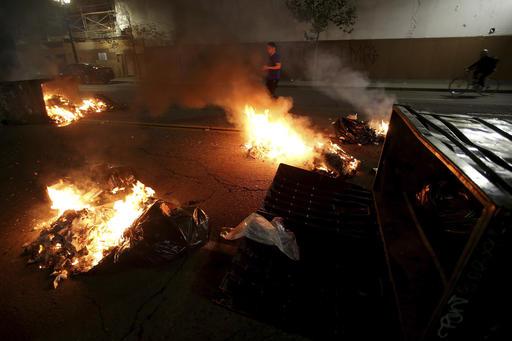
What I did not fully comprehend is how the divisive actions and rhetoric emanating from the White House, prominent progressives and the complicit popular culture and news media have already turned a substantial segment of the public into assholes. There have now been four days of violent tantrums across the U.S. as “disappointed” progressives, Democrats and illegal aliens “protest” the results of the election. MSNBC’s Chris Matthews, an old-school Democrat and unabashed lover of the political process, was gobsmacked, despite his network’s official derogation of Donald Trump.
“What kind of a statement is it really there to make?” Matthews asked. “They lost!”
Of course, there is no statement, just self-indictments, like “We think we know what is best, and will scream and set fires until we get it,” “We have no respect for anyone who disagrees with us,” and “We only believe in the institutions of the nation we live in when they do what we want.” Most obvious of all: “If you don’t fall into lockstep with the policies and rhetoric of the last eight years, you’re a racist.”
Or perhaps “We’re assholes” is clear enough. They are assholes nourished and encouraged by the Obama/ Democratic party culture of arrogant and intolerant progressivism, the demonization of sincere dissent, and the ends justify the means.
OBSERVATIONS: Continue reading
Donald Trump: A Pre-Election Ethics Alarms Character and Trustworthiness Review: 2005-2016 [UPDATED]
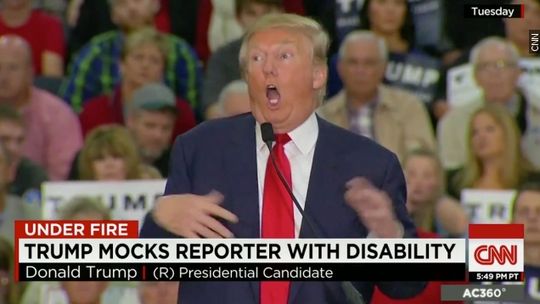
Donald Trump has no character or trustworthiness. Next question?
Oh, all right, in the interests of equity and fairness, I’ll submit The Donald to the same process as I did with Hillary Clinton, though in his case the verdict is res ipsa loquitur. Trump’s lack of ethics and his unfitness to fill the shoes of Washington, Lincoln, Teddy, FDR, or Millard Fillmore is, or should be, self-evident. Those for whom it isn’t self-evident are either ignorant, devoid of values themselves, or intentionally seeking to harm the United States.
I’ve been writing about the awfulness that is Donald Trump since 2005. He was noted for his dishonesty on my Ethics Scoreboard when I called foul on his marketing “various ‘get rich’ products, including tapes, seminars, and “Trump U,” an on-line delivery system for more of the same.” I wrote in part…
There are thousands upon thousands of Americans who started with meager resources and made themselves rich through talent, hard work, creativity, inventiveness, and some luck. …Not Trump. The success of his pitch to the desperate wannabes and clueless is based on their erroneous assumption, nurtured by Trump but not explicitly supported by him, that he can teach them to do what they think he did…make himself rich through hard work and a business savvy. But what Trump is best qualified to teach is how to make yourself richer when you inherit an established business and have millions of dollars plunked into your waiting hands after your Dad has sent you to Wharton.
The fact that Trump doesn’t lie outright about his background but simply allows his marks to jump to the wrong conclusions puts his “get rich like me” marketing efforts in the category of deceit…but deceit is still dishonesty. Trump undoubtedly has useful wisdom to impart about building a successful career; it’s not as easy to stay rich as some people think. Ask most state lottery winners. Still, the most vivid lesson of Donald Trump’s successful campaign to sell himself as a self-made billionaire is the lesson that 19th Century con-man Joe Bessimer pronounced more than a century ago: There’s a sucker born every minute.
So we knew, or should have known, that this was a con artist at least back eleven years. In 2006, I posted on Trump’s misogyny and incivility, writing about the first outbreak of his feud with the equally vile Rosie O’Donnell, and their public name-calling…
Rosie set off the exchange by suggesting on ABC’s “The View” that Trump’s recent assumption of the role of moral exemplar by chastising and threatening to fire the reigning Miss USA for being a party-girl was more than a little ridiculous, given his own well-documented penchant for fast women and extra-marital affairs. Sometimes Rosie’s full of beans, and sometimes she gets it right; this time she was right, but spoiled it by concluding her commentary with some unflattering name-calling. Trump, no girly-man he, immediately said he would sue O’Donnell, and then launched into an extended riff on how unattractive and fat she was, including the charming phrase, “pig-face.” Classy as always, Donald…. Yes, anyone who admires either of these two annoying characters already has a problem, but there is no escaping the fact that both are celebrities, and as celebrities they contribute to establishing cultural norms of civility and conduct. This is especially true of Trump, who despite his low-life proclivities is a successful business executive. Resorting to personal attacks on an adversary’s weight or appearance is disrespectful, unfair, cruel and indefensible. Doing so on national media is like firing a shotgun into a crowd. There are a lot of fat or unattractive women out there, Mr. Trump, who are smart, generous, productive, loving, intelligent people… Golden Rule, anyone? How are we to convince our children not to ridicule the personal traits of others, when those they see as rich, famous and successful do the same openly, shamelessly, and even gleefully?
You can imagine my continued amazement that ten years after writing this rather obvious assessment, without Trump having undergone a complete transformation, and indeed with his conduct and public statements becoming worse rather than better, we are on the eve of a day that may live in infamy as the moment democracy completely failed the United States of America, inflicting on it, and the world, as unstable and unqualified a leader of a great power as history has ever witnessed. Continue reading
A Hopeful Ethics Note
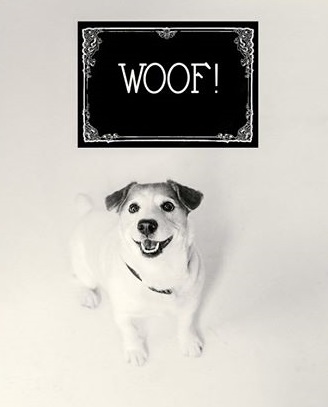
Here’s at least one example of the culture getting more ethical. It might not seem like much, but ask a Jack Russell Terrier, and you’ll understand.
Gradually, dog owners and breeders are stopping the practice of docking—that is, cutting—the ears and tails of puppies so they conform to arbitrary breed standards. The reason is simple: it is cruel and pointless, and the dogs look just as good, indeed better, the natural way.
I first noticed this trend years ago when I saw this breed at a dog show:

I had no idea what it was. I asked, was told it was a natural example of the breed I was used to seeing this way…
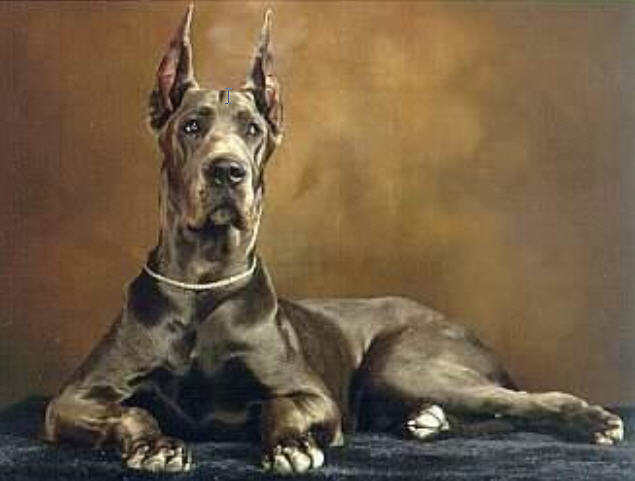
Yes, it’s a Great Dane. In recent years, fewer and fewer owners are opting for the ear operation, allowing the breed to keep the ears that reflect its English Mastiff ancestry.
This beautiful, loving, smart breed dog usually has both its tale and its ears cropped, the tail down to a nub:
A Brief Follow-Up Note On Pop Culture, “The Walking Dead,” Civility, And Related Matters…

Stay classy, AMC…Chris Hardwick…America…
Last night, at exactly 11:02 PM EST AMC’s “Talking Dead” host Chris Hardwick had his live audience scream out in unison “Suck my nuts!,” a quote from the just completed premier episode of the seventh season of “The Walking Dead, apparently the most popular TV show right now. This occurred slightly after an animated discussion about an actor having to cope with a tick on his penis, or a “dick tick” according to Hardwick (to BIG laughs).
Boy, that Donald Trump sure is vulgar when he doesn’t know he’s being recorded…
I am reasonably confident that this cheery gutter level discourse would have been deemed unacceptable as recently as last year. This is how fast basic levels of decency, restraint and civility are declining, although I give AMC credit for not having another “Flip another man’s meat”commercial during the breaks: maybe that’s just for baseball games.
I eagerly anticipate the explanations of why this nosedive in public decorum is unrelated to having a Presidential candidate talk at length about his penis size (I didn’t intend to have it come out that way, but hell, I’ll leave it; it’s 2016, man!) during Republican debates (you know, the conservative, family values party).
Heck, why not? Here’s that link again.
You see?
Just the campaign was enough…
Trending On Ethics Alarms…

KABOOM! Just…KABOOM!
Now I think understand why Ann Althouse, an intelligent, rational lawyer and law professor, has begun holding a “Most Loved Rat” contest on her blog to see which of her rat doodles are most popular. I’m less creative, I guess (though I also draw good rat cartoons!)—my head just explodes. It exploded last night.
It’s hard to explain exactly what did it. Here I was, watching a series of baseball play-off games (since the Red Sox had been eliminated by the Cleveland Indians the day before), and Neil Patrick Harris appeared yet again to tell me that “Heineken Light makes it OK to flip another man’s meat.” (I wrote about the gratuitous vulgarity of this ad here. Apparently this makes me a homophobe.)
Wait…isn’t flipping another man’s meat sexual assault? What is the difference, in lack of respect and sexual assault ethics, between grabbing a woman by the pussy, as Donald Trump so eloquently put it, because you’re a rich celebrity, and flipping another man’s meat because…of beer?
Continue reading
 Ethics Alarms
Bill Maher, role model…
Steve-O-in-NJ‘s reaction to the JetBlue flight harassment of Ivanka Trump by a lawyer could just as easily been written as a comment on this Ethics Alarms post, from shortly after the election, which began..
Here is Steve-O-in-NJ‘s Comment of the Day on the post, “Late Nominations For 2016 Jerk Of The Year: Lena Dunham And Daniel Goldstein, Ivanka’s Jet Blue Harasser,” and I’ll have a few comments at the end: